Thursday, July 30, 2015

Life Is Strange - Episode 4


WARNING: MAJOR SPOILERS PRESENT. If you have not played Life is Strange at all yet, or started and aren't caught up, be warned that there are major spoilers. Go and catch up, then come back! You'll probably want to talk about it.


I was initially waiting for Dontnod's episodic game Life is Strange to conclude before writing anything up about it, but the events of Episode 3 were pretty haunting, and Episode 4 featured one of the most nauseatingly difficult decisions I've ever had to make in a video game, and then proceeded to take an incredibly dark turn that was almost unforeseeable. By the end of the game, I was feeling more concerned for a fictional character than I have in a long, long time. Additionally, the post-credits scene disturbed me more than anything I've seen in shows like Game of Thrones or comics like The Walking Dead. 

So I need to talk about it because god damn it, I cannot quite process everything that just happened.


Backstory.


Before going into what made the latest episode (Episode 4) so impacting and disturbing and brilliant, it's important to take a brief look back.

It's hard to remember at this point, but Life is Strange began as this innocent little point and click adventure game about a teenage girl at a prestigious private school trying to live her life while being something of a social outcast. One day, she discovers she has the power to rewind time. It allows her to change the outcome of certain circumstance. During the day, you witness a drug deal gone bad and an old friend is shot, which you promptly rewind time to save the day. The rest of the game is ultimately about young Max Caulfield reconnecting with her old childhood bestie Chloe. For much of second episode, that's what you're doing.

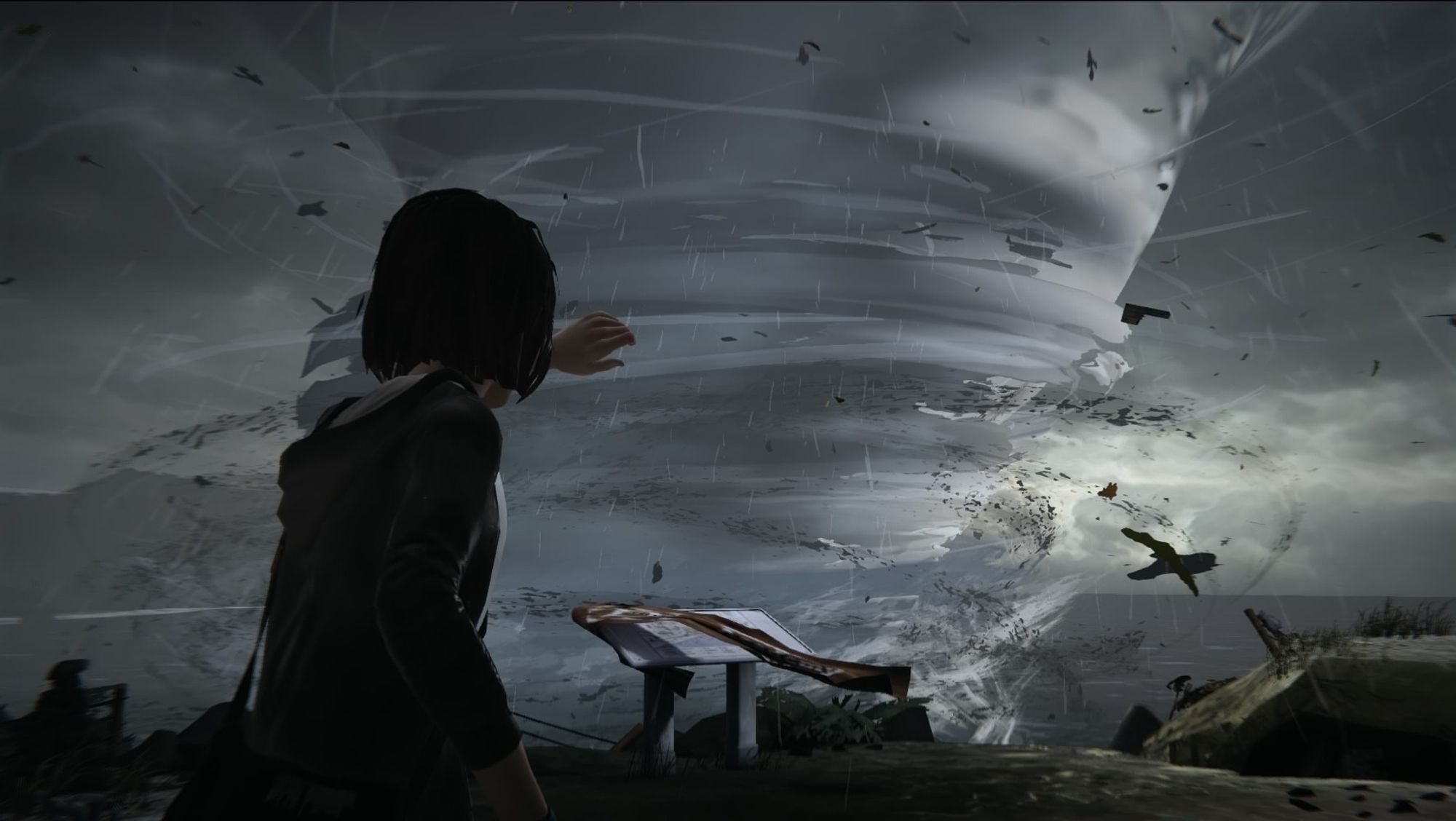
There are hints at what is to come: visions of tornadoes, a ghost deer, an unscheduled eclipse, beached whales. Mystical elements to the game pop up at this stage; it is just smaller and often just a background thing. Also there is the story of a missing girl, Rachel Amber, who you find out was connected to Chloe. She's been missing for some time, but again, it doesn't jump out as a major plot point. Instead, you're focused largely on events surrounding poor Kate Marsh, a girl so bullied she was going to attempt suicide. She had been drugged at a party and videos posted later online ruined her.  Eventually, Chloe and Max make a connection between Kate and Rachel.

By episode 3, you're in full Hardy Boys mode, trying to track down clues and unravel the mystery of Rachel's whereabouts. The girls also start putting together a larger mystery.  Max and Chloe start looking into Nathan Prescott - an erratic and troubled young man with more power and wealth than is good for him - who has long caused problems for them. (He was the one who shot Chloe way back in episode 1).


SECOND WARNING: Going into pretty huge details for Episode 4 right now! 

The Toughest Choice

Before moving onto the mystery element of the episode, I want to just address what might just be the most horrible decision a player has to make in any game. At the end of Episode 3, you attempt to use your time manipulating powers to save Chloe's father, who died years ago in a car accident. When you awake in this altered reality, you rush to visit the Price family to see what your good deeds accomplished. Her father answers the door.

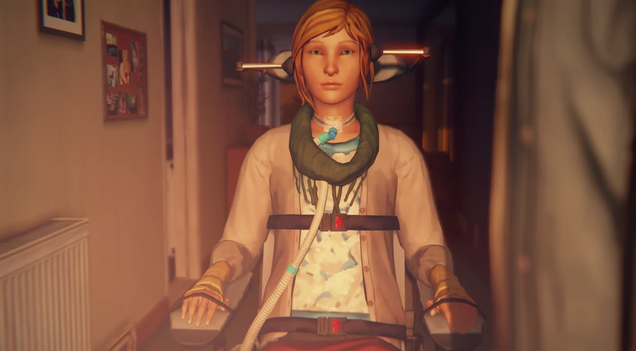
Altering the time line to change William Price's fate fundamentally alters Chloe's though. In this reality, Chloe was the victim of a horrible car accident. She is still alive, but completely paralyzed with a failing respiratory system. She knows she's dying, plus has largely been miserable since the accident. Right when you couldn't feel any more guilty, she pops one totally gut-wrenching question. She asks you to inject her with an overdose of medication, effectively putting her to sleep. Chloe wants to die, and the worst part is? You can totally understand why.

You're presented a choice as to whether to accept her request or refuse. I refused, opting to go back and change the timeline back to the way it was. This meant that her father died a second time, in a sense. Though Chloe has no knowledge of your actions here, it's hard to shake the guilty feelings in the "fixed" reality.

It was a bit harrowing. While it's ultimately just a game, I've always been a theoretical supporter of right-to-die policies. I believe in a person's right to make that choice. Yet presented here, in a video game, with completely fictional characters, I was given the opportunity to help someone achieve that, and I balked.

Though I could completely understand the character's motivation behind the request, and I've always believed in the idea theoretically, I just couldn't appease her. I did not want to see her die. I didn't want to see her give up, even though she was totally right. Her death was impending and in her near future. But I couldn't oblige. I couldn't be a part of it.

And this is a video game! What am I going to do if I ever encounter this situation in real life? (This is the power of interactive media. It's also one of the things I love about Life is Strange. If good art challenges us, then this game has definitely accomplished that.) It sounds silly, but this game provided the tiniest of sampling into what being a part of that situation - something that happens in the real world - might be like. It still tears me up thinking about it.


Back to the Mystery

Episode 4 marks the apparent conclusion of the mystery. The game actually does a pretty good job turning you, the player, into a pseudo-detective. At one point, you're literally staring at a board with tons of evidence, looking for ways to connect things. While not overly difficult, it's still satisfying when you start piecing things together by looking at time stamps on texts as well as surveillance information. All of the evidence you collected points you to a location that should reveal the whereabouts of Rachel.

It is a barn owned by the Prescott family, and it has a dark secret. While exploring, you come across a secret bunker with some disturbing stuff. Long story short, you discover that somebody has been drugging girls, bringing them to this "Dark Room," taking pictures of them in forced bondage or tortured positions, and filling out binders as trophies. It's some real Dexter type stuff. It's an extremely creepy and dark turn for the game, and suddenly you start to realize that Rachel Amber hasn't just disappeared. What started as an effort to find where Rachel went suddenly becomes an effort to find where she's been hidden.

Sure enough, you find Rachel's body buried in the junkyard - a location you've visited several times in previous episodes. Quite literally, she was right under your nose the whole time. With all of the evidence pointing towards Nathan Prescott, an enraged Chloe sets off for revenge.


THIRD WARNING: OK, for real! This will kill the mystery so you've been warned!

The Bread Crumbs

At some point, it isn't hard to start feeling a bit suspicious as a player. All of the evidence seems to fit a bit too nicely. The pieces connect a bit too cleanly. Suddenly, Nathan becomes inherently less suspicious because it all feels a bit too obvious. Of course, it makes sense that Max and Chloe - the characters in the story - are certain of Nathan's involvement. As a player though, sitting neatly on the outside, it all just feels a bit too easy.

If you felt the same on that front, you'd be right. At the end, it is revealed that Nathan was not behind all these things. Instead, it was Mark Jefferson, the photography teacher at Blackwell Academy who everyone seems to love.

What's funny is that though it might take some time and a lot of reflection, but you can eventually figure out why Nathan Prescott was not a particularly compelling suspect to begin with. Some of these bread crumbs might be a stretch, but here are things I keep coming back to (all of which is indicative of great writing).

1. The Dark Room is too tidy.

Before you get to the eerie Dark Room bunker, you spend some time in Nathan's dorm room. Though not a total sty, his room wasn't exactly the tidiest of rooms. He's got stuff sprawling across his desk and dresser, and one of the things you investigate is a bottle of wine next to a pill bottle knocked over. Basic point - his bedroom is relatively neat, but it shows that he isn't exactly the most organized person.

Contrast this with the Dark Room, where everything is pretty tidy and well organized. There isn't much of a mess. The binders are proof enough that the owner of the creep-factory is thorough and tidy, something that Nathan's room does not indicate.


2. The survivalist supplies.

The first thing you notice entering the Dark Room is the stack of canned food and water sitting on the shelf. It is very reminiscent of the stack kept by David (Chloe's step father). Max even brings up the idea that Nathan must shop at the same store as David.

This seems a little fishy though. Although there are some strange letters lying around throughout the episode hinting that Nathan's father is preparing him for some major upcoming event, it seems strange that Nathan would be collecting food for his bunker. Nathan's father has expressed great dissatisfaction with his son for failing to do what he's asked. Plus, Nathan seems more interested in partying and drugs than buying canned food.

A minor hint, but my take away was that David - who we know is very suspicious and had been following several people - had been at some point trailing Mark Jefferson. The canned food doesn't imply the photographer at all, but the idea here is that David was onto someone else. Suddenly his motivation is called into question. Was his spying actually a huge overreach? Was he looking into Kate Marsh because he was suspicious of her? Or did he realize there was a connection between her and Jefferson? Was David actually on the right track? Was he stocking up on canned foods because he was a survivalist nut, or because he followed someone to the store and didn't want to blow his cover? It seems unlikely that person was Nathan.


3. The tripod.

One of the objects you can examine in the Dark Room is a tripod. When you look at it, Max's internal monologue refers to it as a "fancy tripod." On the surface, this isn't that suspicious. The Prescotts are filthy rich and could probably easily afford the best equipment.

However, it seems to very well connect to Mark Jefferson. Think back - way, way back - to the beginning of Episode 1. After the students empty out of the classroom, you can look around. You'll see all sorts of fancy gear lying around, including a carbon fiber tripod, which very much impressed Max the photo nerd.

For keen observers and folks with incredible memories, seeing that tripod - and the very fact that you can examine it - in the Dark Room is a connection to the one in Mr. Jefferson's classroom.


4. Jefferson's introduction.

Also way back in Episode 1, Jefferson asks his class which photographer tried capturing the human condition in black and white. Victoria answered by saying Diane Arbus. His response is actually quite telling (in retrospect, of course.)

"She saw humanity as tortured, right? And frankly, it's bullshit," he says. He also claims that capturing moments of desperation or being pinned in a dark corner is "too easy."

This one is easily the most hindsight-driven clue, but given what we learned at the end of Episode 4, it seems pretty clear now that Jefferson was likely trying to keep people off his trail. It appears as though he actually finds her particularly influential on his work, as he is forcing the that very thing for the sake of his own photography.


5. The connection with Rachel Amber.

The most glaring issue with Nathan Prescott as a suspect is that his connection to the missing Rachel Amber is pretty weak. There is one, as he knew her a little bit from a few parties, but largely had little to do with her. Frankly, the idea that he would drug her, take her to the Dark Room, murder her, then hide her body seems like quite a stretch given that he barely had much interaction with her.

Meanwhile, word had it that Rachel and Jefferson had slept together. Though unconfirmed, it is heavily implied that Rachel's attraction for her teacher caused them to become involved in some capacity. This rumor also provides a much clearer motive for Jefferson being the culprit than Nathan. While possible that Nathan was just a psychopath picking targets he barely knew, it stands to reason that Jefferson had more to lose with Rachel still roaming around. Were someone to find out he slept with a student, it could ruin his career.

At any rate, Max also discovered photos of Rachel among Jefferson's works. Again, word was that she was his favorite model. This could also provide a motive for murdering her, given that she was gearing up to leave Arcadia Bay at the time of her disappearance. Perhaps Jefferson was upset at the prospect of losing his favorite model.


6. The Kate Marsh connection.

There's also the issue of connecting Kate Marsh. The line between Nathan and Kate was pretty clear. They were in the same class, and Nathan was a big part of the bullying force against Kate. Being from a very religious family, she was an easy target. After she was drugged and the video went viral, things just got exponentially worse.

If Jefferson were particularly interested in capturing moments of despair, Kate is a great subject for him. In Episode 2, he was even unnecessarily mean to her, perhaps as an effort to push her over the edge, hoping she would disappear. Either way, the connection from Jefferson to both Kate and Rachel is substantially stronger given they were both prominent students in his class at some point.


7. Nathan is erratic.

It seems perfectly reasonable to think Nathan could kill someone, but it also is made clear from his characterization throughout each episode that it would be from impulse. He might be in desperate need for psychiatric help, but he is erratic.

Consider how much planning needs to go into one of those drugging and kidnapping events. Even more, mix murder into the equation. To get away with it cleanly, one must have a pretty solid plan. Lacking foresight is not an option. This doesn't inherently hint at Jefferson, but it does raise concern with the idea that Nathan was behind everything.

Looking back at the evidence on the board from earlier in Episode 4, we see the text exchanges between Nathan and Frank. Nathan generally did obtain some drugs prior to parties, but the bulk of his messages were last second scores. By and large, he had to annoy Frank to get drugs after a party had started. Most of his purchases occurred late night, indicating a lack of foresight and planning. It's hard to imagine someone who can't figure out how much stuff to bring to a party is capable of planning a kidnapping and murder. At least, not cleanly and efficiently.


Of course, there are also hints that Nathan might be in cahoots with Jefferson. For starters, the Dark Room exists on Prescott property, and features some mighty expensive equipment. Then there is Kate's report of her abduction. She remembered Nathan offering to take her to the hospital. Next thing she knew, she woke up in a bright, white room and heard Nathan's voice and an unknown second voice before being pricked and knocked out again. At the end of episode 2, we see a mysterious figure working on Kate's red binder in the Dark Room. An alcoholic drink and a bottle of pills lay next to it, which is similar to the glass of wine and spilled pill bottle Max found in Nathan's room. Finally, there are a number of elements to Episode 4's finale that seem like they could have only occurred if Jefferson had help from Nathan.

This element remains up in the air, but will presumably be answered in the final episode.


The Rewind Mechanic

One of the complaints that seems to be making its way through some reviews is the idea that in Episode 4, the time rewind mechanic has practically vanished. The reviewer for Gamespot, for example, questioned why Max couldn't use her powers at moments that seemed like an obvious moment to do so. This is pretty misguided, however.

The application and availability of rewinding has actually been one of the most brilliant design elements of the entire series so far. It's true that you don't get to use it that much in Episode 4, but it isn't random. The game established two episodes ago that using the power takes a physical toll on Max. It causes stress, headaches, and nose bleeds. They've been pretty clear that Max needs to take it easy with it. She can't just use it any time she wants.

Max even says it outright a handful of times throughout the episode that they can't rely on her time manipulation powers too much. At times, Chloe represents gamers. She knows her friend has this power, so she rushes off carelessly, figuring if anything happens, Max will just rewind time and fix it, easy peasy. Max, however, is constantly pointing out the flaw in this logic. She can't always use her powers, and her control over them is pretty limited. Throw in the toll its taking on her body and you have a perfectly reasonable narrative-driven explanation for why there aren't too many moments in Episode 4 that have you rewinding time.

It's not a weakness with this particular episode, but rather a strength with this narrative. When I think back to the first episode - after Max learns she can rewind time - I seem to recall just how frequently I used this power. With no idea of what was to come, I used it a lot for conversations. I kept rewinding so that I could converse with classmates in order to get them to like me more. Or to joke around with Chloe, your friend. It was petty and immature, but also something you might expect a 15 year old to do.

Over time, players came to learn that this power is not the same as the laser beams of Superman. She can't just use it whenever she wants at no cost. During the dramatic finale of Episode 2, you find yourself suddenly weakened from using the powers a lot. Flash forward to Episode 4 and you can't help but think back about how dumb you were by wasting your powers for childish things.

All of this serves the narrative by increasing the drama and urgency. Now that access to this power is limited, it makes everything that happens feel more important and nerve-wracking. Even more, the story's reasoning for the diminished ability increases the sense of regret and guilt and responsibility for helping things spiral out of control like this. It's easy to look at this episode and see the one mechanic that changes up the point and click nature of the game, but to do so would be a bit off point.


The change in tone.

It's also easy to look at the disturbing and harrowing end of the episode and hate it. After all, our hero who we've come to love has been kidnapped and things aren't looking good for her. Meanwhile, Chloe - who we've also come to love - lies dead from being shot. (Interesting note, if I'm not mistaken: there are three occasions in which Chloe can be shot throughout the game. Hard not to notice that she wears a necklace with three bullets attached. It is also really starting to seem like there's just no saving her, ultimately.)

Of course you hate it. You're supposed to. Some players have said this finale has caused them to no longer want to play the game. They've said it sucks. Thing is, art shouldn't be only fan service. We as players, viewers, or readers should be challenged to deal with difficult happenings. We aren't meant to feel comfortable with this ending. It's dramatic for a reason. When bad things happen to our favorite characters, we tend to react with anger towards the writers instead of the characters within the story. This is entirely unfair though because we don't have the finished product yet. We don't know what will ultimately happen with Chloe and Max. Let's let them finish their story before we claim it sucks. Shouting, "it sucks," is more often than not an immediate emotional response rather than an well thought out one built around the perspective of the story's context and point.

Still, it is hard to ignore the huge tonal shift. Things were already getting a bit bleak with the Kate suicide attempt in Episode 2 and the finale of Episode 3, but the end of Episode 4 goes full blown twisted. It feels a little out of place because the previous episodes were grounded in a very relatable reality. Apart from the underlying supernatural happenings, everything about Arcadia Bay seems realistic. It feels like a normal town, with normal people. You play as a normal girl (minus the time powers), befriend normal classmates. This gives the game a sort of innocence.

Suddenly, we are forced to confront a whole new reality - one in which a serial killer is on the loose and seemingly irrevocable things are happening. It completely changes the world. And that's why it works.

This shift in tone would not nearly be as tough to swallow if the game hadn't been so meticulous in crafting a perfectly grounded reality. It's because this world seems so normal and unsuspecting that it falls into chaos when something horrible does happen.  It isn't hard to see why this dramatic mood swing - lacking any remaining innocence the game had as part of its initial charm - might be a turnoff for some players. I'm still trying to remember how exactly the game got to this point! It feels like such a different game now.

However, this is what makes its story so compelling. By and large, the cliffhanger endings to each episode have not been solely to hook players for the next episode. They carried over in a meaningful way. This one feels more like both than ever. I'm still disturbed thinking about that post credits sequence, and I'm super irritated that it will be about a month and a half to find out what happens. Then again, it would hardly be as impacting if I could just play the next episode. (Which admittedly is what I tend to do with The Walking Dead games.)

While the game has not been perfect, it has done plenty of things really well and has remained one of my favorite games of the year. And it only sinks further into that top spot with each new episode. 

Saturday, July 25, 2015

ANT-MAN (2015)

Let's get one thing out of the way here; we need to stop with this stupid narrative about Marvel taking "risks." There has been this weird idea that every new Marvel film is somehow a risky proposition. Yet twelve films in, they've yet to release a complete dud that totally bombs at the box office. Even more, they've firmly asserted themselves as the brand name of Hollywood blockbusters. Even if you don't care about superhero movies, you can't escape it. You know when Marvel is putting out a film. And at this point, it's pretty much a given it will do well.

Please don't confuse making weird movies with making risky movies.


Ant-Man is a weird Marvel movie, but not for the reasons one might think. It isn't weird because of its basic plot and unusual powers. It's weird because in post-Avengers Hollywood, the scale has to just get bigger. The fate of the world always has to be on the line. You need bigger, faster, and louder action set pieces. You need to go all out.

Yet Ant-Man stands out by not doing that. Instead, it keeps the focus smaller and more intimate. It stays zoomed in on the characters and their arcs, not just meandering from action set piece to action set piece.  In many ways, this film is a lot more like the first Iron Man than the more recent Guardians of the Galaxy. You aren't overwhelmed by the loud noises and fast-moving shaky cam zeroed in on hard-to-distinguish CGI figurines all that often. Really, this film is weird because it falls into Marvel's Phase 2 despite feeling far more at home in Phase 1.

If The Avengers is a sports movie and Guardians of the Galaxy is sort of Marvel's version of The Dirty Dozen, then Ant-Man is their heist film. It pits a team of misfit thieves with the theoretically obsolete Dr. Hank Pym (Michael Douglas) and his daughter Hope van Dyne (Evangeline Lilly) together to steal Pym's secret suit and destroy Cross's research to prevent it from falling into the wrong hands. Oh yeah, and there are lots and lots of ants. They can't break in without them! It's goofy and ridiculous, but thoroughly entertaining and enjoyable.

Perhaps the most interesting part of the film is how they mix the old Ant-Man lore of Hank Pym with the newer history of Scott Lang (Paul Rudd). While Scott is the primary Ant-Man of this feature, by no means is Hank sitting on the sidelines. There's a slight tendency in these films to hire an older, more distinguished actor to come on set and just do a lot of talking or dispense a lot of wisdom or literally just stand there watching for no reason other than to say, "look who we cast!"  (see Robert Redford, Anthony Hopkins, and Glenn Close in Captain America: The Winter Soldier, Thor, and Guardians of the Galaxy respectively).

Here, Michael Douglas's Dr. Pym is every bit a part of the team. Sure, he functions as Scott's mentor, but he's also a part of the heist plan at the end. He's not reduced to the sidelines (well, at least not from the outset). Every team member brings something to the heist plan, including Hank. It's always nice to see them let these actors be a part of the action.

While Iron Man movies tend to go globetrotting and Thor movies go between the real and fantastical, Ant-Man stays at home. There are really only about five major locations in the movie, and two of them are Scott's home and Hank's home. This is greatly refreshing as it helps keep it feeling personal in scope. It also helps viewers really buy the parallel between Scott's trying to redeem himself for his daughter and Hank's trying to reconcile with his daughter. When all is said and done, Ant-Man is really a film about fatherhood.

Marvel still seems to struggle with villains, but Darren Cross is largely pushed to the side in the film. Instead of seeing much of his antics, the focus is more on Scott's training to become the Ant-Man. Villains aren't the only thing Marvel seems to struggle with. For all the great female characters they've pushed in the comics, they've largely failed to do much with them in the movies. Hope is a solid character, but stop me if you've heard this one: a totally capable woman who is intelligent and can take care of herself is pushed to the sidelines for "her protection," and oh yeah, she gets flustered the moment she sees the male hero's six pack abs. (Seriously, this is the third time they went out of their way to make this joke - Jane Foster in Thor, Agent Carter in Captain America: The First Avenger, and now this.)  Hope van Dyne fairs much, much, much better here than Jane Foster does in the Thor movies, and she's a bit more of a badass than Agent Carter from the first Cap film. By and large, she actually is handled pretty well, and she and Scott do develop more naturally than any other Marvel couple. Still, it's starting to get a bit repetitive.

The script, casting, acting, and action are the selling points of a film that - from a visual and film making perspective - are pretty generic and bland. There isn't much that sets it apart from anything else Marvel has done, which is probably why such a stylistic director like Edgar Wright inevitably left the project. The structure of the film is predictable and boring, but they make up for that with a funny, heartfelt script and some of the most interesting action sequences.

At the end of the day, Ant-Man came at the perfect time. It had been in the works for a long time, originally to be part of Marvel's Phase 1. It's good that it came out now though, because the smaller scope and more personal focus is exactly what the comic book superhero movie needs to break up the monotony of world-in-peril action-fest that it has become for the past few years.

Plus, for those of us of a certain age, it brings back memories of Honey I Shrunk the Kids, minus awesome sets (replaced here by CGI). While it looks like Ant-Man is poised to be one of Marvel's weaker efforts at the box office, it might actually be one of their stronger films in recent years. Certainly, it's one of the more enjoyable.


Friday, July 3, 2015

How Women Are Bringing Sports Back To The Way It Should Be

I had this long piece discussing some of the issues facing women in a lot of the things I love - gaming, movies, comics, and sports - but then I was watching the Women's World Cup and then this happened. The response of fans has been largely supportive and empathetic, so while I felt horrible for poor English defender Laura Bassett, I did love that the fans actually acted like fans. It's a strange notion, I know, and for all of the sexist thoughts that go against the women, there is at least one that is kind of positive.

See, there's a good probability that if Bassett were a man playing on England's team, and had he lost a World Cup semifinal on that sort of horrible luck, he would have been subjected to extremely mean-spirited headlines. Twitter would probably be filled more with anger (and death threats). Fans would be raging. You don't have to dig too deep to find this sort of reaction. Bill Buckner, anyone? In the world of men's sports, mistakes are often responded to with irrational and almost inhuman behavior. Yet when it's the women? It's followed by support and empathy.

The reality is, we tend to be a lot harsher towards male athletes who make mistakes than toward the female athletes in the same position. And it's hard not to see that as a little bit sexist, both toward men and women. I'm not quite sure where it comes from. Maybe it's that old idea that women are more emotional, and thus more mentally fragile than men and so we need to treat them almost like children in order to protect them. Or perhaps fans recognize that unlike the men, they're not just playing for their club or country.

In the Men's World Cup, all of the athletes are merely "athletes." They aren't seen as ambassadors for their sport in the same way. They aren't trying to sell the world on soccer. With the exception of the United States, the world has pretty much already bought soccer - hook, line, and sinker. When Neymar steps onto the pitch, he is really only representing Brazil. When Marta steps on though, she represents Brazil...and women...and women's athletics as a whole. Female athletes have an uphill battle everywhere. They've been often ridiculed and demeaned. They often struggle to keep leagues active because a large portion of the public doesn't care about women's sports. There's always the bump for women's soccer during the World Cup, but they're always playing for more than just a title.

They're playing to win. They're playing for respect. They're playing to prove a point. They're playing to inspire. And they're playing to survive, basically.

Male athletes have a privilege that often gets ignored. The truly hard work has already been done for them. To be clear, this is not to suggest making it to the NBA or NFL or Major Leagues is easy. It can certainly be argued that it's never been more difficult to make the pro-level. However, at the end of the day, they have the benefit of only needing to think about the game. With the exception of maybe the NHL and MLS, the major sports leagues don't need to worry about "growing the game," or "being taken seriously." Peyton Manning is a superstar in the NFL, but let's be honest: the NFL can and will survive when he's out of the game. In fact, despite all that has gone on in the past year, the NFL is more popular than ever! The league is self-sustaining. The best players don't really grow the sport anymore. They might push sales of jerseys or Reebok deals, but the major leagues have a strong foothold in our society.

Yet there is a bit of concern when the likes of Mia Hamm retire (or the upcoming Abby Wambach retirement, although I think they're in better shape this time around with the advent of other stars stepping up). Female athletes are widely not as popular as their male counterparts. Sure, people can probably pick out Hope Solo or Alex Morgan from a line up, but what about Brittney Griner or Elena Delle Donne, or even the likes of Kelley O'Hara or Shinobu Ohno, who we've seen in this very World Cup?

Maybe the real reason people are kinder and more empathetic when women athletes make mistakes or come up short is that the women's game reminds us what sports is really about. The men's game is often too serious for its own good. All that matters is winning (something that matters to all athletes, but generally, the men don't have the pressure of the entire public losing interest if they don't win). Mix in all of the fantasy sports and the money that ties into that, plus all the gambling that happens, you get fans who feel they have more personally on the line. When a male athlete screws up and costs his team the game, "fans" are primed to be unreasonably hostile.

Basically, they lose sight of the human element to sports.

If there's one edge that women's sports clearly have over men's, it's that the fans rarely seem to lose sight of that. Because the leagues are so much smaller and they're trying to grow the league, the athletes are much more accessible. For example, the Boston Breakers have "autograph ally" after the games, where fans can meet the players, shake their hands, and get an autograph. This is part of the charm for baseball fans, who have the chance to get autographs before the games during batting practice. You don't see this sort of thing in the NBA and certainly not the NFL. While organizations will sometimes have events giving fans the chance to meet their favorite players, they're ultimately few and far between.

The end result is more relatable players in the women's game. This further pushes the human element. Sure, guys like Rob Gronkowski are goofy and fun to watch, and people can gravitate toward Peyton Manning's sense of humor, but by and large, male athletes seem - in a sense - larger than life. As a Patriots fan, I can't even hope to ever meet Tom Brady. I can't even begin to relate to him. Yet whenever Julian Edelman posts a YouTube video, I become a bigger fan, probably because you get a weird insight into him as a person. Sure, there's still zero chance I'll ever get to meet him for even a second, but it feels like I know him as a human being a little bit.

We all want our sports heroes to be decent human beings. We don't want to believe that the person whose jersey we bought murdered several people, or killed a bunch of dogs, or beat their fiancees, but so many male athletes are all "business" about everything that we never really get to see anything other than the athlete. With the women's game, they're sort of selling themselves. The reason I came to love the USWNT was not because they're great (although that is part of it, for sure). It's also that they seem so cool. They seem so close. They approach the game seriously, but they also clearly have fun with it too. It's often less about the individuals and more about the greater team, something we always want to see in team sports.

There's also just something about being at a women's sporting event that seems to connect the fans a bit more. I don't want to say that men's sports are not fun. I believe quite the opposite. I don't even care about baseball, but I would always go to a baseball game in person because they are very fun. It's usually a great atmosphere. Yet there is something a bit more exciting about being part of a smaller crowd. Sitting in the nosebleeds with tens of thousands of other people for far over-priced tickets can actually make one feel a bit more removed from the action.

To be clear here, I do hope that the women's game grows to similar points. Tens of thousands in attendance for a NWSL game would be awesome! It would be so meaningful and exciting. That might admittedly be a part of what makes being a women's sports fan so fun. Personally, I feel more important as a fan. Sure, I don't ultimately make that much of a difference, but I definitely feel more like I'm helping by being there and buying tickets and all. So as it grows, it feels a bit like I helped it grow in some small way. I can't imagine ever feeling that way about going to an NFL game or NBA game.

However, these smaller crowds do actually help feel more a part of the "fan community." There's always a good seat, close to the action. You're surrounded by people who are in the same boat as you. It feels a bit like you're all in on a big secret that you want everyone to hear about, but weirdly no one seems to know of. But then also, it really just feels like a more fun, casual atmosphere.

A lot gets made about the fact that women's sports tend to draw families and kids especially. Somehow, this is a knock on the sport. I guess "real sports" draw mostly adult audiences. This seems a bit flawed though. Shouldn't "going to the game" be a family activity? Isn't going to the game with your mom or dad supposed to be a quintessential childhood experience? Aren't athletes role models to children? Here in New England, two tickets to a Patriots game will cost you over $200, especially with parking and anything you might buy in stadium. Shouldn't attending games be a more accessible experience?

In all, I think the reaction to Laura Bassett's horrible, terrifying error is something we should bring back to the men's game. Why shouldn't we empathize with men? They're humans too, and it's highly unlikely he who makes game-costing mistakes doesn't fully understand their impact. It's not to say, "stop being critical." Criticism and scrutiny are totally fine. A cool element to this year's Women's World Cup has been the fact that more people than ever have been criticizing the USWNT's play and coaching. For the first time that I can remember, the focus has been on actual, technical soccer. This seems like a small thing, but it's actually huge for the women's game. It means it's being taken seriously by fans. Just look at how many reporters have been covering the event here in 2015, then consider that in the early to mid 1990s, there were about two sports writers from the US covering the same event. That's pretty clear progress.

It's another thing entirely to become hostile and mean. Bostonians ought to be ashamed of the way they treated Buckner. There's a pretty ugly history of "fans" becoming monsters. Is that really what we want sports to be about? Isn't part of being a "fan" being supportive? Yes, it sucks to lose games on critical errors. But we so often forget that these are humans trying their best. We as fans have significantly less to gain or lose in a victory or loss than the athletes.

Basically, there's something wrong if we're complaining about the fact that an athlete was sent flowers as an act of compassionate support instead of death threats anonymously online for making a critical in-game error. We shouldn't be trying to mold the women's game to be more like the men's in this case. It's the other way around. We need to bring the compassion and empathy from the women's game to the men's game.

For me, when people ask why I sometimes prefer the women's game, it ultimately comes down to this: women's sports seem to be much more in the spirit of sports than the men's. The latter often takes itself way too seriously, and in some cases is too big for its own good. But when I watch women's teams - especially women's soccer - it reminds me of the experience I wanted when I was younger and playing sports.

Sports are supposed to be fun and entertaining. It's supposed to highlight the highs and lows of the human spirit. We as fans have such a small role in the outcome of games, with the stakes insanely low for us - no matter what some fans want to think.

When I watch or attend a women's soccer game, from the way the players play to the way the fans react, I can't help but think, "Ya know, this is what sports is supposed to be."


Addendum: Oh yeah, Andy Benoit is totally right. There's nothing worthwhile about women's soccer...


Wednesday, June 24, 2015

Ranking the Marvel Movies - With Brief Critical Analysis

1. CAPTAIN AMERICA: FIRST AVENGER (2011)

Captain America as a character can in some ways be tougher than any other character. He's as "pure good" as you get, which can easily be boring to watch. The first act of the film well establishes where Steve Rogers gets the chip on his shoulder, and that is more of a driving factor than simply being genuinely good. They also do a good job establishing that while the super soldier serum is what gave him power, it's not what made him great.

Admittedly, I'm a sucker for the alternate history stuff, so the retro-futuristic style is more appealing than most of these movies. It's also filled with clever little nods and easter eggs, from skinny Steve picking up a trash can lid as a shield to Professor Zola's introduction being his face blown up on a little screen as he looks into some device. There are even some moments of neat film making, with Captain American and the Red Skull standing on the platforms, explosions in between them. They are opposite sides of the same coin, yet given the war, it's as if to show that while they face off, the world burns between them.

It also sets the ground work for the the Stark/Rogers divide. Both characters spend their time in the public spotlight, facing down cheers and celebrity status. Stark comes from that and loves it, plus no one really ever calls him on it. Rogers doesn't love the spotlight, plus comes to realize that his talents aren't being used properly, which further adds to the chip always on his shoulder, making him the man he is.

The final act is set up fairly well, following a similar structure to its predecessors. Steve's plan to infiltrate the Hydra base is built around the fact that he can take a punch, something we saw early in the film. He displays cleverness that we saw while he was in training. Colonel Philips's grenade test in training camp highlighted Steve's selfless heroics, which foreshadows his ultimate end, apparently sacrificing himself to save the world. There's even a somewhat humorous moment where a Hydra soldier pulls a knife on Cap, which is a callback to Howard Stark showing Cap some armor and saying that Hydra won't be coming at him with blades, instead opting for high tech weapons.

And my favorite moment is after he sees Agent Carter in the Hydra base, where she encourages him to continue the mission and he regains focus. They have a relationship, but both understand the stakes and maintain focus. Steve grabs his shield - which was propping the door open - and moves on with the mission. And we see Agent Carter standing in the background as the doors close behind him and hints at the tragedy that his role as Captain America will cost him many thing. He must keep moving forward with the mission, leaving his own desires behind him.

The ultimate conclusion is one of the weaknesses, however. After a promising start to the final Cap/Skull battle, it ends in a rather anti-climactic fashion. Skull grabs the tesseract, then just, vanishes. And that's that. It's a very Indiana Jones type of moment, but leaves a lot to be desired. Cap's sacrifice though is well executed. While Tony Stark has had several moments in Marvel movies showing his willingness to sacrifice himself to save the day, Cap actually does have to. The last thing he says to Carter is about dancing, saying, "I'd hate to step on you..." before being cut off by the crash. This too is echoing earlier, when a tiny Steve was talking about how he could never find women to dance with, because they're "afraid of stepping on him." He finally finds a dance partner, and the role is reversed, and it's over.  It's also easily the most bittersweet of the endings, as he has survived in the end, but wakes up in modern New York. "I had a date..." is a really sad and tragic line to end the film on.

It's just a shame nothing more ever came of Dum Dum Dugan and the Howling Commandos.


2. IRON MAN  (2008)

The one that started it all, the first Iron Man was not quite the charming, quick-witted, pithy one-liner-filled fun fest we expect from Marvel today. In fact, it actually gets a bit dark throughout. It also has a good balance of action entertainment as well as thematic substance. Tony Stark will never be more interesting than he was as the spoiled man-child suddenly forced to confront the reality of his family business. It's perhaps the only time in any of these movies that he actually takes responsibility for anything, really. Many bemoan the weak villain and generic conclusion as a problem, but Iron Man does more to firmly establish the conclusion than any other Iron Man films.

There's a sort of tragic cycle enforced at the end. In the first half, Stark decides he no longer wants to build things that destroy. So he focuses on the arc reactor and the Iron Man suit. Yet at the end, another person took his suit design and turned it into a weapon. And they defeat Stane by essentially dropping him into the reactor, which then explodes. Basically, everything Stark worked on for peace is inevitably used to destroy, making it one of the most potent finales in Marvel's resume. All of this is only successful because of the ground work laid in the first half of the film.


3. CAPTAIN AMERICA: THE WINTER SOLDIER  (2014)

Let's just get this out of the way: people make more out of this movie than they should. There's a tendency to over-promote the whole "privacy vs. security" element of the film, or Cap's growing concern about the behavior of the government body whose team he plays for, or the whole thing involving the soldiers from wars "returning to the world" - a clear parallel between real life soldiers and Captain America both trying to figure out how to fit back in to a world that is now completely foreign to them. While all of these are aspects of the film or exist within the film, they ultimately aren't really major elements of it. There's a tendency to make this movie seem smarter and more layered than it is.

Which is really the only major problem with it. There's a layer of depth that seems like it could exist if Marvel Studios would ever let substance return to the post-Avengers cinematic universe instead of overly focusing on world building, film and show connections, and working things from the comics into the movies. In the end, the Winter Soldier never gets the kind of attention he deserves for a film subtitled after him, and similarly, Black Widow and Falcon only get slices of back story that make them both interesting enough to merit being part of the team while also not getting enough to really be satisfying. Additionally, any political metaphors that could have been perceived in the first act of the film get completely undermined by the revelation that SHIELD is not actually so much corrupt as much as its been hijacked by the group of literally pure evil neo-Nazis that is Hydra. The plot element of Cap vs. the government/authority is also undermined by this fact, since this is a contrivance rather than an organic development within the film. We are never meant to question whether Cap is right or not because we are shown he's right. And the big twist that Pierce is Hydra doesn't hold much weight given they specifically tell us this at the start of the second act, meaning we spend the majority of the film already knowing exactly what's going on. And of course, the film suffers many of the same trappings of modern Hollywood action films in that they overuse quick cuts and shaky camera work to increase the feeling of action without actually letting the audience really see said action.

All that said, the action is really awesome. Both Captain America movies have hands down the best action sequences of any of the Marvel films, including the big cross-over Avengers films. A lot of this is because Cap fights hand-to-hand. He doesn't just blow stuff up with lasers and missiles like Iron Man. He doesn't just fly around and hit stuff with a hammer like Thor. He gets down and dirty, fighting in martial arts-driven combat sequences. Plus the stuff with the shield really is some of the coolest, most visually interesting and unique things all comic book movies have to offer.

Where the first Captain America was a sort of revisionist history war adventure film, this sequel both increases the scope while decreasing the focus. The stakes aren't that much different than before, with the whole world at risk of being destroyed by Hydra, but this time, they're more secretive about it. Instead of openly fighting everyone, they're trying to orchestrate this through infiltration of their enemies. The result here is that it's much more of an espionage thriller instead of the epic war film of before. And it's refreshing. Black Widow gets more to do, which is always great, and the fact that the Winter Soldier connects to both her and Cap gives him a little bit more weight than past Marvel villains, even despite the fact he doesn't ultimately get to do that much. And, while more is made of it than it should be, those elements of the scarred soldiers finding their place in the world after returning from war and the whole "can you trust the authorities?" do give it a little bit more of a punch than other installments in Marvel's resume. Although admittedly, even here the "spy thriller" is maybe slightly less interesting than it's made out to be because the film never hides anything from the audience. It's pretty clear on who we can trust, who is lying, and who the good guys are. It never loses sight of these things, so we're basically watching Cap and his team figure out a mystery that we already know the answer to.

So much of the success of these films though are on Chris Evans' portrayal of Steve Rogers. Despite being the Marvel equivalent of Superman in many ways, he makes Cap one of the most real characters in the movies. He is serious when he needs to be, but he never loses his sense of humor either. He isn't disrupting the tone of the film to make inappropriately timed jokes, but he will crack wise in situations that make sense for him to do so. And despite being put on a pedestal by the public, he sort of is a reluctant hero. He is completely aware of the toll this job has on him as an individual. What's strange is that going into these films, it would be easy to suspect he'd be the most boring character, being too "goody" of a character to really be interesting. Yet it's that fact that makes him so compelling. He's the most "good" person in this universe, so we want to see him overcome. Plus here, while he is annoyed with Fury's secrets, he also still does trust him in the end. His faith in Fury keeps him grounded on the right path, ultimately leading him to victory. We get to see him show his perhaps outdated - yet very much needed - idealism, which inspires the best in others as well. And this is why he works on screen. In a world where we as the audience are obsessed with Breaking Bad, Game of Thrones, and Nolan Batman movies, Captain America gives us a little bit of that pure goodness that we sometimes need to see. He isn't a cocky asshole like Stark, or the hot-headed king of Thor. He's just a good guy doing the right thing according to his code in a world that's become increasingly cynical and corrupt. That's what makes him so compelling and these movies so good.

Plus again, the action really is that good, and that final fight with Winter Soldier and Cap is one of the most emotionally charged fights.


4. GUARDIANS OF THE GALAXY  (2014)

Ok, so this might be blasphemy to put this "so low" on the list given that Guardians of the Galaxy was something of a revelation to many people. Admittedly, while the movie is really fun and entertaining, I didn't personally have the same experience given that I've been a fan of the comic since I started reading comics a decade ago. So for me, while I never imagined a movie, never mind one that other people would also enjoy and love, more or less I got something I was not as blown away overall due to my familiarity with the source material. Fair? Probably not, but it is the reality for me.

What's really refreshing about the film is the fact that for most of it, they are careful to keep makeup, costumes, and sets a major part of the experience. A film like this could easily be 99% CGI, yet that's not what they do. The make up is great and the sets are gorgeous. Yes, there are a couple of totally CG characters, as is sort of required when you have a moving tree creature and a genetically engineered super raccoon. But the inclusion of such great practical elements makes viewing the film so much more of a pleasurable experience.

As is the cast, by and large. Zoe Saldana is relatively ok as Gamora, though they make her more traditionally feminine than she is in the comics. Dave Batista is ok as the hulking Drax the Destroyer, though they make him sillier. And Vin Diesel is surprisingly good at Groot, a role which has a lot of heart despite having only one repetitive line of dialogue. The real core of this film though is Chris Pratt as Peter Quill and Bradley Cooper as Rocket, both of whom make the silliness of the film completely enjoyable. You never really think much of the fact that Rocket is a raccoon (but don't call him that to his face) because Cooper does an excellent job giving him personality. Casting Pratt was perhaps the smartest move any casting director has done, given his charm - while occasionally a bit out of place given the specifics of the story - is just so damn infectious that you can't help but love watching him.

Ronan the Accuser is a weak villain - something Marvel continues to struggle with for whatever reason. Here, he fits neatly into your typical "vengeance" motivation. In some ways, the film also gets bogged down my the Iron Man 2 syndrome of spending a little too much time and attention on world building. It's important to have Guardians of the Galaxy to start really connecting the dots between Thanos and the Avengers, and there are times where it feels like that's the main reason the film exists, but otherwise, it does a solid job being its own thing.

It's weird and silly and funny and irreverent. It's like nothing else. The ending might be stupid or brilliant depending on how you take it. (They basically beat Ronan by dancing to distract him, then just holding hands. Personally, I'm torn between thinking this is really stupid, but also appreciating that they defeat the villain in a way that has not been done before.)

And of course, it has a killer soundtrack.


5. THE INCREDIBLE HULK (2008)

Yes, yes, I know how ridiculous it sounds to put The Incredible Hulk above The Avengers, but this is called an opinion piece for a reason! It's a pretty safe bet that you'll fundamentally disagree, which is fine! You're entitled to your opinion too! At least hear me out on mine first.

The apparent black sheep of the Marvel cinematic family, The Incredible Hulk starts off wisely by introducing the origin story within the confines of the opening credits sequence. Banner and Hulk get moments of complexity. Hulk both is and isn't a monster. Bruce loses control to turn into Hulk, but Hulk also loses control to harm and damage things and people around him. Even more, General Ross isn't inherently evil. Not even Blonsky is, really. He just enjoys the thrill of a fight (like a screwed up Goku), all while trying to remain relevant as an aging soldier. Filled with Easter eggs, but not in a distracting way, it also makes a lot of fun nods to the comics and show. Plus, there's a good mixture of the loneliness that comes with the Hulk with the CGI punch-fest and destruction people hope for. The more serious, melodramatic tone (along with whispery Liv Tyler) can seem out of place given Marvel's turn to make things super light hearted, but the change of pace is great. The Hulk isn't a funny character, so the film shouldn't be super light hearted one either.

It continues some of the themes from Iron Man before it. The best part is that yet again, the finale is set up. All movie long, General Ross is hunting down Hulk. He finally gets him and has to reluctantly give him up to stop yet another problem he created in the process. The early Phase 1 Marvel movies really did a solid job of setting up the final act. It is a shame though that Marvel seems content to just ignore the movie ever happened, leaving several loose ends.


6. IRON MAN 2  (2010)

*Gasp!* More blasphemy! Again, I know that this is one of the Marvel movies that almost universally gets ridiculed and used as a shining example of what not to do, but again, here's where I'm coming from on this.

Though it gets a bad rap, Iron Man 2 might be filled with some silly moments, but it isn't actually all that bad. Ivan Vanko and Justin Hammer are actually among the better Marvel villains for their thematic significance. Both characters are alternate versions of Tony Stark. Ivan has the brains of Stark, but never had the means. Meanwhile, Hammer has the means of Stark, but not quite the brains. Both want revenge, but neither can accomplish it alone. Being a product of a capitalistic, western society, Hammer puts stock into the old expression, "the enemy of my enemy is my friend." So he hires Vanko. Yet Vanko isn't out to get rich. Hammer cannot understand this, as evident when he tries to exert power over him by taking his bird and pillows and boots. Vanko is out to destroy Stark. Before he kills him though, he wants to destroy his legacy.

See, the inherent story of Iron Man is one of redemption: a man who made money off of creating tools of destruction, and since creating Iron Man, has tried to right all the wrongs, especially with death looming. The public even loves him now, but Vanko - whose family has been hurt by the Starks - doesn't believe he is worthy of the second chance. Of course, this plot is made a little thin when it's revealed that Anton Vanko - his father - was deported by Howard Stark when he saw Anton using their technology to get rich (this revelation contradicts the apparent thematic significance of Ivan Vanko, which is unfortunate). The film does more to set up the greater Marvel Cinematic Universe, which can bog the film down. The daddy issues come up briefly, and gets resolved equally quickly, all of which should be considered weaknesses of the film.

Though the action is more shallow and "entertainment" focused than in the first film. Favreau still does a good job setting it up. The Iron Man/War Machine action returns - even providing the winning solution, as does the Happy/Black Widow joke as well. Plus, the Hammer ex-wife set up pays off. It's easy to look at the finale as generic, it's worth noting that we hadn't had the whole "fighting off an army of robots" trope seemingly countless times prior. Iron Man 2 set that standard, and in many ways, set up everything seen in The Avengers.

7. THE AVENGERS (2012)

A film so popular and successful, it completely changed the nature of the Hollywood blockbuster franchise overnight, The Avengers breaks new ground in a lot of ways, but also comes up short in many others. While not the first "cross over" film, it is the most successful at integrating different franchises into one world.

At its core though, it's a pretty typical sports movie. Nick Fury is the coach, putting together a ragtag group of misfits that few people believe in. The recruitment phase is executed well, effectively establishing the individual characters. The now-classic "heroes misunderstanding" fight among Cap, Iron Man, and Thor even establishes some of the realities of the world. Thor is stronger than Iron Man's suit, but his hammer can't dent Cap's shield. There are even some great shots, including Black Widow's interrogation of Loki, when he's trying to get into her mind, we see his face reflected off the glass, appearing right next to Widow's head. He thinks he's playing her, but Widow is stronger than that and he remains on the outside, unable to really get into her mind. Shortly after, all the heroes are gathered together, bickering. It's effective use of dutch angles and some subtly shaky camera work.

The film starts to fall apart shortly thereafter though, meandering unevenly from action set piece to action set piece. One of the big problems with the film is the dialogue once everyone is together. It goes back and forth between solid, multi-character writing and cheesy, out of character one-liners. On the most part, it is fine. Every once in a while though, they write lines for characters for the sake of injecting a joke. It can be distracting. The humor in previous films was practically seamless. Jokes came up organically within the character interactions. Here, it often feels less like a character is making a joke and more like Joss Whedon is making a joke. Additionally, there are plot elements that basically ignore the first four films. Cap calls out Stark for his unwillingness to make the sacrifice play, but we saw Stark do that in the very first Iron Man movie. They also conveniently ignore the conclusion of both Thor and The Incredible Hulk. It doesn't really help that Loki's plan makes no sense, and the goal is pretty unclear.

The meta-narrative and commentary is perhaps the most fun and interesting element. At times, the film references the innovative nature of itself. The mysterious heads of state talking to Fury early on can be viewed as studio executives shooting down the idea of an Avengers movie and mixing properties. Later, Stark figures out what Loki's play is, describing the Hulk ploy as "previews." Plus, there's all the mentioning of "Phase 2." These sorts of comments are Whedon at his best.

The final act is the big game. The team has already suffered an ugly loss at the hands of their rivals. It took a moment for them to get their act together and come closer as a team, which would be needed to win the championship/battle. For real, it's just a more fun sports movie, really, hitting all the same beats. It all culminates into that one big moment that you knew was coming the whole time, but still feels very satisfying.

Of course, it also requires a silly deus ex machina plot device to save the day, which is a bit lackluster. Still, it's effective in its structure. But like all sports movies, the second half is rarely as interesting as the first.


8.  THE AVENGERS: AGE OF ULTRON  (2015)

These team up movies are rarely more than just a giant CGI spectacle, but Age of Ultron at least attempts to add a little more character to some of those who don't have their own solo features. But it's ultimately short on substance and just sort of re-hashes some of the same things as the first: the Hulk versus another Avenger fight, the psychological hit that puts the team at odds, the rallying pep talk from Nick Fury, the future heroes being manipulated by the villain, the giant army of robotic-looking creatures. It kind of is just the first film, just with more everything. Any thematic significance to the film had also already been touched upon, from Banner's reluctance to Hulk out to Stark's overzealous attitude and self-assurance causing problems for the world.  The one new element - the implications of AI - gets such little attention that there's nothing interesting about it.

Not really much more to say on it than that.


9. THOR: THE DARK WORLD  (2013)

Thor films always had a knack for getting the character close, but not quite. Thor: The Dark World surprisingly gets it closer than any other Marvel film, but it doesn't get anything else quite right. On the most part, everything on Asgard is solid. It even features a strong opening with Thor and his band of merry warriors fighting a solid fantasy battle on one of the other realms. It shortly after brings the audience back to Earth to follow Jane Foster and her band of merry comic relief sidekicks. Pretty much everything that happens on Earth is terrible where it can't go more than two lines without going out of its way to present yet another dumb joke. It couldn't clash more with the tone of the rest of the film, which is actually rather grave, featuring perhaps the most emotional actual death of a character in a Marvel movie (at least, until they reset everything with Ragnarok). There's also a strange conflict in visual styles, with Asgard having a fantasy look while the Dark Elves come in with a total sci-fi style.

Though comic relief is necessary, they go far beyond what is needed to the detriment of the film. It also isn't necessary to use the humans for it when you've got Loki prominently featured. Still, it actually does many things really well. The first of which is really upping the ante with Loki. As sharp and untrustworthy as ever, we finally see a more "human" side to him. His conversation with his mother, plus his reaction to the news of her death are among the best scenes in any of these films, in large part because of Tom Hiddleston's perfection as an actor. Indeed, the main reason this gets the nod above the first Thor is the increased role they give to him - which is easily the smartest thing any writer has done.  The film hits its pinnacle when Thor must recruit the help of Loki. The prison break, followed by their team up, is actually some of the best stuff in these things.

Once again though, things fall apart in the third act. Rather than trying to set up something of relevance, it devolves into a mere, typical, gigantic and destructive action sequence. Loki's near-perfect character arc gets immediately reset and made irrelevant, ruining his plot completely. It also features one of the most forgettable villains in the movie-verse in whatever the name of the Dark Elf king is. The tone is all over the place, rotating between stupid joke and "the world is in grave peril" action.

Only other thing worth praising though is it's special "Avengers" cameo. Chris Evan's showing up as Loki making himself appear like Captain America was great, and Evans does a great job playing Loki playing Cap.


10.  THOR  (2011)

There are plenty of problems plaguing Thor. It's filled to the brim with CGI that can often clash with the great sets and makeup. The costumes look mostly ok, but occasionally come off as plastic toys. All of the human characters are under written, especially Jane Foster - who goes from leading physicist to clumsy bimbo the moment she sees a ripped dude without a shirt. There are often many out-of-place jokes (although there are some really well executed jokes as well). At times, it suffers from distracting world building references. And of course, the dutch angles. There are lots of them, though most often, it's used during scenes with SHIELD, to further add to the uncertainty to their role in each of the Marvel movies or when Thor is confronted with battling his brother Loki, basically highlighting that everything he used to know is about to change.

But there are a number of well executed elements to the film too. Tom Hiddleston as Loki is not only the best "villain" of any Marvel movie to date; he also gives perhaps the best acting performance in any Marvel movie as well. On the surface, he seems simple - jealous of his brother Thor's spot as heir to the throne. Yet there's more beneath that. He doesn't know his place in Asgard, or in his family. He also seems to truly believe that the hot-headed Thor might not be best for Asgard. Actually, Loki's plan ultimately works. He brings about the final defeat of Lafi, the Frost Giant King. There's also an almost sort of Shakespearean element to the film at times. Nothing is inherently good nor evil. There are subtle complexities and duality to almost everything. Pitting brothers against brother is one of the more tragic-feeling and bittersweet conclusions in one of these movies.


11. IRON MAN 3  (2013)

Iron Man 3 seems to be one of the most polarizing entries in the Marvel Cinematic Universe. A lot of people love it; a lot of people hate it. It does some things really, really well. It's borderline insulting in how stupidly it handles other elements. People go back and forth on whether it's good or bad because it spends a lot of time with Tony Stark out of the Iron Man suit. Depowering a character can be a really effective plot device though for some interesting character arcs. It worked very well for The Wolverine. On the most part, it works well here too. It functions in a similar way in that while we know Logan and Stark aren't ever really going to bite the big one, it does heighten a sense of concern for the character.

One of the things that makes the film interesting is that it actually gives some weight to the events of The Avengers on the small scale. Stark seems to be dealing with a lot of anxiety, and maybe even some post traumatic stress from the alien invasion of New York. It's cool to see a solo flick that has a character actually dealing with something from his or her experiences in the past films.  The first two acts might actually be the strongest entry into the Iron Man series of films. The crippling anxiety attacks and self-destructive tendencies in dealing with them are some of the more profound elements a character has had to deal with in a Marvel movie. It just completely falls apart by the third act.

It also suffers one of the weaker villains of the franchise. Where Justin Hammer and Ivan Vanko are basically alternate sides of the Tony Stark coin, Aldrich Killian is a petulant child. His revenge motif comes from a grudge because Stark skipped an impromptu meeting at a New Year's Eve party. Weak. Even more, the Mandarin starts off badass and intimidating, but serves no function in the structure of the film or in the story as anything other than a distraction (and a really, really bad joke - it's telling that shortly after the film, Marvel started backtracking on the Mandarin, hinting that the "real" Mandarin is still out there in a special short film for a blu-ray release).

And of course, all it takes for Stark to overcome his anxieties and PTSD symptoms is for that kid to tell him to build something. And he literally just goes, "Ok." Remembers he's Tony Stark. And BAM! Cured. Plot element dropped entirely. It's a little bit strange that for the character to grow, he needs to remember who he was. His arc is completed by going back to the start. (Or rather, back to the Stark.)  The finale winds up being a pretty generic action sequence with tons of robots, cheesy villain dialogue, fake deaths, and going out of its way to make sure you know no innocent people got actually injured. All culminating in a lot of "resets" to bring the film back to where we were at the end of Iron Man 2. 

Plus there's the whole thing that the point of the movie is to show that Tony Stark realizes he's more than just the suit. It isn't the armor that makes him a hero. And yet at the final battle, he's only actually able to save the day because he gains all the suits.  In fact, it isn't even Stark that saves the day. It's a newly powered Pepper Potts in one of the dumbest fake-out deaths in these movies who defeats the villain. It runs counter-productive to the point of the film, marking the first time that the third act gets away from and has almost no relevant thematic connections to the first two.


I know, I know. It's almost a given that no one has the same list as I do. Most would put Captain America: The Winter Soldier or Guardians of the Galaxy or certainly The Avengers as the top three. Surely, no one else would put The Incredible Hulk or Iron Man 2 on the top half, when conventional wisdom is that those are among the worst.

Still, I can't help but feel a bit like "conventional wisdom" is a bit too built around the "cool" factor and less about actually quality film making or anything of substance. I've also got to admit that while I've genuinely enjoyed pretty much all of these films, it's hard to imagine many of them standing the test of time. The films that laid the ground work - the pre-Avengers films - have a better chance though given they crafted decent films built on a solid framework. There is a part of me that thinks that everything post-Avengers will eventually just be forgotten, inevitably function as dust collectors as part of every nerd's growing blu-ray collection. The movies, like many of the comics, will ultimately become valueless pieces of shallow entertainment meant to be consumed in the now, rarely to be revisited after the next piece of "now entertainment" hits theaters.

The trouble with a movie franchise functioning like the comics is that it's only a matter of time before it becomes too big and too complicated and too convoluted, and eventually, it will be rebooted. When that happens, we'll collectively forget everything that came before and focus again on whatever piece of shiny CGI-slathered, studio-driven movie comes out in the now. And we'll leave our blu-rays on the shelf, just like we leave the old comics in their boxes. These have been fun, but do seem to lack a bit of that "something special" that made other blockbusters like Jaws, Indiana Jones, or Die Hard such all-time classic action/adventure blockbusters. They're also losing their unique qualities by their own volition, given that Marvel is going to just keep pumping out three movies a year, all while rival studios will try to keep pace. The CGI-driven superhero punching fest will inevitably stagnate just the way the natural disaster film craze of the '90s did. Not that it will ever lose a place in the market (natural disaster flicks clearly didn't lose a spot either) but it's not something every studio is trying to do now.

For now, we can just enjoy the ride and see what happens, which is half the fun anyway.


What is your list?

Sunday, June 21, 2015

All The Dumb Things - The Stupidity of Jurassic World

It's been almost a week since I watched Jurassic World. Time has not been so generous for the film though. It was enjoyable to some extent because of the meta-commentary about Hollywood and the nature of blockbuster franchises. Still, the longer it's rattled around my brain, the less sense it actually makes. By and large, it really doesn't deserve the slack it gets, especially when it's every bit as stupid as the much maligned Green Lantern. 

Just a warning though: SPOILERS! The following piece will bring up a number of specific plot points to highlight how the script seems like the least important part of the film's production, and how it feels like they just made stuff up as they went (which is fine when you're making a movie with your friends, but less so when making a film with a $150 million budget for mass consumption).

Training velociraptors. 

A lot has been made of this singular plot element since the beginning. Each version of the trailer made it more and more clear that Chris Pratt's character would be a raptor trainer, and fans were pretty split on it. On the surface, it sounds really, really, really dumb. And in the film, it...is also really, really dumb, but not for that reason.

See, apart from the fact that Owen (Pratt) clearly has no idea how to clicker train an animal, the introduction to this plot thread is actually kind of cool and interesting. It's a new idea that doesn't actually stand out as idiotic. Sure, you have to suspend your disbelief. The argument was always that we train bears and tigers, so why not raptors? This is obviously a stupid sentiment if you know anything about how different these animals' brains are, but Jurassic Park was never about scientific accuracy.

However, this plot thread becomes ridiculous with the way it unfolds. When we're introduced to Owen and the Raptors (band name! called it!), we see how precarious this situation is. The trainers are able to get some desired behavior out of the creatures, but it is a tight rope act. When Owen runs into the pit to save the young guy who fell in, we see him able to calm the raptors - barely, for about ninety seconds. The moment Owen turns his back to run out of the pen, the raptors jump to try and eat him.

This sequence is actually fairly well done, but it establishes a set of rules that the film blatantly ignores later on because it needs to. Not only does this sequence establish the "badassery" of Owen; it also establishes that the raptors are still deadly creatures not to be trifled with. They're only trainable to a certain extent. It is established that Owen can just barely keep them settled and focused for a moment. Basically, it establishes that they're not anywhere near where Vincent D'Onofrio's character seems to think they are.

Then Claire (Bryce Dallas Howard) shows up and removes him from the raptors. We don't see Owen interact with them at all for about an hour, maybe even longer. By the time Hoskins (D'Onofrio) forces his hand by forcing him to let the raptors loose, they are suddenly totally obedient to Owen. Nothing happens between these two points with this plot thread. They literally just go from barely controllable to obedient police dogs like that. Owen describes himself as "the alpha" before they're let loose, which I guess makes it so that we're suddenly cool with the fact that these creatures that tried to eat him an hour earlier are now running along side him without even checking him out like he's a possible meal.

The final sequence fairs even worse when the raptors seem like they're going to attack, but really just want him to remove the equipment placed on their faces. I get that the raptors are supposed to trust Owen more than other humans, but this is really idiotic and forced. Even more is the absolute conclusion when after the fight, the remaining raptor looks longingly at Owen, wherein its trainer gives it a "you can't stay here, but you done good, boy!" look, and it takes off. Totally skimping out on an easy meal because... uh... I guess he's really a dog?

It's a pretty glaring issue with the script, and just one of many incredibly contrived plot "developments." Granted, you can't really call anything in the film a "development." It's more like "plot switches," because that's how it works. They establish one set of rules in the first act, then change them completely whenever they need to establish the next big action set piece.

Training raptors could have been a cool plot element - indeed it started as one! - but only if they gave it actual time and focus, and actually allowed it to develop. Instead, they simply go from high risk, barely controllable creatures that tried to eat Chris Pratt to suddenly being Chips the War Dog because they suddenly need them to. (Also, am I really the only person who remembers Chips the War Dog?)


Weaponized Raptors.

If the way they handled the raptor training wasn't enough, the entire plot thread of Hoskins wanting to weaponize the raptors is not even a B-movie plot line. It's the bottom of the barrel, at home on the SyFy channel. I get that this guy was excited at the prospect of weaponizing velociraptors and all, but how stupid was he that he saw what happened in the pen and still thought, "No, this seems good enough!'

I'm also not at all sure why his default plan to stop the indominus rex was to unleash four velociraptors with cameras on their heads. What exactly were they going to do? The indominus rex was bigger, stronger, and faster than a tyrannosaurus rex. There's so much build up to that confrontation that when they finally get to it - after a really stupid psych out - it's over in a flash because, well, it was a really stupid plan. This guy was supposed to be security forces, right? In a world with bombs and machine guns and flame throwers and drones, he honestly felt that a handful of barely trained velociraptors was going to stop a creature that was way bigger and deadlier and smarter?

I know dinosaurs are always presented as bulletproof in the movies, but even the indominus rex didn't seem impervious to bombs or mines. If the goal is to kill the thing, there are many, many, many simpler ways to do it.  The entire concept of engineering the disaster to highlight the capabilities of raptors in a battlefield is stupid, and is maybe just one level above Sharknado. 

Bottom line here: this plot thread is idiotic and ridiculous. It's over the top. These are the kinds of things that people complain about in The Lost World: Jurassic Park and Jurassic Park III. If people can't handle a girl knocking out a raptor using gymnastics, people shouldn't tolerate this plot thread. This kind of nonsense is exactly what the Jurassic Park franchise doesn't need. (Unless we're willing to concede we're in the 1970s Godzilla portion of the franchise's history, in which case, the more idiotic ideas, the better!)


Talking raptors.

Oh yeah, and one final thing about the raptors: the way that they communicate with each other like they're speaking a foreign language is never going to not be stupid. It was a big reason why Jurassic Park III was terrible. It isn't any better here.

To be clear: yes, I understand that animals have means to communicate with each other. Yes, I'm totally ok with the idea of raptors communicating with each other. No, they shouldn't be able to basically "speak" to each other though. One of the big, contrived twists is that the indominus rex is part raptor, so when the humans unleash the raptors on it, the giant monster dino basically tells them to hold on and to attack the humans. And sure enough, they do.

Apart from being super forced to begin with, it also just doesn't make sense. I know I just said at the start that these movies aren't about scientific accuracy and all, but have some god damn respect for your audience and their intelligence. Does anyone really buy the idea that just because this thing has a little raptor DNA in it, they'll suddenly be friends? They can communicate with each other? The indominus rex might have some raptor DNA in it, but it isn't a raptor. (Actually, the entire movie makes me wonder what exactly they think DNA is or does, now that I think about it.)

Problem here is similar to the one with the training: it's not the general idea that is stupid. It's the execution. They go right back to the Stupid Well of raptors that basically "talk to each other" that was stupid in the last movie. And somehow, people now seem fine with it. What?


Everything Indominus Rex can do.

Speaking of contrived plot elements, how about the indominus rex? Yes, its very existence is inherently contrived - after all, it was specifically created to be a bigger, badder, cooler version of the t-rex. But how about the fact that they clearly didn't know what made up the creature until the script needed a new "power." I imagine the conversation went a bit like this:

Trevorrow: So they keep this thing in a pen and they keep track of it with thermals.

Producers: Ok...So how does he get out?

Trevorrow: Well, he disappears and tricks them into thinking it got out.

Producers: How does it trick them if they can track its body heat?

Trevorrow: Well it, uh...it lowers its body temperature!

Producers: What? How?

Trevorrow: They spliced some tree frog in it. Some frogs can lower their body temperature.

Producers:  Ok... so then it gets out and people presumably hunt it?

Trevorrow: Yes. They track it and it tricks them too so it can eat the hunters.

Producers: Wait. If it's basically a bigger t-rex, wouldn't it just, ya know, eat them head on?

Trevorrow: Nah, see, this guy is smart. So it lures them to a location and then camouflages itself so the hunters can't see him.

Producers; What? How?

Trevorrow: Well it, uh...it uh...they spliced in some cuttlefish DNA. And cuttlefish can change colors practically on a whim!

Producers: ...ok... So you said something about the raptors hunting him?

Trevorrow: Yeah, see, they track him and are about to attack him, but then turn on the humans instead.

Producers: Why?

Trevorrow:  Well, uh.. ummm.... the indominus rex can communicate with them.

Producers: What?

Trevorrow: Yeah! See, it, uh...they spliced some raptor DNA into it, so it's basically like a raptor too.

Producers: (whispering to each other) Wait...is this at all how DNA works, like, at all?


Role playing over. Imagine pitching that at a creative meeting? Point here being: everything they decide the indominus rex can do is merely because they need it to be able to do that thing for some reason, but only in that moment. None of those powers - from the camouflage to the body temperature to the communicating with raptors - comes up at all ever again. They only occur once, when they need it to be able to do something, then a few moments later cut to a conversation with Dr. Wu who explains which animal they randomly spliced DNA from to give it these random powers.

The thing is, would it really have been so much worse if they just had it climb out? Would it have been so much worse if it had just attacked the hunters? They tried so hard to make the thing seem unreasonably intelligent that they made all of these stupid contrivances to accomplish that goal. The indominus rex was basically smarter than the screen writers. It was unnecessary.

If that's not problematic, I don't know what is.


The Indominus Rex is a psychopath. 

Owen, in his self-righteous, know-it-all manner, chides Claire and company about the way they've raised the indominus rex. In one weak attempt to make the creature seem like something even remotely different than just an evil movie monster, he explains that these animals can't just be raised in isolation. They learn "social skills" by being around other animals. He tells them that by raising it alone, separated from other animals, they turned it into a psychopath. (His words, not mine!)

There are some major issues here though. Again, I know I said (twice now) that these movies aren't about scientific accuracy, but the beauty of the original film was how it made up bullshit science that was never so blatantly bullshit that it stunk up the entire film. Yes, the whole idea of cloning 65 million year old DNA is silly, but that's about it as far as stretching the science. All the specific inaccuracies about dinosaurs are for visual reasons, not plot ones. It doesn't jump out nearly as much as a result.  The cloning thing is a concession they have to make to get the plot. Apart from the whole way raptors communicate and the idea that DNA basically function like Espers from Final Fantasy VI in that you can just equip it and you suddenly have all the powers of that animal, this psychology of animals lesson is equally ridiculous.

Not all animals are social creatures. A Jurassic movie should know that better than anyone. Yes, it makes sense why Owen would think this to an extent, given he trains raptors and they're social animals, but surely this guy is not stupid enough to believe that all dinosaurs function like velociraptors? The t-rex in the first film was raised in isolation, and she was fine! Because t-rexes generally weren't social creatures. For example, lions live in prides. They are social creatures. Tigers tend to take care of themselves and live on their own.

But ok, let's get away from the mind blowingly idiotic, and terribly immersion-breaking science. This also makes no sense from a basic plot perspective as well. The film literally opens with two of these creatures hatching from eggs. These two indominus rexes are born and raised together. We learned earlier on that they weren't trying to raise it in isolation. There was another dinosaur from which it could learn "social skills." We learned, however, that this one ate the other.

Meaning, it was already a psychopath! Isolation had nothing to do with it. Sure, maybe captivity did, but the isolation is a ridiculous excuse. Like everything else, it was a forced line of dialogue to pull contrived meanings and messages from their asses.


UPDATE: Not to mention, for a creature Owen tells us is a psychopath because it never learned social skills living in isolation, the indominus rex sure does seem to have some pretty solid dino social skills once it runs into the velociraptors.


The conclusion to the t-shirt fight.

What I mean by the "t-shirt fight" is that the final action sequence feels more appropriate to a silly internet-purchased shirt than on a movie screen. But ok, it is so ridiculous that it actually is weirdly entertaining. What starts as four raptors quickly turns into no raptors, but then the t-rex shows up. And then another raptor shows up. And then you've got a t-rex and a raptor fighting the indominus rex. It's looking like a good back-and-forth battle when they force the indominus rex to the edge of the pool.

And then the mosasaur leaps out of the water and grabs the villain by the neck, dragging it into the pool for its next meal. Maybe it's just me, but apart from feeling totally abrupt and anti-climactic, I'm also not sure why no one ever considered that as a possibility. The indominus rex wasn't exactly standing somewhere people wouldn't be.

But mostly, the problem here is that it's just a ridiculous and totally forced conclusion, presumably because they couldn't think of something else like, I don't know, the t-rex and raptor just winning on their own? This might just be me, but I would have found it far more satisfying to see the t-rex win the fight than to see it basically about to lose only to have this random other creature come out of the water and kill the indominus rex instead. I wanted to see the king of the dinosaurs win! Don't know if Trevorrow was channeling his inner George R.R. Martin, but as a viewer, I definitely felt robbed of a satisfying moment.


The human relationships.

If everything involving the raptors and indominus rex weren't enough, the humans don't fair much better. In fact, they're pretty much only there for contrived character beats and emotional cues. The best part might be when Gray - the younger brother - starts crying on the tram completely randomly because he suddenly realizes their parents are getting a divorce. Sure, they hint at trouble in paradise at the beginning with just a moment of bickering from their parents, but it's not really much of a plot thread in the film. Why include it at all?

Further, the entire thing that the older brother is "too mean" is silly too. It barely even comes up. Sure, he's kind of a jerk, but he isn't outright about being mean to his younger brother. I don't even really know where this fits into the movie at all. It is barely existent to begin with, and all it does is build to one brief moment where the two brothers bond in yet another contrived scene (because it doesn't get proper build up or attention).

Even more is the romantic relationship between Claire and Owen, which seems like it's there because it's Hollywood and you need a love story. I talked in my previous article about why this plot is actually pretty terrible (the TL;DR version - Owen doesn't have to change, but in order for Claire to "get him," she must learn to stop prioritizing her career and instead focus on family). Apart from that, there's no reason to care about this relationship either. Other than the opening scene between them, there is practically no chemistry at all between them. They also don't really have any bonding moments at all, other than that they happen to be in peril. Otherwise, their relationship is strictly functional. They're working together to secure the park. In essence, they're both doing their job. It would be a bit like if two doctors worked together to figure out what was wrong with you, figure it out, then start making out.

The entire thing is a contrived "opposites attract" plot, that has no real impact on the story, or really any place within it except that virtually everything in the film is forced.


Nothing about the movie makes any real sense. Everything about it is extremely contrived. It just feels like the ultimate "made it up as we go" movie. A lot of these are reasons the other two sequels get a bad rap. It's true that there are contrived plot elements to the other two - and even the original - but it wasn't this bad. It wasn't this obvious.

And it sure as hell wasn't this damn stupid.

If Jurassic World retains its 71% on Rotten Tomatoes, then there's a real argument to be made that Green Lantern is basically a modern Citizen Kane. 

We deserve a better kind of Hollywood blockbuster, one that doesn't need to be entirely idiotic and dumb just so it can sort of resemble "fun." The original film didn't sacrifice that much intellect for "fun." It didn't create a script after they came up with action set pieces. I never thought I'd say it, but Jurassic World makes me miss Jurassic Park III.