This year for Christmas, I found myself in a bit of a pickle. I didn't exactly have a lot of money to spend on gifts, and I'm not gifted artistically or creatively. Making stuff wasn't an option. I needed an idea that was cheap, but also thoughtful. What do I know a good amount about, in which I could sort of "curate" the gift collection? Well, video games, obviously, but that's not a good idea for many reasons. Ah! Comics! I've read a lot of comics over the years, and a lot of different kinds of them too! I'm pretty sure I can find comics that people who don't care about comics might enjoy!
I recognize that the medium isn't for everyone. It can be a little weird trying to read them if you're not used to it. Pausing after dialogue to look at the pictures can feel a bit tedious and unusual. Still, it's something that is easily accessible. It functions just like a book. You don't need a special console or computer to access it. And if people don't like them, then can just donate them to the library or something. These books don't spoil!
So, here are all the comics that I selected for this surprisingly challenging and time consuming idea. (It actually was pretty challenging and required a lot more work than I thought. Some of these I had read, but a good number of them were books I was familiar with but hadn't read yet in their entirety. That meant I had to read a lot of books in a really short period of time. Not necessarily difficult, but when you factor in trying to recognize who might like what, it becomes so. A lot of my original plan changed because some books seemed better suited for other people, and some books I thought would be good turned out to be a lot different than I remembered, and had to be scrubbed.) For the sake of nonsensical titles, here are Comic Books for Non-Comic Readers!
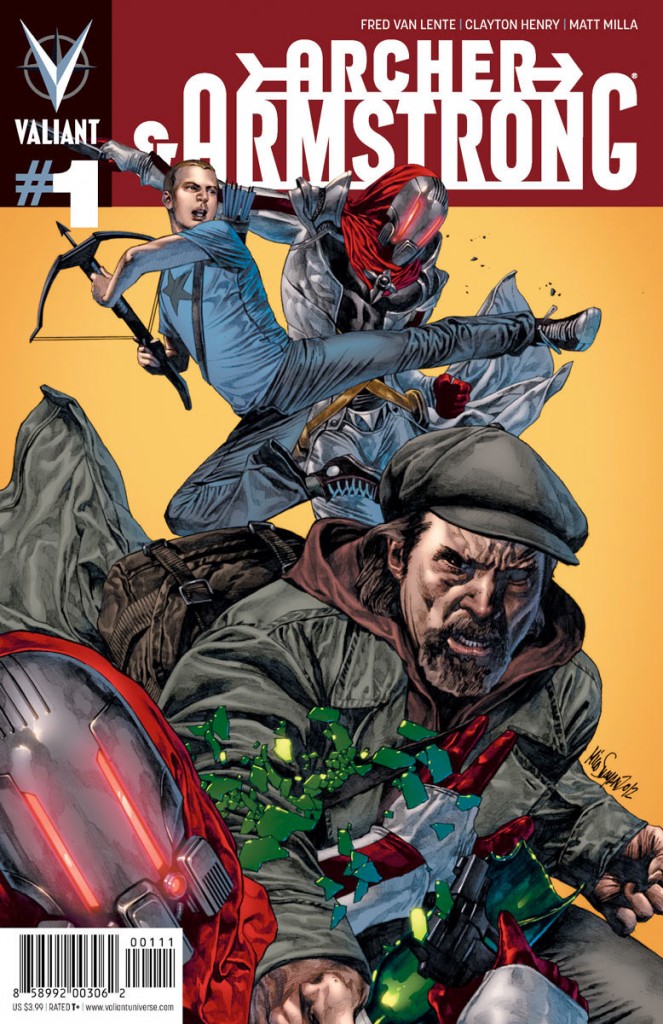
ARCHER & ARMSTRONG - Valiant (2013)
Fred Van Lente (writer) & Clayton Henry (artist)
For: Someone with a good amount of comic experience
I got this book for my friend who is super easy to shop for because, really, all I have to do is find something that
I like. There were a number of book ideas that floated around, but ultimately, it just made sense to recommend
Archer & Armstrong. It's just so much fun.
Fred Van Lente had a pretty great run on a few Marvel titles back in the day, and this book is sort of the pinnacle of that fun and humorous style. Here, he has a fat, drunk, invincible, Hercules-type character who was present when a mythical device was being used by his brother. He wanted to stop his brother from using the device, but all sorts of things went wacky and the trio of siblings wound up becoming immortal. Now, a variety of groups are hunting down the pieces to this machine with hopes of controlling and shaping the world to their liking.
The best part though is Archer. Archer grew up one of many, many children in this hyper Christian cult that is hellbent on finding said device. They train several of their most promising children in countless styles of martial arts (some real, some not so real). Archer is the top of the class and is sent on a mission to kill Armstrong, not realizing he is immortal.
End result is basically a funny Odd Couple scenario with a drunk immortal and a hyper Christian martial artist. I don't know that I can really sell that any better than that. It's just so much fun. One of my personal favorites.
PAGE BY PAIGE - Amulet (2011)
Laura Lee Gulledge (writer/artist)
For: Someone with presumably none to just a little comic experience
I had heard a bit about this book, but had never managed to get my hands on it until now. From what I had heard of it, it sounded like it might be a good fit for my brother's fiancee, who I know only a little about. She's one of those mystery people whose tastes I don't know and struggled to think of a good book option off the top of my head.
Page By Paige happened to be just a perfect book. It's so sweet and touching and personal. It feels somewhat autobiographical, but if it's not, it's one of the most grounded comic I've read in a while. It hits really close to home. The story follows Paige Turner (her parents are writers) as she tries to get through life when her family up and moves from Virginia to New York City. Paige is an artist, but she's also an introvert. She struggles to meet people and make friends.
The overarching story is about Paige figuring out certain "rules" to live by to improve life. A lot of it focuses on her doing specifically what she's afraid of doing in an attempt to open up to others. She starts off a pretty introverted and insecure person who won't show anyone her sketches, and by the end, she's shown her notebook to everyone, including her mother with whom she has a somewhat cold relationship. The book is broken down into chapters that tackle each of the rules.
The art is great, and varies depending on a number of things. Writer and artist Laura Lee Gulledge does a great job matching the pages to the feeling. When she's happy and upbeat, the art can get whimsical. When she's feeling insecure, it gets darker and crazier to highlight her insecurities. Honestly? I loved this book so much that it was hard not to just get it for everyone on my Christmas list.
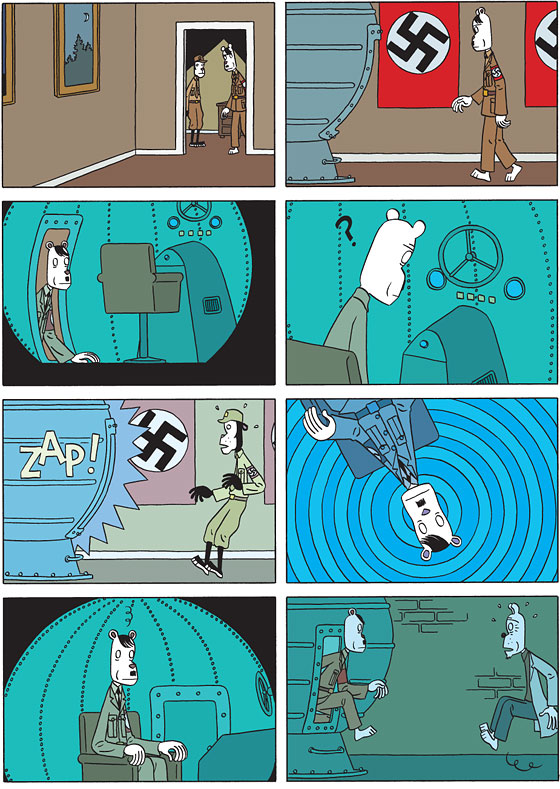
I KILLED ADOLF HITLER - Fantagraphics (2008)
Jason (writer/artist)
For: Someone with a good amount of comic experience
This book is really quirky, and its humor is pretty subtle, but it's funny and sad at the same time. The art can be a little tough to follow given that everyone is drawn the same way. It looks pretty cartoony. But it ultimately isn't that hard, as everyone wears different clothing.
The story takes place in a world where assassination is a totally legit business. In about a three or four page span, the protagonist is walking around and just witnessing assassination after assassination after assassination. It's pretty amusing. One day, he is hired to take a time machine to go back and assassinate Adolf Hitler. Things don't go exactly as planned and he gets stuck in time while Hitler takes the time machine to the present. Now an old man, our assassin has to reconnect with his ex in order to take Hitler out.
A short and easy read, it's easy to like. The traditional panel layouts makes it easy to follow and writer/artist Jason does a pretty good job showing the character's sudden aging. A lot of characters look the same, so sometimes it might take a moment to realize who is who. Otherwise, it's great and really nails this balance between funny and kind of sad.
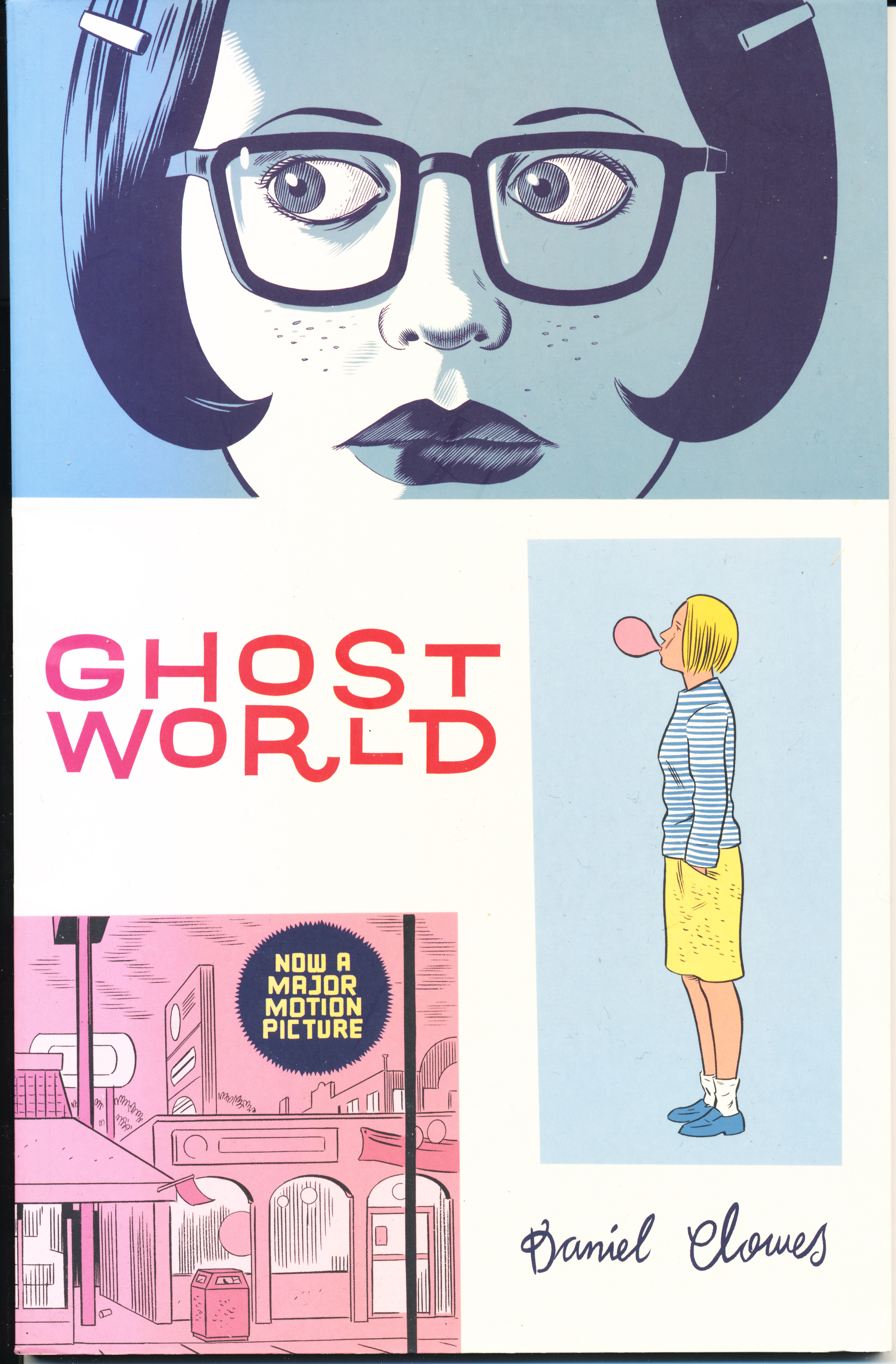
GHOST WORLD - Fantagraphics (1997)
Daniel Clowes (writer/artist)
For: Someone with little to no comic experience
What makes Ghost World interesting is the way that it's two main characters, Enid and Rebecca, are simultaneously relatable and unlikeable. I had read it way back when I was in high school, and they seemed so much better then. Maybe it was because I was dating someone who was a bit of a judgmental hipster and had a super judgmental hipster friend too, or maybe it was the way the movie handled them a little better. Either way, there's something interesting about the way these young women come off as total jerks, and yet you can see where they're coming from.
Trying to describe the plot of the comic is a little strange because ultimately, nothing really happens. It's really a comic about these two young women who have been really close friends (even if it's a weird friendship) who are transitioning to a new part in life. Daniel Clowes is pretty good at these sort of sad and melancholic stories. Ghost World is no different. The final chapter rushes a bit too quickly for its own good, but he otherwise does a good job showing them drift apart before it flashes forward.
It can be a slightly tough read because the characters are almost unbearably judgmental and mean to people for no real reason, but that's part of what makes it an interesting book. This one is maybe cheating slightly in that most people, even if they never read it, probably know about it because of the movie. Still, Clowes is a good writer/artist to go to when trying to find a comic for a friend who doesn't really read them.
MS. MARVEL VOL. 1: NO NORMAL - Marvel (2014)
G. Willow Wilson (writer) & Adrian Alphona (artist)
For: Someone with little to no comic experience
My one big rule to the list was to avoid superhero books. They're weird and tend to be super dorky, and more importantly, usually require a vague sense of larger-world knowledge to get all the references in the book. Plus, I just think a lot of people get turned off to comics in general because whenever you walk into a shop, it's overwhelmingly dominated by the superhero market.
Writer G. Willow Wilson's run on
Ms. Marvel is the one exception. Though there are references to things that happen in the larger Marvel universe, Wilson does a good job making it so you don't need that knowledge. You don't really need to know about the Inhumans or Black Bolt's terragin bomb that he released during this big event to understand that this weird mist that suddenly hits Jersey City is causing Kamala Khan to gain her powers. You also don't really need to know anything about Carol Danvers - formerly Ms. Marvel and currently Captain Marvel - to recognize that she's just another superhero in this world, and the one Kamala looks up to the most.
What we get in the entire run, but especially the first volume, is a really touching and sweet story about a young Muslim girl in Jersey City who is struggling to find her place. She's not as religious as her family, but she also comes from a background in Islam, which puts her in this weird position to be constantly misunderstood by her fellow classmates. The first arc is ultimately about her coming to terms with the fact that she is good enough as she is to be a superhero. When she first jumps into action after gaining her powers, she transforms herself into Carol Danvers-Ms. Marvel: white skin, blond hair, big boobs. She thinks that is who she needs to be in order to be liked and accepted. By the end, she's got her own costume and accepts that she doesn't need to be someone else to be a hero.
The art is great and fits the tone of the book and the character's personality perfectly. It's a great book for new or young readers to pick up, but it also has something for older readers too. Kamala is a nervous, wise-cracking high school superhero struggling to balance her social relationships with family obligations with her new superhero responsibilities. She's basically a modern Peter Parker/Spider-man.
It's a really empowering and touching book. It also feels especially significant in a world where the leading GOP presidential candidate is honestly advocating we throw out the Constitution's first amendment so we can specifically discriminate against Muslims. If there were any superhero title I'd recommend to someone who doesn't really like or care about comic books, it would likely be
Ms. Marvel. It's just one of the most touching and meaningful books on the market.
I said about
Page by Paige that I wanted to just get that book for everyone.
Ms. Marvel: No Normal was another book that it was almost tough to determine which of my sisters to get this for, and whether I should just get them both a copy!
LUMBERJANES VOL. 1: BEWAR THE KITTEN HOLY - Boom! Box (2015)
Noelle Stevenson and Grace Ellis (writers) & Brooke Allen (artist)
For: Someone with a fair amount of comic experience
Lumberjanes is an all-ages book that has won a number of awards in recent years. The book follows a close-knit group of young girls at a camp in the wilderness. They're basically a mixture of boy and girl scouts, but stranger and slightly more badass. Each character has their own individual traits to make up this awesome little group of adventurous, goofy girls.
At the camp, these girls find their way into a really weird and mysterious situation complete with sea monsters, possessed boy scouts, and hipster yetis. That might be another thing where if you're not sold on that yet, I'm not really sure what else to add. The book is sweet and funny, taking elements of
Adventure Time and making it less weird and more easily digestible.
It might be a strange book for adults to read, as it is going for the all-ages thing, but if you can see it for what it's doing, it's actually a really great and fun title. The characters are funny and relatable. The story is weird and humorous. The tone is innocent and touching. It's a book that really does have something for everyone. The cartoonish art style only aids to the sweet and weird tone of the book. There's a reason it's won a bunch of awards.
MAUS: A SURVIVOR'S TALE - MY FATHER BLEEDS HISTORY - Pantheon Books (1986)
Art Spiegelman (writer & artist)
For: Someone with little to no comic experience
If you want a book that's serious and depressing, but historically relevant, then look no further than
Maus: A Survivor's Tale. Art Spiegelman is a cartoonist whose father somehow managed to survive the Holocaust. The first book,
My Father Bleeds History, is a recounting of the early days of the Nazi power grab. Spiegelman's father, Vladek, tells his son about each of the more disturbing steps the Nazis took to ousting Jews.
It's really a first-hand account of those incidents. It's tragic, heartbreaking, and all kinds of messed up. But it's also really important. The art is cartoonish, with Jews drawn as mice, Poles drawn as pigs, and Nazis drawn as cats. The art can be a little tough to follow as a result. Still, it's not
that hard, and it's really the dialogue that tells the story. It's a powerful tale, with this first book cutting off just before Spiegelman's father tells of his time in Auschwitz. That is what makes it a solid and significant book to recommend.
PERSEPOLIS - Pantheon Books (2000)
Marjane Satrapi (writer & artist)
For: Someone with little to no comic experience
Surprise, surprise: another meaningful and powerful autobiographical account turned into a comic book from Pantheon Books! Well, fact of the matter is
Persepolis - like
Maus before it - is a great, poignant, and important book. Satrapi tells her story growing up in Iran as a rebellious young girl in the early days of the Islamic Revolution. Her distinct art style might seem to betray the seriousness of the world around her, but it actually highlights the significance of her innocence as a child in a world uninterested in such things.
More importantly than telling her story, trying to wear the newest Nike sneakers and listening to Michael Jackson records at a time when that is considered a sign of Western decadence, it's also telling the story of her parents. Satrapi's introduction spells out why she made this book: to remember those who didn't just take Iran's oppressive regime change lying down. So many in the West think of the Iranian revolution as something everyone was into. It's been a large symbol of the "us versus them" culture war mentality many seem to hold. Yet Satrapi's parents - among a host of other people in the book (who were real people in real life) - did not. They opposed the regime, and were highly skeptical of their new government.
Sadly, it just got too dangerous for dissenters, and this first book ends with them recognizing that Iran is no longer a safe place for their problem-starting daughter. So, they sent her to Paris, and they never saw each other again. Like
Maus, it's a sad and significant tale that sheds light into a country we in the West don't get much accurate exposure too because it's often hyper-politicized.
It was adapted into a feature length animated film in 2007, where it was nominated for an Oscar. The film is great too.
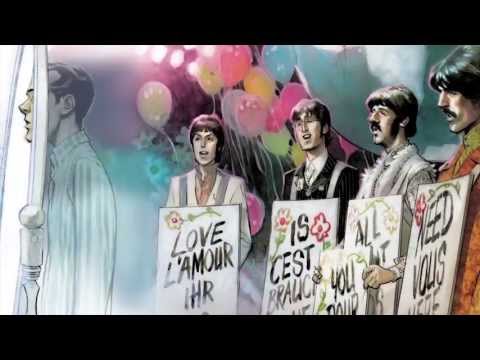
THE FIFTH BEATLE: THE BRIAN EPSTEIN STORY - Dark Horse Comics (2013)
Vivek Tiwary (writer) & Andrew Robinson and Kyle Baker (artists)
For: Someone with presumably little comic experience (but unknown)
What I initially thought was going to be just a tacky novelty biographical story about Beatles manager Brian Epstein turned out to be a rather unique and compelling story. Sure, a lot of it is just what's inherently built into such a tale. Not a lot of people know much about Brian Epstein, and he is one of the unheralded cultivators of pop culture in the 20th century. Mix in the fact that he was a gay man at a time when one would go to jail for such behavior in England and you've got a rather layered story here.
A lot of it is told in a rather intriguing and poetic fashion. During Epstein's meeting with Elvis Presley's manager, Colonel Tom Parker, Parker is presented as something of a demon contrasted against Epstein's angelic behavior. The two managers couldn't be more different, with Parker ruthlessly looking after his own financial interests while Epstein made many personal sacrifices so the Beatles might succeed and reap the benefits themselves. There are also some slightly confusing dream sequences and other moments that give insight into Epstein's psyche of the time.
This makes for what could have been a rather by-the-books type of biography, one that wouldn't seem necessary for the comic book format. Instead, the flowery and poetic nature of the narrative maximized the artist's handiwork, making it clear that this story is best told through the medium. It's weird enough to not be the most easily digestible comic, even for the die hard Beatles fan, but it's good enough to be checked out.
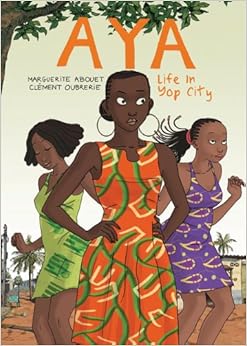
AYA: LIFE IN YOP CITY - Drawn and Quarterly (2005)
Marguerite Abouet (writer) & Clement Oubrerie (artist)
For: Someone with some comic experience
This book isn't for everyone, largely because it's plot isn't exactly one that goes somewhere. For as big a book as it is, it's mostly just capturing life in the Cote d'Ivoire during the 1970s. It can be hard for Western audiences to really follow, as it doesn't have any one central protagonist. Aya is a more "modern" and Western-like woman, so she's the one most readers will be able to relate to and identify with, but all in all, it'd be a bit of a stretch to call her the protagonist. Instead, it follows several people and the drama in their lives, largely in relation to life in the city in general.
It's an interesting perspective on a uniquely African location and culture. The author even mentions in the foreword that part of the reason for the book was to give people a more realistic look in on some African culture and lifestyle that many people have not been presented with. It is an interesting insight. It can maybe be a bit boring, and it is a bit long, but it's not a difficult read. Pages go by quickly with it's uniformed layout, and the cartoon-like artwork keeps things on the lighter side. It's worth checking out for a different presentation of Africa than the one we Westerners may be accustomed to.
FUN HOME - Mariner Books (2007)
Alison Bechdel (writer & artist)
For: Someone with little to no comic experience
Alison Bechdel (yes, of the often misunderstood Bechdel Test fame) tells the story of her relationship with her father in this graphic novel memoir. She refers to it as a "tragicomic," and certainly, there are many tragic elements to it, but it never really gets too depressing. What we get in
Fun Home is a really intriguing, complex, and sad tale about a weird family. A lot of it seems to be some way for her to deal with the loss of her father, who often came off as cold and closeted, but we can see the influence he had on her anyway.
It's a really well-crafted memoir that is both sad and touching. It also informs the reader a lot about who Alison Bechdel is herself. Certainly if you wanted a funner or more uplifting book, this isn't it, but it is a good and insightful book worth checking out.
TOMBOY - Zest Books (2014)
Liz Prince (writer & artist)
For: Someone with little to no comic experience
Liz Prince has more of a cartoonish art style, but it works for her writing. Another graphic memoir, Prince tells the story of her life as a Tomboy. She talks a lot about how difficult it was since boys and girls both made fun of her for not dressing like a typical girl. It starts off when she's pretty young, but continues on past that. The age range makes for a more compelling tale, as it highlights just how weird it can be for people who don't feel comfortable adhering to traditional gender expectations.
Prince's story is rather sad and insightful, like most memoirs, but she's also really funny. She's careful to include a good sense of humor. Seeing her get bullied doesn't bum you out any less, but you do feel a bit better knowing that she came out of this whole experience relatively ok. She isn't having a laugh at the bullying either, which is a critical component.
It can be a little weird at times. She sometimes draws her present self into the panels so she can narrate more efficiently, breaking the fourth wall. A cartoon version of Prince is literally looking out of the comic at you as she talks to you. It's kind of interesting and you don't really see that very often in comics. (Matt Fraction does this a bit in
Sex Criminals, which is awesome and you should pick up too, as an unrelated aside.)
It's a neat breakdown of the typical gender norms and where we seek validation from. It isn't saying that the typical ideas of femininity are bad or wrong, it isn't saying that women shouldn't be "girly" even if they want to be. It's really just looking at how limiting such defined and strict boxes can be. There are more ways to be a woman, and they're all ok, is basically the point.
I can't necessarily say I think all of these books are "great," but I think they all provided something really interesting. I've enjoyed them all, and thought they were really well put together. Pretty diverse list too. Sure, the majority focus on women (eight out of the twelve, to be exact), but it covers a fairly wide range of characters and styles of comics. You've got a few graphic memoirs, some superhero stuff, some just quirky and weird stuff, some more realistic drawings, some more cartoonish, some more artsy.
I don't know if the people I got these books for will enjoy them. It's hard to know if people who have never read comics will really be able to take it in. (It is a bit different than just reading a normal book.) And to be clear, these aren't books that I felt "reminded me of so-and-so." These are just books that I think so-and-so might like. But, if you're into comics, or even if you're not and you want to know what might be a good place to start, this is a pretty solid list, if I say so myself.