Showing posts with label RANTS. Show all posts

Wednesday, May 9, 2018

Thanos Is An Idiot

Warning: Spoilers for Avengers: Infinity War are present, d'uh. I mean, you've probably already seen it. It's been out for two weeks. But still.


Josh Brolin's performance as the Mad Titan, Thanos, is incredibly engaging. Predominantly CGI and face paint, it somehow manages to be loaded with subtleties. The benefit of being the central character of the whole film allows him to work with more characterization, backstory, and motivation than most other superhero film baddies. It's not that surprising to see many rushing to call Thanos the best Marvel villain yet.

Certainly, he belongs up there, but "best Marvel villain" is a low bar to clear. It's like saying Man of Steel is the best Superman movie of the modern DC cinematic universe. Sure, it's possibly true, but primarily because the other two have been, by some strange circumstance, complete dumpster fires. It's hard, though, to think of too many Big Bads from the MCU that could top Thanos. I'd still personally put Killmonger from the recent (and much, much better film) Black Panther above him. He is more thoughtfully written, and thematically relevant to the film he appears in. I'd also put Loki above him, even though he has largely veered off into more classical anti-hero characterization after the first Thor. He started off more compelling, as well as more entertaining. And, look, I know I'm alone on this, but I still think the team up of Whiplash and Justin Hammer in Iron Man 2 is a solid combination, with two villains working in tandem toward thematic significance in a way the Russo brothers fail to really explore with their villain.

The big issue with Thanos is that his motivation makes no sense. Maybe that's by design: after all, few things are scarier than an unpredictable madman with an infinity gauntlet! I don't think that is the case here, however, largely due to his presentation within the film.

Thanos is the protagonist and the villain. It's an interesting structure for a superhero film. Not even Christopher Nolan ever really attempted anything like that before within the confines of superheroes. This creates a bit of a disconnect between the reality of Thanos with the film's portrayal of him. Throughout Infinity War, we are constantly meant to think of Thanos as someone operating on some kind of logic. It's cold, moral calculus; the very type that the "good guys" refuse to do. "We don't trade lives," Captain America says at one point in the film. And yet, even Dr. Strange - who started their arc by telling Iron Man he wouldn't hesitate to abandon him to save the time gem - would inevitably fall into that very narrow moral code (despite no contact with Cap, so, where exactly did Strange get his newfound ethics?)

We are not meant to feel like Thanos is making the right call, nor are we ever really given a reason to sympathize with his motivation. That makes him different than, say, Killmonger, who - while we are never meant to approve of his actions - often is presented as having a point. Same thing is true of Loki in the Thor: The First Thor. We are never on his side, but we can understand him as someone unsure of his place among multiple worlds he is not actually native to. Infinity War occasionally tries to present Thanos through this lens as well. The flashback to when he stole Gamora is slathered in, "He has a point" rhetoric. Part of this is due to the fact Thanos is the one retelling events, and he obviously views himself as the good guy. However, the Russo brothers want audiences to strangely empathize with Thanos multiple times throughout the film, too. So it isn't just a case of a character within the narrative pushing an idea. Rather, the filmmakers contribute as well.

It all falls apart when you really start thinking about Thanos's plan. His goal is to acquire the infinity gems and use them to wipe out half of all life in the universe. The reason: there is a finite amount of resources in the universe, and life continues to expand at a rate in which those resources will be gone at some point, making any life impossible. Basically, he has to end life to save life.

There are so many holes to this logic that it is hard to know where exactly to begin. First, for a guy who teeters on nihilism, it's strange that he doesn't recognize that the universe itself is not forever and there will inevitably be a point where no life is possible at all. Second, it shows a lack of any real consideration or consistency on his part. He evidently can empathize with those who are struggling to survive, but not those he is knowingly killing. Third, his plan is incredibly small in focus and opens up potential to make things worse. And fourth, it doesn't even attempt to get to the root of the issue which highlights a complete lack of foresight.

Those last two points are where it matters within the film. Thanos was, according to the film's own backstory, supposedly an intelligent person. Only he had the foresight on Titan to recognize that overpopulation would lead to its destruction. But apparently, not a single person in the Marvel cinematic universe - including the forward thinking Thanos - could see how little his plan actually addresses his primary concern.

If Thanos were truly interested in protecting life in general from the problem of shrinking resources, why would he choose a system of chance that selects people at random? One of the big characters to get wiped out was T'Challa. Yet this change has the potential to do so much more damage. Black Panther ended with T'Challa opening up Wakanda to the rest of the world, literally embarking on a campaign to *share* their resources. And now, that king is gone because of Thanos's idiotic, short-sighted plan to bring "balance" to the universe. Now, instead of a political leader making things better and establishing fair trades of resources with others, a power vacuum opens up. Wakanda could be exposed for another like Killmonger to take the throne and enact policies of violence. Or, with the lack of a strong leader with a clear vision in place, Wakanda's neighbors could use it as an opportunity to start a war to reclaim areas they felt were rightfully theirs. Effectively, Thanos has destabilized the region.

The idea that the primary cause of war and suffering is shrinking resources flies in the face of history. For example, there were more than enough resources to go around in early North America. There was plenty for the many native tribes already present, and there was even plenty for the European settlers that got there. And yet, greed drove the Europeans to take and take and take. The bountiful resources itself caused plenty of suffering. The settlers spread diseases and, quite literally, wiped out more than half of several native tribes in efforts to take those resources and those lands. They did not do that because resources were scarce.

Thanos's motivation is built around the idea that overpopulation is a problem in need of solving, but he can't comprehend concepts of greed. A quick look around the Marvel cinematic universe, you will find several stories built around the villains holding grudges because they did not get enough, despite there being plenty to share. Sure, the bad guys are the bad guys and always hold some moral defect as characters. Yet many of them have, at their core, a story of the "bad guys" getting kind of shafted. It's rarely a matter of someone seeking limited resources, or such things becoming scarce.

If the problem on Gamora's planet was that the food was being hoarded by some of the population, how exactly does killing half of them fix that? Ok, there are now more resources to go around. What's to stop that world from seeing the same exact outcome? Perhaps, like North America, it will wind up very much a situation where such a small population controls such a large amount of those resources. That because there is now a smaller population and more resources, there will be bigger gains for those who manage to get control of them. Plainly, Thanos's plan does nothing to address the root cause of greed.

The logistics should also not be ignored. Because Thanos doesn't actually care about any life, he opts to wipe people out at random. Those at the end disappear from existence by chance, just as those he gunned down on Gamora's world were sorted without any thought as to who they were executing. This is important because what if he just accidentally wiped out most of the people that know how to farm, or fish, or hunt? He just killed half the population because some people were starving, but without consideration as to who he was killing, he risked ensuring the remaining population continue to starve. Or, like with T'Challa, he might have wiped out the leaders that could help keep the peace or educate the survivors for self-sufficiency. What if he just wiped out most of the doctors? Or the person on the cusp of curing a disease or, god forbid, an actual plan to deal with either food distribution problems or overpopulation problems? There is so much downside to randomization of murder that it's hard to believe Thanos ever actually thought this was the solution. I get that it would have to abandon his quasi-nihilistic thing wherein he is supposed to think life has no intrinsic value, except that everything was being done in the name of preserving lives, so he must inherently find some do.

Even if the problem were indeed overpopulation, what exactly does wiping out half of the universe's population accomplish? What is to stop these people from overpopulating again? Maybe it's just me, but even if I were nihilistic, I might consider using the all-powerful Macguffin to sterilize half the population, or do something that otherwise reduces population growth. Wiping out half of all life while retaining reproduction rates would be like putting down a few ant traps without doing anything about the ant hill just outside your door. Ok, you can take out some ants and it's better for a few days. What do you do when their numbers are back up and they're invading your home again?

In my review of Avengers: Infinity War, I noted that I'm tired of the "have to destroy life to save life" trope increasingly common as motivation for sci-fi villains. We saw this in the MCU previously with Ultron, who was attempting to create an event so destructive that it wiped out humankind in the short term but would spare life in general on Earth over the long term. It seems increasingly common in sci-fi stories to have a Big Bad motivated by this idea that destruction leads to peace. It is not always a bad vein to tap, but it feels clunky in Infinity War, largely because it seems as though the writers didn't put any real thought into it.

A great example of this trope written well (on the most part) is BioWare's video game trilogy Mass Effect. In that series, sentient machines called Reapers are in the midsts of executing a recurring plan to eliminate all intelligent organic life in the galaxy. This is done, they claim, to prevent intelligent life from creating synthetic life that will inevitably rise up and destroy all organic life. On the surface, it sounds similar to, or even worse than Thanos's plan. There is a pretty key difference, however

The Reapers have a very specific group of lifeforms they seek to eliminate. They are not killing people through chance. Their targets are deliberate and thought-out. Lifeforms they do not deem intelligent are spared and specifically given the opportunity to evolve along a designed trajectory. After every cycle of 50,000 years, the Reapers intentionally leave enough technology behind to influence the evolutionary path of organic life. Essentially, it is a logical, predictable program. There is very little up to chance with their plan. According to their cold moral calculus, which they were built to consider by organic lifeforms, this cycle has been repeated and successful many, many times. They have factored in many variables and always got the same result. They are not getting caught up in concept of life's value, even in the face of the player's Commander Shepard defying the odds and showing organic life can be so much more than the Reapers expected. However, there is actual logic behind their plan.

The "chance" aspect of Thanos's plan is what makes it fundamentally different and more ridiculous. There isn't any actual logic to it. At its core, the only reason it "works" is if we conclude that he's just a crazy idiot. Sure, that can be scary, but it's not compelling. It's the difference between Jared Leto's Joker just acting on a whim and not being about anything (boring) and Heath Ledger's Joker being about chaos with intent and purpose (really intriguing and griping).


Thanos could also have taken a page from Mass Effect. The overpopulation of an aggressive alien race called Krogans was a big concern for much of the "civilized" galaxy. And so Salarian scientists created the genophage: an airborne toxin that genetically mutated the Krogan people in a way that effectively sterilized many and dramatically reduced their reproduction rates. Much of the trilogy examines the morality or justification of such a plan, but again, there is logic to it. People saw a problem, and they sought to address it. Thanos does no such thing.

In this way, Thanos is a pretty frustrating villain. Brolin's performance is top notch and worth watching. Yet how he is written and presented by the filmmakers is so underwhelming and stupid that it removes any of the compelling potential of him. He isn't anything other than mad. Mix in the overpowered bad guy trope he checks off, and Thanos actually embodies some of the worst villain writing out there. Sure, there are a few bold choices made in Infinity War. We don't often see the bad guys win (although one could argue we got to see Hela do this in Thor: Ragnarok with a much more potent and complex ending). Sure, we really get to see more from the perspective of "the bad guy never thinks he's the bad guy." But that doesn't itself make him compelling.

Even more, if the idea is that Thanos represents the opposite side of the Avengers' thematic coin - that our heroes don't trade lives while Thanos trades them at a 1:1 ratio - that falls completely flat so far. This, of course, should be taken with a grain of salt as we do not have a complete film yet. Infinity War is so clearly an incomplete film that it is difficult to say much until we have the second part. Still, the Russo brothers have constantly provided surface-level "depth" with their Captain America films. For all the talk of The Winter Soldier examining themes of privacy vs. safety, or Civil War looks into individualism vs. collectivism/private rights vs. government oversight, neither film takes too much time to explore in any sort of meaningful way. Plus, they both completely fall apart by the third act.

Infinity War does nothing besides establish that Thanos is the opposite of the Avengers. That's it. There's literally no more to that. It doesn't make any commentary on it. It doesn't really do anything to explore those two positions juxtaposed against one another. In fact, all it serves to do is blatantly tell audiences that Thanos is the bad guy and the Avengers are the heroes, which, ok. I guess that needed clarification 19 movies into the MCU?

If Thanos is a top five MCU villain, it's largely because they have always struggled with villains. They have never really gotten the kind of care or attention they deserve within the writing process. People are going to be all into Thanos because he actually gets the most screen time of any non-Loki bad guy, but I'd argue he's just as shallow, uninteresting, and weak as Ronan, Yellowjacket, Obadiah Stane, Aldrich Killian, or Malekith.

Wednesday, January 13, 2016

LIST-O-MANIA: Games For the Non-Gamer

I always find it interesting when someone says something like, "I don't like video games." To me, that's a bit like saying that you don't like movies or books or something (which, I suppose there are people who don't like movies in general, or books in general either). I'm pretty confident that I might very well be able to find something you would like, if you told me you don't like or care about video games. As long as you're opening to trying it, that is.

So, here is my attempt at a list of ten games for the non-gamer. These are games that don't require that much gaming literacy to pick up and enjoy. And, they're just really great games, so even if you are a seasoned gamer, these are worth checking out.


11. Valiant Hearts: The Great War
Available On:  XBox360, XB1, PS3, PS4, PC, iOS, Android

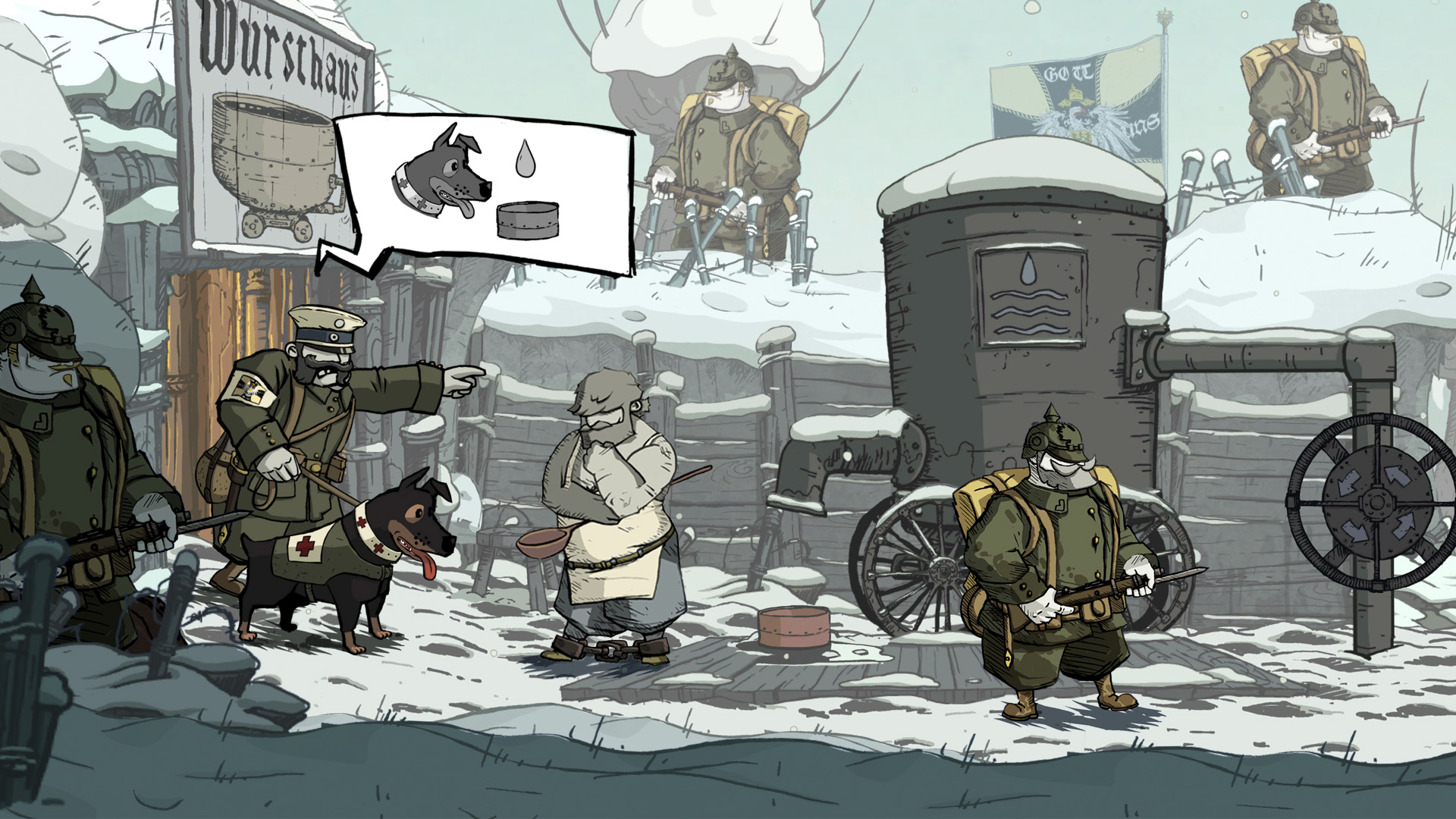
You don't need much gaming experience to enjoy Valiant Hearts: The Great War. It's a simple, linear puzzle game that, for a game about World War I, doesn't include much violence. You never shoot or kill anyone. Indeed, you play as characters in a war trying to avoid violence. It's not particularly difficult, making it easily accessible for non-gamers.  It's informative and emotional all at the same time. It may be a simple game, but it does most of those simple things really well.

And just the emotions...


10. Pretentious Game
Available On: PC, iOS, Android, Kongregate.com (for free, even)

The name of the game probably fits according to some people, but it's a pretty well thought out and genuine game. It mixes simplicity with mechanics as metaphor kind of like a Mike Bithell game. In fact, it kind of looks like Thomas Was Alone. The characters are little blocks, but they represent people.

The game itself is almost entirely built on the premise of mechanics as metaphor. Each chapter is pretty short - only a couple of minutes, really - but there isn't necessarily a consistent style of play, other than that you move each square to a particular destination. It's basically a puzzle game in which you figure out what to do based on the clues given in the narrative. For example, there's a part talking about how this man would get drunk and couldn't control himself, at which point the square you control will often switch, so left arrow moves you right and right moves you left. One moment talks about how lost someone is feeling, causing the square to disappear in a dark background.  It can sometimes be a little tricky to figure out what exactly each thing meas, but it's an interesting idea.

The story is a rather sad tale of lost love, really. Like Thomas Was Alone, Pretentious Game has a surprising amount of emotional power behind it for a game that features primarily cubes.


9. Her Story
Available On: PC, OS X, iOS

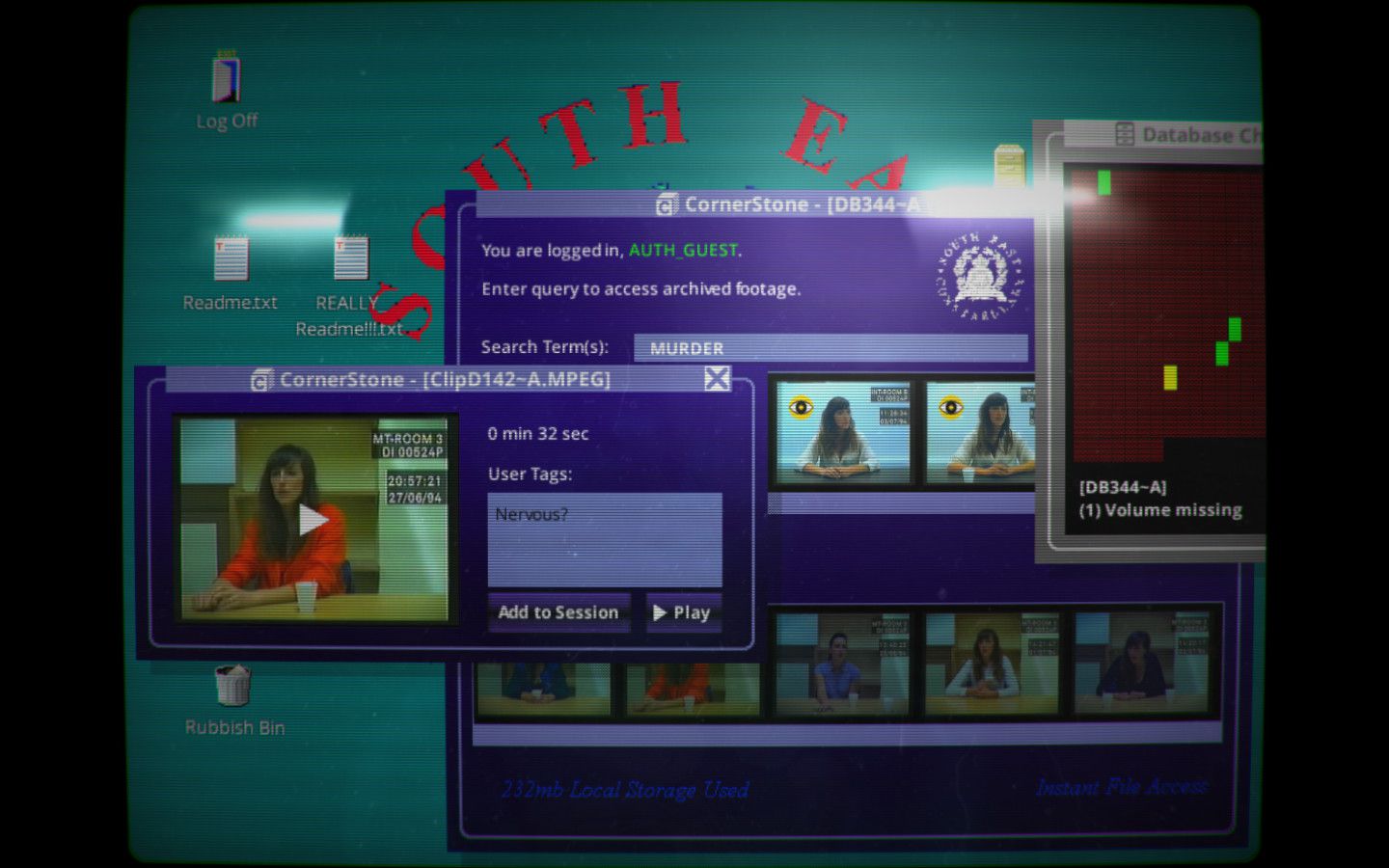
Her Story breaks the mold of what people might expect from a video game. It's actually kind of a passive game. Players don't get overly involved in it. In fact, the only thing players will input are keywords into a search bar in order to find new videos. The primary mechanic of the game is, quite simply, watching video clips of a woman as she tells her story about her history and her relationship to a man who has been found dead. Basically, the concept is that you are given access to old police tapes from when they interrogated a suspect in a murder case back in the '90s. The clips themselves look like old VHS tape recordings, but the computer screen is also a mock up of '90s computers as well, complete with a little time-wasting computer game you can play.

The videos are broken up into a ton of little pieces, and it's up to the player to find them all via searching the computer by keywords. Players can also re-organize the clips by "tagging" them with different labels, which is helpful when referring to older clips. The game is basically a giant puzzle, but unlike most puzzle games, the player doesn't get confirmation if they're right or wrong. There aren't really any moments to indicate that you're on the right track, and you never get an actual answer. Instead, you're left with all the notes you may have taken and a pretty good idea - maybe - of what happened and whether she were reasonably suspected of murder.

It's an interesting idea for a puzzle game, and I'd say it's maybe for anyone who became obsessed with the Serial podcast. It does a great job making you feel like a detective, but be prepared for what might be a slightly unsatisfying conclusion, given it's somewhat ambiguous. Sure, not a ton of replay value on this one, but I can't put into words how great I found my initial playthrough. It's quite the experience.


8. This War of Mine
Available On: PC, OS X, iOS, Android, PS4, XB1

I tried to avoid putting some of the bleaker, more serious games on the list because, well, people typically want to play games to have fun. Still, there are two games that I highly recommend because they're quite powerful and highlight what games are capable of doing. If you've ever watched television, you've probably seen commercials for one of the seemingly endless supply of war games. Typically, war games are built on premise of turning you into an elite soldier. It's an easy thing to do, but a lot of games use war as their background because of the action and adventure inherently built into it.

This War of Mine is not that kind of war game. Instead of turning you into one of the soldiers, built up as all heroic and all, it puts you in the role of civilians trying to survive in a war zone. Players control a number of survivors stuck in a house during the day in a region decimated by war. During this phase of the game, you use resources you've collected to survive. You'll tell some of your house mates to eat, or sleep, or take medicine, or whatever else they may need to do. Some, you'll have using resources to build new things like beds, stoves, animal traps, or even just boards to stop looters.

At night, you'll send one of your party to a location from a map. Some areas are off-limits because of recent battles. Others are home to civilians who aren't able to defend themselves, allowing you to steal from them with ease if you should choose. Some places, though, will have you run into other survivors. Occasionally, they'll be peaceful and even want to trade, but others will shoot you on sight. Your goal is to collect as many resources as you can. Food, water, medical supplies, building supplies: there's a lot of variety in what you can gather. Problem is, you have a limited number of things you can carry.

Each character has their own ailments to deal with. You're constantly trying to balance your limited food supply with each person in the party who is almost always hungry. You also get people who are sick, injured, or just sad. It's a really, really difficult and heartbreaking. Surviving is really difficult.

The game itself is simple. It's just point and click. You don't need much skill to play it. You just need to be able to stomach the difficult decisions. It's a really poignant game, demonstrating the brutality that a lot of people in real wars have to deal with.


7. Papers, Please
Available On: PC, OS X, iOS

Yep. Another bleak and depressing, yet extremely poignant game. Papers, Please puts players in the role of an immigration officer. Throughout the course of the game, all you basically do - from a game perspective - is look at an immigrant's paper work, determine if it's valid or invalid, and either approve them for entry or deny them entry. It's tedious, and at times very cold, but that's the point.

When not processing applicants, you're trying to figure out the best way to manage your finances. The game puts players in a fictional world that is probably run by a fascist dictator. At the end of each day, you must allocate your money into a variety of important things like food, heat, or medicine. Your family gets sick frequently enough, especially if you can't spend money on heat all the time. Money is a pretty limited resource, which connects to the immigrant processing gameplay too.

At times, you are presented with bribes. Immigrants will offer to pay you to allow them entry despite invalid paperwork. At the same time, border guards will offer you a cut of their bonuses for imprisoning applicants, forcing you to confront the uncomfortable scenario of apprehending someone with an invalid passport just so you can make money to pay for your child's medicine. There's a lot of gray area in the game, making it one of the best and most excruciating games built on morality. Like This War of Mine, the morality isn't clear cut, and is meant to make players reflect on the situation.


6. One-Finger Death Punch
Available On: XBox360, Android, iOS, PC

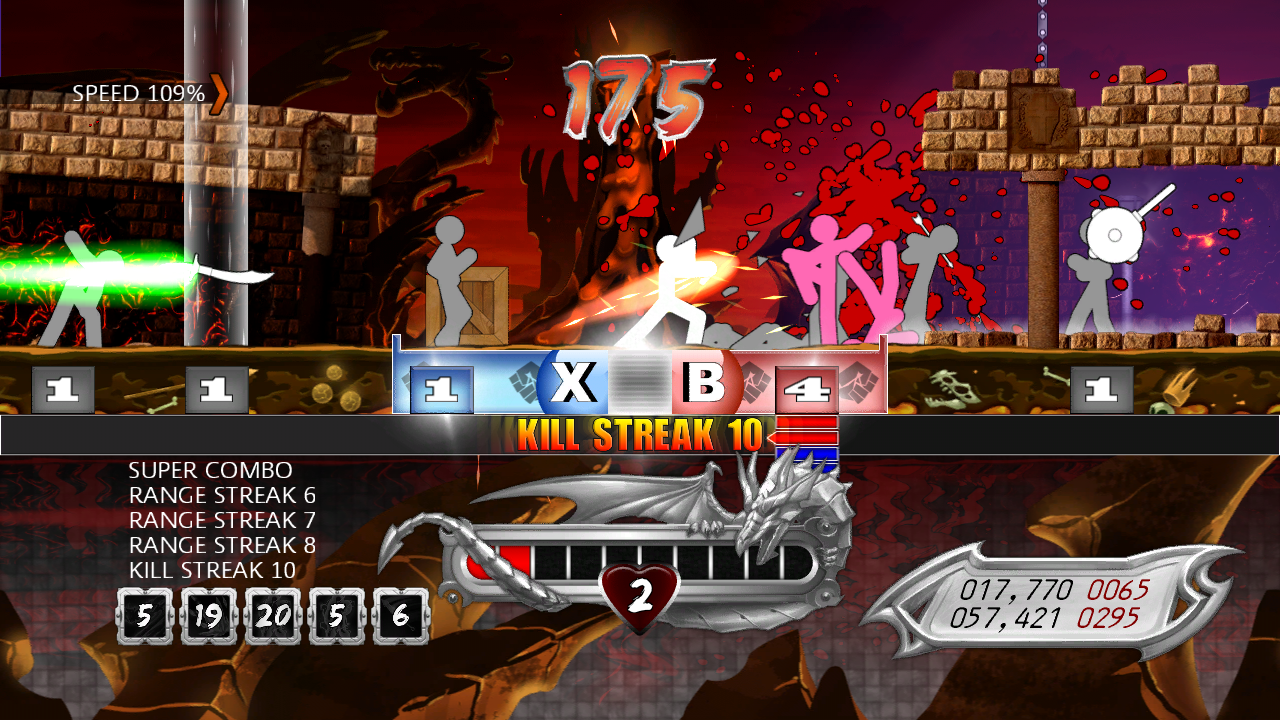
Ok! Let's get away from the bleak, but important games for a moment. One-Finger Death Punch is one of the simplest, craziest, and most fun games I've played in a while. The game does a good job getting progressively more challenging, offering splits in the story's path so players can choose how quickly they want the game to get more difficult. At some point, it stops being particularly easy, but it never stops being super simple.

Quite literally, you will only ever hit one of two buttons. One that correlates to "left attack" and one that is "right attack." The rest is just a rhythm based game, almost shades of simpler Dance Dance Revolution. All you do is tap the correct button when it shows up. It's all timing based, which makes later levels really challenging as they introduce new button combos to deal with and faster paces.

Bottom line: it's just sooooo much fun.


5. Monument Valley
Available On: iOS, Android

I'm not much of a mobile gamer, and I'm especially not typically into games on touch screen phones. Yet every once in a while, there is a super addictive game that I really enjoy. Whether it's the stylized side-scrolling Canabalt or the hyper addictive platforming Doodle Jump, it's not like there aren't fun games for your phone. Even as they try to adapt older classics like Chrono Trigger or Wolfenstein 3D so they're playable on your iPhone or Galaxy, it never quite works well enough for me to ever stick with it.

Monument Valley is a short and unique puzzle game that captures a lot of the spirit of the great indie games you can find on Steam. It's got a bit of Fez influence in the sense that perspective can matter. The main difference though is that all of the levels are built like these MC Escher-like puzzles. It might take a few levels to really get the hang of it, given that it's all built around optical illusions, but as a puzzle game, it's simultaneously different and similar enough to many of your more popular puzzle games on mobile.


4. Portal 2
Available On: XBox360, PS3, PC, OS X

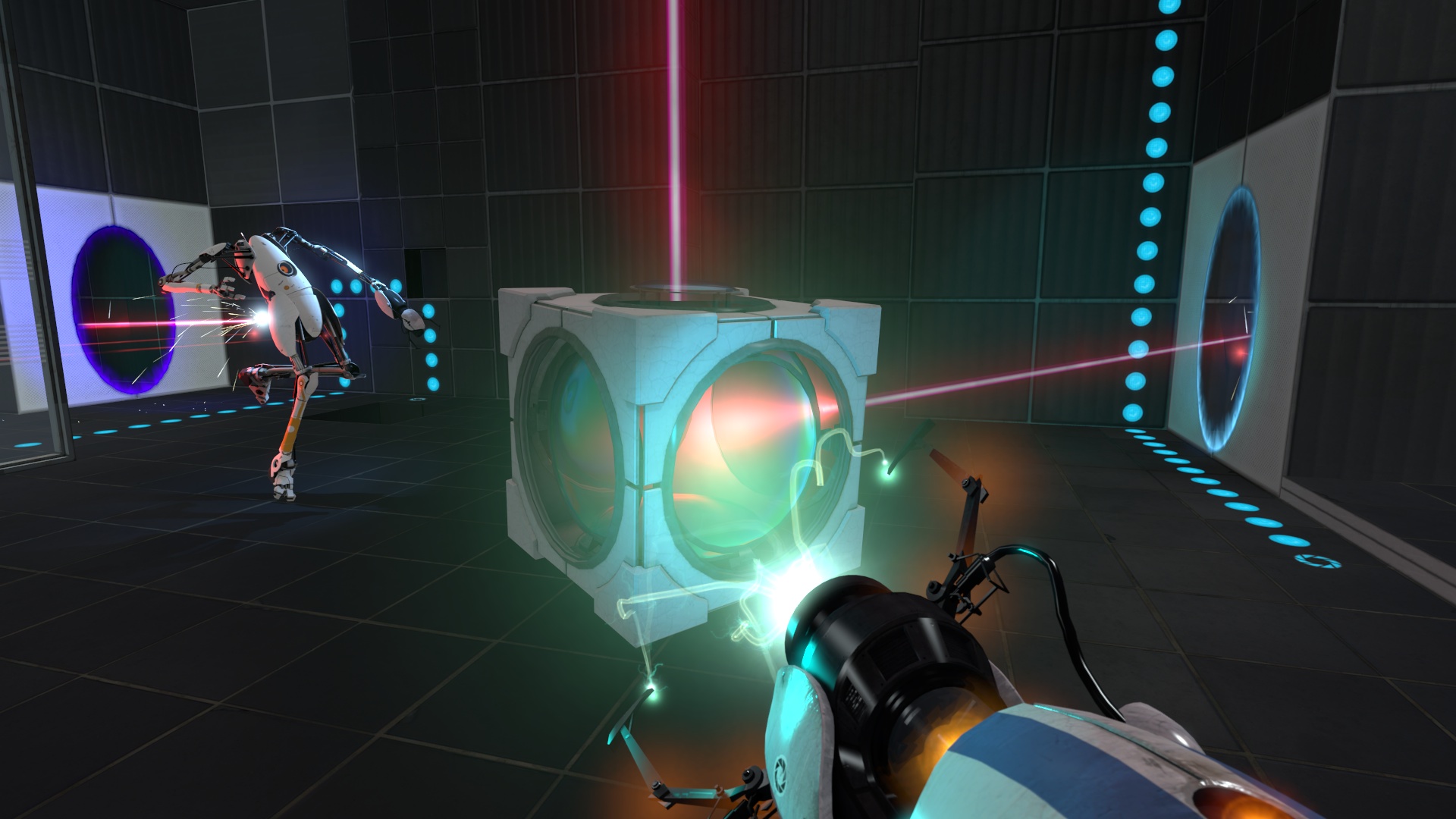
Look, Portal 2 or even it's predecessor are among the greatest games ever made, but it made a little more sense to drop it from the top spot because it is a first person perspective, and you have basic FPS controls. The puzzle nature of the game is really fun. Mixed with the incredible humor, it also makes the game very appealing for people who don't play a lot of video games.

Because of it's more advanced controls, it can take a little more time and commitment for non-gamers to get it down. For veteran gamers, the FPS controls are intuitive. It's easy to think, "It's second nature to me, so why is anyone else struggling with it?" But it's important to keep in mind just how much experience a lot of us core gamers have with such schemes. (Just try to remember the very first FPS game you've played. Probably hard to recall at this point, but it probably felt weird at first, and took some time to really get down.)

While the first Portal was excellent, it just felt right to put the sequel ahead, since it's so much funnier. Plus, you can play in a co-op mode, making it a great game for gamers to try with their non-gamer friends.


3. Life Is Strange
Available On: XBox360, XB1, PS3, PS4, PC

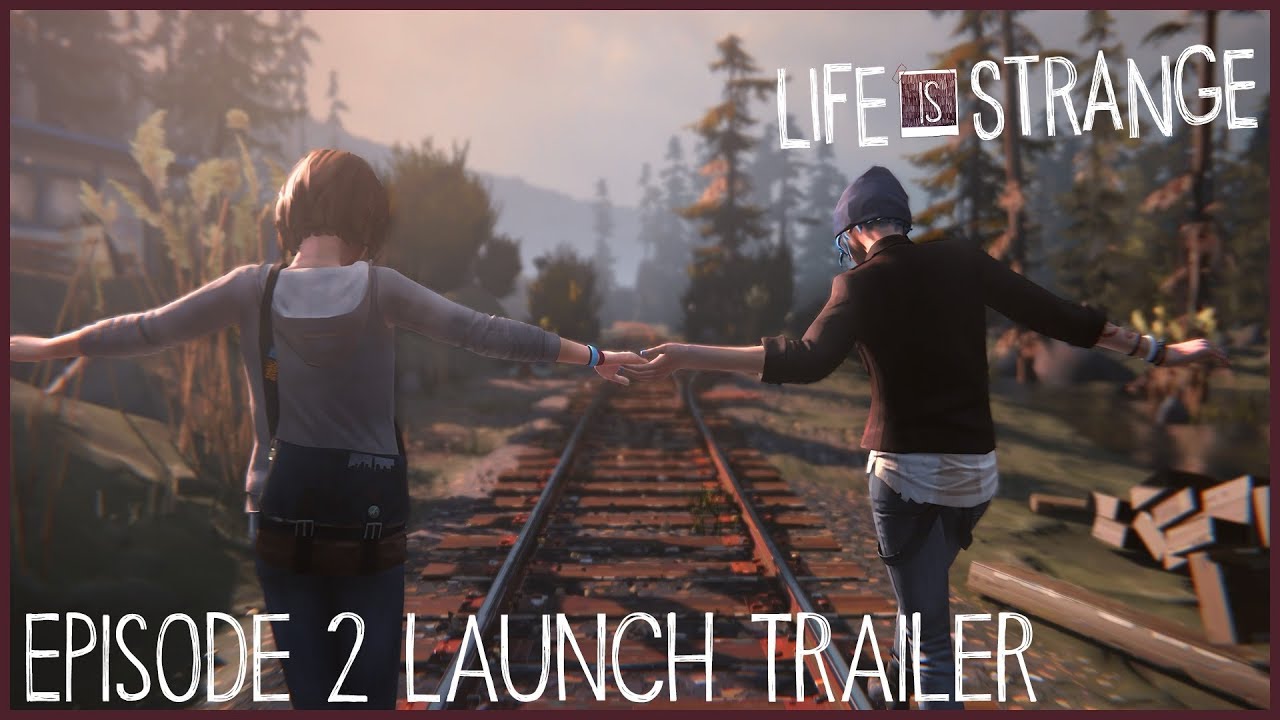
Much can be said about the flaws inherent to narrative-drive games with its primary mechanics built around making choices, but Life Is Strange does a lot of things better than most. The time rewind powers add to the adventure/clicking gameplay, and also add to the overall themes and story. While the final episode is a bit disappointing, the game is strong enough - with good enough characters, an intriguing enough story, significant decisions to make, and a killer soundtrack - to make up for it.

The fact that it starts off really grounded, and centers around some fairly realistic characters makes it an easy game to relate to. There are few games that resonated with me on such a deeply personal level. It's an easy game to pick up and figure out, making it a great game showcasing the power of video games as a medium of story-telling.


2. Flower
Available On: PS3, PS4, PS Vita

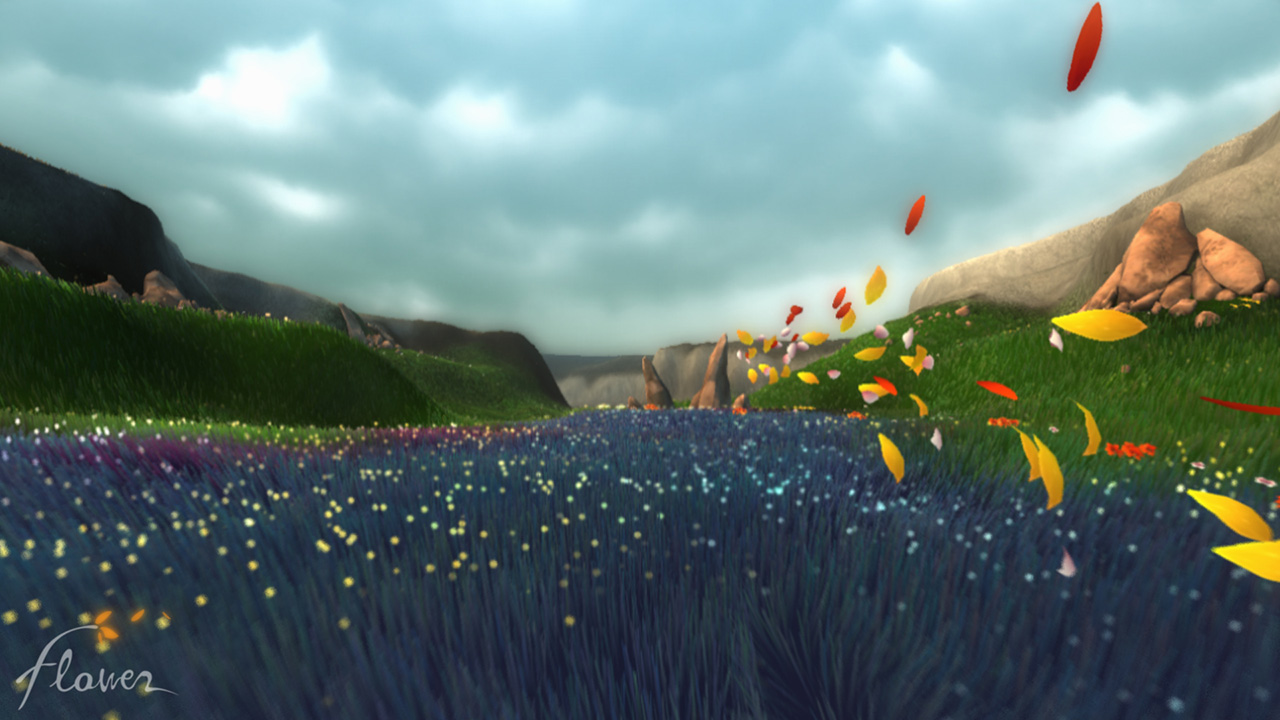
If you want a really simple game that is beautiful and relaxing, then look no further than Flower. Thatgamecompany has really made a name for itself with beautiful, calming experiences. Fl0w is also a weirdly relaxing and simple game, and Journey is probably it's master opus at this point (which I admittedly have yet to play, which is why it's not on this list...yet!)

What's the premise of Flower? Well, you play as pedals on the wind as a row of house plants in the city dream about life in a field rather than the polluted metropolitan areas they know. Quite literally, you just blow around the fields collecting pedals. The goal is primarily to just beautify the fields. Thatgamecompany doesn't plan on producing any huge games, and that's totally fine. While some gamers might prefer their games to be really difficult and challenging, I think there is something to the idea of "lean back" games that we can play, interact with, and relax to.

It's also super rad for the way it uses musical notes to correspond to different types of pedals, allowing players to essentially create their own unique take of the music tracks.


1. Thomas Was Alone
Available On: PS3, PS4, PS Vita, XB1, PC, OS X, iOS, Android, Wii U

One of the best, and most simple games in a long time, Thomas Was Alone is a game that anyone - gamer or non-gamer - can love. At its core, it's a basic puzzle game. You're navigating a bunch of rectangles through a level to their respective exit points. Each rectangle has its own unique ability that will help get everyone to their spots.

At the same time, it offers a surprisingly compelling and emotionally touching story. Each rectangle has their own personality too. While voice over narration isn't the most complex form of story telling, it's what is needed for this game. (Also, the game is built on simplicity, so it fits tonally.) Often, the character traits match the power traits of each rectangle as well.

Fun gameplay, a compelling story, surprisingly human characters, and a killer soundtrack make this one of the most accessible games that anyone can enjoy.


Tuesday, January 5, 2016

LIST-O-MANIA: The Best of 2015

Another year is in the books. Like always, there was no shortage of complete garbage (Fantastic Four), but there were also a lot of great stuff! I didn't get a chance to play too many games released this year - $40-$60 for a new/new-ish game is a bit much right now, but I did get to play some stuff. For that category, I'm keeping it to five entries. I also don't watch too much television, so we'll keep that list to five as well. Movies are easy though. Cheap by comparison of video games, and much less time consuming than television, we'll expand that category to ten. Plus, we'll mention some of the stuff that makes 2016 look promising!

TOP 5 VIDEO GAMES


 5. Volume

Mike Bithell makes great games by embracing simplicity. Thomas Was Alone was a beautiful game, and certainly one of the more mentioned of the indie sweetheart games. It's success is largely from the way it used simple gameplay in a compelling fashion. His follow up, Volume, follows a similar trend. It's more complex, but his stealth-game that is a futuristic retelling of Robin Hood is really easy to pick up. Each level is a time-based challenge, so you won't get stuck on difficult sections for too long. This allows players to get through it how they wish. More of a casual gamer who wants to get through the story? It's a bit challenging at times, but you won't get overly frustrated. More of a hardcore gamer who wants to get the high score or get under par each time? That will take up a fair amount of time. Volume is another great game that is beautifully simplistic. 


4. Rocket League

One of the most genuinely fun games in a long time, Rocket League succeeds by creating the simplest premise combining two things: soccer and racing. How do you describe the game? Well, it's soccer, but the players are rocket cars. It's fast and chaotic, but pure fun. They've recently added mutators to the game as well, only enhancing the mayhem. It takes a while to get really good at it, but even at the "beginner" level, it's hard not to enjoy yourself.


3. Her Story 

My big take away from Her Story is that I would be the worst detective in the world. Her Story is a neat and unique little game wherein there's surprisingly little gameplay. No, it's not another one of those "walking simulators." Instead, the game is a big puzzle that wants you to put it together yourself and never tells you if you're totally right or way off base. Basically, you're watching a giant library of old video clips of a woman being interviewed by a detective. The questions are edited out, so all you get are her responses. It's your job as the player to piece together this person's story. The only real input you have as a player is to input keywords as you search the database. You type in keywords and video clips with that word will show up. It's actually a bit trickier than it sounds, as there are a lot of videos. There might not be that much replay value in the game, but few games have provided as awesome an initial experience as Her Story, and the way you feel as you start unwinding this story.


2. Life Is Strange

Episodic games have become a lot more popular and common in the aftermath of Telltale's The Walking Dead success. Dontnod Entertainment tried their hand at it with Life Is Strange. What sets this game apart is how it begins by being really grounded and innocent, then progressively gets darker and darker. By the end, it's almost entirely unrecognizable. At its core, it's very similar to those Telltale games. You control Max around the environment, looking at and interacting with items. Max learns she can manipulate time, which adds a little about to the "walk-and-look" gameplay. Most puzzles involve watching events unfold, rewinding time, and figuring out the proper way to change what's coming. Though the finale is a little weak overall, the rest of it is so nice and emotional. It's the characters that sell it (and maybe the awesome indie soundtrack). And, ya know, the feelings!


1. Undertale

Undertale is the latest indie sweetheart game, but with good reason. It's funny that the retro look of gaming has made for itself a tidy little corner of the market! This RPG takes a lot of its cues from Super Nintendo-era gaming, most often drawing comparisons to Earthbound. It's not hard to see why. While the gameplay might be a little weird - it's largely either timing-based attacks or a Asteroid-like mini-game to avoid attacks while figuring out how to "spare" enemies - everything else is nearly perfect. The characters are great and realized incredibly well. The writing is nearly perfect. And it's just a lot of fun. What's interesting about the game is that you can go through killing everything (like you normally would), you can go through and not kill a single enemy (which requires certain actions during battle), or some combination of the two. It might not be the best game for people who don't like to get stuck on challenging bosses, or who get frustrated easily, but if you don't mind needing a few tries to get through an enemy, it's definitely worth checking out.


TOP 6 SHOWS


6. Last Week Tonight With John Oliver

The student has become the master as John Oliver took over his own political comedy after his stint on The Daily Show. As the genre expands, there's one that stands above the rest. It might not be the institution of Jon Stewart's show, but John Oliver has crafted one of the most legitimately informative and enraging (in the right ways) comedy show on television. Sure, it's a little unfair to compare Last Week Tonight with The Daily Show or The Nightly Show. Being weekly means that Oliver and his crew can dig deeper into a single subject. Yet it's that ability to do so that makes it the best. Even more is all the stuff they've done outside of the show in service of it, like starting a legally recognized church or putting up billboards around the world.


5. Daredevil

No, it's not a perfect show. The dialogue is sometimes clunky and some of the relationships seem rather contrived. And let's not bring up how bad the Daredevil suit at the end looked! Or that the finale was a bit rushed and disappointing. Still, what made Daredevil so captivating was it's dark, crime noir story and arguably Marvel's best on-screen villain to date. Wilson Fisk was compelling in his layers and complexity. Daredevil stands out from all the other Marvel movies and shows by immediately going dark. The violence can get pretty brutal at times. This is not your Joss Whedon Avengers style of Marvel stuff. It works by remaining true to the character while telling an intriguing story, all while working in some key mystical elements of Daredevil's lore.


4. The Last Man On Earth

Phil Lord and Christopher Miller have been making a name for themselves. Even if you don't recognize them, you're probably familiar with their work. The LEGO Movie and 21 Jump Street have both been widely loved, and they're both really funny. Teaming up with Will Forte again (see Clone High), they've created one of the weirder comedies on a mainstream network. Focused on a group of survivors in a world where a plague has seemingly killed all other life, it's a strange placement for a comedy. Yet it works, largely due to Forte's comedic acting chops, as well as Kristen Schaal's perfect performance as well.


3. Jessica Jones

While Daredevil may have been a more accurate comic book adaptation, Jessica Jones was probably the better overall show. The way everything connected and was in service of the greater themes and concepts adds a layer that its Marvel Netflix predecessor lacked. It also didn't hurt that it had slightly better dialogue and character writing, but overall, it's that it's more than just a comic book show that gives it a slight edge.


2. Master of None

Probably the least likely show you would expect out of Aziz Ansari, Master of None is just really, really good. It's funny and touching and poignant at all the right moments. It's a bit weird seeing Ansari play an actually realistic and relatable character, dealing with a lot of the same generational problems we all are, and keeping it in context with and acknowledging other people's issues and histories. It's just a really well balanced show.


1. Unbreakable Kimmy Schmidt

The strange thing about comedies is that it's hard to explain to someone who might not have the same sense of humor as you why it's so funny. Kimmy Scmhidt is the funniest and most charming shows in a long, long time. Ellie Kemper's smile is contagious, and it's awesome to get a show that makes it a point to retain a sense of wonder and optimism at a time when cynicism and brooding characters are making a strong comeback (seriously, it's getting dangerously similar to the '90s lately...) It's a winning combination of cheesy jokes with nerdy referential humor, all anchored by a brilliant performance from Kemper. This is honestly just a show I can always go back to and watch at any point and still be entertained by. I've watched it so many times this year, and rewatching it the other day, I still found jokes I laugh out loud to.


Honorable Mentions:  I also just wanted to take a moment to throw out a few honorable mentions to shows that didn't premiere in 2015, but had what I felt to be strong seasons. Most notably, I really though Community recovered well for its final season earlier in the year. It hit a rocky patch in the aftermath of NBC's firing of Dan Harmon and then going from NBC to Hulu to Yahoo, but it did regain a lot of the charm and heart of the early seasons in time for its finale.

Also wanted to give credit to Parks & Recreation for crafting one of the weirder series finale seasons in a while. The futuristic sci-fi elements of the finale, mixed with very modern political issues made it such a joy to watch. For a show that struggled a bit in the beginning, it ended on such a high note.

And finally, Orange is the New Black continues to impress. Season three was really, really good, and has further cemented it as one of the top shows being made.


TOP 10 MOVIES


10. It Follows

Yes, at the end of the day, It Follows is kind of a dumb movie. It's not the scariest, and the psychological terror only goes so far. It's message - if it has one - is muddled and confusing, and its resolution is sudden and almost annoyingly vague. Yet the style and tone of the film makes it such a good watch. It has its thrills, and it's brilliant in the way that it channels its inner '80s John Carpenter. Plus, that Disasterpeace soundtrack.


9. Ant-Man

The general consensus with Ant-Man is that it's pretty ok. Fun, but nothing incredible. Certainly, it's not hard to imagine how much better it would have been if Marvel had been able to retain Edgar Wright. Still, what we got was a return to "Phase I" style of Marvel movies at a time when "Phase II" was in full effect. The return to a smaller scope and a more personal impact, I found, greatly refreshing.


8. Kingsman: The Secret Service

Based on a lesser known Mark Millar comic of the same name, Kingsman: The Secret Service is a stylized, violent, and fun twist on James Bond. Following a mythical group of British spies, Colin Firth gets to try his hand as a quasi-action star, and he kills it. It's just a good, fun action movie. Matthew Vaughn continues to impress with his comic book adaptations. Even Kick-Ass - based on the hugely overrated Mark Millar comic - was good!


7.  A Girl Walks Home Alone At Night

This movie isn't going to be for everyone. Not because it's "scary" (it's not) or "violent" (it's not) or "gory" (it's not), but because it's so stylized and slow. It feels a lot more like a Western than a horror or drama. In fact, a whole lot of nothing actually even happens. There's not much dialogue, and there are a lot of scenes of characters just sort of silently watching each other. But that's why it's such a cool movie. It conveys so much through so little action or dialogue, and it's just visually an awesome movie.


6. The Martian

A good Ridley Scott movie? I know that sounds unbelievable, but it's true! Scott has finally made a solid, fun, entertaining movie that's a blast to watch. Matt Damon turns in one of his best performances as an astronaut stranded alone on Mars. He's largely acting against himself, with no one else sharing the screen with him for the overwhelming majority of the film. It's also refreshing to see a movie that functions as a love letter to science, rather than simply treating it as a silly plot device that can be just randomly made up and altered whenever convenient (a la Gravity).


5. The Overnight

Jason Schwartzman and Adam Scott, and their (prosthetic) dongs. That's pretty much what you're in for with this weird, awesome, hilarious film that's one of the best "adults trying to grow up."  On the surface, it might appear to be just an indie Hangover knock off, but it's so much more than that, and so much better. Just watch it. Trust me.


4. Kumiko, The Treasure Hunter

This one might be a tougher sell, since I haven't found anyone who liked it nearly as much as I did. They sell you on the idea that it's "based on a true story," but it's really just based on an urban legend. There's a tale in Minnesota of a Japanese woman who was searching for the treasure buried in Fargo - the fictional treasure in a fictional movie. Kumiko, The Treasure Hunter puts a human face on this legend. Pretty much what drives this movie is the performance of Rinko Kikuchi, who is just a complete joy to watch. If the film is more of a character study, then you need a great actor to pull it off. Kikuchi straight up kills it here. It's one of my favorite movies in a while, but take that with a grain of salt, since - like The Secret Life of Walter Mitty before it - it might just be one of those films that hits me in just the right spot that it won't hit anyone else.


3.  What We Do In The Shadows

Two vampire movies on my top ten list! Weird. What We Do In the Shadows is a hilarious fake documentary comedy centered on a house full of vampires as they make their way through the world around them, especially when they have to show the ropes to a new vampire that they accidentally turned themselves. Few movies made me crack up as frequently and as hard as this one.


2. Inside Out

Pixar continues their domination over American-made animation, this time providing one of the most interesting and touching films of their entire repertoire. It was probably always going to be a more emotional tale given it is literally centered around a young girl's emotions, embodied by some great voice actors. The way Joy and Sadness work together makes for some of the most compelling character action of the entire year, and the way it impacts young Riley has it one of the most emotional films in a long time. It's hard to pick a favorite Pixar film, but I thought it was their best to date.


1. Mad Max: Fury Road

Look, I really, really wanted to find a movie I liked more this year than Mad Max: Fury Road. I tried so hard to pick something over it, just because it's been the one to get all the hype and accolades. So many have put it as their favorite film of the year. At the end of the day, there was just nothing else that even came close. Of all the films I'd seen this year, Mad Max is the only one I specifically went to see several times in theater. It's a high octane blast - just loads of fun - with two great characters in Furiosa and Max. George Miller weirdly advances cinema by going back to more practical-driven effects. Make no mistake; there's a lot of CGI in the film too, but it's all used to enhance the practical effects. Even more, Miller manages to make something new while hitting some of the same beats as some of the other Mad Max films. A lot of the film is derivative of itself, but in a way less blatantly than, say, Star Wars: The Force Awakens. I still watch this movie and still can't believe it. It's also one of the few Hollywood blockbusters that doesn't sacrifice substantial story for mindless action. Sure, the story is not the most deep thing ever, but it's not a softball story either. As much as I wanted to avoid doing what everyone else is doing, at the end of the day, there's a reason it's widely being considered the top movie of the year.


So, those are my lists. What's at the top of yours?


Monday, January 4, 2016

The Last of Us: The Outskirts Part 2: Tess/Run


Things are supposed to be looking up. We've made it through the unstable building, survived the clickers in the subway, and fended off a rushing horde of infected. We're past the danger posed by the infected now, and we are supposed to feel a bit like we're out of the woods. This is also reinforced by the arrival of daylight, something we tend to associate with safety in these types of stories. Even more, our target destination is just a few blocks away. We're pretty much there.

Of course, not everything is great. Tess, who we know can handle herself, is starting to act a little strange. She's no longer engaged in much of the conversation, instead mostly issuing orders and keeping everyone focused. At the same time, she's a bit panicky. When Ellie asks what they'll do if they get there and the Fireflies are all dead, Tess gets almost confrontational while saying everything will be fine. "It has to be," she mutters under her breath. Though everything around us suggests we're good, there are these kinds of subtle hints to tell us we're wrong.

Just before we get to the capital building, we see a bombed out street that is flooded. We must cross it. It's easy-peasy, of course. Nothing special about it, really. What's interesting is that they choose to use this moment to introduce the idea that Ellie can't swim. Normally in games, they introduce a new concept when it is relevant to the gameplay. Here, they introduce something that will come up a bunch of times throughout the game, but it doesn't matter here. It seems like such a small thing, but this helps reduce the "gamey" feel of the game. I know, I know. That sounds really strange and dumb. However, so much of The Last of Us is successful because of how immersive it is. It's these kinds of seemingly minor decisions that increase that feeling. It would feel a bit "gamey" if Ellie stated that she can't swim, and then immediately the player has to find a palette for her to jump on so we can cross a body of water. And sure, we have to do that in a little bit, but that delay between when you have to do something "gamey" and when the concept is introduce as a character trait through the narrative helps keep us fully immersed.


Of course, here we get our first big emotional moment in this new world. Turns out, Tess has been acting strangely because she was bitten and infected. This is her last stop, as she calls it. It's not as emotional a moment as Sarah's death in the prologue, but it's still a powerful scene with great writing. More importantly though, there is great acting and animating here. Those are critical in the way the scene plays out.

The acting and animation have to work in tandem here, otherwise the scene wouldn't work. Everyone's body language is key. Joel is angry, almost pissed off that Tess is going to be leaving him. Tess is, understandably, flustered knowing she's about to die. She's also desperate to have her death mean something - in this case, getting the immune Ellie to the Fireflies so there may someday be a cure. Ellie, meanwhile, is smart and observant, but she stands there tensed up. What is extremely clear in this scene (if it weren't already) is that these actors are on a set and acting physically. A lot of video games will have animators work on the character motions with the actors just lending their voices to the scene. Here, all actors are present on a set. They're in mo-cap suits. And they're doing more traditional style of acting. That decision goes a long way in this game.

Joel seems angry at Tess, as if he's offended that she could "let this happen." When he says that this is not "us," Tess finally snaps. "What do you know about us? About me?" It's a great little moment where you realize that Joel's relationship with Tess might very well be similar to the player's. It's easy to like Tess, and she's a solid ally in these early stages, but we don't ultimately know that much about her. This is probably how Joel sees her too. She's easy enough to like and get along with, but really, she's been a survivor. Joel may have been drawn to her simply because she's been around and lasted. We know he likes to keep his distance. There's some ambiguity in their relationship presented here. On the one hand, Tess says that there surely is enough between them for her request to mean something, for Joel to feel some sort of obligation to her. At the same time, it's tough to tell just how close and open these two really were with each other, and how much of the relationship may have been built on the foundation that they're good at surviving.

Now, I'm admittedly not sure how the military knew they were at the state house. It's one of those plot contrivances for the sake of drama and action. It sort of doesn't make much sense, really. No one ever argued the game was perfect. Nothing ever is. The nice thing it does, though, is allow Tess - someone we've probably come to really like - to go out on her terms as best as possible. She's always been strong and determined from what we've seen of her, so refusing to turn into a mindless zombie creature is within her character. It also helps us deal with it a bit better. She tells Joel to "just fucking go" in order to make it easier for her, but letting her go out to delay the military so we can escape makes it a little easier for us too.


Of course, the military fires a hilarious number of rounds just to take out one person. We're now left with the remainder. It's the first time we will spend in an enclosed space with armed enemies. It can be a bit tricky, as a result, especially since the map here can be a little confusing to navigate with it's many rooms, open spaces, and enemy and cover distribution. As we go, Ellie seems pretty disturbed by everything. Makes sense. She's young and new to this stuff. Joel basically yells at her for getting too emotional, pretty much the basis for their relationship in the first half of the game.

The Tess moment is one of the few occasions in which we immediately follow an emotional beat with a lot of action. Typically, they let you catch your breath, or sit on what you just witnessed for a bit. After Sarah's death, for example, we flash forward twenty years and then just walk around for a bit. Here, we're forced to deal with a few segments of armed soldiers.  The second part of the state house is surprisingly difficult to sneak through. It's one of the great maps where you have to be really careful and aware of your surroundings. Every room has several open doors, and they all sort of face each other meaning guards will almost always have the ability to spot you if you aren't cautious.

After escaping the state house, you find yourself again in the subway. There are spores everywhere, prompting Joel to put on his mask, but Ellie doesn't have to. If we players weren't convinced yet, like Joel, now we know for certain that she absolutely is immune. No faking here. (They don't do anything to really make us as players skeptical of her claim, so this more proves to Joel than anyone.) Visibility tends to be a bit weird here. With the poor lighting and spores, it's kind of hard to see. That's pretty rad level design, to be honest. In small portions, that idea is great! What can be a bit frustrating though is that you can't really take advantage of that, as the enemies seem to have no problem whatsoever seeing you across the spore-filled room.

Either way, it's not tough. There are just two guards and even if they spot you, it's pretty easy to take them out. We then continue down the subway, poor lights, spores, and all. It's a really creepy atmosphere and one of my favorite mini-sections of the game. The first time you play it, you can't know there are no infected here, but they sure make it seem like there must be clickers somewhere! After all, we were just in the subway an hour earlier and it was crawling with them! We've also come to associate spores with infected. Most players probably make their way through this section on their toes and staying alert. We've avoided the military now, but we're not in the quarantine zone anymore. This is infected territory!

In actuality, there's nothing here. There are no enemies after those first two soldiers. It's basically one big psych out. What does come back is the fact that Ellie can't swim. Now we have to deal with that, as a chunk of the subway is flooded pretty badly. This is our introduction to palettes and ferrying Ellie from Place A to Place B. Like the whole plank thing, this is a rather weak attempt at introducing "puzzle elements" to the game. It's not really very puzzling, first off. Nor is it at all a challenge in any way. It's more just occasionally time consuming and choppy. Planks and ferrying are probably the weakest parts of gameplay and level design in the game, but they also only come up every once in a while. It's not a super common thing.


As an aside, you can find a corpse with a note about meeting a smuggler. Apparently, this person was supposed to meet a man named Frank to trade supplies with, but Frank never showed up. This comes up later, actually. These little things are really interesting and appealing about the game.

We conclude the section back at daylight. The soldiers are gone, and we get one more cutscene to highlight what a grump Joel is (although, understandably so). He seems really annoyed to be involved in this at all - which is how he felt from the get-go - but we also understand that he will keep his word to Tess. She was right that there was enough between them for Joel to feel an obligation to her. Ellie is pretty much the more traditional heroic character in the game, so she tries to offer her condolences about Tess. Joel shuts her up and tells her to keep their histories to themselves.

This is the moment where Joel is really in charge. Up to this point, Tess had been leading, or Tommy before that. Now, Joel is finally taking point in the game. And he's a lot more stern and cold. Now that Tess isn't there to provide some relatively normal human interactions, Joel will pretty much do whatever he can to keep his distance.


Monday, December 28, 2015

The Last of Us: The Outskirts Part 1: I Love that Dirty Water...and More Tutorials


We've learned to fight. We've learned to take people out quietly. We've learned to sneak. We've learned a lot of the total mechanics of the game, but there's still some more things, and we've also got a few more things to learn. Plus, we haven't really been given the ability to practice these on infected.  Getting into Boston gives us our first true encounters with the infected, but it's also a means to show us the true state of the world.

Outside the Boston quarantine zone doesn't see any gangs or thugs, but we get to see the state of the world. The city is overrun with vegetation. Buildings are decrepit and falling apart. The two largest skyscrapers are in a precarious situation in which one is leaning against the other. Ellie spends much of the time asking questions about what happened. Tess isn't a giant grouch like Joel, so she answers. At this point in the game, Ellie functions not only as the mission objective; she's also a narrative device. Since she's never been outside the QZ, this is all new territory for her. She is the portal in which characters can feed the player backstory into this world and build it up. This isn't an uncommon device, but it's well executed. It's clearly her primary function at this stage of the game, but it's never distracting.

Consider what I consider a bad example of this: Final Fantasy X. That game features the main protagonist from a "different world" for the same reason. The difference is, FFX doesn't stop hand-feeding you "background" until about twenty to thirty hours in. It gets tedious and tiresome, and feels a little condescending at times. The Last of Us uses this device from time to time, but doesn't keep it up for long periods. Additionally, Ellie is a fourteen year old girl. She's basically still a child. We've already established she's inquisitive, and this is a trait she carries through most of the game. Again, though clearly a means for the writers to communicate information and do some world-building, they work this device into Ellie's character itself, so it never feels out of place.

We also get more of the pacing flow here. After just escaping the military's clutches, we get a lull in action. Wandering through a part of the city and through some of the building, it takes a little bit before we finally encounter infected enemies. Not only does this give us a moment to catch our breath and observe our surroundings; it also builds suspense. Some of the best moments in the game are ones in which nothing actually happens, but it feels like something is about to. Cutting through the tilted skyscraper is the first time we experience this. Of course, it ultimately does culminate in some enemies, but it's not as bad as they build it up for. In essence, it's a big "psych!"

There's also an interesting thing here where finding notes also fills in backstory. More than that, the characters will react to them. This isn't the first time it happens. When you find a note about Robert at the docks, Joel will mention that Robert seems to be pissing everybody off. The notes here serve to solidify a narrative reason to look for them.  The notes found here add to the environment around you, and the situation you find yourself in.


Ellie doesn't just ask questions to fill us in on the world and character backgrounds though. Her curiosity also helps the players understand some of the enemies they may encounter. One of the slightly more confusing explanations is regarding clickers. These are enemies that have been infected for so long that the fungus has  rendered their hosts blind. After asking about them, Tess tells Ellie (and us, if you're focusing on them to overhear it) that clickers use echo location, like bats. The clicking sounds they make function as sonar. They're able to "see" using sound. Tess also states some strategy: "when you hear one, you have to hide."

It's a little confusing since that idea is virtually no different than any other enemy. Instead, they should mention that clickers are deadlier than your average infected. Without shivs, a clicker will insta-kill you if it grabs you. That doesn't get established in this dialogue exchange - they simply tell you to stay out of its sight, which is weird because they just told you that they can't see. This rule about seeing via echo location also gets ignored several times throughout the game during scenes. It's one of the more inconsistent "rules" of the game, and gets ignored whenever convenient for dramatic action moments.

Though we're now into the game more fully, there are still a few tutorial elements in the building. There are pills that teach us about improving our character stats. Tess hands us a recipe for med kits, which also teaches us about crafting. Both of these will be important and don't need too much hand-holding. Odds are, you may have already figured the crafting part out already just on your own.  The first clicker you run into in the open field is designed so that you use distractions to sneak around it, teaching you the value of avoiding conflict. There's a lot of cover and a bunch of bricks and bottles to toss.


Then you find a revolver. More powerful than the pistol, it holds fewer rounds and takes more time to reload. This segment can be really tricky for new players, in part because it's designed for failure. Though the last few sections were teaching you about stealth, this section is teaching you that not everything can just be avoided.  It is possible to get through it without disturbing the other infected, but it's challenging and it doesn't take much to screw up. That's the big lesson from this part.

The segment features the three most common forms of infected enemies: clickers, runners, and normal infected. To the right is one motionless infected you can easily take out. Back turned and standing still, that's the easy first step. Right near him is usually a melee weapon to pick up, which you'll want to do because to the left are three "runners" and a clicker. Runners, as the name might imply, are infected who move around a lot. This makes it really difficult to sneak up on them to take them out quietly. It doesn't help that the three runners move in a triangular pattern in sync. It's quite tricky to take one out with stealth without drawing the attention of the others. The usually do keep each other within their line of sight. The clicker stands still in the center, which makes things even more tense. If you can take the runners out, the clicker isn't a problem. You can sneak up on it and take it out, no problem. But if you mess up or draw the other runners' attention, the clicker becomes active, making it more difficult to take it out.

It is possible to get through this without alerting the others, but at this point in the game - especially for new players - it's not very likely.

The final section of the skyscraper takes you down below into the subway before dumping you back out on the street. There are about four clickers and three normal infected in this area, but there are also a few side rooms to explore and your first safe to discover. The placement of the enemies makes exploration tricky, but it's worth it to do so. If you just try to truck through to get away, you'll miss out on some resources. Everything can be done with stealth pretty easily, but it's a good way to put everything together. You can sneak, or use distractions, or - with the introduction of Molotov cocktails - you can go in guns blazing. (Well, no, not enough ammo for four clickers, but the Molotovs make it easier to take some of them out.)


We learn our final piece of non-item specific tutorial: upgrading weapons. All those gears and whatnot you find lying around can be used to upgrade your weapons. Each weapon has a different set of traits that can be improved. For example, the rifle can have its accuracy and range increased while the shotgun can have its spread improved. Most weapons also allow for increased clip capacity and reload speed. Upgrading your firearms can be critical in surviving. It's a good thing to do at this point too, given what is to come at the end of the museum.

The museum is one of the cooler levels. It's creepy as heck, plus you get separated from Ellie and Tess. Clickers show up, prompting Tess to shout, "Run!" That might be the first minor example that can cause some to wonder if they've forgotten how things work. (Why would you shout anything when you hear clickers, for example, if they "see you" through sound? We just had a few levels designed to teach us to stay quiet when they're around!)

Again, the level is set up so that you can approach it a number of ways. There are enough bottles and bricks and enough cover to sneak around if you want. Similarly, you probably should have enough resources at this point to take each clicker out too, if you want. Additionally, the clickers are spaced out just far enough that you can work some mixture. If you do manage to sneak by all of the clickers in the first leg of the level, it does make you realize how nice it would be to do little things like, I don't know, close the doors you just opened. I've personally found that a slight problem in this section when going all out stealth is that once you get by and open the door, those clickers can follow you into the next section for a little bit. It can cause a bit of a problem if you lose track of where they are, and means you have to really be careful to watch your six.

We finally run into Tess as she's being attacked by an infected. It looks like she can take care of herself, as she grabs a plank and smashes it in the head. The next section is the first one in which you are required to actively fight infected. We've been in shootouts already, with the first two of Robert's men, and there's a good chance you got swarmed by infected in the skyscraper at one point. Still, if you managed to get through without drawing attention, this is the first time you have no choice. The game occasionally removes the option, which has it's pros and cons. I'm not personally a big fan of those moments when you have no choice as to how to play a section, but this moment here is helpful as it is perhaps your first real chance to experience hand-to-hand combat against a horde of enemies. Getting that kind of experience this early in the game might actually be helpful for later in the game, even if you're like me and try to always sneak by everyone. What's nice about this section too is that there's a lot of stuff to pick up. If you're low on ammo and your melee weapon breaks, you can pick up bottles and bricks and smash the infected with them. Plus, there are enough corners and structures in the small map to use.


The highlight of this section is just after getting out of the museum. First, you can check up on Tess, who does a good job staying focused. Then, you can talk to Ellie. The back-and-forth is a nice moment that lays the groundwork for their relationship. Joel asks if she is ok, to which she retorts, "Define ok." He answers that she's ok if she's still breathing. Ellie, ever the wise-cracker, then asks, "Do small, panicked breaths count?" There is a very quiet, brief chuckle from Joel. It's not super obvious, but it's there.

The big moment though is just after that. You put a plank across a couple of buildings to advance, prompting the first touching moment between Ellie and Joel. Perhaps bitter and sarcastic, Joel asks her if this is everything she hoped for as they can see the rest of the city, especially the Capital Building, which is their destination. Ellie responds that the jury is still out, but, "...you can't deny the view."

In that moment as she walks away, Joel can be seen looking at his watch. This is the watch Sarah got him for his birthday before the outbreak. It's a very subtle moment, but you can really tell that this is the first time Ellie has reminded him - in a positive way - of his daughter. There's another great and subtle moment with the watch to parallel this, but that doesn't happen until the end of the game, so we'll save that for another time.

After this moment, Tess gets kind of stern with Joel. She suddenly seems strangely on edge. Of course, we'll find out way in a little bit.

Monday, December 14, 2015

The Last of Us: The Quarantine Zone Part 2: Fireflies Shipping Out To Boston


After being introduced to Marlene, we're out of the more traditional tutorial section of the game and moving into the "real" beginning. Not only are you pretty much equipped with the basic skills you need to get through the levels, you're also at the true start of the story. The Robert subplot is just an introduction, and while it is meaningful to some extent, it's primary function in the narrative is simply to introduce Joel and Tess to the leader of the Fireflies and give them a reason to undertake this mission.

Before we can really get the story underway proper, we follow Marlene through a series of alleyways and buildings, avoiding military detection and encountering more heavily armed opponents. At this point, we've been introduced to the three basic kinds of enemies that we will regularly face. First, there's the normal infected. On the most part, slow and easy to sneak up on. Second, Robert's crew introduces us to thug enemies, mostly armed with melee weapons. Some of them are armed with guns, but on the most part, it's close range combat, should you be unable to get the drop on them. Third, we've got the military. While not prominently featured, it puts us in a situation where we're dealing with more enemies with ranged weapons, increasing the difficulty of sneaking, and your ability to recover if discovered.

It's also interesting to note that the military are not the "good guys" here. They're not necessarily the "bad guys" either. To be sure, the game doesn't present them in same light as your typical thugs throughout the game. Still, there's no secret that the people's opinion of the military and government in general are jaded, and rightfully so. Keep in mind that, especially from Joel's perspective, the military has been pretty controlling. They shoot infected on the spot. The opening news reports mentioned them hanging people suspected of being Fireflies. And, of course, Joel's own daughter wasn't killed by infected, or by thugs, or by desperate people. No, Sarah was shot by a soldier operating under orders. So while the soldiers in the game aren't presented as particularly "evil" in the same way that, say, the Pittsburgh pirates were (heh heh), it's also clear that they are threatening to Joel and Tess and people around them too.

This could be an easy excuse to justify the violence, of course. If everyone is a dangerous prick, then it makes killing or beating them more reasonable an action. We don't think much about it. It's a very "gamey" thing to do. It's why we see a lot of video games where the enemies are Nazis or aliens or zombies. If the enemies are inherently dehumanized, killing them doesn't make us feel uncomfortable. The Last of Us is guilty of that, especially later in the game. Still, I would just note that I personally always made it a point to either just knock out or sneak by military guards, while I certainly never had many reservations about killing the thugs.


We also get access to another important gameplay element: crafting. In the first open area after dealing with Marlene, you find a bunch of supplies. These supplies can be used to craft specific items, such as shivs, med kits, and Molotov cocktails. Again, they give you this introduction in a low-stakes environment. Though the story involves being hunted by military, you can't actually get caught. There are no other enemies around, so you're free to take your time shifting through items and thinking about supplies. Odds are, you'll be doing a good amount of this, especially in combat, so it's nice to get the opportunity to play around with it, without the added pressure of possibly getting killed. Seems like a small thing, but this is good tutorial design. The argument in favor of The Last of Us is that it does a lot of these little things really well.

Though this isn't truly the tutorial section, it's still an easy part, designed to let you ease into everything. Even on the hardest difficulties, these segments aren't really that difficult. That's not the point. They've given you the information. Now they're presenting a simple scenario in which to use it.

It also reaffirms a few things in terms of the pacing and world building. First, it reminds us that this is a pretty dark world. After all, we're accustomed to the military or police or security forces to be the unequivocal "good guys." Here, it's a little different. There aren't really any "heroes." Second, it gives us a reason to dislike the designated safety zones. Joel and Tess may be safe, but we can see why Marlene and others would form the Fireflies to resist. Most of the time spent walking back to Marlene's safe house, we can hear the PA system dictating orders to civilians, and basically threatening those who don't abide. Third, it continues to build the ebb and flow of the pacing. After a somewhat tense moment of trying to sneak by guards, we're right back to walking. This game is every bit as much about the in-between moments as it is the action. (I'd argue that my favorite moments, and the parts I like the best, are the parts where you're not fighting, but walking around the maps.)


And then there's Ellie's intro. Man, if these characters aren't just incredibly well-written. So much of what the writer's do in this game is give a good amount of insight without simply dumping in-your-face exposition about it. Tess's introduction is a good example. When we meet her, she's coming back from a deal wherein she got jumped. We know Joel didn't go with her, and Tess just seems to be acting in charge. We find out she killed the men who attacked her, and she is setting out to find the man who sent them. Without spelling it out in annoyingly specific detail, this interaction tells us that if anyone is in charge here, it's Tess. It informs us that she is smart, tough, and capable. We don't need a moment where she specifically states that she is in charge. She does say to Joel that she can take care of herself, which maybe spells it out a little too much, but the way she delivers it is telling. When she says that, Tess seems annoyed. She's more irritated in that moment that Joel is condescending to her, acting like she can't defend herself. And she moves on to the next piece of information, because that's all that matters.

What does Ellie's introduction tell us about her? Well, literally the first thing we see her do is attack Joel with her switchblade. That action alone tells us that she is a fighter. She is a firecracker, and she won't ever just take things lying down - a trait that we see a ton of throughout the game. Tess steps in and grabs Ellie's arm to stop her attack, and Ellie's first line of dialogue is, "Get the fuck off me!" Again, this establishes her resistant nature. Plus, she doesn't shy away from the F-bomb. She cusses quite a lot, and quite consistently. While not a major aspect of her character in general, it is a marker that we can use to highlight consistent writing of her character.

Marlene tells Ellie that she won't be able to accompany her to wherever they're going, to which Ellie states that she's staying then. Again, in just one simple line of dialogue, we can already see that she's also fiercely loyal - another trait we see regularly. She has a history with Marlene and won't abandon her. There's then that great moment where Marlene comes up with a plan that involves Ellie going with Joel somewhere, and both characters freak out. Joel with his, "whoa whoa whoa, I ain't doin' that" kind of old school Texan attitude, and Ellie with her, "This is bullshit!" modern youth flair.

What makes the cutscenes so great is the attention to detail. They play out just like the best movies do. You can tell that this stuff is motion captured, with the actors on sets. You can see it in the way Ellie gets defensive, or the way that Joel holds his arm just before rubbing his forehead. The voice acting is so perfect because it's done with real world acting as well. This, of course, heightens the realism of the game which, in effect, heightens the emotion.


And then we set out with Ellie. We'll be working with her for the remainder of the game, pretty much. Again, they make it clear that a lot of the character relationship will unfold through conversation that happens during the game. You don't get interrupted from moving forward through the level for the sake of dialogue. Instead, you hear banter as you progress.

In this case, we can tell right away how annoyed Joel is. Ellie is inquisitive and interested in knowing a little about Joel and the world around her. She'll ask questions, and Joel is super grumpy about it all. He doesn't even make any effort to hide it. At that first dumpster you have to move, you move Joel to jump up to the stairwell. Ellie won't really advance up there until you progress a little farther up the stairs. This highlights how cold this relationship is right now.

It is kind of funny that the player, controlling Joel, is sort of in this weird position where you're not leading, but you're also not totally following. Whenever Tess is in the picture, she's in charge. At the same time, you as Joel are still responsible for taking care of Ellie. The stipulation for Joel taking on Ellie as a partner is that she stay close and do what he says. He orders her around, even. Yet Tess is the ultimate boss here, as she orders Joel around.

The big reveal at the end of this section, just before getting into Boston proper, is that Ellie is infected. After you're caught by guards, Tess and Joel take care of them, killing them. It might be the first time Ellie is involved in killing, and she's freaked. "Oh fuck!" she exclaims. "I thought we were just going to hold them up or something." Ellie is a force of innocence. She's fourteen years old and doesn't really understand how brutal the world is, especially outside the QZ.

This scene also finally establishes the real story here. Ellie is infected and claims to be immune. It's easy to disbelieve her. The conversation even includes some more subtle world building. Tess rejects her claim by stating that everyone turns within two days of infection. This is one of those little moments that functions perfectly fine within the discussion. She's stating why she doesn't believe that Ellie has been infected for three weeks. At the same time, that one tiny line of dialogue fills the player in on a little of the infection itself. We already know that it can spread via spores, and the wound on Ellie's arm is clearly a bite mark, so it can spread that way. Now, we also know that the infection spreads quickly. If you get bit or inhale the spores, you're basically screwed.


The next part can be a little tricky. Where the earlier sections with enemies might offer a range of options for how to handle it, they largely force you to deal with them somehow. You can kill them in a straight up fist or firefight, or you can sneakily take them out one by one. Here, you're presented with a situation where you can't actually take them out. There is just not enough ammunition to shoot them all, plus you don't have enough health to stand much of a chance. Plus, there are some soldiers that are in positions that you cannot reach. No, your only option is to go around them. For new players, this will likely be the most challenging part of the game so far. I think this section is primarily trying to teach you the value in tossing bricks and bottles as distractions, but the game itself doesn't make it particularly clear.

Unrelated, I was thinking about those doors you have to lift, and how it seems kind of pointless. The first couple of garage doors, you just hold triangle. You don't get to do anything else, so it seems like just a brief little scene to get you through to the next section. This is accomplished by "taking away control" of the player. After all, you can't really do anything. Yet you are interacting with the door. It doesn't happen unless you're holding the button. So it's a bit of both player agency and lack of control simultaneously, which is kind of interesting.

We'll end this section having just gotten away from the soldiers and just about to enter Boston. We've already established that Tess is more optimistic than Joel. Here further proves it. While Joel is agitated at this whole thing, feeling like this is all just more nonsense from the Fireflies (again, they don't spill what exactly has happened in the past twenty years, they give us some idea), Tess is beginning to transition from this being just a job to being more of a moral mission. "What if it's true?" she asks. Suddenly, she's starting to think that this isn't about them anymore.

Joel is still reluctant, even though it's clear that Tess already has her mind made up to go on. It concludes with Tess looking back at Ellie, then simply saying, "I get it." This makes it pretty clear that she knows about Sarah, indicating that they have a pretty meaningful relationship. (Joel will not offer that information easily to Ellie.) It's the first hint we get that twenty years later, Joel is still thinking about everything that happened with his daughter.

And that reluctant sigh is a perfect way to conclude that.