Wednesday, September 14, 2016

Retrospective: Harry Potter and the Re-Defining Hollywood Blockbuster Franchise (2001 - 2011)


Though the fantastical world and griping story of Harry Potter came to an end five years ago, one does not need a Time Turner to re-live the magic. Marvel Studios has created such an intriguing, game changing Hollywood product in their "cinematic universe," but it could be argued that that might not have come to fruition without the Potter franchise preceding it. Indeed, thinking back on it now, the very idea of a single franchise telling largely one overarching story throughout the course of a decade and eight films, with largely the same cast throughout the entire process, was hugely ambitious. It is something that truly had never been done before.

Despite several director changes, we somehow obtained a rather cohesive vision of the world, mixed with some interesting and visually stunning work from others (namely Alfonso Cuaron, but Yates contributed to this as well in his second film Half-Blood Prince). We could have wound up with wildly differing versions of Hogwarts, or even the characters, with altering tones and visual queues. Instead, we saw a franchise with some flexibility, yet remain consistent. Like the source material as well, we saw the darkness brought to life, with maturing themes and story elements to match the aging cast and characters.

So much of the franchise's success is intrinsically dependent on author JK Rowling, who penned an incredibly well structured book series. While some of the films perhaps lacked interesting filmmaking or felt cinematically bland, they still work largely because the structure is solid. Rowling did a great job establishing key plot elements that would return. Things rarely vanished, and the conclusion of each installment was well set up. Examples of this would be the introduction of Professor Pomona Sprout and her mandrakes, which served as the typical first act classroom scene to establish the schooling element of Hogwarts, but later provided the cure for the petrified students at the conclusion. Another simple example would be the game of Wizard's Chess that Ron and Harry play in Philosopher's Stone, which quietly establishes Ron as being good at the game, and comes back as one of the big tests the trio must overcome at the end.

Of course, sometimes there are some contrived plot points, like the whole bit about Dobby telling Harry that he can only be freed if his master presents him with clothes at the beginning of Chamber of Secrets. It isn't exactly the smoothest, since that plot element is so strange and he brings it up rather clumsily, but that does come back at the end. So even with some forced points, they still make it a point to set things up. Nothing should ultimately come as a surprise, even if it sometimes takes a while to develop. The perfect example of this would be the use of polyjuice. This is a rather minor plot element in Chamber of Secrets, establishing this potion's power and popularity within the world. It doesn't ultimately pay off in terms of plot, though, until Goblet of Fire, when attentive and knowledgeable film goers (who haven't read the books) might guess at the fact that Mad-Eye Moody was actually David Tennant's Barty Crouch Jr in disguise. It's a brilliant pay-off that rewards viewers should they be paying attention and retaining information they've witnessed already.


If you go back and re-watch all eight films in the franchise, you can't help but notice how much they do things like this. This, again, is because of Rowling's writing. Setting Dobby free at the end of Chamber of Secrets is explicitly setting up his inevitable return in Deathly Hallows. Similarly, Ron mentions his brother being a dragon trainer a couple of times in the first few films, which is setting up his aiding Harry (sort of) in Goblet of Fire. The Room of Requirement in Order of the Phoenix ultimately holds little significance to the greater plot of that individual installment, but serves to set up its return of much greater value in Deathly Hallows. Quidditch itself is primarily there to establish Harry's abilities on a broom, which sets up key moments in Goblet of Fire as well as Deathly Hallows. Even thematically, they establish reasons for Ron to feel insecure when comparing himself to Harry in Goblet of Fire, which comes back later in Deathly Hallows as he wears the horcrux. Basically, they develop a natural feeling in Ron that the horcrux then exploits later. There are so many examples of this kind of groundwork being laid early that it would take too long to list them all. (And if you have read any of my reviews of Edgar Wright films, you probably know that this is the kind of thing I absolutely adore.)

What makes Harry Potter stand apart from any other Hollywood franchise is how it merges the worlds of basic entertainment with a story filled with themes, that requires some thinking, and often includes visual styles that challenge viewers to pay attention. It is not asking viewers to simply enjoy the ride the way that, say, Transformers does, nor does it simply scratch the surface of thematic points the way that Marvel movies do.

All things considered, there is really one film in particular that stands out: The Prisoner of Azkaban. This piece could easily turn into gushing praise of the film, and the incredible job that director Alfonso Cuaron brought to the franchise (yes, Children of Men, Gravity, Y Tu Mama Tambien Alfonso Cuaron). Following the capable, but rather stale filmmaking style of Chris Columbus, Cuaron introduced young Potter fans to interesting filmmaking, well executed shot composition, more individualistic characters, and put emphasis on viewers obtaining visual literacy. Gone are the stiff, by the books transition of time, replaced here through images depicting it. The whomping willow outside the school, once the source of a brief action sequence, now serves to depict the passage of time in a unique way. Cuaron also breathed real life into Hogwarts, allowing the young actors to have input on what they wore. Taking them out of their robes gave greater personality to each character, and provided a more naturalistic feeling to the school.

He also allowed the actors to do more. Consider the times where he has a long take featuring Daniel Radcliffe discussing things with Remus Lupin. The fact that some of those scenes lasts over 90 seconds without a cut, complete with camera movements and character actions, shows a clear trust in the actors. Perhaps best of all is the sequence with the boggart. Watch that scene and try to fully follow it. Here, let me post it below so you can:


The content of the scene features the students confronting what they fear most - thematically about self-reflection. The camera begins "in" the mirror itself, coming out through it into the "real world." After several minutes of wandering around the room, Remus is forced to step in and throws the boggart back into the cabinet. The camera follows it, going once again back "through" the mirror, ending the scene "in" the reflection. All the while, quietly foreshadowing Remus's secret that he's a werewolf (when he steps in, the dementor changes into a full moon - his greatest fear). Plus, it again hints at the Time Turner of Hermione (as the camera starts in the reflection and makes its way out, Hermione is nowhere to be seen, only to show up standing right next to Ron a moment later, just off camera so as to not see her simply pop in).

Prisoner of Azkaban also marked the beginning of the darker story threads, with each subsequent film getting progressively darker. As the tone of the plot became more intense and distressing, the visual look matched. Taking over the final four films, David Yates wound up with several films filled with scenes at night, or without light. Both parts of Deathly Hallows are so visibly darkened that you can't watch them with any sort of light on in the room, otherwise you can't see what's going on! (This functions as a bit of a double edged sword. On one hand, it creates a stylistic appearance syncing up with the tone of the story. On another, it is maybe not great to make a cinematic film that is so poorly lit that you sometimes can't even see anything.)

By the end of Goblet of Fire, the plot has gotten fully underway. The more enchanted nature of the first two Columbus films fall to the wayside. Yet for all the grittier story elements and the bleaker prospect for the characters, they are careful to never totally remove the magic of this fantasy world. Up until Deathly Hallows Part 2, there is always at least one sequence featuring Harry smirking as he discovers some new aspect to this realm. Though smaller moments and less frequent than the first few films, they are cautious to retain the awe-striking nature of magic. Cuaron is the first to really establish it as equally dangerous as it is magnificent, but Yates and Mike Newell (Goblet of Fire) make sure to keep some aspect of the wonderful side. This creates an important tonal balance. Magic is scary, but it is also incredible.


The format of each film is also kind of interesting when watching in a marathon. Philosopher's Stone establishes the foundation of the three best friends. Ron and Hermione both contribute greatly to aiding Harry get to the stone and temporarily stop the Dark Lord. In Chamber of Secrets, they remove one of those pieces: Hermione gets petrified, forcing Ron and Harry to make due. Prisoner of Azkaban flips it, taking Ron out of commission when Sirius accidentally bites him while trying to help him. This forces Harry and Hermione to team up sans Ron, who is left recovering in the infirmary. Goblet of Fire then breaks it up more, essentially putting Harry on his own. He does get some assistance from his friends, but it is comparatively minimal (consider that Neville Longbottom does more to help him than Ron does). By the time of Order of the Phoenix, Harry has been empowered to act on his own, but his friends are still there to help him anyway. Additionally, he has the support of many other adults and students.

All in all, for a franchise that spanned eight films over ten years and saw four different directors to tell one story, they are surprisingly consistent in quality. They're not all equal, of course. Chamber of Secrets is a bit of a slog given how much it repeats the beats of the first film. Goblet of Fire, by nature of its plot, suffers a bit from the team of Harry, Hermione, and Ron being a bit disjointed. Deathly Hallows Part 1 also falls victim to studios trying to maximize the profitability of the franchise, splitting one book into two films, with the first part being little other than set up for the second.

Additionally, it's amazing how lucky they got with their casting. Yes, it helps that they cast the majority of the British actors you know, but they cast young child actors at an early age, before anyone would know whether they'd be good or not. They wound up with Daniel Radcliffe, who has become one of the best actors working today (seriously, his super strange acting choices make him supremely fascinating to watch). They also got Emma Watson, who has proven a solid actor in her own right, in addition to being a general powerhouse of a human being offscreen. The weakest link is Rupert Grint, and he isn't even terrible. Consider how many child actors you know that went on to become actually legitimate grown up actors. That they had to gamble on these kids, and had to commit for a decade highlights just how fortunate they were, and how skilled at casting they are.

Given the number of professors and adult characters that would get limited screen time, and that they would provide the emotional stakes late in the story, they also did a great job casting likable actors in key roles. Consider Mad-Eye Moody. Here is a character that we are ultimately supposed to like in some capacity. When you watch Goblet of Fire, he's only in it a little bit. For the majority of his screen appearance, though, it isn't actually Mad-Eye. It's Barty Crouch Jr. under the influence of polyjuice. Yet by the time we reach Deathly Hallows Part 1, we are supposed to like him to some extent, setting up the emotional punch of his off-camera demise. But why is his death actually sad? Well, they cast Brendan Gleeson, of course! Similarly, Sirius Black gets limited screen time, but we are drawn to him immediately. In part it's because he's actually a good dude and the last bit of quasi-family Harry has left, but in another part, it's because it's Gary Oldman. They do this with lower stakes as well. When Sybill Trelawney gets canned by Dolores Umbridge in Order of the Phoenix, it is a surprisingly sad sequence. But why? Who really cares about Professor Trelawney? She had maybe three scenes total up this point, and not even in this same movie! But it's Emma Thompson!


The most perfect casting of all is the late, great Alan Rickman as the most interesting character of the whole series: Severus Snape. For the entire series, Snape is involved in this game of intrigue.  Is he loyal to Dumbledore? Is he actually a Death Eater looking to aid in the return of Voldemort? They constantly give us reasons for both possibilities. It isn't until the very end - after he has died - that we learn the truth. He was involved in a dangerous game as a double agent for Dumbledore, but he also wasn't so much loyal to the headmaster as much as he was operating out of a love for Lilly Potter. He participates for his own personal reasons, which are ultimately exploited by Dumbledore. Rickman was such a beloved actor that to cast him in such an ambiguous role was, as Ron would say, brilliant. Even when Snape was acting in a dubious fashion, many people may have still retained hope that he was actually a good guy, simply because it's Alan Rickman! He plays the duplicity of Snape perfectly, making him one of the most iconic and tragic characters of the franchise.


Sometimes, by nature of the medium, they have to rush things and we miss out on moments that should have been more powerful. At the end of Deathly Hallows Part 2, we see the aftermath of the night's battle. One of the sadder moments features the Weasley family sobbing over the body of one of their members. Which one was it, though? It gets sped by so quickly in the film that it's impossible to tell who it was if you hadn't read the book. It's so dark and the body is slightly blocked by his surrounding family. It looked like one of the twins, but the film makes no specific mention of which one. (Of course, readers of the book know it was Fred.) Though the point remains the same regardless of who it was - a sad scene where one of the Weasley kids has been killed - it is still a bit strange that they don't bother to actually tell us which one it was.

In the same vein was the display of Tonks and Remus's bodies. We learned several films earlier that they were a couple and that Tonks was pregnant. They bring it up very briefly when Harry has a conversation with his deceased parents, dead godfather, and Remus (for some reason - probably so that he can remind the audience that he and Tonks had a kid). But it's such a brief moment that you kind of do lose out on the full emotion of the shot when you see it. It has to hit you later, unless you have a super retentive mind.


Overall, the films are great adaptations. Yes, they skip over a number of big things from the books, but they do a good job figuring out what elements really need to stay, and which ones can be altered or cut altogether for the sake of a streamlined film. Adaptations should do this, rather than adhering strictly to the source material. The films do not serve as replacements for the books, and the Harry Potter films all do a solid job functioning as a representation of them. Die hard fans my harbor ill-will towards the films because of what they left out, but they stand out as among the most well executed and relatively faithful adaptations.

Hopefully, though, they leave it at that. There is The Cursed Child sort-of-sequel, and then this year sees the Fantastic Beasts and Where to Find Them spin-off, but the Harry Potter story is complete. As great as I think JK Rowling did with the books, and as well done as I think the movie adaptations are, I do really wish creators would stop with the "20 Years Later" epilogue. Whatever writers come up with for the long-term future will never be as interesting or exciting as what fans can and will conjure up in their minds. Harry Potter films especially would have benefitted from lingering a little longer on the immediate aftermath of the battle, and not time jumped to nearly twenty years later.

As an aside, it is worth noting that this is one of those stories that wouldn't have been such a big, elaborate thing if Dumbledore actually bothered to tell Harry anything, rather than leaving cryptic clues, putting him in grave peril, and hoping he, Hermione, and Ron (ok, let's be honest: mostly Harry and Hermione) figure it out. Dumbledore is kind of a jerk that way. It's also kind of painful to watch Philosopher's Stone when you get to the end and he meanly announces Slytherin as the winner with most points accumulated - only to then yank the rug from under their feet and award Harry, Hermione, Ron, and Neville just enough points to make Gryffindor the winner. Why couldn't he have added those points before announcing the point totals and the winners? He was just toying with those Slytherin students. They weren't all bullies like Draco Malfoy...

Rewatching the films made it painfully apparent of how badly Hollywood has been failing to imitate the franchise. You can usually tell the good franchises from the bad. The trouble with so many modern series is that it is blatantly evident when they are simply trying to be "the next Harry Potter." Nothing has captured an audience through intelligent writing, a story that grows with its audience, and with a unique concept and world. Not even the Marvel Cinematic Universe has quite managed to provide such an experience. Harry Potter is worthy of revisiting.

OVERALL REDUCTIVE RATING: Pretty Good
(Rating scale - Terrible..., Pretty Bad, It's Fine, Pretty Good, Incredible!)

Harry Potter Rankings:
8. Goblet of Fire
7. Chamber of Secrets
6. Deathly Hallows Part 1
5. Philosopher's Stone
4. Order of the Phoenix
3. Deathly Hallows Part 2
2. The Half-Blood Prince
1. Prisoner of Azkaban

Wednesday, September 7, 2016

Shaun of the Dead (2004)


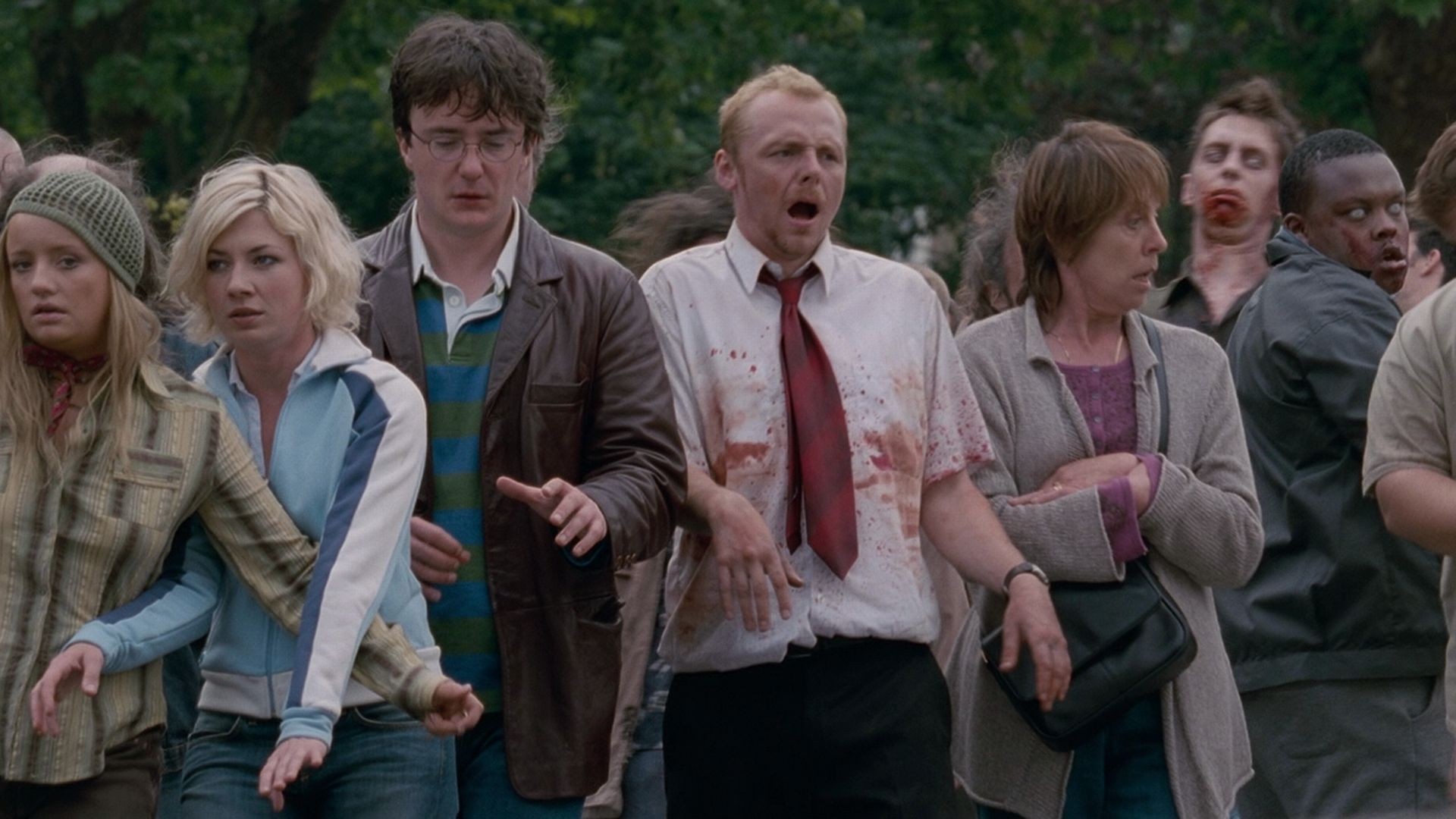
On the surface, Shaun of the Dead is simply a parody of zombie movies (which actually functions quite well as its own zombie movie). If you are a fan of the genre, you can tell that they've put a lot of time into it and that it comes from a great love of those classic George Romero zombie films. There are homages and references to other zombie flicks that aren't necessarily obvious unless you're familiar with those zombie movies and you're really paying attention!

All of the Edgar Wright movies are genre movies on the surface, but what sets his work apart is that they are so much more than just love letters or parodies or full of referential humor. They actually have legitimate substance: an actual, compelling story, realistic character relationships, development. Shaun of the Dead is no exception. The first of Wright's conceptual "Three Flavours Cornetto" trilogy, it tells the story of Shaun - a man going nowhere, stuck with his slacker best friend, ultimately avoiding "growing up." His unwillingness (or perhaps fear) of taking control of his life and "doing something" causes conflict with his flatmate Pete - a man who clearly has his life together. More importantly, it causes conflict with his girlfriend Liz, who does not want to feel stuck anymore, constantly spending nights drinking in the old pub with her boyfriend and his slacker best friend.

Shaun's life is nothing incredible. He appears to co-manage a small electronics store, working primarily with cocky teenagers who mock him constantly. He is at odds with his step father Phillip, who hounds him to remember his mother more. He is also something of a complete screw up, constantly making situations worse through his failure to follow through on promised actions.

This changes, of course, with the outbreak of a zombie plague. Suddenly, he and his best friend Ed find themselves as among the last remaining survivors in a world now overrun by zombies. Together, they come up with a plan to save Shaun's mom and Liz - his now ex-girlfriend - and hole up in the Winchester - the favorite bar of Ed and Shaun that had become a source of contention with Liz.

With this zombie apocalypse as the backdrop, Shaun attempts to take charge. He makes decisions with conviction and takes control of each situation that arises. Of course, his plan ultimately fails and everyone winds up getting killed except for Shaun and Liz. Just before they discover an escape route, Shaun breaks down and acknowledges what Liz and her friends, Phillip, and Pete all essentially told him before: he just can't get it together. Liz provides relief by saying that it's not that he came up with a plan and failed; it's that he tried something at all. Essentially, the difference between this screw up during the zombie apocalypse and all of those seemingly more minor screw ups during normal life is that here, he was trying 100%. He had no reservations; nothing holding him back.  Shaun's development has finally peaked and we see that he has grown up a bit and become a more responsible adult - ironically just in time to be eaten alive by the undead.


Like Hot Fuzz and The World's End, Shaun of the Dead is seemingly designed for re-watching. It exists on multiple levels. You can watch it a dozen times and peel back even more layers. Something Wright and Pegg love to do is play around with double meanings. Often, the first third of a movie is doing one thing. The final third is them doing the same thing again, but in a completely different way.

Take, for example, when Shaun leaves his apartment to run to the store. Immediately after passing the gate, a rogue soccer ball flies in and nearly hits him. Shaun looks at the kid and says, "Hey! You're dead!" It's a cliche threat, but if you've seen the movie before (or are just a really, really attentive movie watcher), you'll understand how accurate that line is. The next time we see the boy, he is a zombie. Or of course, during Pete's explosive speech toward Ed and Shaun. Referring to Ed, he says, "If he wants to live like a wild animal, he can go live in the shed!" And of course, that's exactly what happens. At the end of the movie, Shaun leaves to go to the shed where he keeps a shackled up, zombified Ed.

Then there's Ed's post breakup speech. "You know what we should do tomorrow," he says. "Keep drinkin'! We'll have a Bloody Mary in the morning, have a bite at the King's Head, a couple at the Little Princess, and stagger here to the Winchester for shots." This single line alone lays out the entire development of the movie. It's so obvious now that I can't believe it took me as many views as it did to notice it. Perhaps I was distracted by the relatively cheesy gag of Ed saying, "It's not the end of the world," just before a zombie knocks on the window of the bar.

The very next morning - completely oblivious of the zombie apocalypse - Ed is looking outside and notices a girl in the back yard. They go outside to investigate. Just before she attacks them, Shaun tries to ask her to leave. He notices her name tag says Mary (who you might recognize from the checkout woman in the opening titles). Of course, after she attacks them, they knock her over and she is impaled upon a piece of pipe. Another zombie shows up and the two pull out a shovel and cricket bat in order to bash their brains in - blood squirting everywhere. ("We'll have a Bloody Mary in the morning...")

On the phone with his mom right after, Shaun learns that Phillip has been bitten. They plan to go rescue her from him, but he hasn't quite turned when they get their. Phillip, of course, is Shaun's step dad with whom he has a rocky relationship with. Phillip has always been stern and strict with Shaun: always hounding him to do things, never giving him rewards or trust. In essence, Phillip is sort of like a tyrannical king in the eyes of Shaun. Although he was already bitten off camera, we do see him get bitten again as they try to leave. ("...have a bite at the King's Head.")

And of course, Shaun has to stop by Liz's flat to make sure that she's alright. After a close call, he climbs up the wall (something he tried and failed to do earlier), he finally gets in to rescue her. She is, essentially, his princess. He's come to rescue her (she even has a flat at the top of the apartment building - kind of like a damsel in distress sits in her tower). Her friends David and Dianne are there as well and ultimately decide to tag along. ("...a couple at the Little Princess...")


The final part took me forever to finally pick up as well (I actually didn't notice it initially until I started to talk about the Bloody Mary connection, then it all just clicked). When they finally get to the block the Winchester is on, the street is full of zombies (including an awesome, zombie Tyres from Spaced!). Their plan to get into the Winchester? Act like zombies! They quite literally stagger to the Winchester, only instead of being drunk, they are acting like zombies. Additionally, this is where they hold up. A regular joke throughout was the argument about whether or not the Winchester rifle hanging above the bar were real or not. Turns out that it is and they use it to take out a few zombies. (..."then we'll stagger to the Winchester for some shots.")

Just to touch upon something else: though Liz is essentially Shaun's princess, she is by no means a damsel in distress character throughout the movie. (Wright and Pegg write female characters better than perhaps anyone in Hollywood.) She ultimately makes the decision for her and her friends to go with Shaun. She is engaged in helping them succeed. She is supportive and constructive. And she is often more helpful in dealing with zombies than the other male characters! When Shaun pushed through a fence and attacked by a zombie, it's Liz and Dianne who rush in to help him. They don't even miss a beat. Meanwhile, David stands around watching while Ed just stands there texting. So even though in terms of the story, Liz functions a bit like a cliche "princess" character, she is by no means a damsel in distress nor a half character that only exists as a reward for Shaun. In fact, they only really get back together after working together. Shaun doesn't exactly do anything for Liz to function as a "reward" for his heroic behavior. Yet because the two of them work together, each pulling their individual weight, they both earn the return to relationship status.

Wright and Pegg are very meticulous, organized writers, rarely leaving anything as random. Upon review, I couldn't help but imagine that Shaun and the zombies essentially switch roles. At the beginning, Shaun appears to just be going through the motions of daily life. Even going to the pub with Ed - something they do for fun - seems like just the regular routine. The lack of ambition and enthusiasm for anything he is doing makes him seem like a metaphorical zombie. He only turns his life around after being attacked by literal zombies.

The references to other zombie classics will keep many viewers searching. There are many! They refuse to call them zombies in a reference to Danny Boyle's refusal to do so in 28 Days Later. (They also reference 28 Days Later with a news report at the end that has the anchor saying, "New reports of the virus originating in raged monkeys has been dismissed as bull..." before getting cut off.) There are references to Night of the Living Dead with the radio early in the film referring to a space probe returning to Earth prematurely. The anchorman who says to "remove the head or destroy the brain" is also a reference to the genre-sparking film.  Shaun's place of employ is even a reference to Evil Dead (Bruce Campbell's character works in a similar establishment). He even references that he is in charge today because, "Ash is out." (Ash of course is the name of Campbell's character.) There are a few others as well - in addition to some Star Wars references, a Clockwork Orange reference, and even some inside jokes for "Spaced" fans! ("Fried gold.")

The movie functions very well as a sort of "coming of age" story for mid to late 20 somethings who increasingly seem to be avoiding "growing up" these days. At the same time, it functions pretty well as a zombie movie. And at the same time as that, it functions very well as a comedy!

One of my favorite movies, this is just always going to be my Halloween tradition. This movie has honestly gotten better with every viewing I've ever had of it. I love films that are built on structure and exist on multiple levels. Few do a better job than Edgar Wright.

Reductive Rating: Amazing!
(Scale - Terrible..., Pretty Bad, It's Fine, Pretty Good, Amazing!)


Friday, September 2, 2016

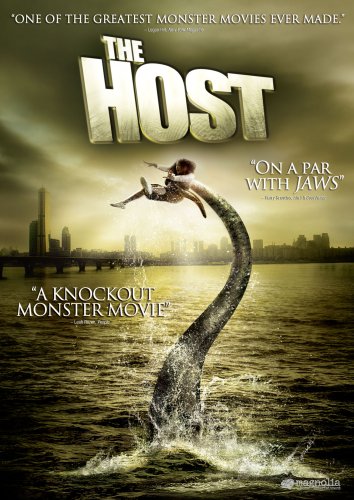
The Host (2006)


The Host is a South Korean monster movie centered around a dysfunctional family slowly, painfully coming together in trying to find their child, who was nabbed by the monster in its initial appearance in Korea. Kang-ho Song plays the slacker dad Park Gang-doo. With his bleach blonde hair and his saggy sweat pants, we get an immediate visual cue that this guy is not a very detail-oriented guy.

Breaking away from typical monster movie norms, director Joon-ho Bong (Mother, Memoirs of Murder - both of which are definitely worth checking out) quickly shows us exactly what we are dealing with. It takes all of 15 minutes before we get our first look at the monster as it attacks onlookers by the Han River. It looks something of a tadpole with giant forelegs, making it a fast and agile creature, often moving almost like an acrobat. At the end of its rampage, it grabs Hyun-seo and takes her with it as it returns to its den.

In the aftermath, people who were there are gathered in a gymnasium for a memorial service. The Park family is reunited in the tragedy of loss. Gang-doo's sister, the bronze medal archer Nam-joo, ignores her family as she walks straight up to the picture of Hyun-seo and breaks down into tears. His brother Nam-il, a former protester and hacker, shows up drunk, immediately blaming his idiot brother. As everyone around them sits in mourning, this family starts fighting, then trying to stop the fight, all while crying. It devolves from a sad, serious scene into an over-the-top comedic one. This perfectly exhibits the general tone of the film. It isn't light hearted, but it is funny. Conversely, it is poignant, but it's not too serious.

Gang-doo eventually gets a phone call from Hyun-seo. She is trapped in a sewer, but she's still alive. The Park family unites and escapes the hospital in order to search the sewers for Hyun-seo. All the while, the South Korean government is being regularly chastised by the Americans for failing to contain the virus and the creature and subsequently intervenes. They take over the hunt by authorizing the release of a chemical called Agent Yellow by the Han River to kill the monster. This sparks protest by angry Koreans who don't want any more chemicals dropped in their river. All plot points - from Nam-joo's archery to Nam-ils past as a rebellious college kid to Gang-doo's desperate rescue attempt for his daughter to the Korean/American stand off - converges at the end. The monster stuffs its mouth with Hyun-seo and another young child captured and heads off to the shore where protesters are butting heads with police as they move a device that will release the Agent Yellow.

The film is not anti-American, but it does have rather strong criticisms of the United States. It's easy to spot the sentiment here, where they make it seem as though the US is lying to get hands-on with a South Korean problem, but the movie isn't entirely anti-American. Indeed, during the first attack, they show a young American soldier on leave risking his life to help people being chased by the monster. It's almost to say that Americans are good people, but the government is shady and manipulative (something probably not that hard to argue, actually). In this way, it felt totally fair.

If you're not familiar with Kang-ho Song, you should check out his work. One of the most entertaining actors on Earth.

Though it breaks away from a lot of typical monster movie tropes and cliches (which is refreshing), it does hold on to one: the introduction scene being based on a real event. As unbelievable as that opening scene is (which features Scott Wilson as the crazy American scientist - Wilson probably best known at this point for his role as Hershel on The Walking Dead), it actually happened. There really was an American scientist who got annoyed that his chemical bottles had dust on them and thus dumped them in the Han River!  With an intro scene based on a real, controversial event and with its criticisms of American policy, it shares a bed with other classic monster movies like Ishiro Honda's masterpiece Gojira. But it does change up the formula in a lot of ways.

It has a unique charm to it, being both incredibly suspenseful and very funny. Most of the story involves this dysfunctional family coming together for a singular purpose. The Host is pretty much Little Miss Sunshine meets Jaws. It depicts a smaller scale version of the monster attack, certainly done better than the way they tried to do the "small scale view" with Cloverfield. This monster movie mixes the personal feel with the wider scope.

The movie is incredibly well acted, with each character making instantly likable characters who you root for the entire film. The character development flows perfectly as we watch Gang-doo slowly evolve into responsible adult and parent, but it took time. He was still screwing things up a long way - in one instance, his screw up costs a life. But he eventually does get his act together. Meanwhile, his brother Nam-il who constantly insults his brother for screwing up nearly blows everything by making a huge mistake himself. By the end, everyone is on equal footing.

In what is a rather surprising twist, they ultimately fail. They cannot save Hyun-seo in time. But Hyun-seo had been able to take care of and save another kid, Se-joo. In this sense, Hyun-seo was the only one who didn't screw things up. This was the final thing pushing Gang-doo into "growing up." Though he couldn't save his own daughter, he saw that she saved this other young boy. Gang-doo winds up adopting the boy and caring for him as his daughter did, and as he knows he should have always done for his daughter.

The final scene shows how far we've come as it we see Gang-doo looking out of the food shack, only this time, he is not the slacker screw-up he was during the opening shots. Instead of lazily watching out, looking bored, he has his rifle by his side and he is staring down at the river, ever vigilante should something else rise up to the shore. Gone is his bleach blonde hair and baggy sweat pants. For the first time, he is dressed like a real adult, and when we see him feed Se-joo, we know that now he finally is.

REDUCTIVE RATING: Amazing!
(Rating Scale - Terrible..., Pretty Bad, It's Fine, Pretty Good, Amazing!)


Thursday, August 25, 2016

Stranger Things (2016)


Netflix has a funny way of handling content sometimes. They'll make a hard push to promote things like Orange is the New Black, Daredevil, or House of Cards. Then they sneak in something like Lady Dynamite or, in this particular case, Stranger Things. For a show that got next to no real hype prior to dropping, the '80s nostalgia trip and Stephen King's Greatest Hits compilation almost immediately struck a chord with audiences, becoming one of the most talked about shows of the year.

In many respects, it's easy to compare Stranger Things to something like the original Star Wars. The creators were clearly influenced and inspired by many things that came before. Using that, they've essentially remixed many of those elements into something fresh. Though it maybe doesn't add too much new stuff to the table, Stranger Things largely succeeds by adequately bringing old things back. So many elements are either lifted from other works or are amalgamations of them, but they feel very fresh in modern times. It doesn't hurt that the Duffer brothers happen to have excellent tastes, subsequently taking from a wide array of films, television, and video games.

There's a lot one can talk about when breaking it down. Following a group of young, nerdy boys as they search for their missing friend, they stumble upon something incredible and terrifying. What makes Stranger Things feel even more refreshing is that they have practically abandoned the "mystery box" formula popularized by J.J. Abrams. There is a mystery in Hawkins, Indiana, and while not everything is spelled out for the viewers, we are not wholly ignorant to the goings-on. We watch D&D group Mike, Dustin, and Lucas search for Will. They don't know what happened to him. We the viewers, however, saw him get attacked by a monster, and get clues from another plot thread that tell us he is alive. Similarly, police chief Jim Hopper investigates unusual circumstances that we know the government is involved in.

It strikes a happy medium between unknown mystery and allowing us to watch how the characters deal with it. The trouble with shows like Lost is that the "what comes next?" and "what's going on?" questions often supersede the characters. It would have been easy for the show runners to hook people by revealing very little, ending each episode with enigmatic cliffhangers. Instead, they make sure to give viewers just enough that the driving factor for coming back to the show is concern or love for the characters.

(As an aside, a friend of mine pointed out that keeping the viewers more informed than the characters actually functions to relate those watching to the character of Will. Trapped in the parallel dimension known as the Upside Down, Will knows what is going on with this horrifying creature, but he is almost powerless to do anything about it. Occasionally, he can flick some lights, but other than that, he can't do much. It's an interesting take, and one that I find worth bringing up.)


Though references and influences of The Goonies and E.T. are pretty obvious (Episode 1 starts and finishes with nearly identical shots from E.T., for example), the show isn't just one of those kids-on-their-own adventure films. You've also got Chief Hopper trying to solve this unique mystery. It's sort of an X-Files, Twin Peaks, Jaws type of story. Plus, you've got Will's mother Joyce (the very enjoyable Winona Ryder) in this "Is she right or insane?" type of tale, fulfilling a Richard Dreyfus/Close Encounters of the Third Kind role. Then there's Nancy, Jonathan, and Steve who are essentially in an '80s rom-com at the start.

So much of the show excels when all these differing stories and genres start to converge onto a single point. At just eight episodes, it moves quickly. There isn't much time to dillydally, and these plots all begin to meet at almost exactly the middle. Being well paced dramatically impacts the effectiveness of the mystery, rewarding viewers in such a timely fashion so as to never feel like we're being reeled in by creators who would reveal that they used a lure instead of real bait.

Not everything is perfect, of course. While the internet appears to have a love affair with Barb, she's ultimately not much of a character worth noting in terms of the narrative. Her brief arc is tiny, slightly disappointing, and even highlights that sometimes the writing is a tad distracted - occasionally unsure of how much time to dedicate to each area of the story. The conclusion also has some anti-climactic moments that felt like they could have either used more of a build up or more clarity. The series starts off with the boys playing a Dungeons & Dragons campaign that spells out what is going to happen in the series (a structural tactic I always enjoy - see every Edgar Wright movie). The finale sees them finishing the campaign, with each friend objecting to its end with a series of questions related to the show's plot. Their questions about the campaign, and its lack of satisfying answers, all connect to the viewer's questions about the conclusion of the season. This is one of my favorite techniques in media. However, I'm not quite sure the fantasy aspect of the Dungeons & Dragons game ultimately connects that well with the sci-fi/horror elements that dominated the show. It's a neat way to spell everything out, but it doesn't quite connect as well as other aspects of the show, and feels a tad bit like a way to build their "nerd cred" by showing that they know something about D&D.

The acting is top notch for a show reliant on young child actors. Each one really stood out, right at home with all of your favorite kid-centric movies. The teens are also surprisingly believable characters for an '80s era set. There's been some strange criticism of Ryder, but frankly, she nails the understandably distraught and disheveled mother with the Dreyfus-esque "might be losing her mind" trope. Even David Harbour excels at the nuance of Chief Hopper, a character who starts off seeming like he's going to be unlikable, but winds up the most interesting part of the show.

Of course, no discussion of Stranger Things can be considered complete without mentioning the original score as well.  Composers Kyle Dixon and Michael Stein nail the '80s nostalgia, John Carpenter-inspired soundtrack. It's arguably more perfectly recreated than Disasterpeace's amazing soundtrack for It Follows, itself a throwback to Carpenter films.

Even if you're not a big fan of the '80s, or don't care about all of the references, Easter eggs, and nods to all those things thirty-somethings cling to out of an often misguided sense of unwarranted nostalgia, Stranger Things is still great. It's incredibly well structured, intelligently written, excellently paced, and one of the more visually intriguing shows to grace the Netflix platform.

Although, can we please agree to stop talking about its title fonts? Really, it's not that interesting...

REDUCTIVE RATING:  Amazing!
(Rating Scale - Terrible..., Pretty Bad, It's Fine, Pretty Good, Amazing!)


Tuesday, August 23, 2016

Xenogears (1998)


Xenogears is an old school JRPG from the PS1 days that often makes its way onto people's lists of best or most underrated RGPs of all-time. On some level, it makes sense. It's got a unique, interesting combat system split into different types, has beautiful sprites for a generation of games in which graphics haven't exactly aged well, dabbled in 3D landscapes for every area besides the world map, and has a pretty awesome score. Its story also is one of the more intricate, complicated, and confusing in any game you can find from the period.

Yet it is also a game that could be used as a shining example of what not to do in a game today. (Full disclosure: I did not complete the replay. I beat it once about a decade ago, but I remember so very little from it. I've been playing for months and have recently had to give up for various reasons. I made it 50+ hours in and got about half way through the second disc before quitting. Personally, I don't see how finishing the game could possibly alter my review, but if you're someone who feels an entire review is completely invalid if the author doesn't complete the game, then you might as well not bother reading on.)

Originally slated to be a Final Fantasy installment, Xenogears incorporates some of the classic Squaresoft elements that made its flagship franchise so popular. An epic - if completely confounding story - with distinct characters, a new combat system, and a sprawling world map filled with history and lore, the game does a lot of things well.

Most notably is the combat. It scraps the ATB system found in most JRPGs of the time, opting for a strictly turn-based system. Menus are a little strange to navigate through at first - depicted in a sort of wheel-like manner in the upper corner - but instead of your traditional options of "fight, item, magic, et cetera," players pummel enemies through series of combos. Each character has X amount of points to expend for a turn, and the player may choose to distribute them however they'd like. If the character has 5 points, it could be divvied up into three attacks (2 weak attacks at 1 point apiece, and 1 strong attack at 3 points), or two attacks (1 medium attack at 2 points, 1 strong attack at 3 points). Or, if desired, five attacks (all 5 attacks being weak attacks worth 1 point).

It's an interesting and fun system. Basically, think of the entire character-driven fighting system as Sabin specialty moves from Final Fantasy VI. As you progress, the party members learn "Deathblows" as well - combinations of attack sets that unleash special moves. Players might also choose to pocket some spare AP each turn, saving up to unleash huge "Combo" chains, though this tactic does take some time to make worthwhile.


Additionally, the game created a second style of combat with Gears. Large mech suits that each character rides and fights in, Gear battles function somewhat similarly, yet also have different dynamics entirely. Each Gear requires fuel to perform any action at all. Fuel plays a bit like a mixture of AP and EP from character battles, only it's much easier to find yourself out of in the middle of a fight. Indeed, relying on fuel is a big reason why Gear battles are often the toughest in the entire game. There's more to be conscientious of. Plus, for about a third of the game, you cannot heal gears. Doing so requires a special item sold later in the game. As a result, when you take damage, your Gear can't get that health back during the fight. This is especially problematic in areas where you have to marathon bosses.

While an interesting idea, that fact makes the Gear battles feel slightly unfair. It doesn't help either that many boss fights are at the end of long, drawn out story scenes that cannot be skipped. This puts a lot of pressure on each fight, and it's extraordinarily frustrating to find yourself losing to such bosses. The argument that putting save points at a distance from bosses to make the game more difficult only holds water if there is a stretch of the level the player must complete again if they die. Here, it's annoying because the only thing you must repeat is an unskippable story sequence.

Late in the game, one of the more annoying elements is how the fuel cost of many attacks keeps increasing, but recharging does not. For example, some moves will scale up its fuel consumption cost as you level up and improve the Gears. Yet "Charge" - a move that lets you gain fuel - never yields more than 30 units. By the time you're on Disc 2, 30 fuel is nothing, and it's even easier to run out of fuel.

In fact, the hyper-focus on narrative is often detrimental to the game. Many will mention that the problem is especially noticeable on Disc 2. By that point, it is clear that the team developing the game ran out of time and resources, hastily slapping the final disc together. The narrative style changes drastically, often relying on a character in a chair straight up explaining the bits of story that they didn't have time to include in the game otherwise. Yet the slog of story problems begins well before the end of the first disc. If they had been able to include everything they wanted in disc 2 in a natural way, the game would have taken well over 100 hours to complete.


That in and of itself isn't a huge problem. However, the issue with Xenogears' story is that it isn't paced very well, and it's reliant on incredibly cryptic story elements that take forever to understand or get explained. The pay offs are almost never worth it, and many character elements are contrived in ways that extend beyond the norm for JRPGs of that era. It doesn't help that some sequences can last up to twenty minutes, followed by no save point, merge right into a boss fight, and oh yeah, you can't skip anything. (This was a problem it's spiritual successor, Xenosaga, fixed by allowing players to skip cutscenes.)

The end result is a game that often feels like a slog. It drags as you trudge through it. It's almost shades of Final Fantasy XIII too in the sense that there is surprisingly little for you to do at any point in the game, besides go wherever it wants you to go next. Exploration is substantially less of a role in Xenogears as it is in any Squaresoft Final Fantasy. The world map is nice and big, but doesn't offer any room for worthwhile sidequests or towns to look around in. This very linear design kind of conflicts with the idea of rendering all environments in 3D, which was obviously meant to make the game feel more open. It does not, in fact, feel remotely open.

The 3D maps, by the way, are interesting, but not executed super well. Certain dungeons will require a quasi-platforming element, with players needing to make jumps to a platform or landing based off of clunky and awkward camera angles. Plus, the running and jumping mechanics aren't tight enough for these elements to ever be anything other than frustrating.

Going into the replay, all I could really remember was that I thought I liked it when I played it a while ago. Perhaps it is truly good for the time it came out in, but I'm inclined to think that calling it underrated is inherently overrating it. It's not a terrible game without any merit, but it fails in a lot of ways.

REDUCTIVE RATING: It's Fine
(Rating scale: It's Terrible..., Pretty Bad, It's Fine, Pretty Good, Amazing!)

(I'm inclined to rate it "Pretty Bad," since I spent months on the game and it felt like such a slog, and eventually some glitches made me finally give up. But I think it does have enough positive attributes in the gameplay department. I think fans of the genre might take something away.)


Friday, August 5, 2016

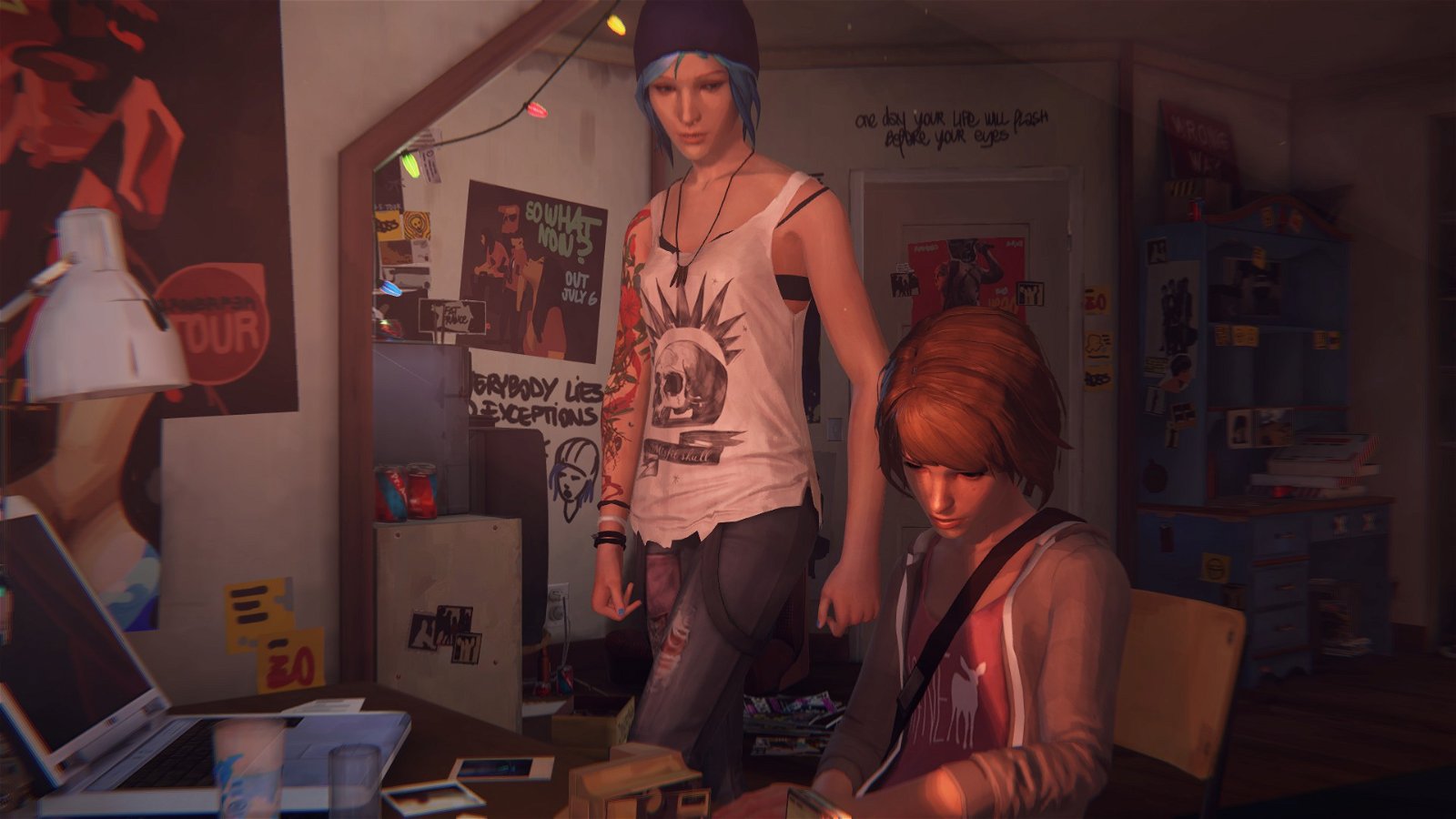
Life Is Strange (2015)

NOTE: SPOILERS - Seriously, do yourself a favor and play it first. Then come back and read this analysis.


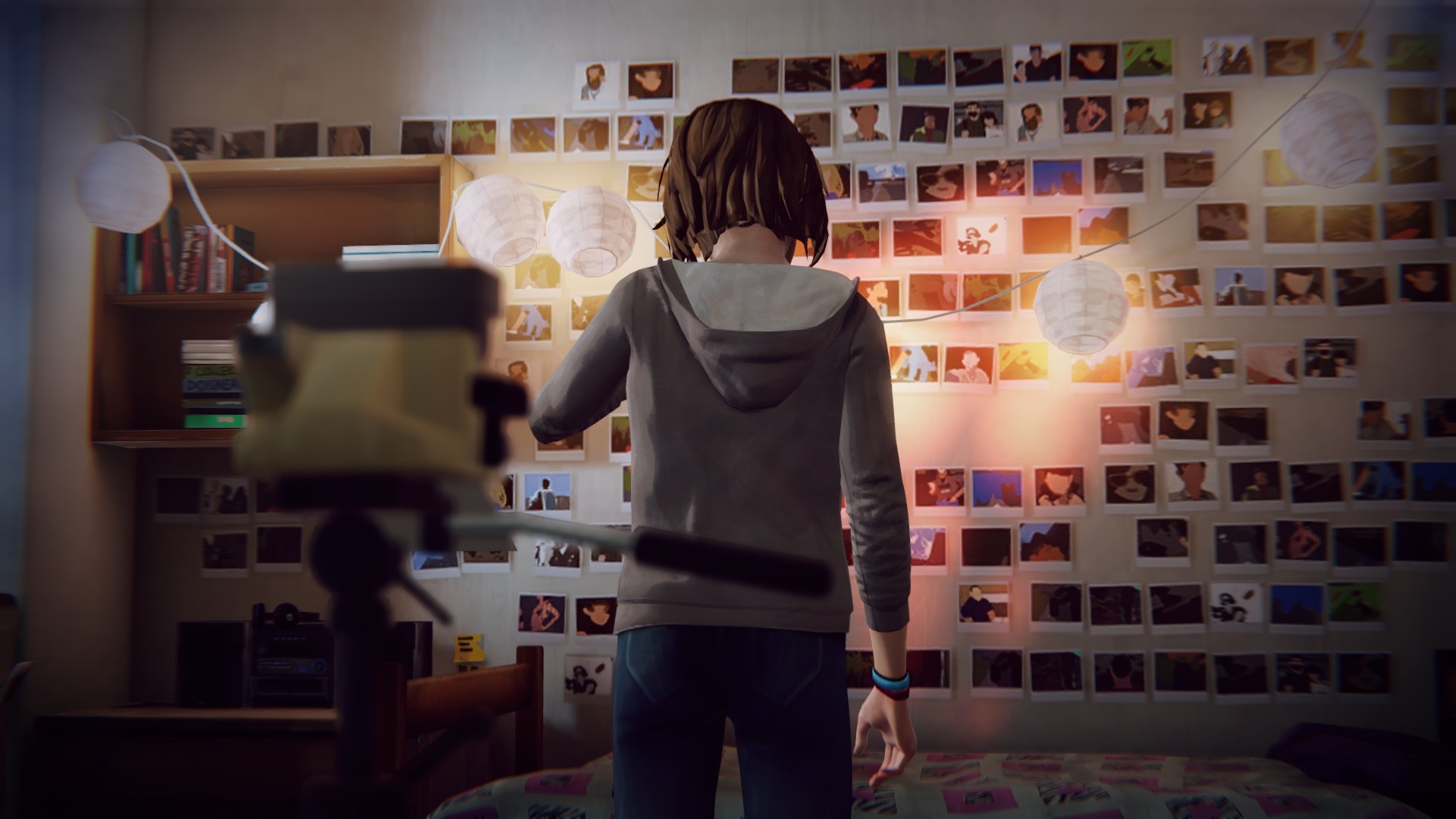
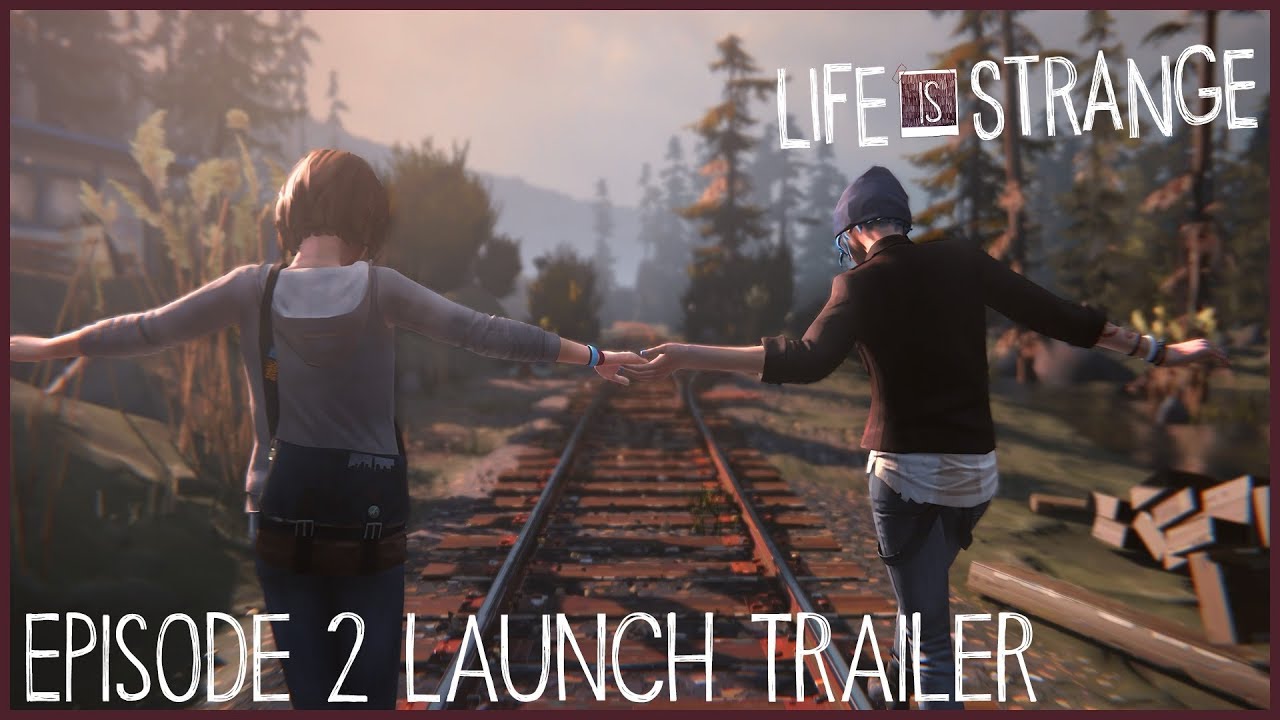
A choice-driven, episodic game in the same vein as all of Telltale's properties, Life is Strange follows the freakish time-manipulating adventures of Max Caulfield at a prestigious art school in the Pacific Northwest. In essence, it is part Twin Peaks, part "Twilight Zone," and part The Catcher in the Rye. References to all works are scattered throughout (from the location to the last name of the main character). When the story starts getting especially strange and crazy, it might betray the grounded, relatable nature of the first episode, but is not unexpected as a result.

The story itself delves deep into issues that many people - especially younger folks - deal with. They deftly maneuver to include issues of bullying, suicide, and drug use while tackling themes of lost innocence, coming of age, and dealing with regret.

The long and short of the game is that it's one of the better choice-based games with the added twist of an interesting and well executed time rewind power. It's extremely touching, focused on two young women rekindling an old friendship in the aftermath of what could have been a horrible tragedy. It offers some cringe-worthy dialogue at times (sometimes comes off as "what older people think younger people sound like"), but it also features some of the most tense and difficult decisions ever asked of a player. Episode 4 is the pinnacle of the game, featuring arguably the most challenging choice I've ever had to confront personally, plus one of the better, more organic, and satisfying puzzles to solve. It does kind of fall apart at the end a bit, and its timeline of events could have used a little more ironing out, but it's still an incredible entry into the choice-based gaming.

Instead of doing a breakdown of the game overall, it might make more sense to tackle some of the bigger themes, and in particular why I might be one of the few who actively liked the final choice presented at the end. I was struck upon replay with how much it seemed to encourage players to dig into the meaning of things that it would make for a more interesting post to break down some of that, rather than a straight-forward review of it as a game. So indulge me as I do a deeper dive into some of that stuff.


One of the complaints people had at the end was that there aren't any reasons given for why Max developed the powers. By the conclusion, we are left without answers to those questions. Certainly, it's easy to understand why some would not be thrilled by that prospect. However, the game was never so much about the power itself. It was always about the characters and what Max did with it. There never needed to be an explanation as to why she got the powers.

Yet one thing that could have used further explanation is why her powers created the tornado seen in her apocalyptic vision of Arcadia Bay's destruction. Throughout the game, they loosely connect Max's time manipulation powers to things like the Butterfly Effect or Chaos Theory. Essentially, we as players are meant to understand that Max manipulating time is also manipulating reality and causing all of these unusual events: an unscheduled eclipse, snow during the summer, and a bunch of beached whales and dead birds everywhere. Max's power is also clearly behind the impending tornado. While they do a relatively solid job connecting that idea for the players, they don't exactly produce any super compelling evidence for the characters to buy into within the game. Max and Chloe both seem sold on the idea that that is the truth, but there isn't really much evidence for them to believe it whole-heartedly. Confounding it more is that the sequence of events is not that Max uses her power, then has premonitions of the twister. In fact, she has the vision first. Then she learns she can manipulate time. If they had just sorted that out properly, more people likely would have bought into the idea that the characters know it's cause and effect.

Of course, the biggest controversy of the game is its conclusion. When all is said and done, players are left with one binary choice: sacrifice Arcadia Bay or sacrifice Chloe. First off, I'd like to point out the beauty of phrasing here. The final choice isn't who you want to save. It's who you feel you must sacrifice. The game is by no means presenting Max as a hero at this point, and it aims at the harsher side of decision-making. Sometimes, you have a choice to make that just sucks either way. By phrasing it as "sacrifice" instead of "save," it forces you to confront the fact that it is a choice, and even if you find it a rather easy decision to make, there is an alternative. You don't have to let Chloe die again.

Some have argued that such a choice renders the rest of the game irrelevant. This is essentially the Mass Effect 3 argument, but it's not quite accurate. See, Mass Effect 3's concluding choice feels crappy because it feels oversimplified and disregards the point of the game. With Life is Strange, the finale serves the primary theme of the game. It's a video game take on the philosophical "trolley problem." More to the point, it marks the conclusion of Max's development either way.


So much of the game is about loss of innocence and dealing with regret. Max is an aspiring photographer, in which she constantly wants to snap images that "capture a moment in time." She's constantly stuck looking at the past, often at the cost of the present and future. The trauma endured when witnessing her childhood friend Chloe getting shot and killed in the bathroom is compounded by the guilt she feels from having lost touch with her. This was her best friend as a kid, and they had grown apart. Everything after that moment is simply Max trying to get more time with Chloe, to avoid that feeling of guilt and regret. All of the time manipulation is designed to retain that innocence of the past. She doesn't want to grow up and deal with serious problems of the adult world. So, she treats her time rewind power like she does her camera - just a way to re-live a moment in time.

The phantom doe is a bit of a strange creative decision that gets no real explanation and has sparked much debate among fans. Many felt betrayed by it just disappearing without reasons, as some argued it was the connection between Max and the missing Rachel Amber.  However, it could be argued that the spirit doe didn't represent Rachel, nor did it even represent Max herself. It represented the innocence of childhood - something fading rapidly, but still Max pursued. She's seen chasing the doe several times, but it only disappears completely once they find the truth about Rachel. Max's innocence is completely gone when she's forced to confront the horrible reality of a supremely serious situation. At the same time, it was her pursuit of that innocence - spending all that time with Chloe, trying to mend that friendship - that brought them to that point. Chasing the doe drove her to the point where she could no longer go back to those happier days.

Some of this is also displayed in Max's outfits. In the first three episodes, she is always wearing a shirt that depicts a deer or doe in some fashion. Does typically represent innocent creatures, baby deer that are cute and harmless. At that point, Max is still chasing the past. She is trying to fix her old friendship with Chloe while still a bit ignorant of the more sinister plot of Rachel Amber's disappearance.

After the events of Episode 3, Max cannot escape her feelings of guilt anymore. She no longer wears a shirt featuring a doe. Instead, she dawns a black shirt featuring a rugged looking butterfly that appears to include a skull. It's substantially darker, depicting the loss of innocence completely. She knows she can't ever go back to those more pure times, and she's now fully wrapped up in the dark and horrifying events of a serial kidnapper.

Max's chase for innocence lines up well with Mr. Jefferson's scheme as well. A famed photographer, Mark Jefferson has made a name for himself by obsessing over one thing: capturing the moment where innocence is lost. That is why he works at a school and pursues teenagers. They're just on the cusp of adulthood and having no choice but to abandon notions of returning to the happier times of childhood. He's surrounded by people losing innocence and gaining more cynicism and darkness. While Max tries to hunt down those fleeting moments of past pleasantries, Jefferson hunts her down to capture the moment where she loses it.


All of this creates a cohesion of specifics and themes. Max being into photography serves her main arc of learning to come of age and become more of an adult. Pictures are capturing moments in time. This hobby is not just some pretentious art for her to randomly be interested in. It fits her character's development and the primary theme of learning to get out of the past and live in the present, ideally in a way that prevents regret.

Similarly, Jefferson's obsession with photographing the moment when "light turns to dark" or innocence is lost fits the theme as well. He is trying to capture Max in the moment she is trying to avoid, pitting them as natural thematic enemies. In a sense, Jefferson is the darkness to Max's light. The two are opposite sides of the same coin. This is represented through their actual photography. Jefferson tries to capture dark, tortured images while Max has a tendency of snapping photos of more positive, cheerful things.


The idea that the final choice renders the entire game pointless is not entirely fair, nor accurate. It's worth keeping in mind that everything that happens prior to that moment - including all of the alternate timelines and rewound scenarios - all happened for Max. Whether you choose to go back to the beginning and let Chloe die or to move forward and screw over the town, Max will remember virtually everything that happened. She will have to live with further guilt either way, and live with the fact that she did possess the ability to change things. Letting Arcadia Bay get destroyed does not render everything you did meaningless, but it would indicate a level of selfishness that she wouldn't have otherwise developed into.

Indeed, the entire point of the game is really about Max dealing with the guilt of failing to keep in touch with a dear friend, and wishing she had more time. All of the interactions with other characters, whether it was Victoria or Warren or Kate, all serve to show character development. The whole thing is told from Max's perspective, complete with her inner dialogue, explaining her feelings and opinions. She is not a stand-in for you, the player, even though you get a choice in how she develops. It should be clear, then, that no matter what you choose at the end, Max will continue about her life knowing all of those things did happen. And she will have to carry additional burdens as well.


At times, I have been accused of making great stretches to create a pretentious justification for the flaws of the final choice. Certainly, binary decisions are rarely amazing, and indeed the timeline of events is flawed in a way detrimental to the specific plot. However, replaying the game in a week - start to finish with no breaks as we did when it was being released - I'm more convinced than ever that I am not making wide leaps in my explanations here. This is not to suggest that I believe my interpretations are "correct." There have been many theories and commentaries about what certain things mean, all of them every bit as valid as I believe mine to be. Great art is something that will impact people differently. Great stories will allow different consumers to take different things from them. Maybe the doe doesn't represent that sense of innocence to other people, but it absolutely seemed that way to me.

So, despite some noticeable flaws and missteps here and there, it's hard for me to call the game anything other than great. It's one of the better point-and-click style of choice-driven games. It handles choices in vastly better and more interesting ways than Telltale has in any of there games, to be frank. I love that the game had me reading into things, challenging me more. More importantly, I adored that it presented some decisions that actually made me reconsider my positions on real life issues. And, admittedly, it's one of the only games that ever made me tear up (which it did both times, even when I knew what was coming).

Life Is Strange is one of the more powerful entries in narrative gaming, and it's one of the better examples of just how much empathy and emotion interactive media can generate.

Reductive Rating: Incredible!
(Rating Scale: It's Terrible..., Pretty Bad, It's Fine, Pretty Good, Incredible!)


Saturday, July 16, 2016

Ghostbusters (2016)


COMPLETELY UNNECESSARY PREFACE (Feel free to skip down for the review itself):

It's hard to even begin to talk about Ghostbusters without mentioning all of the nonsense involved in the build up. From legitimately sexist dudes annoyed that women would be predominantly involved in a property they love, to fanboys honestly just upset that their favorite paranormal eliminators would not be involved (yet still angrily making public announcements that they refuse to see it), to people arguing that the problem is less with an all-women cast and more with "reboot culture," it was next to impossible to get away from all of the outrage and negativity. Was any of that pessimism and pissed off attitude justified? Perhaps a better question: did anyone of those people actually see it, and actually give it a truly fair shot?

Before getting into it, I should set up how I approached the film. I mean, I shouldn't have to, or even feel like I have to, but the internet is just the worst and all the bologna surrounding the film suddenly has everyone having to explain their Ghostbusters background in order to have their opinion seem valid. So, here is mine:

I went into the movie reservedly optimistic. The trailer looked horrible, but I am one of those weird movie-goers who doesn't put much value in trailers or posters. I am a fan of Paul Feig and that entire cast. While Sony has given me plenty of reasons to be skeptical, there was just too much creative talent involved here for me to think it was going to be awful. (Spoiler: it isn't - not even close to being the worst movie of the year, never mind the last five.) I was concerned about how cartoon-like everything seemed, and how generic of a Hollywood summer blockbuster it appeared.

I'm also a die-hard fan of the original. I grew up drinking Ecto Cooler, watching "The Real Ghostbusters," and ran around the house with a plastic, blue proton pack on my back, busting ghosts around my room. I'm even a huge fan of Ghostbusters II, and a few of those (legitimately terrible) video games. The 1984 Ghostbusters is one of my all-time favorite films, and I could talk at length about why it's a genuinely incredible piece of film making that will always stand the test of time, despite some of its dated references and visuals.

However, I also never cared about the canon. The idea of rebooting the "franchise" never bothered me in the slightest. The draw to the original film, for me, is that it is an incredibly amazing piece of cinema. Given the nature of Hollywood, it never bothered me that they might continue with Ghostbusters as a franchise. It was, after all, a profitable franchise. They made another movie, three cartoon shows, a bunch of video games (including a quasi-sequel to the film), many comics, and tons of toys. It's almost more unreasonable to think that they would just leave the series alone. Even more, it doesn't bother me that they called this new film Ghostbusters. That has been a common complaint for some reason, but to me, it literally doesn't matter. Partly, it is because it takes half a second to clarify which one you mean when you talk about one of them. Partly, it's because I am primarily a Godzilla nerd above all else, so I've already lived a life with three separate films (of various quality) just called Godzilla, and it has really not been inconvenient at all.

Basically, I went in as a huge fan of Ghostbusters, it being a big part of my childhood, not caring much about any of this reboot stuff, turned off by several things from the trailer, but optimistic about the creative talent behind it. I watched figuring it would be fine, and hoping to enjoy it - although admittedly concerned I would hate it.


SO HERE IS THE REVEW OF THIS FILM, FREE FROM OUTSIDE NOISE (Relatively):

If it's hard to talk about it at all without mentioning the online outrage preceding it, it's also hard to talk about it without the inevitable comparing and contrasting to the original. In many ways, it's unfair since the new Ghostbusters is fundamentally different in almost every way imaginable. At the same time, it is another installment in the franchise, so some comparisons are justified - and indeed required to address some of the problems.

As a fan, I'm admittedly not sure what exactly I wanted in another live action film. The previews made it seem particularly cartoon-ish, which was a bit concerning. However, the application of that style was surprisingly effective and well done. They succeeded at creating a singular, cohesive look and tone to the film that contributed greatly to why it works as a piece of entertainment. Indeed, the characters are very cartoon-ish. So are most of the sets and environments. So are the bright, neon ghosts. So is the story, really. From the very start, you are meant to stop taking anything seriously.  Had just one or two of those elements been like a cartoon, it wouldn't have worked. Yet they do a great job keeping it all consistent.

The cast is great, with two stand outs in particular. Chris Hemsworth as the hunky, stupid receptionist makes the most of his opportunity to break his type-casting. Though the "he's so stupid!" joke gets hammered a bit too hard at times and lasts a tad too long, Hemsworth himself is a delight to watch at work. He's genuinely hilarious, and hopefully has more comedies in his future. The other stand out is Kate McKinnon. Her character is an all-over-the-place type of crazy, which some people certainly may find a bit too much, but McKinnon simply nails it. Watching her reminded me a lot of watching Rick Moranis in the original -  so good that I was looking at every subtle gesture, or tonal inflection, or facial expression.

The rest of the cast also shines, of course. Kristen Wiig doesn't do too much outside what we have seen from her in the past, but it's still funny. Melissa McCarthy got to enjoy some time outside the unfortunate trap of being cast frequently as the "female Chris Farley," which is nice to see. She plays one of the more grounded characters, which is refreshing. And Leslie Jones does a great job balancing an exaggerated "everyman" with the total history nerd. From the trailers, there was a lot made of the fact that the black character isn't a scientist. Additionally, they made it seem like her knowledge was of "the streets." All that feeding a perpetuated stereotyping of black characters and continuing to limit roles available to black actors. Yet in the end, that concern is - however justified from the trailers alone - without much ground. Her character, Patty, is a historian, spouting information and knowledge that one would usually describe as "book smart." While she doesn't quite fulfill the same important role that Ernie Hudson did in the original, Jones actually does balance "book" and "street" smarts really well.

The humor can be a bit all over the place. It isn't as slapstick-focused as the previews made it appear, but there are a lot of styles of comedy that come into play. There's the classic, bumbling awkwardness not uncommon for Wiig. There's referential humor popular today as well. As one might have expected, there's a lot of stupid humor too (some of it really good, including amazing lines like, "An aquarium is a submarine for fish.") The humor is not often the same kind of smart, subtle humor from the original, but there is some intelligence in there too. Not all of the jokes land or worked for me, but enough of them did that I laughed or chuckled plenty of times.

By the end, it kind of devolves into your typical action sequence, which was also one of my concerns going in. Yet the team, the new gadgets, and the ways that they had the "fight," was actually kind of visually interesting and fun. In fact, for me, a lot of it reminded me of how I used to play when I was a kid! I imagined doing some of those very same things! This new film certainly adds a number of moves for kids to pretend to do. All of the nerdy, "science" mumbo-jumbo was also entertaining and fun to my nostalgic brain. Dan Aykroyd endorsed the film, and one can see why. There's a lot of that made-up science talk that Aykroyd loved doing in the originals. It's super nerdy and the most effective "out of love" references to the source material.

So, yes, I found it really enjoyable, with a lot of elements working effectively and the cast very delightful.


However, it's hard to argue that it's a particularly great film. Unfortunately, this is where I have to refer to the original - just because it highlights what I mean.

Most of the problems with the new film lies within its structure. A big reason why the original still stands as an amazing classic is that it was highly unconventional. Think about it: when was the last time you saw a Hollywood summer blockbuster that didn't have character arcs, didn't have a traditional villain character scattered throughout, and didn't require the heroes to learn a lesson in order to overcome the obstacles? There wasn't anything like that coming from Hollywood before Ghostbusters, and there hasn't been anything like it since!

Which makes it a bit disappointing, then, that this Ghostbusters lacks anything structurally to stand apart from any of the other typical, "world threatened by armies of ghosts/robots/aliens descending from a portal in the sky" blockbusters. It's not completely different, of course. The character arcs are there, but only Wiig's is blatant and in your face about it. Similarly, there is no "lesson" they learn in order to defeat the villain and save the day. They go in - like Ray, Egon, Peter, and Winston - with confidence in their tools and talent, and they win. But there is still some meaningful life lesson about commitment and loyalty that plays into the conclusion.

There are also a few dangling plot points or threads that feel like they're supposed to go somewhere, but don't. For example, Patty is a historian of the city. At the end, the city is overrun by ghosts from different New York City eras. Kind of seemed like that would be a great time to have her historian characteristic pay off in a meaningful way, but they just don't bring it up at all. Similarly, the villain being the opposite side of the same Ghostbusters coin should have been explored, well, at all. They don't go into it, leaving a lackluster conflict further adding to the inadequate build up for the finale.  Even that gargoyle ghost seen in the trailers doesn't really get an actual conclusion.

About that villain... I would not be able to genuinely review Ghostbusters without bringing him up, given this is a constant complaint of mine towards Marvel movies (which I love, by the way). Corny, under-explored villains that exist simply to provide an obstacle don't typically make for a great film. It hasn't helped Marvel, and it hasn't helped Sony here either. A villain like Rowan adds little to the film, despite there being grounds for thematic connections to the heroes. The lack of substance here similarly hurt Ghostbusters just as it has practically every Marvel movie.

They also do that think that Jurassic World did in that it sometimes tries a little too hard to provide fan service and references to the original. Many will likely moan about how forced many cameos from original cast members seems, but I don't know that that's even the biggest problem. Actually, I mostly enjoyed those moments overall. However, there were a few moments of playing on dialogue from the original, or taking visual cues (like the ghost in the museum is meant to be a play on the librarian). Some of the references are clever, but a lot of them come off as clunky and contrived.

In some respects, it's interesting to watch the original and then watch the new Ghostbusters, just to see how different Hollywood film making has become. The new film is quite enjoyable, funny, and entertaining, but it feels very paint-by-the-numbers in structure, and almost goes a bit too far to trap itself into the "comedy" genre. The original film was more complex and layered, with unconventional structure and more subtle humor. Both films are very much character-driven, though. It will likely come down to whether you're on board with them or not. I found the new characters to be great, even if slightly less endearing than the original characters (although McKinnon's brand of crazy was amazing to me). Certainly, some might not feel that way about them, and that will make it impossible to like the movie overall.


All that said, it's almost hard to figure out who they made the film for. It's Ghostbusters, so one would imagine they are hoping to get a lot of fans from the original, yet it's completely different in almost every way possible that it if you loved the original, you might very well hate the new one. In some ways, it seems like they tried to make it for everyone else, who has no strong connections to the source. And in some ways, that might actually be the smartest way to completely reboot a franchise. Make something completely different and try and build a new fan base! Contrary to what some nerds might say, the original Ghostbusters isn't going anywhere. We'll always have that. Maybe now, someone else will have a version that they love and obsess over too.

REDUCTIVE RATING:  It's Fine
(Scale: It's Terrible..., Pretty Bad, It's Fine, Pretty Good, Incredible!)


RE: THE FEMINIST TONES

Ok, so I wasn't sure whether to cover this aspect or not, but since word is making rounds on the internet (go figure), I will add thoughts on this. A number of dudes online have made plenty of comments about how Ghostbusters is sexist against men, because every single male character is depicted as being stupid, incompetent, or just a complete asshole. It's actually not a hard trend to notice while watching the film, but these comments are a bit hilarious. For starters, a lot of these are coming from the same people who complained about making the film with all female Ghostbusters.  It's also coming from a lot of people who complain whenever someone criticizes a film they like for the way it represents women.

That's sort of the point, though. While the new film doesn't have the layers and depth of the original, it does have some moments of meta-commentary. Apart from the obvious jokes wherein they read comments about a video they posted online (notably, "No bitches be busting ghosts" which got a good laugh in the theater I was in), there are many more moments that are from a distinctly female perspective. When Erin (Wiig) is trying to obtain tenure at Columbia University, her president (Charles Dance) makes a passing comment about her clothes, but decides to "forget it" before exiting. This confounds and confuses Erin. This is pretty clearly a moment coming from a female perspective. Women have to contend with comments upon their appearance for almost everything. It doesn't just pertain to women in the public spotlight, like actresses or athletes. People, especially men, will more often than not make some unnecessary comment about a woman's attractiveness, even in the work place.

Later at the mayor's office, the four women are being told that they appreciate their efforts in fighting the paranormal. They thank the women for their work, but then tell them to stop. "That's enough," basically. Given the other moments of feminist undertones or meta-commentary, mixed with the male representation in the film, this felt especially applicable to modern times. Most people - including men who complained about all women Ghostbusters - probably agree that "feminism had its place." Most would agree that feminism "made sense" back in the days when women were not really allowed to work or hold office or even vote. But there are many people who feel like the feminist movement should have ended by now; that there is no longer a need for them. Basically, "that's enough."

And, of course, Chris Hemsworth's Kevin ("he seems more like a Chet,") is a literal, walking embodiment of male privilege.

As for the way men are presented in the film: that's kind of the point. The film exists in this sort of meta-commentary about the status of the movie industry. That all of the men are presented poorly serves to draw attention to the way that any group - by gender, race, sexuality, age - are generally presented in cinema. Granted, this is just my interpretation build upon the other moments throughout the film, but I gathered we were supposed to notice how the men were presented as a means to draw attention to the conversation regarding how anyone is presented. It's a problem that so many people have called the film "sexist against men," but then willfully shoot down any criticism about male-oriented films for the way they present women. In fact, those of us who do wind up getting chastised for "making a big deal" about gender representation. I've been told repeatedly that I'm being unreasonable when I was criticizing studios for never giving women a chance to do much other than be a damsel in distress or a love interest for the male hero to be rewarded with.

That's, in my opinion, the entire point of that aspect of the film. And ya know what? It's fine either way. For every one Ghostbusters film that focuses on female characters only and depicts men as less than ideal, actual characters or people, you can find a dozen or more films that focus on primarily male characters in which female side characters are depicted as less than ideal, actual characters or people.

It's ok to not like the way men are presented in the film, but it's not ok to then turn a blind eye on how women are presented in most Hollywood films.