Tuesday, January 5, 2016

LIST-O-MANIA: The Best of 2015

Another year is in the books. Like always, there was no shortage of complete garbage (Fantastic Four), but there were also a lot of great stuff! I didn't get a chance to play too many games released this year - $40-$60 for a new/new-ish game is a bit much right now, but I did get to play some stuff. For that category, I'm keeping it to five entries. I also don't watch too much television, so we'll keep that list to five as well. Movies are easy though. Cheap by comparison of video games, and much less time consuming than television, we'll expand that category to ten. Plus, we'll mention some of the stuff that makes 2016 look promising!

TOP 5 VIDEO GAMES


 5. Volume

Mike Bithell makes great games by embracing simplicity. Thomas Was Alone was a beautiful game, and certainly one of the more mentioned of the indie sweetheart games. It's success is largely from the way it used simple gameplay in a compelling fashion. His follow up, Volume, follows a similar trend. It's more complex, but his stealth-game that is a futuristic retelling of Robin Hood is really easy to pick up. Each level is a time-based challenge, so you won't get stuck on difficult sections for too long. This allows players to get through it how they wish. More of a casual gamer who wants to get through the story? It's a bit challenging at times, but you won't get overly frustrated. More of a hardcore gamer who wants to get the high score or get under par each time? That will take up a fair amount of time. Volume is another great game that is beautifully simplistic. 


4. Rocket League

One of the most genuinely fun games in a long time, Rocket League succeeds by creating the simplest premise combining two things: soccer and racing. How do you describe the game? Well, it's soccer, but the players are rocket cars. It's fast and chaotic, but pure fun. They've recently added mutators to the game as well, only enhancing the mayhem. It takes a while to get really good at it, but even at the "beginner" level, it's hard not to enjoy yourself.


3. Her Story 

My big take away from Her Story is that I would be the worst detective in the world. Her Story is a neat and unique little game wherein there's surprisingly little gameplay. No, it's not another one of those "walking simulators." Instead, the game is a big puzzle that wants you to put it together yourself and never tells you if you're totally right or way off base. Basically, you're watching a giant library of old video clips of a woman being interviewed by a detective. The questions are edited out, so all you get are her responses. It's your job as the player to piece together this person's story. The only real input you have as a player is to input keywords as you search the database. You type in keywords and video clips with that word will show up. It's actually a bit trickier than it sounds, as there are a lot of videos. There might not be that much replay value in the game, but few games have provided as awesome an initial experience as Her Story, and the way you feel as you start unwinding this story.


2. Life Is Strange

Episodic games have become a lot more popular and common in the aftermath of Telltale's The Walking Dead success. Dontnod Entertainment tried their hand at it with Life Is Strange. What sets this game apart is how it begins by being really grounded and innocent, then progressively gets darker and darker. By the end, it's almost entirely unrecognizable. At its core, it's very similar to those Telltale games. You control Max around the environment, looking at and interacting with items. Max learns she can manipulate time, which adds a little about to the "walk-and-look" gameplay. Most puzzles involve watching events unfold, rewinding time, and figuring out the proper way to change what's coming. Though the finale is a little weak overall, the rest of it is so nice and emotional. It's the characters that sell it (and maybe the awesome indie soundtrack). And, ya know, the feelings!


1. Undertale

Undertale is the latest indie sweetheart game, but with good reason. It's funny that the retro look of gaming has made for itself a tidy little corner of the market! This RPG takes a lot of its cues from Super Nintendo-era gaming, most often drawing comparisons to Earthbound. It's not hard to see why. While the gameplay might be a little weird - it's largely either timing-based attacks or a Asteroid-like mini-game to avoid attacks while figuring out how to "spare" enemies - everything else is nearly perfect. The characters are great and realized incredibly well. The writing is nearly perfect. And it's just a lot of fun. What's interesting about the game is that you can go through killing everything (like you normally would), you can go through and not kill a single enemy (which requires certain actions during battle), or some combination of the two. It might not be the best game for people who don't like to get stuck on challenging bosses, or who get frustrated easily, but if you don't mind needing a few tries to get through an enemy, it's definitely worth checking out.


TOP 6 SHOWS


6. Last Week Tonight With John Oliver

The student has become the master as John Oliver took over his own political comedy after his stint on The Daily Show. As the genre expands, there's one that stands above the rest. It might not be the institution of Jon Stewart's show, but John Oliver has crafted one of the most legitimately informative and enraging (in the right ways) comedy show on television. Sure, it's a little unfair to compare Last Week Tonight with The Daily Show or The Nightly Show. Being weekly means that Oliver and his crew can dig deeper into a single subject. Yet it's that ability to do so that makes it the best. Even more is all the stuff they've done outside of the show in service of it, like starting a legally recognized church or putting up billboards around the world.


5. Daredevil

No, it's not a perfect show. The dialogue is sometimes clunky and some of the relationships seem rather contrived. And let's not bring up how bad the Daredevil suit at the end looked! Or that the finale was a bit rushed and disappointing. Still, what made Daredevil so captivating was it's dark, crime noir story and arguably Marvel's best on-screen villain to date. Wilson Fisk was compelling in his layers and complexity. Daredevil stands out from all the other Marvel movies and shows by immediately going dark. The violence can get pretty brutal at times. This is not your Joss Whedon Avengers style of Marvel stuff. It works by remaining true to the character while telling an intriguing story, all while working in some key mystical elements of Daredevil's lore.


4. The Last Man On Earth

Phil Lord and Christopher Miller have been making a name for themselves. Even if you don't recognize them, you're probably familiar with their work. The LEGO Movie and 21 Jump Street have both been widely loved, and they're both really funny. Teaming up with Will Forte again (see Clone High), they've created one of the weirder comedies on a mainstream network. Focused on a group of survivors in a world where a plague has seemingly killed all other life, it's a strange placement for a comedy. Yet it works, largely due to Forte's comedic acting chops, as well as Kristen Schaal's perfect performance as well.


3. Jessica Jones

While Daredevil may have been a more accurate comic book adaptation, Jessica Jones was probably the better overall show. The way everything connected and was in service of the greater themes and concepts adds a layer that its Marvel Netflix predecessor lacked. It also didn't hurt that it had slightly better dialogue and character writing, but overall, it's that it's more than just a comic book show that gives it a slight edge.


2. Master of None

Probably the least likely show you would expect out of Aziz Ansari, Master of None is just really, really good. It's funny and touching and poignant at all the right moments. It's a bit weird seeing Ansari play an actually realistic and relatable character, dealing with a lot of the same generational problems we all are, and keeping it in context with and acknowledging other people's issues and histories. It's just a really well balanced show.


1. Unbreakable Kimmy Schmidt

The strange thing about comedies is that it's hard to explain to someone who might not have the same sense of humor as you why it's so funny. Kimmy Scmhidt is the funniest and most charming shows in a long, long time. Ellie Kemper's smile is contagious, and it's awesome to get a show that makes it a point to retain a sense of wonder and optimism at a time when cynicism and brooding characters are making a strong comeback (seriously, it's getting dangerously similar to the '90s lately...) It's a winning combination of cheesy jokes with nerdy referential humor, all anchored by a brilliant performance from Kemper. This is honestly just a show I can always go back to and watch at any point and still be entertained by. I've watched it so many times this year, and rewatching it the other day, I still found jokes I laugh out loud to.


Honorable Mentions:  I also just wanted to take a moment to throw out a few honorable mentions to shows that didn't premiere in 2015, but had what I felt to be strong seasons. Most notably, I really though Community recovered well for its final season earlier in the year. It hit a rocky patch in the aftermath of NBC's firing of Dan Harmon and then going from NBC to Hulu to Yahoo, but it did regain a lot of the charm and heart of the early seasons in time for its finale.

Also wanted to give credit to Parks & Recreation for crafting one of the weirder series finale seasons in a while. The futuristic sci-fi elements of the finale, mixed with very modern political issues made it such a joy to watch. For a show that struggled a bit in the beginning, it ended on such a high note.

And finally, Orange is the New Black continues to impress. Season three was really, really good, and has further cemented it as one of the top shows being made.


TOP 10 MOVIES


10. It Follows

Yes, at the end of the day, It Follows is kind of a dumb movie. It's not the scariest, and the psychological terror only goes so far. It's message - if it has one - is muddled and confusing, and its resolution is sudden and almost annoyingly vague. Yet the style and tone of the film makes it such a good watch. It has its thrills, and it's brilliant in the way that it channels its inner '80s John Carpenter. Plus, that Disasterpeace soundtrack.


9. Ant-Man

The general consensus with Ant-Man is that it's pretty ok. Fun, but nothing incredible. Certainly, it's not hard to imagine how much better it would have been if Marvel had been able to retain Edgar Wright. Still, what we got was a return to "Phase I" style of Marvel movies at a time when "Phase II" was in full effect. The return to a smaller scope and a more personal impact, I found, greatly refreshing.


8. Kingsman: The Secret Service

Based on a lesser known Mark Millar comic of the same name, Kingsman: The Secret Service is a stylized, violent, and fun twist on James Bond. Following a mythical group of British spies, Colin Firth gets to try his hand as a quasi-action star, and he kills it. It's just a good, fun action movie. Matthew Vaughn continues to impress with his comic book adaptations. Even Kick-Ass - based on the hugely overrated Mark Millar comic - was good!


7.  A Girl Walks Home Alone At Night

This movie isn't going to be for everyone. Not because it's "scary" (it's not) or "violent" (it's not) or "gory" (it's not), but because it's so stylized and slow. It feels a lot more like a Western than a horror or drama. In fact, a whole lot of nothing actually even happens. There's not much dialogue, and there are a lot of scenes of characters just sort of silently watching each other. But that's why it's such a cool movie. It conveys so much through so little action or dialogue, and it's just visually an awesome movie.


6. The Martian

A good Ridley Scott movie? I know that sounds unbelievable, but it's true! Scott has finally made a solid, fun, entertaining movie that's a blast to watch. Matt Damon turns in one of his best performances as an astronaut stranded alone on Mars. He's largely acting against himself, with no one else sharing the screen with him for the overwhelming majority of the film. It's also refreshing to see a movie that functions as a love letter to science, rather than simply treating it as a silly plot device that can be just randomly made up and altered whenever convenient (a la Gravity).


5. The Overnight

Jason Schwartzman and Adam Scott, and their (prosthetic) dongs. That's pretty much what you're in for with this weird, awesome, hilarious film that's one of the best "adults trying to grow up."  On the surface, it might appear to be just an indie Hangover knock off, but it's so much more than that, and so much better. Just watch it. Trust me.


4. Kumiko, The Treasure Hunter

This one might be a tougher sell, since I haven't found anyone who liked it nearly as much as I did. They sell you on the idea that it's "based on a true story," but it's really just based on an urban legend. There's a tale in Minnesota of a Japanese woman who was searching for the treasure buried in Fargo - the fictional treasure in a fictional movie. Kumiko, The Treasure Hunter puts a human face on this legend. Pretty much what drives this movie is the performance of Rinko Kikuchi, who is just a complete joy to watch. If the film is more of a character study, then you need a great actor to pull it off. Kikuchi straight up kills it here. It's one of my favorite movies in a while, but take that with a grain of salt, since - like The Secret Life of Walter Mitty before it - it might just be one of those films that hits me in just the right spot that it won't hit anyone else.


3.  What We Do In The Shadows

Two vampire movies on my top ten list! Weird. What We Do In the Shadows is a hilarious fake documentary comedy centered on a house full of vampires as they make their way through the world around them, especially when they have to show the ropes to a new vampire that they accidentally turned themselves. Few movies made me crack up as frequently and as hard as this one.


2. Inside Out

Pixar continues their domination over American-made animation, this time providing one of the most interesting and touching films of their entire repertoire. It was probably always going to be a more emotional tale given it is literally centered around a young girl's emotions, embodied by some great voice actors. The way Joy and Sadness work together makes for some of the most compelling character action of the entire year, and the way it impacts young Riley has it one of the most emotional films in a long time. It's hard to pick a favorite Pixar film, but I thought it was their best to date.


1. Mad Max: Fury Road

Look, I really, really wanted to find a movie I liked more this year than Mad Max: Fury Road. I tried so hard to pick something over it, just because it's been the one to get all the hype and accolades. So many have put it as their favorite film of the year. At the end of the day, there was just nothing else that even came close. Of all the films I'd seen this year, Mad Max is the only one I specifically went to see several times in theater. It's a high octane blast - just loads of fun - with two great characters in Furiosa and Max. George Miller weirdly advances cinema by going back to more practical-driven effects. Make no mistake; there's a lot of CGI in the film too, but it's all used to enhance the practical effects. Even more, Miller manages to make something new while hitting some of the same beats as some of the other Mad Max films. A lot of the film is derivative of itself, but in a way less blatantly than, say, Star Wars: The Force Awakens. I still watch this movie and still can't believe it. It's also one of the few Hollywood blockbusters that doesn't sacrifice substantial story for mindless action. Sure, the story is not the most deep thing ever, but it's not a softball story either. As much as I wanted to avoid doing what everyone else is doing, at the end of the day, there's a reason it's widely being considered the top movie of the year.


So, those are my lists. What's at the top of yours?


Monday, January 4, 2016

The Last of Us: The Outskirts Part 2: Tess/Run


Things are supposed to be looking up. We've made it through the unstable building, survived the clickers in the subway, and fended off a rushing horde of infected. We're past the danger posed by the infected now, and we are supposed to feel a bit like we're out of the woods. This is also reinforced by the arrival of daylight, something we tend to associate with safety in these types of stories. Even more, our target destination is just a few blocks away. We're pretty much there.

Of course, not everything is great. Tess, who we know can handle herself, is starting to act a little strange. She's no longer engaged in much of the conversation, instead mostly issuing orders and keeping everyone focused. At the same time, she's a bit panicky. When Ellie asks what they'll do if they get there and the Fireflies are all dead, Tess gets almost confrontational while saying everything will be fine. "It has to be," she mutters under her breath. Though everything around us suggests we're good, there are these kinds of subtle hints to tell us we're wrong.

Just before we get to the capital building, we see a bombed out street that is flooded. We must cross it. It's easy-peasy, of course. Nothing special about it, really. What's interesting is that they choose to use this moment to introduce the idea that Ellie can't swim. Normally in games, they introduce a new concept when it is relevant to the gameplay. Here, they introduce something that will come up a bunch of times throughout the game, but it doesn't matter here. It seems like such a small thing, but this helps reduce the "gamey" feel of the game. I know, I know. That sounds really strange and dumb. However, so much of The Last of Us is successful because of how immersive it is. It's these kinds of seemingly minor decisions that increase that feeling. It would feel a bit "gamey" if Ellie stated that she can't swim, and then immediately the player has to find a palette for her to jump on so we can cross a body of water. And sure, we have to do that in a little bit, but that delay between when you have to do something "gamey" and when the concept is introduce as a character trait through the narrative helps keep us fully immersed.


Of course, here we get our first big emotional moment in this new world. Turns out, Tess has been acting strangely because she was bitten and infected. This is her last stop, as she calls it. It's not as emotional a moment as Sarah's death in the prologue, but it's still a powerful scene with great writing. More importantly though, there is great acting and animating here. Those are critical in the way the scene plays out.

The acting and animation have to work in tandem here, otherwise the scene wouldn't work. Everyone's body language is key. Joel is angry, almost pissed off that Tess is going to be leaving him. Tess is, understandably, flustered knowing she's about to die. She's also desperate to have her death mean something - in this case, getting the immune Ellie to the Fireflies so there may someday be a cure. Ellie, meanwhile, is smart and observant, but she stands there tensed up. What is extremely clear in this scene (if it weren't already) is that these actors are on a set and acting physically. A lot of video games will have animators work on the character motions with the actors just lending their voices to the scene. Here, all actors are present on a set. They're in mo-cap suits. And they're doing more traditional style of acting. That decision goes a long way in this game.

Joel seems angry at Tess, as if he's offended that she could "let this happen." When he says that this is not "us," Tess finally snaps. "What do you know about us? About me?" It's a great little moment where you realize that Joel's relationship with Tess might very well be similar to the player's. It's easy to like Tess, and she's a solid ally in these early stages, but we don't ultimately know that much about her. This is probably how Joel sees her too. She's easy enough to like and get along with, but really, she's been a survivor. Joel may have been drawn to her simply because she's been around and lasted. We know he likes to keep his distance. There's some ambiguity in their relationship presented here. On the one hand, Tess says that there surely is enough between them for her request to mean something, for Joel to feel some sort of obligation to her. At the same time, it's tough to tell just how close and open these two really were with each other, and how much of the relationship may have been built on the foundation that they're good at surviving.

Now, I'm admittedly not sure how the military knew they were at the state house. It's one of those plot contrivances for the sake of drama and action. It sort of doesn't make much sense, really. No one ever argued the game was perfect. Nothing ever is. The nice thing it does, though, is allow Tess - someone we've probably come to really like - to go out on her terms as best as possible. She's always been strong and determined from what we've seen of her, so refusing to turn into a mindless zombie creature is within her character. It also helps us deal with it a bit better. She tells Joel to "just fucking go" in order to make it easier for her, but letting her go out to delay the military so we can escape makes it a little easier for us too.


Of course, the military fires a hilarious number of rounds just to take out one person. We're now left with the remainder. It's the first time we will spend in an enclosed space with armed enemies. It can be a bit tricky, as a result, especially since the map here can be a little confusing to navigate with it's many rooms, open spaces, and enemy and cover distribution. As we go, Ellie seems pretty disturbed by everything. Makes sense. She's young and new to this stuff. Joel basically yells at her for getting too emotional, pretty much the basis for their relationship in the first half of the game.

The Tess moment is one of the few occasions in which we immediately follow an emotional beat with a lot of action. Typically, they let you catch your breath, or sit on what you just witnessed for a bit. After Sarah's death, for example, we flash forward twenty years and then just walk around for a bit. Here, we're forced to deal with a few segments of armed soldiers.  The second part of the state house is surprisingly difficult to sneak through. It's one of the great maps where you have to be really careful and aware of your surroundings. Every room has several open doors, and they all sort of face each other meaning guards will almost always have the ability to spot you if you aren't cautious.

After escaping the state house, you find yourself again in the subway. There are spores everywhere, prompting Joel to put on his mask, but Ellie doesn't have to. If we players weren't convinced yet, like Joel, now we know for certain that she absolutely is immune. No faking here. (They don't do anything to really make us as players skeptical of her claim, so this more proves to Joel than anyone.) Visibility tends to be a bit weird here. With the poor lighting and spores, it's kind of hard to see. That's pretty rad level design, to be honest. In small portions, that idea is great! What can be a bit frustrating though is that you can't really take advantage of that, as the enemies seem to have no problem whatsoever seeing you across the spore-filled room.

Either way, it's not tough. There are just two guards and even if they spot you, it's pretty easy to take them out. We then continue down the subway, poor lights, spores, and all. It's a really creepy atmosphere and one of my favorite mini-sections of the game. The first time you play it, you can't know there are no infected here, but they sure make it seem like there must be clickers somewhere! After all, we were just in the subway an hour earlier and it was crawling with them! We've also come to associate spores with infected. Most players probably make their way through this section on their toes and staying alert. We've avoided the military now, but we're not in the quarantine zone anymore. This is infected territory!

In actuality, there's nothing here. There are no enemies after those first two soldiers. It's basically one big psych out. What does come back is the fact that Ellie can't swim. Now we have to deal with that, as a chunk of the subway is flooded pretty badly. This is our introduction to palettes and ferrying Ellie from Place A to Place B. Like the whole plank thing, this is a rather weak attempt at introducing "puzzle elements" to the game. It's not really very puzzling, first off. Nor is it at all a challenge in any way. It's more just occasionally time consuming and choppy. Planks and ferrying are probably the weakest parts of gameplay and level design in the game, but they also only come up every once in a while. It's not a super common thing.


As an aside, you can find a corpse with a note about meeting a smuggler. Apparently, this person was supposed to meet a man named Frank to trade supplies with, but Frank never showed up. This comes up later, actually. These little things are really interesting and appealing about the game.

We conclude the section back at daylight. The soldiers are gone, and we get one more cutscene to highlight what a grump Joel is (although, understandably so). He seems really annoyed to be involved in this at all - which is how he felt from the get-go - but we also understand that he will keep his word to Tess. She was right that there was enough between them for Joel to feel an obligation to her. Ellie is pretty much the more traditional heroic character in the game, so she tries to offer her condolences about Tess. Joel shuts her up and tells her to keep their histories to themselves.

This is the moment where Joel is really in charge. Up to this point, Tess had been leading, or Tommy before that. Now, Joel is finally taking point in the game. And he's a lot more stern and cold. Now that Tess isn't there to provide some relatively normal human interactions, Joel will pretty much do whatever he can to keep his distance.


Thursday, December 31, 2015

Valiant Hearts: The Great War (2014)


As the name implies, Valiant Hearts: The Great War focuses on four characters during World War I. On the surface, it looks like an all-ages game, and certainly it is to an extent. Part adventure game, it's got a beautiful, cartoon-like art style and features characters mumbling in their respective languages. Part educational game, it also makes sure to provide you with historical facts spread out the story. About to be taken into the Battle of Verdun? Here's a little blurb you can read that's just a few sentences explaining it. It's informative and engaging in a way that makes it both safe for younger players and profound for older or more mature ones.

Despite its art style and lean-back gameplay, it manages to tell one of the most compelling, hopeful, and depressing stories of any war game. There is none of the false bravado found in Battlefield or Call of Duty, nor do you truly see much in the way of specific violence. One of the most interesting things you pick up on in this game is how none of your characters ever seem to hold a gun. In those rare instances you do, it's either stuck to your back or you hit people with the butt of it. You don't kill anyone for the majority of the game. 

It's hard to explain fully how a cartoon-looking, non-lethal puzzle game with a penchant for having the characters get out of rough situations perfectly depict war as gruesome and bleak. Yet Valiant Hearts does. Breaking away from typical war game tropes, you don't start as a soldier. You aren't dropped into the middle of the war as someone who has enlisted. Instead, you are brought into the every day life of a farming family. More poignantly, you start off as someone who has been drafted. It highlights the toll war can have on families, but it's a fundamentally different starting point than most war games to start as someone who doesn't want to go to war.

For the longest time, the game avoids the dark and disgusting nature of the war.  Each character manages to get out of whatever sticky situation they find themselves in. At face value, it appears relatively safe. However, we eventually do see a bunch of characters get mercilessly gunned down as they try to cross the trench, or get blown up by falling mortar shells, of friends die. Death is a very real threat in the game, even if at times it feels like something that just happens to other people.

That is, until the very end. As the story progresses, we learn more and more about the inefficient ways the war was conducted. Military and political leaders looked at soldiers as mere numbers, and often tried to defeat the enemy by throwing more at them. They threw these citizens into the most terrifying and vicious conditions with little aid and expected victory. By the end, it seems likely that soldiers would start to mutiny. And indeed they do.  The final mission places one character in the deadliest battle of the entire war, in which a foolish charge keeps going and going. Plus, you're constantly dodging machine gun fire and mortars.

This level is brilliant, and designed to be metaphor itself. After a few minutes, you start to realize that you've been been charging for a pretty long time. Almost too long. As you see people around you get slaughtered, you start to wonder when this charge will end. It feels like it never will, and that whatever is at the end can't be worth it. Then you realize, that's exactly what the soldiers must think too. What was the point of charging through No Man's Land? To what end where they doing so? Every time they took a few meters of land, the enemy would simply take it back. The only thing keeping you as a player charging forward is the French commander behind you, ready to shoot you should you refuse to obey orders.

After hours and hours of the game appearing to play it safe - careful to show the despair without itself becoming overwhelmingly depressing - they flip the script. First, they show a character saving a family at the last possible second, with an achievement unlocking called "Some Will Survive."  Another character even finally receives another letter from her father. Things seem oddly hopeful, until one character is sentenced to death for disobeying orders and accidentally kill his commanding officer.

As he is marched to the firing squad, he passes his fellow soldiers. All of them salute him, recognizing that he did what all of them wanted to do. In his letter to his daughter, he says, "War makes men mad."  He is describing the men who started the war and tore their families and nations apart. He's describing the men who forced soldiers to perform suicidal charges for little to no gain. And he's describing the situation he is in. War makes men mad. They create these horrible and unreasonable situations, and it's other men that pay the price. 

It's such a profound statement - albeit nothing unusual. It is nonetheless powerful and sad. It's strange that the game spent so much time avoiding tragedy that it ends on such a tragic note, but when it comes to World War I, there was never going to be any other result, really. In many ways, Valiant Hearts plays out like one of those classic poems from the War.


It's an incredible game with interesting and fun puzzles. It also features one of the better uses of a dog ally in any game. The art is beautiful and the music is so sad and heartfelt. So few things recall the events of the first World War. No one seems to give it much thought. It's only fitting that this game reminds us that we are dangerously close to completely forgetting one of the most tragic events in human history, never mind of the last century. 

Fun, educational, poignant, emotional, and beautiful, it's truly a great little game.


Tuesday, December 29, 2015

Comics for the Non-Comic Reader

This year for Christmas, I found myself in a bit of a pickle. I didn't exactly have a lot of money to spend on gifts, and I'm not gifted artistically or creatively. Making stuff wasn't an option. I needed an idea that was cheap, but also thoughtful. What do I know a good amount about, in which I could sort of "curate" the gift collection? Well, video games, obviously, but that's not a good idea for many reasons. Ah! Comics! I've read a lot of comics over the years, and a lot of different kinds of them too! I'm pretty sure I can find comics that people who don't care about comics might enjoy!

I recognize that the medium isn't for everyone. It can be a little weird trying to read them if you're not used to it. Pausing after dialogue to look at the pictures can feel a bit tedious and unusual. Still, it's something that is easily accessible. It functions just like a book. You don't need a special console or computer to access it. And if people don't like them, then can just donate them to the library or something. These books don't spoil!

So, here are all the comics that I selected for this surprisingly challenging and time consuming idea. (It actually was pretty challenging and required a lot more work than I thought. Some of these I had read, but a good number of them were books I was familiar with but hadn't read yet in their entirety. That meant I had to read a lot of books in a really short period of time. Not necessarily difficult, but when you factor in trying to recognize who might like what, it becomes so. A lot of my original plan changed because some books seemed better suited for other people, and some books I thought would be good turned out to be a lot different than I remembered, and had to be scrubbed.) For the sake of nonsensical titles, here are Comic Books for Non-Comic Readers!


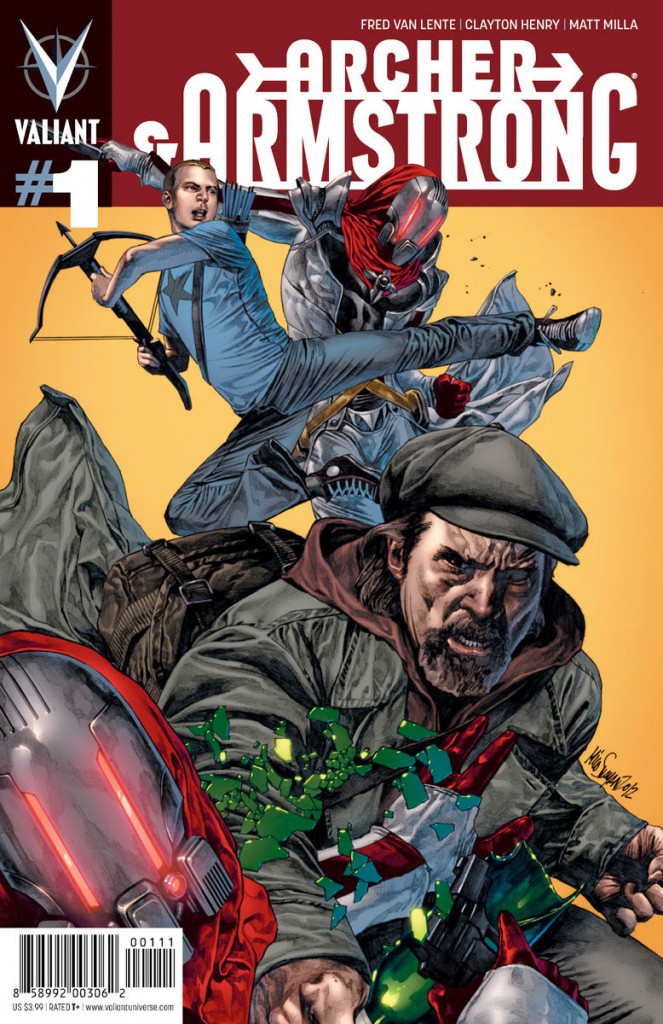
ARCHER & ARMSTRONG - Valiant   (2013)
Fred Van Lente (writer)  &  Clayton Henry (artist) 
For: Someone with a good amount of comic experience


I got this book for my friend who is super easy to shop for because, really, all I have to do is find something that I like. There were a number of book ideas that floated around, but ultimately, it just made sense to recommend Archer & Armstrong. It's just so much fun.

Fred Van Lente had a pretty great run on a few Marvel titles back in the day, and this book is sort of the pinnacle of that fun and humorous style. Here, he has a fat, drunk, invincible, Hercules-type character who was present when a mythical device was being used by his brother. He wanted to stop his brother from using the device, but all sorts of things went wacky and the trio of siblings wound up becoming immortal. Now, a variety of groups are hunting down the pieces to this machine with hopes of controlling and shaping the world to their liking.

The best part though is Archer. Archer grew up one of many, many children in this hyper Christian cult that is hellbent on finding said device. They train several of their most promising children in countless styles of martial arts (some real, some not so real). Archer is the top of the class and is sent on a mission to kill Armstrong, not realizing he is immortal.

End result is basically a funny Odd Couple scenario with a drunk immortal and a hyper Christian martial artist. I don't know that I can really sell that any better than that.  It's just so much fun. One of my personal favorites.


PAGE BY PAIGE - Amulet   (2011)
Laura Lee Gulledge (writer/artist)
For: Someone with presumably none to just a little comic experience


I had heard a bit about this book, but had never managed to get my hands on it until now. From what I had heard of it, it sounded like it might be a good fit for my brother's fiancee, who I know only a little about. She's one of those mystery people whose tastes I don't know and struggled to think of a good book option off the top of my head.

Page By Paige happened to be just a perfect book. It's so sweet and touching and personal. It feels somewhat autobiographical, but if it's not, it's one of the most grounded comic I've read in a while. It hits really close to home. The story follows Paige Turner (her parents are writers) as she tries to get through life when her family up and moves from Virginia to New York City. Paige is an artist, but she's also an introvert. She struggles to meet people and make friends.

The overarching story is about Paige figuring out certain "rules" to live by to improve life. A lot of it focuses on her doing specifically what she's afraid of doing in an attempt to open up to others. She starts off a pretty introverted and insecure person who won't show anyone her sketches, and by the end, she's shown her notebook to everyone, including her mother with whom she has a somewhat cold relationship. The book is broken down into chapters that tackle each of the rules.

The art is great, and varies depending on a number of things. Writer and artist Laura Lee Gulledge does a great job matching the pages to the feeling. When she's happy and upbeat, the art can get whimsical. When she's feeling insecure, it gets darker and crazier to highlight her insecurities. Honestly? I loved this book so much that it was hard not to just get it for everyone on my Christmas list.


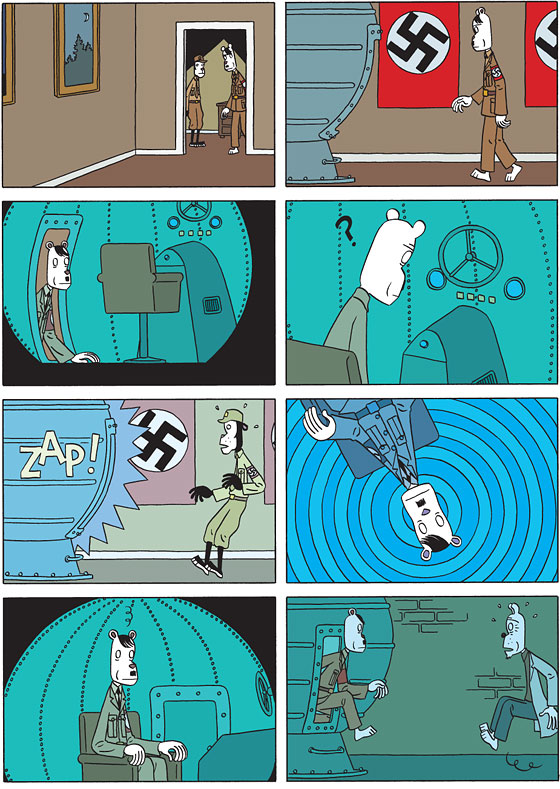
I KILLED ADOLF HITLER - Fantagraphics   (2008)
Jason (writer/artist)
For: Someone with a good amount of comic experience


This book is really quirky, and its humor is pretty subtle, but it's funny and sad at the same time. The art can be a little tough to follow given that everyone is drawn the same way. It looks pretty cartoony. But it ultimately isn't that hard, as everyone wears different clothing.

The story takes place in a world where assassination is a totally legit business. In about a three or four page span, the protagonist is walking around and just witnessing assassination after assassination after assassination. It's pretty amusing. One day, he is hired to take a time machine to go back and assassinate Adolf Hitler. Things don't go exactly as planned and he gets stuck in time while Hitler takes the time machine to the present. Now an old man, our assassin has to reconnect with his ex in order to take Hitler out.

A short and easy read, it's easy to like. The traditional panel layouts makes it easy to follow and writer/artist Jason does a pretty good job showing the character's sudden aging. A lot of characters look the same, so sometimes it might take a moment to realize who is who. Otherwise, it's great and really nails this balance between funny and kind of sad.


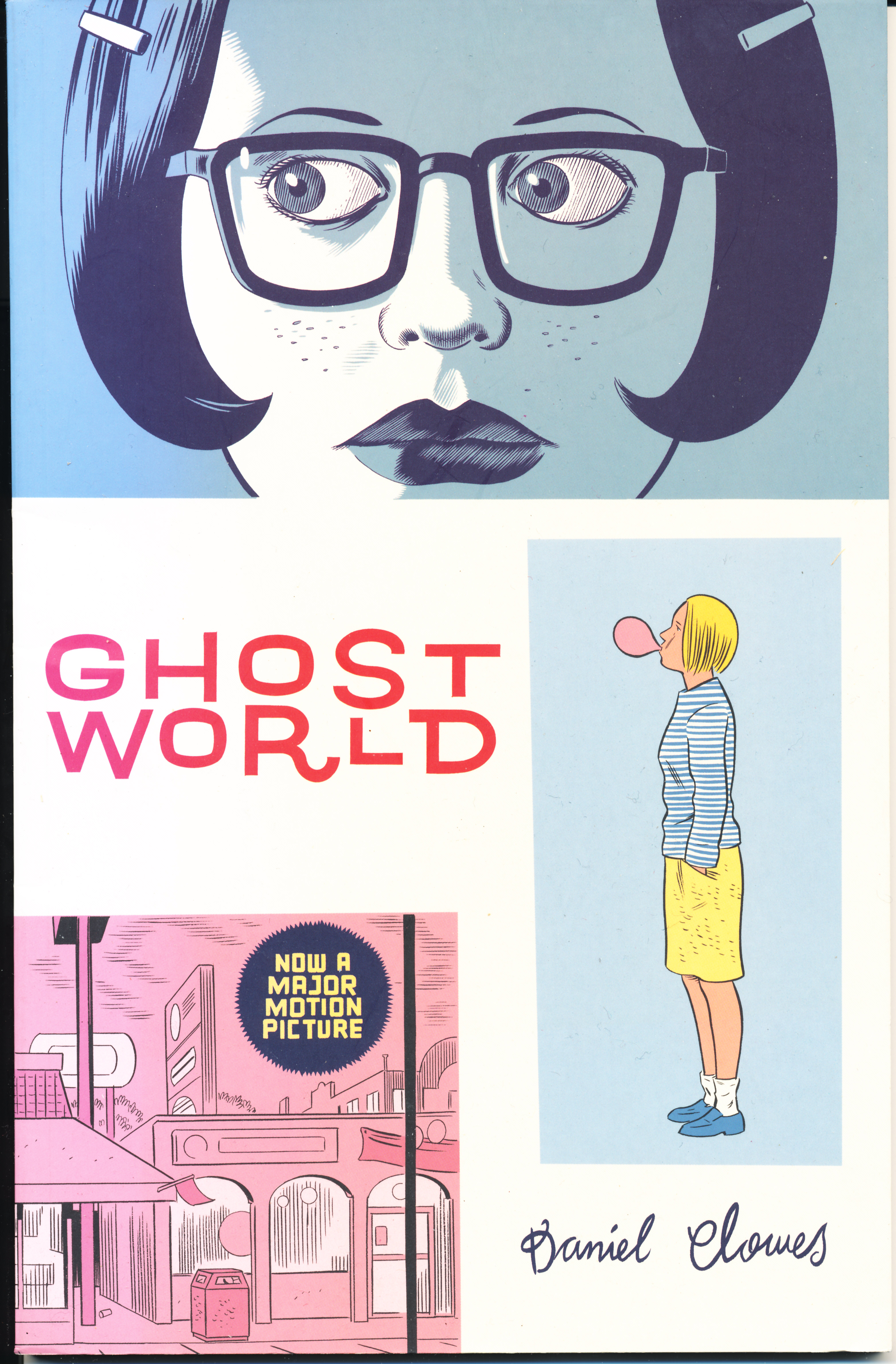
GHOST WORLD - Fantagraphics   (1997)
Daniel Clowes (writer/artist)
For: Someone with little to no comic experience


What makes Ghost World interesting is the way that it's two main characters, Enid and Rebecca, are simultaneously relatable and unlikeable. I had read it way back when I was in high school, and they seemed so much better then. Maybe it was because I was dating someone who was a bit of a judgmental hipster and had a super judgmental hipster friend too, or maybe it was the way the movie handled them a little better. Either way, there's something interesting about the way these young women come off as total jerks, and yet you can see where they're coming from.

Trying to describe the plot of the comic is a little strange because ultimately, nothing really happens. It's really a comic about these two young women who have been really close friends (even if it's a weird friendship) who are transitioning to a new part in life. Daniel Clowes is pretty good at these sort of sad and melancholic stories. Ghost World is no different. The final chapter rushes a bit too quickly for its own good, but he otherwise does a good job showing them drift apart before it flashes forward.

It can be a slightly tough read because the characters are almost unbearably judgmental and mean to people for no real reason, but that's part of what makes it an interesting book. This one is maybe cheating slightly in that most people, even if they never read it, probably know about it because of the movie. Still, Clowes is a good writer/artist to go to when trying to find a comic for a friend who doesn't really read them.


MS. MARVEL VOL. 1: NO NORMAL  -  Marvel   (2014)
G. Willow Wilson (writer)  &  Adrian Alphona (artist)
For: Someone with little to no comic experience


My one big rule to the list was to avoid superhero books. They're weird and tend to be super dorky, and more importantly, usually require a vague sense of larger-world knowledge to get all the references in the book. Plus, I just think a lot of people get turned off to comics in general because whenever you walk into a shop, it's overwhelmingly dominated by the superhero market.

Writer G. Willow Wilson's run on Ms. Marvel is the one exception. Though there are references to things that happen in the larger Marvel universe, Wilson does a good job making it so you don't need that knowledge. You don't really need to know about the Inhumans or Black Bolt's terragin bomb that he released during this big event to understand that this weird mist that suddenly hits Jersey City is causing Kamala Khan to gain her powers. You also don't really need to know anything about Carol Danvers - formerly Ms. Marvel and currently Captain Marvel - to recognize that she's just another superhero in this world, and the one Kamala looks up to the most.

What we get in the entire run, but especially the first volume, is a really touching and sweet story about a young Muslim girl in Jersey City who is struggling to find her place. She's not as religious as her family, but she also comes from a background in Islam, which puts her in this weird position to be constantly misunderstood by her fellow classmates. The first arc is ultimately about her coming to terms with the fact that she is good enough as she is to be a superhero. When she first jumps into action after gaining her powers, she transforms herself into Carol Danvers-Ms. Marvel: white skin, blond hair, big boobs. She thinks that is who she needs to be in order to be liked and accepted. By the end, she's got her own costume and accepts that she doesn't need to be someone else to be a hero.

The art is great and fits the tone of the book and the character's personality perfectly. It's a great book for new or young readers to pick up, but it also has something for older readers too. Kamala is a nervous, wise-cracking high school superhero struggling to balance her social relationships with family obligations with her new superhero responsibilities. She's basically a modern Peter Parker/Spider-man.

It's a really empowering and touching book. It also feels especially significant in a world where the leading GOP presidential candidate is honestly advocating we throw out the Constitution's first amendment so we can specifically discriminate against Muslims. If there were any superhero title I'd recommend to someone who doesn't really like or care about comic books, it would likely be Ms. Marvel. It's just one of the most touching and meaningful books on the market.

I said about Page by Paige that I wanted to just get that book for everyone. Ms. Marvel: No Normal was another book that it was almost tough to determine which of my sisters to get this for, and whether I should just get them both a copy!


LUMBERJANES VOL. 1: BEWAR THE KITTEN HOLY  -  Boom! Box   (2015)
Noelle Stevenson and Grace Ellis (writers)  &  Brooke Allen (artist)
For: Someone with a fair amount of comic experience


Lumberjanes is an all-ages book that has won a number of awards in recent years. The book follows a close-knit group of young girls at a camp in the wilderness. They're basically a mixture of boy and girl scouts, but stranger and slightly more badass. Each character has their own individual traits to make up this awesome little group of adventurous, goofy girls.

At the camp, these girls find their way into a really weird and mysterious situation complete with sea monsters, possessed boy scouts, and hipster yetis. That might be another thing where if you're not sold on that yet, I'm not really sure what else to add. The book is sweet and funny, taking elements of Adventure Time and making it less weird and more easily digestible.

It might be a strange book for adults to read, as it is going for the all-ages thing, but if you can see it for what it's doing, it's actually a really great and fun title. The characters are funny and relatable. The story is weird and humorous. The tone is innocent and touching. It's a book that really does have something for everyone. The cartoonish art style only aids to the sweet and weird tone of the book. There's a reason it's won a bunch of awards. 


MAUS: A SURVIVOR'S TALE - MY FATHER BLEEDS HISTORY  -  Pantheon Books   (1986)
Art Spiegelman  (writer & artist)
For: Someone with little to no comic experience


If you want a book that's serious and depressing, but historically relevant, then look no further than Maus: A Survivor's Tale. Art Spiegelman is a cartoonist whose father somehow managed to survive the Holocaust. The first book, My Father Bleeds History, is a recounting of the early days of the Nazi power grab. Spiegelman's father, Vladek, tells his son about each of the more disturbing steps the Nazis took to ousting Jews.

It's really a first-hand account of those incidents. It's tragic, heartbreaking, and all kinds of messed up. But it's also really important. The art is cartoonish, with Jews drawn as mice, Poles drawn as pigs, and Nazis drawn as cats. The art can be a little tough to follow as a result. Still, it's not that hard, and it's really the dialogue that tells the story. It's a powerful tale, with this first book cutting off just before Spiegelman's father tells of his time in Auschwitz. That is what makes it a solid and significant book to recommend.


PERSEPOLIS  -  Pantheon Books   (2000)
Marjane Satrapi  (writer & artist)
For: Someone with little to no comic experience


Surprise, surprise: another meaningful and powerful autobiographical account turned into a comic book from Pantheon Books! Well, fact of the matter is Persepolis - like Maus before it - is a great, poignant, and important book. Satrapi tells her story growing up in Iran as a rebellious young girl in the early days of the Islamic Revolution. Her distinct art style might seem to betray the seriousness of the world around her, but it actually highlights the significance of her innocence as a child in a world uninterested in such things.

More importantly than telling her story, trying to wear the newest Nike sneakers and listening to Michael Jackson records at a time when that is considered a sign of Western decadence, it's also telling the story of her parents. Satrapi's introduction spells out why she made this book: to remember those who didn't just take Iran's oppressive regime change lying down. So many in the West think of the Iranian revolution as something everyone was into. It's been a large symbol of the "us versus them" culture war mentality many seem to hold. Yet Satrapi's parents - among a host of other people in the book (who were real people in real life) - did not. They opposed the regime, and were highly skeptical of their new government.

Sadly, it just got too dangerous for dissenters, and this first book ends with them recognizing that Iran is no longer a safe place for their problem-starting daughter. So, they sent her to Paris, and they never saw each other again. Like Maus, it's a sad and significant tale that sheds light into a country we in the West don't get much accurate exposure too because it's often hyper-politicized.

It was adapted into a feature length animated film in 2007, where it was nominated for an Oscar. The film is great too.


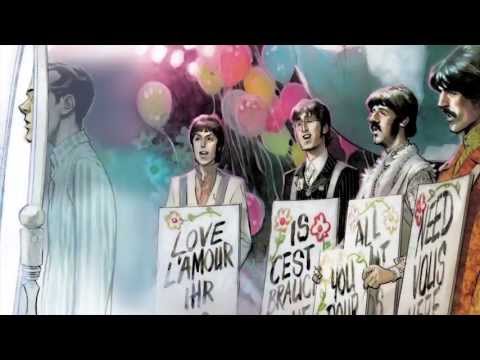
THE FIFTH BEATLE: THE BRIAN EPSTEIN STORY  -  Dark Horse Comics    (2013)
Vivek Tiwary (writer)  &  Andrew Robinson and Kyle Baker (artists)
For: Someone with presumably little comic experience (but unknown)


What I initially thought was going to be just a tacky novelty biographical story about Beatles manager Brian Epstein turned out to be a rather unique and compelling story. Sure, a lot of it is just what's inherently built into such a tale. Not a lot of people know much about Brian Epstein, and he is one of the unheralded cultivators of pop culture in the 20th century. Mix in the fact that he was a gay man at a time when one would go to jail for such behavior in England and you've got a rather layered story here.

A lot of it is told in a rather intriguing and poetic fashion. During Epstein's meeting with Elvis Presley's manager, Colonel Tom Parker, Parker is presented as something of a demon contrasted against Epstein's angelic behavior. The two managers couldn't be more different, with Parker ruthlessly looking after his own financial interests while Epstein made many personal sacrifices so the Beatles might succeed and reap the benefits themselves. There are also some slightly confusing dream sequences and other moments that give insight into Epstein's psyche of the time.

This makes for what could have been a rather by-the-books type of biography, one that wouldn't seem necessary for the comic book format. Instead, the flowery and poetic nature of the narrative maximized the artist's handiwork, making it clear that this story is best told through the medium. It's weird enough to not be the most easily digestible comic, even for the die hard Beatles fan, but it's good enough to be checked out.


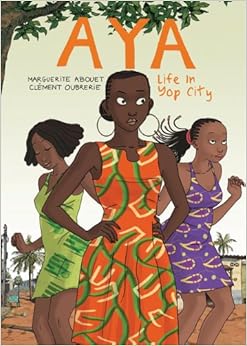
AYA: LIFE IN YOP CITY    -   Drawn and Quarterly  (2005)
Marguerite Abouet (writer)  &  Clement Oubrerie (artist)
For: Someone with some comic experience


This book isn't for everyone, largely because it's plot isn't exactly one that goes somewhere. For as big a book as it is, it's mostly just capturing life in the Cote d'Ivoire during the 1970s. It can be hard for Western audiences to really follow, as it doesn't have any one central protagonist. Aya is a more "modern" and Western-like woman, so she's the one most readers will be able to relate to and identify with, but all in all, it'd be a bit of a stretch to call her the protagonist. Instead, it follows several people and the drama in their lives, largely in relation to life in the city in general.

It's an interesting perspective on a uniquely African location and culture. The author even mentions in the foreword that part of the reason for the book was to give people a more realistic look in on some African culture and lifestyle that many people have not been presented with. It is an interesting insight. It can maybe be a bit boring, and it is a bit long, but it's not a difficult read. Pages go by quickly with it's uniformed layout, and the cartoon-like artwork keeps things on the lighter side. It's worth checking out for a different presentation of Africa than the one we Westerners may be accustomed to.


FUN HOME  -  Mariner Books  (2007)
Alison Bechdel (writer & artist)
For:  Someone with little to no comic experience


Alison Bechdel (yes, of the often misunderstood Bechdel Test fame) tells the story of her relationship with her father in this graphic novel memoir. She refers to it as a "tragicomic," and certainly, there are many tragic elements to it, but it never really gets too depressing. What we get in Fun Home is a really intriguing, complex, and sad tale about a weird family. A lot of it seems to be some way for her to deal with the loss of her father, who often came off as cold and closeted, but we can see the influence he had on her anyway.

It's a really well-crafted memoir that is both sad and touching. It also informs the reader a lot about who Alison Bechdel is herself.  Certainly if you wanted a funner or more uplifting book, this isn't it, but it is a good and insightful book worth checking out.


TOMBOY   -   Zest Books (2014)
Liz Prince  (writer & artist)
For: Someone with little to no comic experience


Liz Prince has more of a cartoonish art style, but it works for her writing. Another graphic memoir, Prince tells the story of her life as a Tomboy. She talks a lot about how difficult it was since boys and girls both made fun of her for not dressing like a typical girl. It starts off when she's pretty young, but continues on past that. The age range makes for a more compelling tale, as it highlights just how weird it can be for people who don't feel comfortable adhering to traditional gender expectations.

Prince's story is rather sad and insightful, like most memoirs, but she's also really funny. She's careful to include a good sense of humor. Seeing her get bullied doesn't bum you out any less, but you do feel a bit better knowing that she came out of this whole experience relatively ok. She isn't having a laugh at the bullying either, which is a critical component.

It can be a little weird at times. She sometimes draws her present self into the panels so she can narrate more efficiently, breaking the fourth wall. A cartoon version of Prince is literally looking out of the comic at you as she talks to you. It's kind of interesting and you don't really see that very often in comics. (Matt Fraction does this a bit in Sex Criminals, which is awesome and you should pick up too, as an unrelated aside.)

It's a neat breakdown of the typical gender norms and where we seek validation from. It isn't saying that the typical ideas of femininity are bad or wrong, it isn't saying that women shouldn't be "girly" even if they want to be. It's really just looking at how limiting such defined and strict boxes can be. There are more ways to be a woman, and they're all ok, is basically the point.


I can't necessarily say I think all of these books are "great," but I think they all provided something really interesting. I've enjoyed them all, and thought they were really well put together. Pretty diverse list too. Sure, the majority focus on women (eight out of the twelve, to be exact), but it covers a fairly wide range of characters and styles of comics. You've got a few graphic memoirs, some superhero stuff, some just quirky and weird stuff, some more realistic drawings, some more cartoonish, some more artsy. 


I don't know if the people I got these books for will enjoy them. It's hard to know if people who have never read comics will really be able to take it in. (It is a bit different than just reading a normal book.) And to be clear, these aren't books that I felt "reminded me of so-and-so." These are just books that I think so-and-so might like. But, if you're into comics, or even if you're not and you want to know what might be a good place to start, this is a pretty solid list, if I say so myself.

Monday, December 28, 2015

The Last of Us: The Outskirts Part 1: I Love that Dirty Water...and More Tutorials


We've learned to fight. We've learned to take people out quietly. We've learned to sneak. We've learned a lot of the total mechanics of the game, but there's still some more things, and we've also got a few more things to learn. Plus, we haven't really been given the ability to practice these on infected.  Getting into Boston gives us our first true encounters with the infected, but it's also a means to show us the true state of the world.

Outside the Boston quarantine zone doesn't see any gangs or thugs, but we get to see the state of the world. The city is overrun with vegetation. Buildings are decrepit and falling apart. The two largest skyscrapers are in a precarious situation in which one is leaning against the other. Ellie spends much of the time asking questions about what happened. Tess isn't a giant grouch like Joel, so she answers. At this point in the game, Ellie functions not only as the mission objective; she's also a narrative device. Since she's never been outside the QZ, this is all new territory for her. She is the portal in which characters can feed the player backstory into this world and build it up. This isn't an uncommon device, but it's well executed. It's clearly her primary function at this stage of the game, but it's never distracting.

Consider what I consider a bad example of this: Final Fantasy X. That game features the main protagonist from a "different world" for the same reason. The difference is, FFX doesn't stop hand-feeding you "background" until about twenty to thirty hours in. It gets tedious and tiresome, and feels a little condescending at times. The Last of Us uses this device from time to time, but doesn't keep it up for long periods. Additionally, Ellie is a fourteen year old girl. She's basically still a child. We've already established she's inquisitive, and this is a trait she carries through most of the game. Again, though clearly a means for the writers to communicate information and do some world-building, they work this device into Ellie's character itself, so it never feels out of place.

We also get more of the pacing flow here. After just escaping the military's clutches, we get a lull in action. Wandering through a part of the city and through some of the building, it takes a little bit before we finally encounter infected enemies. Not only does this give us a moment to catch our breath and observe our surroundings; it also builds suspense. Some of the best moments in the game are ones in which nothing actually happens, but it feels like something is about to. Cutting through the tilted skyscraper is the first time we experience this. Of course, it ultimately does culminate in some enemies, but it's not as bad as they build it up for. In essence, it's a big "psych!"

There's also an interesting thing here where finding notes also fills in backstory. More than that, the characters will react to them. This isn't the first time it happens. When you find a note about Robert at the docks, Joel will mention that Robert seems to be pissing everybody off. The notes here serve to solidify a narrative reason to look for them.  The notes found here add to the environment around you, and the situation you find yourself in.


Ellie doesn't just ask questions to fill us in on the world and character backgrounds though. Her curiosity also helps the players understand some of the enemies they may encounter. One of the slightly more confusing explanations is regarding clickers. These are enemies that have been infected for so long that the fungus has  rendered their hosts blind. After asking about them, Tess tells Ellie (and us, if you're focusing on them to overhear it) that clickers use echo location, like bats. The clicking sounds they make function as sonar. They're able to "see" using sound. Tess also states some strategy: "when you hear one, you have to hide."

It's a little confusing since that idea is virtually no different than any other enemy. Instead, they should mention that clickers are deadlier than your average infected. Without shivs, a clicker will insta-kill you if it grabs you. That doesn't get established in this dialogue exchange - they simply tell you to stay out of its sight, which is weird because they just told you that they can't see. This rule about seeing via echo location also gets ignored several times throughout the game during scenes. It's one of the more inconsistent "rules" of the game, and gets ignored whenever convenient for dramatic action moments.

Though we're now into the game more fully, there are still a few tutorial elements in the building. There are pills that teach us about improving our character stats. Tess hands us a recipe for med kits, which also teaches us about crafting. Both of these will be important and don't need too much hand-holding. Odds are, you may have already figured the crafting part out already just on your own.  The first clicker you run into in the open field is designed so that you use distractions to sneak around it, teaching you the value of avoiding conflict. There's a lot of cover and a bunch of bricks and bottles to toss.


Then you find a revolver. More powerful than the pistol, it holds fewer rounds and takes more time to reload. This segment can be really tricky for new players, in part because it's designed for failure. Though the last few sections were teaching you about stealth, this section is teaching you that not everything can just be avoided.  It is possible to get through it without disturbing the other infected, but it's challenging and it doesn't take much to screw up. That's the big lesson from this part.

The segment features the three most common forms of infected enemies: clickers, runners, and normal infected. To the right is one motionless infected you can easily take out. Back turned and standing still, that's the easy first step. Right near him is usually a melee weapon to pick up, which you'll want to do because to the left are three "runners" and a clicker. Runners, as the name might imply, are infected who move around a lot. This makes it really difficult to sneak up on them to take them out quietly. It doesn't help that the three runners move in a triangular pattern in sync. It's quite tricky to take one out with stealth without drawing the attention of the others. The usually do keep each other within their line of sight. The clicker stands still in the center, which makes things even more tense. If you can take the runners out, the clicker isn't a problem. You can sneak up on it and take it out, no problem. But if you mess up or draw the other runners' attention, the clicker becomes active, making it more difficult to take it out.

It is possible to get through this without alerting the others, but at this point in the game - especially for new players - it's not very likely.

The final section of the skyscraper takes you down below into the subway before dumping you back out on the street. There are about four clickers and three normal infected in this area, but there are also a few side rooms to explore and your first safe to discover. The placement of the enemies makes exploration tricky, but it's worth it to do so. If you just try to truck through to get away, you'll miss out on some resources. Everything can be done with stealth pretty easily, but it's a good way to put everything together. You can sneak, or use distractions, or - with the introduction of Molotov cocktails - you can go in guns blazing. (Well, no, not enough ammo for four clickers, but the Molotovs make it easier to take some of them out.)


We learn our final piece of non-item specific tutorial: upgrading weapons. All those gears and whatnot you find lying around can be used to upgrade your weapons. Each weapon has a different set of traits that can be improved. For example, the rifle can have its accuracy and range increased while the shotgun can have its spread improved. Most weapons also allow for increased clip capacity and reload speed. Upgrading your firearms can be critical in surviving. It's a good thing to do at this point too, given what is to come at the end of the museum.

The museum is one of the cooler levels. It's creepy as heck, plus you get separated from Ellie and Tess. Clickers show up, prompting Tess to shout, "Run!" That might be the first minor example that can cause some to wonder if they've forgotten how things work. (Why would you shout anything when you hear clickers, for example, if they "see you" through sound? We just had a few levels designed to teach us to stay quiet when they're around!)

Again, the level is set up so that you can approach it a number of ways. There are enough bottles and bricks and enough cover to sneak around if you want. Similarly, you probably should have enough resources at this point to take each clicker out too, if you want. Additionally, the clickers are spaced out just far enough that you can work some mixture. If you do manage to sneak by all of the clickers in the first leg of the level, it does make you realize how nice it would be to do little things like, I don't know, close the doors you just opened. I've personally found that a slight problem in this section when going all out stealth is that once you get by and open the door, those clickers can follow you into the next section for a little bit. It can cause a bit of a problem if you lose track of where they are, and means you have to really be careful to watch your six.

We finally run into Tess as she's being attacked by an infected. It looks like she can take care of herself, as she grabs a plank and smashes it in the head. The next section is the first one in which you are required to actively fight infected. We've been in shootouts already, with the first two of Robert's men, and there's a good chance you got swarmed by infected in the skyscraper at one point. Still, if you managed to get through without drawing attention, this is the first time you have no choice. The game occasionally removes the option, which has it's pros and cons. I'm not personally a big fan of those moments when you have no choice as to how to play a section, but this moment here is helpful as it is perhaps your first real chance to experience hand-to-hand combat against a horde of enemies. Getting that kind of experience this early in the game might actually be helpful for later in the game, even if you're like me and try to always sneak by everyone. What's nice about this section too is that there's a lot of stuff to pick up. If you're low on ammo and your melee weapon breaks, you can pick up bottles and bricks and smash the infected with them. Plus, there are enough corners and structures in the small map to use.


The highlight of this section is just after getting out of the museum. First, you can check up on Tess, who does a good job staying focused. Then, you can talk to Ellie. The back-and-forth is a nice moment that lays the groundwork for their relationship. Joel asks if she is ok, to which she retorts, "Define ok." He answers that she's ok if she's still breathing. Ellie, ever the wise-cracker, then asks, "Do small, panicked breaths count?" There is a very quiet, brief chuckle from Joel. It's not super obvious, but it's there.

The big moment though is just after that. You put a plank across a couple of buildings to advance, prompting the first touching moment between Ellie and Joel. Perhaps bitter and sarcastic, Joel asks her if this is everything she hoped for as they can see the rest of the city, especially the Capital Building, which is their destination. Ellie responds that the jury is still out, but, "...you can't deny the view."

In that moment as she walks away, Joel can be seen looking at his watch. This is the watch Sarah got him for his birthday before the outbreak. It's a very subtle moment, but you can really tell that this is the first time Ellie has reminded him - in a positive way - of his daughter. There's another great and subtle moment with the watch to parallel this, but that doesn't happen until the end of the game, so we'll save that for another time.

After this moment, Tess gets kind of stern with Joel. She suddenly seems strangely on edge. Of course, we'll find out way in a little bit.

Tuesday, December 22, 2015

Star Wars: The Force Awakens (2015)


Unless you've spent most of the last couple years trapped in the Old West because of a mishap with your time machine, you know there was a new Star Wars movie released this past weekend. Odds are, you've already seen it too. After the debacle with the prequels, there was a sort of nervous optimism going into this film. The hype was strong with this one. Indeed, it broke records and probably will continue to do so. But is it any good?

Full disclosure: I have a rather unpopular opinion of it. I've often been accused of simply being "contrarian," but that's not really the case. (I avoided any and all talk of this film before going into it, so I had no idea what other people thought of it until after I watched it and formed an opinion.) Still, I will admit that I'm going to be a minority here, and that anything critical or negative I have to say about it is something few people I've spoken to shared.

Let me structure this as a compliment sandwich, starting and ending with things I really liked, and stuffing it in between with some of criticisms or things I wasn't crazy about.

As an aside - these are all pretty overarching praises and criticisms. You won't find spoilers. Indeed, none of the specifics I touch upon briefly are things you won't find in the trailers or even on the poster.


The first thing to discuss is the characters. Yes, as was noted in the trailers, some of the original cast are back. If you really felt the desire for old Han Solo, here ya go! To his credit, Harrison Ford is a professional and doesn't phone it in at all! Personally, I was never really interested in seeing anyone other than old Luke Skywalker, but Ford was a delight to watch.

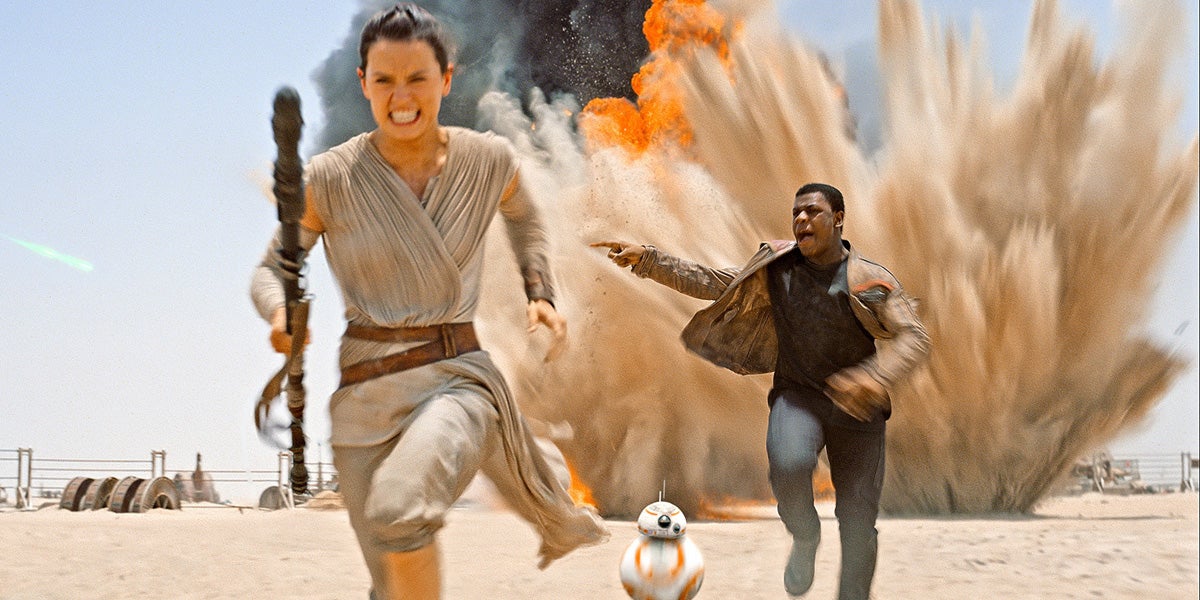
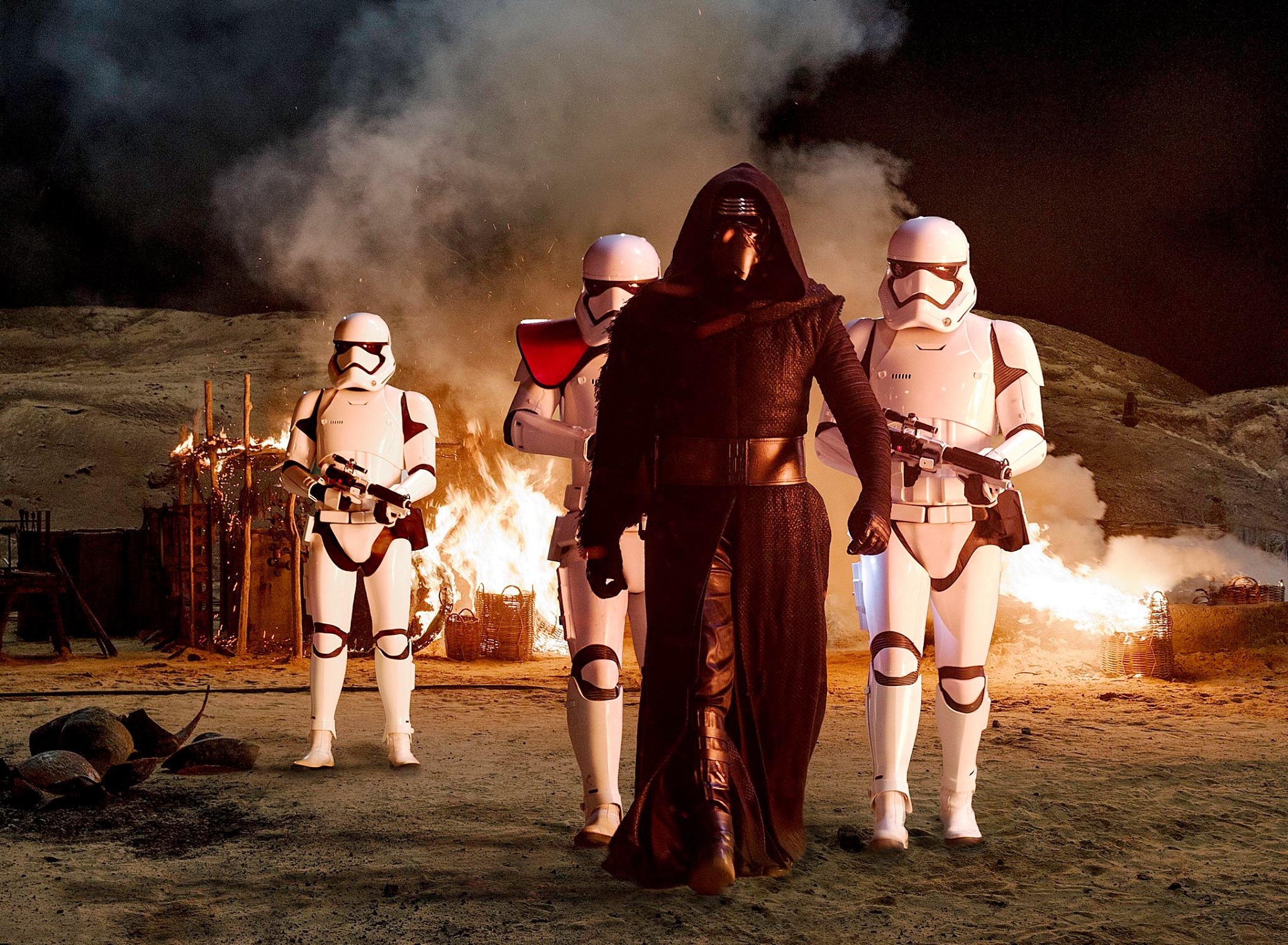
However, the strength of the movie isn't on the returning cast members. Instead, it's on the new characters, to whom the torch is being passed. The primary group here would be Rey (Daisy Ridley), who is something of a Han Solo/Luke Skywalker hybrid, Finn (John Boyega), who is something of a Han Solo/Luke Skywalker hybrid, Poe Dameron (Oscar Isaac), who is something of a Han Solo/Luke Skywalker hybrid, the much publicized BB-8, who is the new R2-D2, and finally, Kylo Ren (Adam Driver), who is the primary villain.

These characters make up the core of the film, and on the most part, they're every bit as strong as the original crew of characters. Yes, I jokingly mentioned that pretty much all of the heroes are like a Han Solo/Luke Skywalker hybrid, but that actually isn't a bad thing. It makes them feel like more ranged characters, instead of fulfilling a singular function in the narrative, like the archetypal characters of the originals. It's a good way to go, really. Each character can fulfill several narrative functions, and you can see why any one of them might be someone's favorite (versus earlier movies where everyone wanted to be Han Solo and never anyone else.)

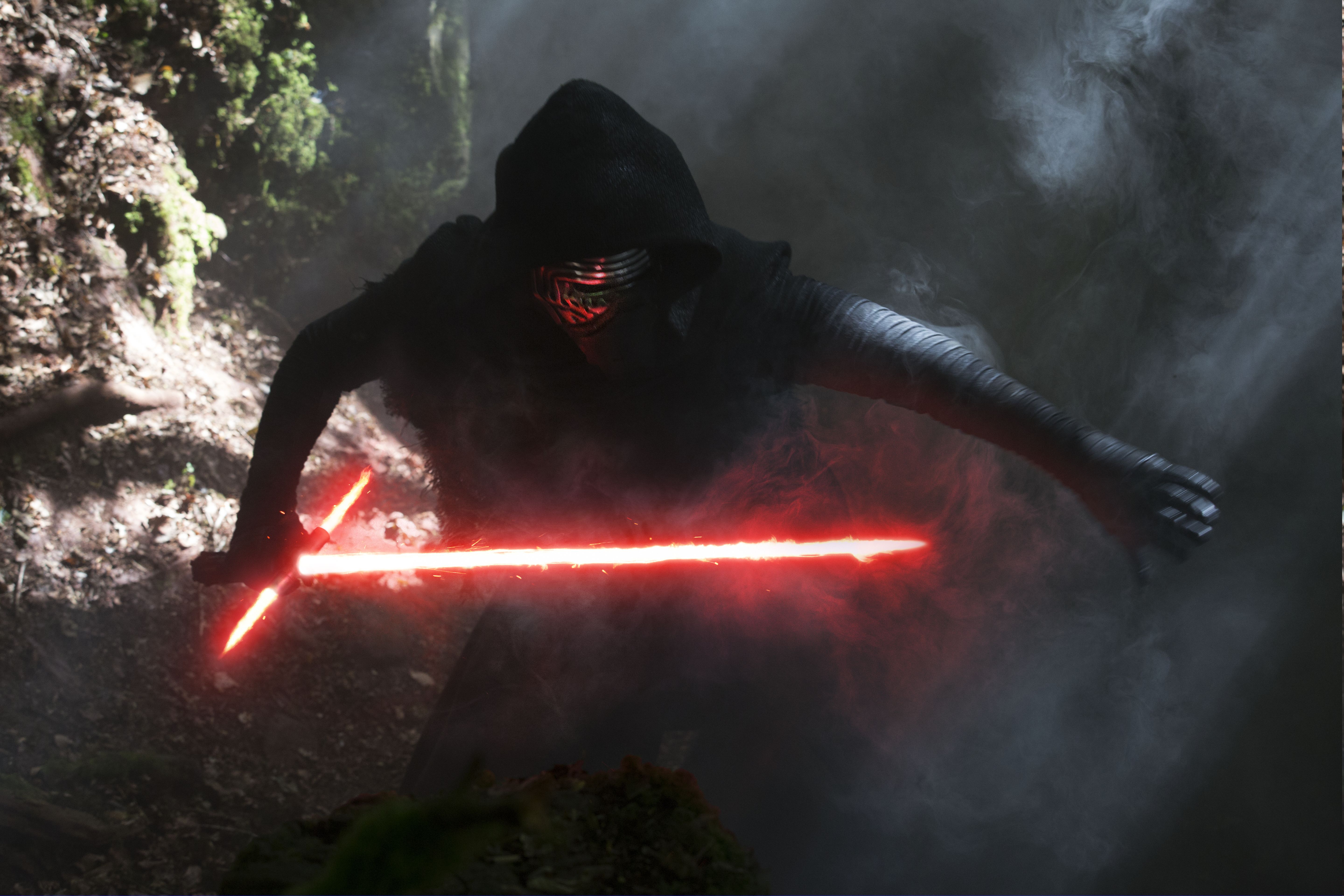
Admittedly, the more I reflect on Kylo Ren, the more I like him as a villain too. His story still has much to be revealed, so we don't really know him too well, but he's already ten times more interesting a character than Darth Vader was. Note: I'm not saying he's as good of a villain! It's too early to call. And certainly, he isn't as iconic right off the bat. (Actually, he looks like he came off the set of G.I. Joe in his design.) However, there are already so many more layers and much more complexity to him than Darth Vader ever had.

To be sure, the strength of Star Wars is in its characters. The stories are always kind of dumb or filled with plot holes or elements that just don't make sense. That extends to The Force Awakens as well, of course. I don't think the characters are strong enough yet to make the film "good," but they are certainly good enough that, for any and all criticisms I have, I'm interested in the rest of their story.


The problem with this film is a bit two-fold. First, it's construction is fundamentally different. See, so much of why things work in the original Star Wars is in the entire conceit of the film. It was designed to conjoin elements from tons of other works; smashing them together into one kind of cheesy, overly simplistic serial story using rather archetypal characters. If you can't buy that concept, there's a good chance you won't like the movie at all. It will come off as too dumb or nonsensical and the characters too generic.

Here, the film isn't trying to do anything like that. Instead, The Force Awakens spends much of its time trying to hit the same exact beats as the original trilogy. J.J. Abrams has basically made a "Greatest Hits" Star Wars movie, just with more interesting characters. More or less, he just spends too much time reminding everyone of the original trilogy. It practically hits every major plot point of the originals. The final action sequence is the end of Return of the Jedi, with some Empire Strikes Back sprinkled in for good measure.

That's probably my biggest gripe with the film overall. I know it sounds counter intuitive, but I wanted it to be a little bit more original and different. The cast is great, but everything else is just more of the same. The First Order is the Empire, without actually being the Empire. The Resistance is the Rebel Alliance without actually being the Rebel Alliance. BB-8 is R2-D2. The Starkiller base is the Death Star. They've got their Yoda stand in. They've got their Boba Fett stand in. They've got their Mos Eisley rip off. They've got their young protagonist destined for something greater stranded on a desert planet. They've got their trench run. They've got their Emperor. They've got their Tarkin. They've got their Leia senses something bad moment. They've got their hero runs off to take care of himself, but returns because he really is a good guy moment. There was a moment I even thought for sure they were about to give us a Porkins stand in too!

The beauty of the original Star Wars is how it was derivative of a ton of other things, creating a unique amalgamation in and of itself. The trouble with The Force Awakens is that it's just hyper-derivative of its own franchise. Which might be pleasing to many fans, of course, but isn't exactly what I was hoping for myself as a fan. Because of this super repetitive structure, I found it utterly predictable - including the big "reveal" as well as the "moment" that everyone is sure to be talking about. For me, hitting all the familiar Star Wars notes just made it drag and feel a bit boring.


The other main problem I have with it is a bit of a larger-scope problem with how Hollywood goes about making movies lately. It felt like so many key plot and character elements were specifically left out to leave people hanging for the next film. I'm all for some open ended elements. It's not like the original trilogy avoided those things itself. But typically, those were presented in a way that suggests, "What's going to happen next?" and less like a "What is actually going on in this movie you're watching right now?"

Basically, I'm not a fan of making blockbusters in the same way they make television shows. Needing to get to the next episode to understand the one you just watched works for television because you get the next episode in a week. In the case of season finales, you get the next piece in the span of a few months. We're literally going to be waiting a couple of years before we can really even tell what is happening in The Force Awakens.

It might be a little unfair to pin that on Abrams, but given this is the guy who made his name in episodic, keep-'em-confused television shows, I'm going to...

I will conclude the compliment sandwich by discussing the lightsaber battle. They nailed it, in my opinion. I totally get why some feel the overly choreographed fight sequences were way cooler. They're faster, and have more of that "cool" factor to them. In context, it even makes sense why the fights would be more skilled in the prequels, since those were all very well trained Jedi or Sith. They're highly trained with lightsabers, and with the Force. Come the time of the original trilogy, no one really has that. Vader is older and mostly machine. Luke is young and doesn't really have anyone he can spar with for practice. Even here, it's not like anyone really has all that much training with a lightsaber.

There aren't any twirls or jumps or flips or anything like that. Instead, we get these exhausted and heavy swings. There is a sort of weight to the lightsabers again. It really did feel like people fighting for their lives! Even though the finale is just a complete rehashing of Return of the Jedi, it does increase the sense of urgency with the heroes, who are fighting to survive.

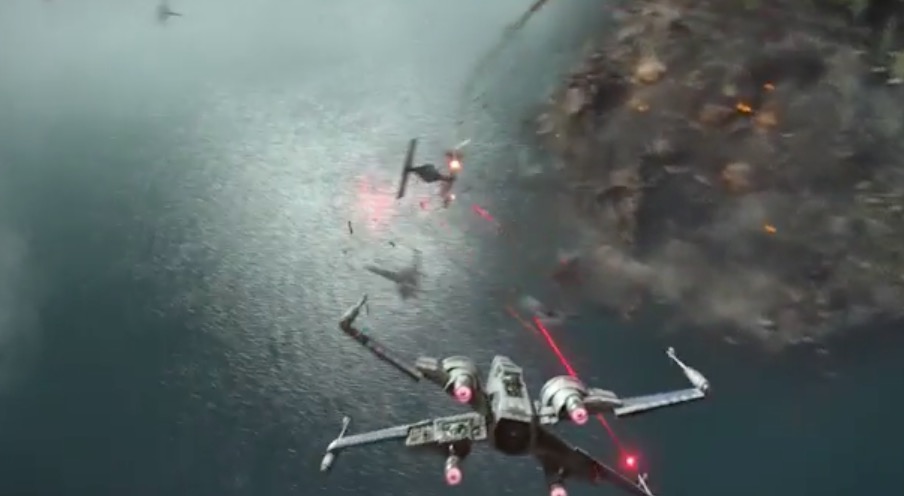
To be completely honest, I also really enjoyed the fights with the space ships, even though they don't often occur in space, nor do they get the focus they deserve, really.


All in all, the structure of the film, and just how much time it spent trying to remind us of the original trilogy just bogs it down a bit. Some nods are welcome, and some references are needed given the nature of the story, but it really felt like they didn't need to just copy and paste the trilogy into one film. I found it a bit dull and dragging as a result. Similarly, I don't exactly appreciate how the film basically answers no questions, instead functioning more as a step ladder to the next film. Again, some of that is fine, but I'm not into the whole "sacrifice this movie now so you go see the next one later" thing.

But, as far as I can tell, I'm on a pretty deserted island on this one. Some have said they can see where I'm coming from, even if they don't agree, but the end result is that everyone disagrees with my take. Contrary to popular belief, I am not just simply a "contrarian." And by no means am I a "hater." (That doesn't even make sense! Why would I be a "hater" towards Star Wars just for the sake of it? I love Star Wars!)  However, it does seem that no one else has a problem with some of the things I found problematic.

Basic point being: you'll probably totally love it, where I just found it ok. Didn't love it, but it didn't turn me off to the franchise either, which is something only Attack of the Clones did. (I never saw Revenge of the Sith in theaters because I thought Clones was so bad, I stopped caring about that movie series.)