Cheerleaders are kind of a funny thing, huh? They seem the last remnants of a bygone era where only men cared about sports, and nothing is better for men than drinking beer, seeing beautiful ladies jiggle, and watching other grown men in spandex bump into each other. (Wait. What is a "smokescreen" in football, really? Ah! Moving on!)
That's all fine and dandy, except that they're still a thing. Yes, every franchise has their own cheerleaders. And they still parade them out. CBS, NBC, and Fox still make it a point to include shots of them in their broadcasts. The NFL and those individual organizations - with their billionaire owners - make so much bank that it stands to reason that those cheerleaders are getting their fair share of the pie, right?
Well, turns out, not so much. Like, at all.
Turns out, the average hourly wage of an NFL cheerleader is $9 to $15 an hour. Basically, they're making minimum wage, or the same wage as anyone else in an entry-level position. Evidently, Raiders cheerleaders were making $5 an hour in 2014, well below minimum wage. The hourly wage covers the hours spent training, and there's also a "match fee" for game days.
Typically, there are two tiers of cheerleaders, "elite" and "armature." Elite are the ladies you see at the stadium and on television. They make between $100 and $200 in such fees, while armature make about $60 to $70. The breakdown of the season's income though is a little depressing considering the NFL made about $10 billion in revenue. Elite cheerleaders earn about $3,500 for their services while armature cheerleaders make about $2,000.
A lot of people might be willing to shrug it off, saying that $3,500 over the course of eight games isn't too shabby. In essence, they're making almost $500 per game! Sounds pretty good, right? A few thousand dollars for eight shifts sounds all right.
NFL officials - generally the low men (and now women!) on the totem pole - make considerably more money. On the surface, it's easy to pass it off as simple volume. Cheerleaders only work home games, of which there are only eight. Officials, on the other hand, will work an entire season's worth of games, of which there are nearly double the number. So of course officials will make more money.
Except that the breakdown is still highly uneven. NFL officials make between $25,000 to $70,000 per season. (This is much higher in MLB, NHL, and NBA, where there are substantially more games. In this case, the "more money because more shifts" does make some sense.) If you break that down per game, officials on the lower end of that salary spectrum will earn about $1,500 per game - nearly $1,000 more than the cheerleaders. And if those long-time officials who earn on the higher end get broken down, it's about $4,300 per game.
One of the main arguments, of course, will be that the officials are more important to the game. Cheerleaders are just there to look pretty while officials are there to oversee the game. This argument is a fair one to an extent, but it downplays the skill level required for cheerleaders. It talks about them like it's an entry level position, or that it's unskilled labor.
NFL cheerleaders are considered a part-time gig, and many organizations even require these women have other jobs. They're expected to attend two four-hour rehearsals each week, while game days turn into eight-hour shifts. Never mind the demanding nature of the position, wherein the women must be diligent about maintaining their weight and tone, lest they get benched and lose a paycheck. It's also a hyper competitive market. The official requirements might not be that complicated - high school diploma or GED, having a full time job elsewhere, and some squads have a height/weight ratio requirement - it's still something of a skilled position. Applicants with prior dance or cheerleading experience have a better shot than those that don't, although if you're attractive enough, you have a shot. Not to demean the patience of other stadium employees like beer hawkers, vendors, and ticket takers, but cheerleading, by comparison, is much more of a skilled position.
Let it just sink in, by the way, that NFL squads expect women to commit 16+ hours a week to cheerleading while requiring they also have full time jobs outside it. Probably worth noting that practices and rehearsals are unpaid. In essence, cheerleaders are expected to be working and active for 55-60 hours each week. Alternatively, you could skip the other job requirement if you're a full time college student. So yeah, it is something of a time commitment.
None of this is to speak of the appearances they will make at publicity and charity events, some of which are unpaid, but typically, these events net the women more money than the actual cheerleading at games does.
And this is sort of the problem: cheerleaders keep getting treated like part-time, unskilled employees. Yet these women could potentially spend full time hours involved in squad activities - from games to practices to public events. If the justification for paying these women such low wages is that they're part-time, then it gets really absurd when you hear that the minimum salary for NFL mascots is $23,000. The lowest paid mascots make about $3,000 for two games, putting them up there with NFL officials in terms of per game payment - well above cheerleaders.
The other part of the problem is that for a job treated like part-time and entry-level, the teams sure do have a lot of insane requirements. A heavily reported leak from a former Baltimore Ravens cheerleader made its rounds in the news outlets some time ago, and it's pretty messed up. Quite literally, the women are judged explicitly by physical appearances. Right from the rule book, each woman "is expected to maintain ideal body weight and physical look for the duration of your contract. Weigh-ins will be held at the discretion of the Ravens. a) Failure to comply with body weight and/or appearance guidelines could result in suspension from the team or gameday suspensions. b) 3 game misses due to physical appearance suspensions could result in dismissal from the team."
Several women have reported being benched and left out of big games because they gained a few pounds. Despite looking totally fine, and with one woman, still weighing less than she did the year before, they lost paychecks as a result.
I hate to bring up the hypocrisy, especially when it seems so obvious, but this is taken directly from the Ravens contract with cheerleaders:
"Cheerleaders shall not commit any act that will or may create notoriety, bring the Ravens or cheerleaders into public dispute, or reflect adversely on Ravens and/or Ravens' sponsors."
That applies to the cheerleaders. Listed examples include exotic dancing, posing in nude or semi-nude photos, participating in swim suit contests (which sounds absurd when the highest selling Sports Illustrated issue is its stupid swim suit edition), and publishing memoirs of their time as a cheerleader (probably because they know how horrible they are towards those women and want to keep it under wraps).
It seems a little strange that this applies to their cheerleaders - a group of women the organization regularly refers to as "invaluable" to their operations and as "ambassadors" - but not, you'll note, to any of their players. The Ravens are an organization in which two of the best selling jerseys in franchise history were Ray Lewis and Ray Rice. And another highly popular player is Terrell Suggs. So apparently, involvement in a murder and obstruction of justice, knocking out your fiancee and casually dragging her body around, and more beating of wives are not detrimental enough to the organization, but models posing in string bikinis on their free time (because they're told they're part-time employees and should seek alternative income elsewhere) is over the line.
(As an aside, the Buffalo Jills sent their cheerleaders to an event called "The Man Show," which had all the women walking around the casino in their bikinis. So apparently, the women aren't allowed to use their looks for personal gain, but the Bills organization sure doesn't mind profiting from it!)
These organizations are also extraordinarily controlling over the lives of these women. Teams give out guidelines that sound like an 19th century "Lady Etiquette" book. It ranges from how much bread to eat at a formal event to how to properly polish nails. It even covers how to "properly" clean their lady bits. In many cases, they're forbidden from posting selfies on Facebook, and often, they'll pull images from someone's Facebook (without their permission) and display it for all of the other women as examples of what not to do.
Oh yeah, and you know those calendars? Yeah, the cheerleaders themselves have to pay for them. Not just one, but ten a month. Yes, apparently, the cheerleaders are expected to spend their own money and are required to sell as many as they can on their own. You know, kind of like one of those elementary school candy fundraisers! If women weren't able to buy the required number of calendars, they would be benched.
Not enough nonsense? The cheerleaders are also expected to pay for their own uniforms, which are about $650. Even more, the women are required to subject themselves to a physical inspection in their final rehearsal before game day. Coaches and managers stand with clipboards, scribbling down all the physical flaws that must be addressed in order for these women to be allowed to work the game. One would imagine that at best, it's all slightly dehumanizing and demeaning. Quite literally, they're often required to subject themselves to a "jiggle test."
One woman from the Buffalo Jills reported that she was pulled aside and told her hair was not "game ready." She was told to see the squad's stylist to fix the color. Ok, reasonable enough (well, considering everything else, at least). Except that she was expected to pay for the coloring herself. For a $90 hair coloring, being part of the Jills netted her a measly $5 discount.
One of the ultimate problems, of course, is that in this multi-billion dollar industry, with organizations making hundreds of millions on their own and sharing billions in collective bargaining revenue, the cheerleaders don't have any representation. NFL players have been gaining more power in the business - and rightfully so - because they have the Player's Association. The NFLPA has been hugely critical in stopping owners from enacting abusive and exploitative policies. The NFL referees also have a union that participates in collective bargaining agreements. Officials and players, on the most part, get a fair share. (Perhaps an article for another day is how they might not actually be getting a reasonably "fair share" of the NFL pie, but they're in much better positions than other stadium and team employees.)
NFL cheerleaders don't. There's been talk of unionizing, but cheerleaders are less central to the overall product. We've already seen what damage replacement officials can do, and there's a reason they don't even bother trying to have a season if the players hold out. If the cheerleaders unionize, there's a good chance the NFL teams just replace them and try to sweep everything under the rug.
What's strange is that with five teams involved in lawsuits for unfair wages and demeaning workplaces, the NFL should try to get ahead of this. The NFL has something of an image problem. With all that's happened with the Ray Rice incident, and the Greg Hardy incident, and the Terrell Suggs incidents, and the Ray McDonald incidents - all domestic violence cases involving some pretty horrifying violence against women -news has also surfaced of their breast cancer awareness scam.
Each October, the NFL pushes pink to the fold in an effort to raise awareness for breast cancer. It's one of the ways they claim to support women, which makes sense to do that given women are an increasingly important part of their fan base. (All this, mind you, while the NFL has told Steelers running back DeAngelo Williams - who practically started the entire thing - that he can't wear pink on his uniform all season long in memory of his mother and four aunts who died of breast cancer.)
Breast Cancer Awareness is a popular cause, and it makes it appear as if the NFL cares about women. But Business Insider crunched some numbers and found that a little over 8% of profits from the month go cancer research. They tout the whole $4.5 million thing too, but that's not even half a percent of the annual NFL revenue. Even more though, their Crucial Catch program has met criticism for being overly simplistic. It doesn't help either that the whole "annual screenings save lives" thing isn't even factually true. So on top of giving a tiny percentage to cancer research - and if anything, actually profiting from the Pink Ribbon - they're also dolling out inaccurate health information. (Surprise, surprise.) It's even been argued that what the NFL is doing on this might actually be more harmful than beneficial.
Oh, and by the way, only a portion of that 8% donated goes to actual cancer research. The numbers boil down to about $3.50 for every $100 in pink merchandise revenue going to actual cancer research.
So now that we've gone down that rabbit hole, it's kind of hard to look at the NFL as something of a positive force in anyway. (Mix in Lance Armstrong-to-the-nth-degree behavior in covering up concussions, and you've got an organization that is incredibly, morally reprehensible.)
Look, I love football. I do. And I've spent a lot of time and money on the NFL. Part of me is cringing at the fact that I am currently missing Tom Brady's "Revenge Tour," as he has thrown 20 touchdowns to 0 interceptions.* I'm super bummed that I'm missing one of Brady's best seasons, at a time when the Patriots have actual characters like Rob Gronkowski and Julian Edelman, who are hilarious and great and go against the normal idea that Bill Belichick is just this grumpy old man who chases players like Wes Welker out of the organization for being too personable in the media.
I would love nothing more than to be able to actively care about the NFL again, and to watch it, and to go to games. But it's impossible to do now. The NFL is the worst organization in America, clean and simple. Walmart doesn't even have half the dirt and stink on it that the NFL does, frankly.
In the grand scheme of things, paying the cheerleaders fairly and treating them like, I dunno, humans and employees rather than just a collection of jiggling body parts, is literally the smallest thing a $10 billion business can do. No one is saying they should make what the players make. Few are even arguing they should make what officials make. Everyone understands their roles in the overall game.
But if the NFL and its thirty-two organizations have no problem using their images to promote their club and objectifying them at fundraisers and in calendars, the very least they can do is pay them reasonable and actually treat them like employees. Teams like to talk about cheerleaders as being ambassadors for their clubs. They are, in fact, one of the many faces. They're held to a higher standard than the players and owners, but they aren't even paid as well as the mascot.
Well, Kevin Durant knows:
*Yes, yes, I know Brady has actually thrown one interception. I don't know why other people don't use this metric, but I've long separated interceptions from drops. My personal format works a bit like hits versus errors in baseball. If it doesn't count as a hit because an infielder made an error, then a quarterback shouldn't be credited with an interception if it came off of a dropped pass. Brady's one interception was the result of Edelman's drop (which he actually dropped twice, since it hit him in the hands, popped out, and then he hit it again to pop it up again).
Friday, October 30, 2015

Thursday, October 29, 2015
BioShock 2 (2010)

The original BioShock was a critical success and a sequel was quickly put in the works, only done a different studio than the previous installment. In many ways, BioShock 2 tries to stay true to its predecessor, all while feeling fundamentally different.
Returning the player to Rapture immediately feels a bit hollow. It's not to say the environments aren't wonderfully rendered and realized; it's just not as interesting and engaging since it was familiar. A large draw to the original experience in Rapture was that you had no idea what it was. You hadn't been there before. BioShock 2 takes a bit of a different approach to the dystopian civilization, however. Where BioShock set off to create narrow tunnels, small rooms, and a claustrophobic environment, BioShock 2 sprawls it all out a bit more. Rooms are larger and more open. Often, there are multiple pathways to a location. Sometimes, there are multiple levels of buildings within the same room.
This opens itself up to the more chaotic and action-oriented combat style of the game. For all the criticism BioShock: Infinite took for feeling a bit like a more generic shooter, that trend actually can be found in BioShock 2 first. With the open spaces, more enemies are thrown at you. There's more room to maneuver. There are additional splicer types that require quick movements and reactions. In essence, the suspense was removed, replaced with faster-paced, combat-focused gameplay. Additionally, you have access to both plasmids and weapons at all times.
Playing as a Big Daddy, you walk around Rapture with a gun in one hand and your other hand waiting to shoot a plasmid power. Gone are the days of having to switch between weapon and plasmid, which helped create a more tense and suspenseful style of combat in the first game. Here, there is literally no delay between hitting someone with Incinerate and shooting them with .50 caliber rounds. This only adds to the quickened combat.
 |
| Quick and easy access to both weapons and plasmids makes combat smoother, but that's because the combat is bigger and faster paced. Can't say I was a huge fan of that change, but it's not bad. It's just different. |
The inclusion of Big Sisters further solidifies the need for faster combat. As the name implies, Big Sisters are not too unlike Big Daddies in appearance. However, they are fast and agile, easily dodging shots and becoming a moving target. This is a divergence from the Big Daddy formula, which was more of an intense, power-driven format. Both still require planning, of course. Trap ammo and proximity mines do a world of wonders here just as they did in the previous game. Still, it's hard not to see just how different the combat style is in BioShock 2. It's more about the thrills than the chills.
There is an interesting element involving acquisition of ADAM. Instead of rescuing or harvesting Little Sisters, you must first find them, then fight off their Big Daddy. After defeating their original protectors, you can then choose to harvest the girls or adopt them. When you adopt, the Little Sisters will guide you to corpses filled with ADAM. While she's draining the deceased splicers, you must face off against an onslaught of other splicers eager to take you and your Little Sister out in order to get that ADAM for themselves. Each Little Sister is good for two drains. After you are finished and return them to their vents - in which the Rescue or Harvest prompt appears again - a Big Sister will come and attack. This element of adoption and gathering ADAM is one of the most interesting and fun additions to the game.
BioShock 2's story is probably the weak point of the game. It's not that it's a bad story at all; it just lacks the same kind of political and philosophical power from the last game, which tied in many different thematic elements to the plot. Here, we have a relatively simple story that, while revealing the philosophical differences between Lamb and Ryan, doesn't even feature them in the same game. This conflict is revealed through Audio Logs, but at this point, Ryan is already dead from the last game. In many ways, the story is a lot more traditional to video games as well, with a clear-cut villain from the get-go.
Overall, the game is fun and solid and more or less stays true to the basic elements of the first BioShock. Featuring plasmids, the chaos of Rapture, and a plot driven by Audio Logs and radio transmissions, it attempts to keep the same tone and general format of the narrative. However, the openness of the level designs, the increased number of increasingly agile enemies, and the streamlined power/weapon system all serve to showcase how essentially, they appeared to be making a BioShock game catered to people less familiar with the Shock series. It's hard to say if it worked. It generally received positive reviews, with some saying it did a lot of things better than the original. Generally though, I wouldn't agree with that sentiment. In all, I personally felt as if they took the suspense out of Rapture with its quickened, more typical shooter style game play and its larger, brighter environments.
Tuesday, October 27, 2015
Fez (2012)
_screenshot_05.png)
If you've the documentary Indie Game: The Movie (which is on Netflix - you should check it out), then you've probably heard of Fez. At its core, it's an amalgamation of many different games, riding high on something of a nostalgia trip. Influences include The Legend of Zelda, Super Paper Mario, Myst, with, as strange as it sounds, a little bit of 2001: A Space Odyssey.
The story is pretty basic. Gomez lives in a completely two dimensional world. It's a simple place and a simple time, until one day he is recruited to save his world. After obtaining his signature red fez hat, he learns that his 2D world is actually just one side of a three dimensional one. You then set off to find little yellow cubes, artifacts, keys, and anti-cubes.
Designed as more of a low-stress type game, players must figure out how to get through the levels by adjusting the perspective. Quite literally, you rotate the world, changing the 2D perspective so that you can move onto the other sides. It's an interesting mechanic, even if not wholly original, but it's also executed well.
Beating the game doesn't require a ton of brain power, but getting all of the secret anti-cubes and special items for a 100% completion rate can. Scattered throughout the game are classic Tetris symbols that evidently make up a sort of code. The game also features something of its own little language. At one point to unlock an anti-cube, there's a giant QR code in the background, so you have to scan that with your phone, which then takes you to a site with a new input code that unlocks the anti-cube.
A number of puzzles can't be solved until after you've beaten it once and replay it in New Game Plus. This means not everything is accessible your first go. To beat the game, you must find thirty-two cubes total, which sounds a lot easier than it is. In fact, one of the constant criticisms of the game is how much backtracking you are likely to do. You go back and forth throughout the worlds a lot, and the warp system in place is not adequate enough to traverse the whole universe efficiently. It's also pretty easy to get lost, given how many levels there are and how the map itself is also a three dimensional thing you rotate to read.
On the other hand though, it speaks to the size of the world that this is a problem. A little game like Fez could easily feel small or linear. While many levels aren't particularly large overall, they've also got four sides each, and often lead off to another section of the world. It is surprisingly large, making non-linear exploration a big part of the game too. It just also means that it can be easy to get lost.
Unfortunately, the game is often riddled with bugs. This is probably the result of a small team that ultimately became increasingly rushed. Most of the tech issues aren't bad, but there is one nasty bug that prevents you from even loading the game at all. (I had to delete the game file and save file, then redownload and start all over again just to be able to play it again.) It happens on a very small percentage of players, but it is killer when it occurs. (It also gives you a heart attack when you get to one of the "staged glitches" that come up as part of the game's story.)
The final noteworthy element of the game is its incredible and atmospheric chiptune score, composed by Disasterpeace. It further pushes the nostalgia factor, and is a glowing example of excellent sound design the way he works sound effects into the musical track. And it only slightly terrifies you by reminding you of It Follows.
All in all, there was a reason Fez became this little indie heart throb of a game, and garnered much attention and critical praise before it even released. It is a great game with plenty of noteworthy design elements. Its creator, Phil Fish, is a controversial figure, and understandably so, but his game is a fun and clever game.
Hmmm...why does that sound a tad familiar? Why does it creep me out so bad? Waaaaait a minute...
Monday, October 26, 2015
Dan Solo Episode 4: Life Is Strange

There was a lot to unpack with the finale of Life Is Strange. Certainly, it isn't without flaws, but people seem pretty divided on the endings. Thing is, a lot depends on what you see as the point of the game. If you feel the whole thing was about saving Chloe or unraveling this mystery, then you're probably disappointed. But, I think the true point of the game is that it's about Max and having her learn how to deal with guilt and how to live life without regret. That the whole point is about Max learning to make the most of the time we do get with others, and learning how to avoid living a life full of "what ifs."
A lot more thoughts on it, and as always, lots and lots of SPOILERS!
Archived Link:
Thursday, October 22, 2015
Thomas Was Alone (2012)

"Thomas was alone," begins the charming yet simultaneously sad-sounding narration to the hit indie game of that very name. A simple, yet very compelling game, Thomas Was Alone sets off to mix and match simple human personalities and emotions with its simple yet occasionally challenging game play. As a small puzzle platformer, it's easy to pass it off as a game that shoehorns its story and emotion in, but creator Mike Bithell intertwines the story with the gameplay that at times, is a textbook example of mechanics as metaphor.
The game puts the player in control of several rectangles. Navigating them through each level, the goal is to guide all available blocks into their appropriate "portal" (the outline of the portal matches a particular shape). Mostly, this process is accomplished through jumping, climbing, and building steps with other blocks. The beauty of the game is in its simplicity. While none of the puzzles are overly difficult, being a platformer as well requires a bit of skill. Unlike some other indie puzzle game I played - like The Swapper, where the puzzles were at times extraordinarily challenging - here I was mostly frustrated with my own inability to make certain jumps or pull off certain tricks. In a way, it plays a lot more like a basic platformer than it does a puzzle game.
Each rectangle is different in size, shape, color, and has a unique ability. Thomas, the red rectangle who kicks off the game, is arguably the "normal one." His jumps are average in height and distance. He is medium in size, so he's a good stepping stone for shorter blocks, but doesn't often need one himself. But there are about half a dozen additional rectangles. There's Chris, a short orange block who can't jump high or far and often needs help to get through the puzzles. Then there's the tall yellow one who can jump really high (John), the large blue square who can't jump high but has the ability to float in the deadly water (Claire), the elongated flat pink one that others can bounce on (Laura), the green one whose gravity is reversed and moves across the ceiling (James), and a short purple one who can perform double jumps (Sarah). The game ends following a bunch of grey rectangles that can inherent properties of the original batch of parallelograms.
Thing is, they're just rectangles, but if you noticed in the above paragraph, I refer to each one as "who." They are indeed characters. As you progress through the levels, the narrator fills you in on each character's personality. Each one is based around his or her respective power. Laura, for example, is a rectangle that others can bounce off of. The narrator informs us that she is wary of joining this group, concerned they're just using her like everyone else did. Then there's James, the one who falls up instead of down. He is unique and weird. The narrator reveals that that has been the source of bullying and thus, James has grown isolated. John, possessing the greatest jumping abilities, is overly confident and self-absorbed, thinking himself a superhero aiding the lesser rectangles to their destination. And Thomas? Well, he starts the journey simply curious about his world and his own purpose.
Each rectangle is a character, and a flawed one at that. Few video games feature such relatable characters, and Thomas Was Alone just features blocks! It's a credit to Mike Bithell's writing, and his philosophy to keep the design simple, that these characters stand out. And it gives this indie heart-throb of a game an edge over almost everything else.
All of these blocks come together. To be clear, these blocks are actually self-aware AI programs in the story. Between each new section of levels, we get a snippet from what might be a report or a book about the first AI programs that became aware. That plot is kind of funny and interesting, but the main plot is about these characters - blocks with personalities that are built around their special abilities - working together and overcoming their character flaws. John, for example, eventually realizes that he isn't a superhero leading these other characters. Instead, he is their equal and they are working as partners. Chris, ever the cynical block, learns that there are other AI programs that he likes. Laura realizes the difference between being used by others and being friends with others. Claire, who is self-conscious of her bulky size and poor jumping abilities, finds out how important she is with her ability to cross the water traps.
Though simple in design and writing, it is quite excellent. When plots get mixed in with puzzle games, it's easy to see it as forced in, seemingly unnecessary and borderline pretentious. With Thomas Was Alone, however, it is an integral part of the game. Each individual block and his or her respective abilities are tied to their characterizations and their subsequent development. This is where a basic puzzle platformer turns into a great, heartwarming game. It would also be disingenuous to suggest that the plot doesn't really matter to the game, as it is every bit a part of it as the game play, visual art style, and soundtrack (which is incredible and atmospheric - really hammering home some of the emotional impact of the narration).
Overall, there aren't too many negatives about it. It's a short game, which isn't necessarily a negative, but at some point I found myself really hoping it would keep going because I enjoyed it a lot. The levels are mostly solid, but there are a few moments here and there where if you don't do something correctly, you get stuck in No Man's Land. There's no where for you to go, so you can't die, but you also can't continue. In those moments, you must restart the level. I only noticed it a couple of times, so it's not a persistent issue.
But what's really refreshing about it is that the game wants you to get to the end. There's a line in one of the early stages from the narrator that mentions that the world seemed to be pushing the characters to a certain destination, and making it a point to include obstacles that could be overcome. "The world doesn't want us to fail," he says. That's the perfect way to describe the design of the game. There are occasional challenges, but nothing crazy. The game doesn't want players to fail, which might be unappealing to some gamers, but is something I really appreciate about Mike Bithell games.
For me, the fact that I could weirdly connect and relate to a bunch of geometric shapes more than I could most video game (or movie characters, for that matter) is a huge reason why I immediately took to the game. It's short, but it's worth the price of admission. I have sort of a love/hate relationship with a lot of indie games, but this is easily one of my favorite games of the past decade.
Thing is, they're just rectangles, but if you noticed in the above paragraph, I refer to each one as "who." They are indeed characters. As you progress through the levels, the narrator fills you in on each character's personality. Each one is based around his or her respective power. Laura, for example, is a rectangle that others can bounce off of. The narrator informs us that she is wary of joining this group, concerned they're just using her like everyone else did. Then there's James, the one who falls up instead of down. He is unique and weird. The narrator reveals that that has been the source of bullying and thus, James has grown isolated. John, possessing the greatest jumping abilities, is overly confident and self-absorbed, thinking himself a superhero aiding the lesser rectangles to their destination. And Thomas? Well, he starts the journey simply curious about his world and his own purpose.
Each rectangle is a character, and a flawed one at that. Few video games feature such relatable characters, and Thomas Was Alone just features blocks! It's a credit to Mike Bithell's writing, and his philosophy to keep the design simple, that these characters stand out. And it gives this indie heart-throb of a game an edge over almost everything else.
All of these blocks come together. To be clear, these blocks are actually self-aware AI programs in the story. Between each new section of levels, we get a snippet from what might be a report or a book about the first AI programs that became aware. That plot is kind of funny and interesting, but the main plot is about these characters - blocks with personalities that are built around their special abilities - working together and overcoming their character flaws. John, for example, eventually realizes that he isn't a superhero leading these other characters. Instead, he is their equal and they are working as partners. Chris, ever the cynical block, learns that there are other AI programs that he likes. Laura realizes the difference between being used by others and being friends with others. Claire, who is self-conscious of her bulky size and poor jumping abilities, finds out how important she is with her ability to cross the water traps.
 |
| My favorite piece of narration. (Read the text if you can.) |
Though simple in design and writing, it is quite excellent. When plots get mixed in with puzzle games, it's easy to see it as forced in, seemingly unnecessary and borderline pretentious. With Thomas Was Alone, however, it is an integral part of the game. Each individual block and his or her respective abilities are tied to their characterizations and their subsequent development. This is where a basic puzzle platformer turns into a great, heartwarming game. It would also be disingenuous to suggest that the plot doesn't really matter to the game, as it is every bit a part of it as the game play, visual art style, and soundtrack (which is incredible and atmospheric - really hammering home some of the emotional impact of the narration).
Overall, there aren't too many negatives about it. It's a short game, which isn't necessarily a negative, but at some point I found myself really hoping it would keep going because I enjoyed it a lot. The levels are mostly solid, but there are a few moments here and there where if you don't do something correctly, you get stuck in No Man's Land. There's no where for you to go, so you can't die, but you also can't continue. In those moments, you must restart the level. I only noticed it a couple of times, so it's not a persistent issue.
But what's really refreshing about it is that the game wants you to get to the end. There's a line in one of the early stages from the narrator that mentions that the world seemed to be pushing the characters to a certain destination, and making it a point to include obstacles that could be overcome. "The world doesn't want us to fail," he says. That's the perfect way to describe the design of the game. There are occasional challenges, but nothing crazy. The game doesn't want players to fail, which might be unappealing to some gamers, but is something I really appreciate about Mike Bithell games.
For me, the fact that I could weirdly connect and relate to a bunch of geometric shapes more than I could most video game (or movie characters, for that matter) is a huge reason why I immediately took to the game. It's short, but it's worth the price of admission. I have sort of a love/hate relationship with a lot of indie games, but this is easily one of my favorite games of the past decade.
Tuesday, October 20, 2015
Life Is Strange Episode 5: Polarized
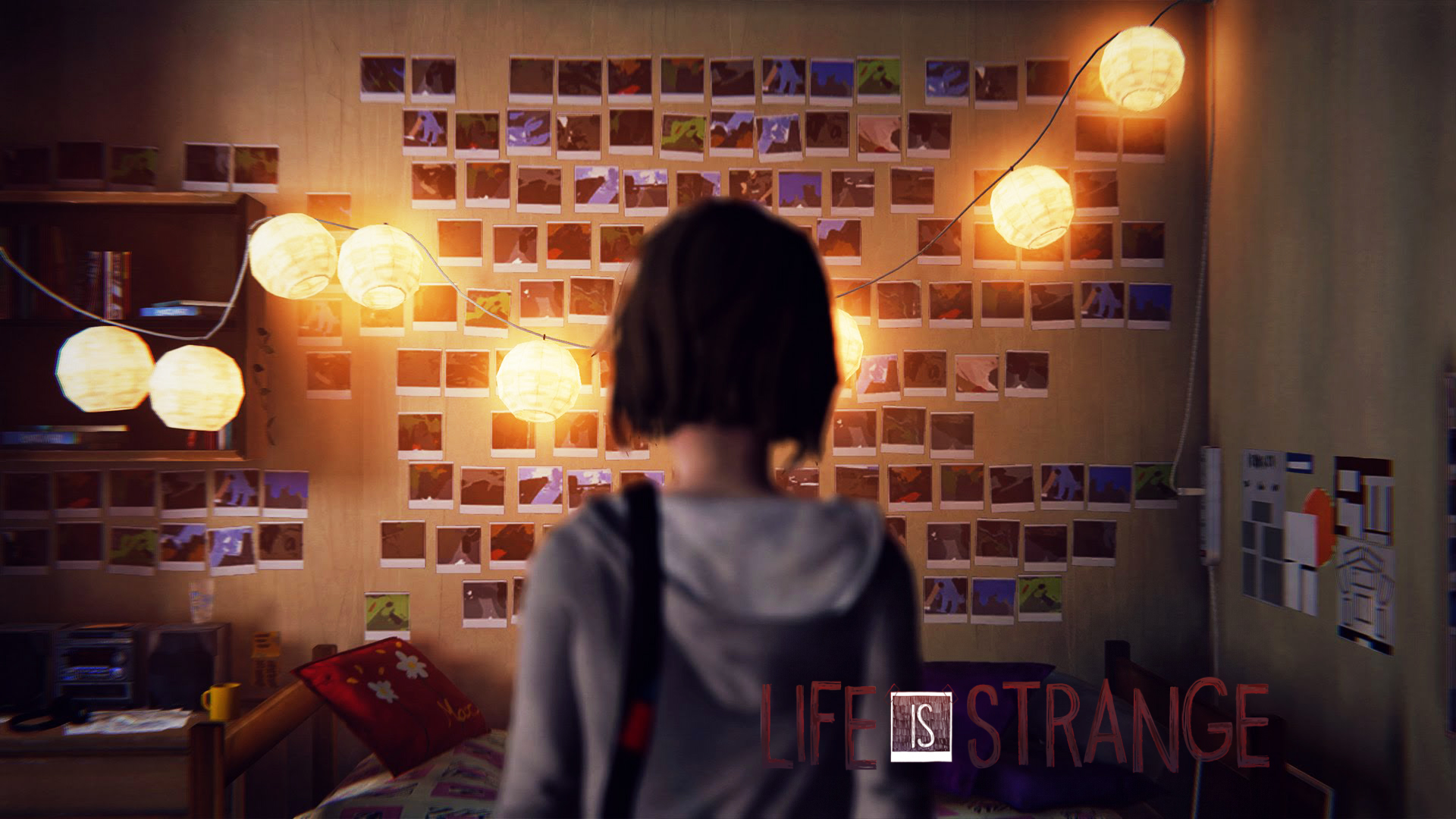
Oh god. Where do I even begin sorting these thoughts? Well, let's just get this out of the way:
SPOILERS. SERIOUSLY. DON'T READ BEYOND THIS POINT IF YOU HAVEN'T PLAYED THIS YET.
For real, Life Is Strange is certainly a contender for my Game of the Year, and the finale continued its trend of making me feel a diverse range of emotions (but mostly, sad). It's impossible to talk about it without getting into specifics, and if you haven't played it, I recommend you close this, download it, play it, and then come back. Don't deprive yourself of such a great story.
Let's start by backtracking a little bit to the events closing out Episode 4. When we last left our heroine Max Caulfield, she had been captured by the psychotic Mr. Jefferson and Chloe once again lay dead somewhere. The post credits scene was this disturbing sequence where we could see Jefferson filling his needle with a drug while a presumably tied up Max begged for mercy off screen.
And so, we dive right into it. The episode starts with Max coming to in the Dark Room, desperately trying to figure out how to get out of this situation. There isn't really much she can do, and her time rewind powers won't help much. Instead, she's able to focus on some pictures and jump into that moment of time. (I don't think I mentioned it last time, but on top of being able to rewind time, she can also transport herself back even further in time by looking at photographs - or moments of time captured.)
Most of the game is split into two main sections. There's the constant back and forth through large chunks of time as she tries to get out of her captivity. But it gets kind of confusing, and the effects of her timeline changes are unpredictable. At times, she finds herself coming to right back in the thick of things in the Dark Room. All of this is ultimately to find some way to save Chloe for a forth time.
The second big chunk of the game is this super weird dream sequence (or something?) that kind of doesn't make much sense, but it's weird in a really cool and interesting way. I suppose that this part of the game might be kind of "polarizing" among players, with some loving it and some hating it. (It does get really weird.) Personally, I was pretty into it. These sequences take place after Max figures out how to save Chloe, and she gets a huge headache which causes her to pass out as the giant tornado closes in on Arcadia Bay.
What I generally appreciated about the weirdness is that, for as weird as it is, it does make some sense. A lot of the things echoed in her mind are her insecurities and doubts. Many events of the past are replayed here, reminding players of their adventures with Max and Chloe. At times, other characters show up to question the choices Max has made - or more precisely, the choices you made.
Now it's time to get into the bigger specifics of what makes all of this work, so again, play the game first!
I think it was a pretty common thought among fans that the game might end with Chloe dying. Certainly, that seemed a likely outcome. It had been noted how frequently she seems to bite the bullet throughout the series. Everything starts when you encounter her getting shot and killed by Nathan in the bathroom way back in Episode 1. Then she gets stuck on the train tracks and gets run over in Episode 2. And then she's seemingly killed off for good at the end of Episode 4. With most of Episode 5 about finding a way to bring her back again, and with more weird stuff happening in Arcadia Bay, it certainly seemed like maybe Chloe was just destined to die, no matter how much effort you put into fixing it.
It all ultimately culminates in one of the biggest and most profound choices of the series. After figuring out how to "fix" the time line so Chloe is alive, she and Max kind of figure out what had been assumed for a while, but never really discussed: the weird stuff - the snow in July, the beached whales, the unexpected eclipse, the two moons, and the giant twister - were connected to Max's timeline altering powers.
As an aside, I really appreciated that they didn't really explain that very much. Sometimes less is more, and if they had spent too much time getting too into the nitty gritty details of how Max's powers were causing these super natural events, it could have come off as too "explainy," and likely would have been widely open up nitpicking. Instead, they just sort of go, "These things are connected!" and that's all there is to it. There doesn't need to be a greater explanation.
Anyway, Chloe gives you one last choice to make, and it's a doozy. With the tornado fast approaching Arcadia Bay, already having killed a bunch of people, she asks you to back in time to that first moment you "fix" the time line - when Chloe was killed in the bathroom. Worse, she asks you to let Nathan kill her. Interfering in the first place is exactly what caused this storm. And if Max doesn't go back to let it play out as it originally did, many more people in Arcadia Bay would die.
That's basically the choice: do you go back and let Chloe die, or do you let the storm hit Arcadia Bay and just move forward from there?
There are a number of angles I want to approach this from, so let's just break it down one step at a time.
First and foremost, this was yet another "Oooooooh man, WHY!?" choice to make. Life Is Strange does choices better than perhaps any other video game out there. It's done better than the decisions in Mass Effect, and it's far superior to anything in a TellTale game - especially The Walking Dead. This wasn't the first time I groaned very loudly, then took my time really mulling over the options. Sacrifice Chloe? Sacrifice Arcadia Bay? I feel like this should be an easy choice, but...it wasn't.
Games have long been introducing these sort of moral choices into the fold, but they've all been relatively simple. BioShock gave us the option to harvest Little Sisters for more Adam now, or we could rescue them and gain more Adam later. It was basically good versus evil. And there wasn't exactly much reason to care about the fate of Little Sisters. The Walking Dead often presented scenarios in which you had to pick which characters to save, but lacked much power behind them. When you're confronted with saving Sean or saving Duck, it doesn't matter. Sean dies either way; Duck lives either way. Choice is meaningless. Then later, we are forced to rescue either Carly or Doug. But there's no power there because we only get one measly conversation with each of them. That choice is basically a coin flip. (And also meaningless since whoever you save dies at the same point in Episode 3 anyway.) Mass Effect is a little better in that way when you have to choose between rescuing Ashley or saving Kaiden, again at the cost of the other. In this scenario, we have history with those characters. They're both part of our crew, and we've presumably had many conversations with them. It's still a little weak though, in part because they're both the brave and heroic soldier. They both knew they could die in combat when they joined the Alliance military. Plus, they aren't exactly the most interesting squad mates in the game, so it isn't much of a loss if you didn't use either of them in your party much.
At its core, the final decision of Life Is Strange is a classic thought experiment, and something people regularly debate. Would you sacrifice one life to save a hundred? Would you let a hundred people die if it meant saving 100,000? That hypothetical scenario is fairly straight forward for a lot of people, but in order to be so, you must break the lives down into numbers. It's mathematics, clean and simple. Of course a hundred lives are more valuable than one. One hundred is greater than one.
What this decision here does though is put context behind those lives. Would you sacrifice one life to save an entire town if that one life you were sacrificing was your very best friend? Would you sacrifice that one life if you knew the person and had an emotional connection to them? Even more, what if you spent a huge amount of time and energy specifically trying to keep that one person alive? And now you're being asked to sacrifice them? Is that one versus one hundred still that simple? It isn't very often that that hypothetical situation accounts for such connections and human emotion. Life Is Strange does though. That's what makes it tough. (It took me about ten minute to finally reach a conclusion.)
It's hugely and entirely heartbreaking. I was sad for Chloe, and I was sad for Max, and I was sad for Joyce and David. It seemed like they had finally figured out a way to make everything perfect, but doing so created the storm. There are some things you just can't change, no matter what. And there are things that just can't be "fixed." Sometimes, things just have to move forward, for better or worse.
If much of the focus on photography was about capturing a moment in time, then most of what Max is trying to accomplish is the same. Everything she does is about stopping time from moving on. Any time something drastic changes, she seeks to change it. In essence, she's trying to stop time from moving, like a photograph.
What makes this decision even more painful is the connection it has to the other major decision at the beginning of Episode 4. In that time line, Chloe is paralyzed and slowly dying. She's also very depressed as she feels like a huge burden on everyone. She asks you to kill her and put her out of her misery. When that choice came up, I just couldn't do it. I refused. I was unwilling to be the person who "pulled the plug" on her, as it were. And yet flash forward to the end, and they managed to present a scenario in which I suddenly had to agree. It was a tough pill to swallow, and felt all the more tragic as a result.
I don't know why, but I had some strange idea that this might end on an upbeat note. Maybe it's that the tone of the first couple episodes were so innocent, and Max is so pure and such a good person, I guess I just naively thought that she would find some way to have her cake and eat it too. Boy was I wrong. It makes sense though. Mr. Jefferson's whole schtick as a psychopath photographer was that he loved capturing that moment when someone young loses their innocence. The game functions pretty much the same, slowly removing the innocence from it until there's little left.
The final episode is sweet, strange, and horribly gut wrenching, but it's also nearly perfect. It works in a lot of the mechanics that made the game so strong in the first place. There's more "photo jumping" than ever. Time rewind is back and perhaps more significant than before. There are limited choices, but it features one of the biggest and toughest decisions to make in the whole series. There's still some uplifting moments with Max interacting with Warren and Joyce and even reconciling with David.
The general rule of thumb is to abandon hope that your game will have a great ending. It's hard to make a great ending to something people pour hours of their time into. I can probably count the number of games with a good ending on one hand. Yet I can't think of a game with a more emotional ending than Life Is Strange. I can't think of a game that made me feel such a complex set of emotions at the same time. I admittedly get a bit teary when I watch the series finales of my favorite shows, and I felt the same way here. It was just one big punch in the stomach.
Max is no longer innocent, and the game stopped being so well before the finale. But that time with an innocent Max and an innocent Life Is Strange is what makes that change so compelling and emotional. All of that is what makes Life Is Strange such a great game. Easily my Game of the Year, hands down.
Now I just need to figure out what I did with my tissues...
Thursday, October 15, 2015
VVVVVV (2010)
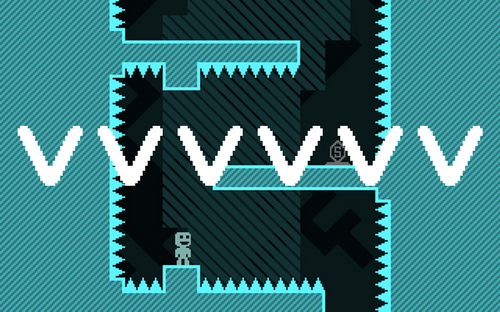
Are you one of those gaming fans who feels that games have gotten "too easy" lately? Do you miss dying a ton? Were games more rewarding when it had the potential to make you rage-quit due to its difficulty? If so, you'd probably enjoy the retro-style 2D platformer, VVVVVV - a fun, challenging game complete with a death counter, so you can see exactly how many times you died.
Nothing about the game is particularly complex. It's entirely built on one mechanical premise - what if instead of jumping, we simply flipped gravity? That's right, you can't even jump in the game. You're either touching the ceiling or floor, or you're falling toward one. Yet it's wrong to confuse simplicity with difficulty. The game is filled with challenging levels to navigate through that range from pretty straight forward to fairly elaborate and tricky. By removing any complexity with the controls though - quite literally, you will only hit the left arrow, the right arrow, and space bar - the game always feels within your control. When you die (and you will - a lot), it always feels that there's no one to blame but yourself. There isn't a strange glitch or a poorly designed mechanic, and even the levels - though sometimes having some pretty enraging design elements - never feel overly complicated. It's just...tough.
You begin the game on board a spaceship with six colorful little humanoids. The ship suffers some sort of strange malfunction which sends all the crew members scattered all over another dimension. As Captain Viridian, it is your job to navigate the minefield of spikes and jumps trying to find your crew. Spread throughout are also little orb prizes, as well as computer terminals that fill you in with the story of what exactly happened. (It's actually kind of like the way The Swapper tells most of its back story.) When you find a crew member, you're often near to a teleportation device which warps you back to your ship.
As simple and straight forward as the game is, it's surprisingly not that linear. Yes, when you are inside of a level, it's pretty clear where you're going; there's only one path. However, there's no specific order in which to do the puzzles. You're given a large area to search through in order to even find the next puzzle, so you also have a feeling of exploration as well. However, it can be a negative thing. After about twenty minutes of play, I made my way through the early, relatively easy part of the game and accidentally stumbled upon one of the really difficult sections. It's worth noting that you can always leave and go back to that area later when you get more experience with the game, but it can be a bit overwhelming to find yourself trapped in the middle of one of the trickier levels too early.
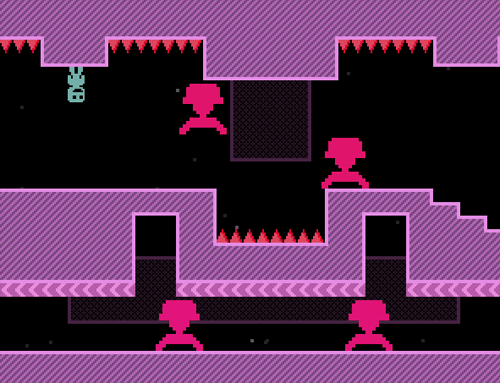 |
| It's a good game to test your reflexes on. Got to be quick! |
VVVVVV is not really a punishing game, despite it's level of difficulty. To give balance, most screens have a check point so when you die, you respawn right there. Though making it through some sections can be really challenging, it's not trying to make you rage-quit. It's a bit like Thomas Was Alone in the sense that it wants you to succeed; it just doesn't want to hand you the objective. You have to earn it. At times, the level can be so tricky that you have to just call it a day after fifteen minutes. The game is short (I beat it in about two hours and fifteen minutes), but each individual screen can be crossed in anywhere from three seconds to thirty minutes. It's easy to get stuck on one screen for ten minutes, then take a break because you just get so frustrated trying the same thing over and over and over and over again.
Yet it's weirdly addictive. It tests your patience here and there, but overall it always maintains the fun element. A couple of my house mates are online gamers who play things pretty seriously, and you can always hear them shouting in frustration when they fail. It's always filled with a bit of rage. While my loving nickname for this game was "God Damn It!" I never felt that kind of anger playing it. The frustration built on several levels (particularly near the end of the game and a section where you have to survive an onslaught of incoming bricks for a full minute - which I'm pretty sure is impossible to do in one try), but it was always a curse shouted followed by a laugh.
One other time, near the end, I got stuck on a section for what must have been about thirty minutes. (Time flies, by the way. You might find yourself saying, "I'll just try this bit for a few minutes," then realize you've been attempting to get through that part for an hour.) It was at that point that the frustration started to boil over and I thought, "This is getting dangerously close to not being fun anymore." About thirty seconds after that, the trial and error saw a major breakthrough and fifteen minutes later I had beaten the game. Granted that's primarily on me as a player, but I thought it was the mark of a well designed game intending to be challenging, but not trying to get me to rage-quit.
Apart from its Commodore 64 inspired visuals and rewarding challenges, the soundtrack might just be one of my favorites out there. Like everything else, it is retro-style chiptune. It's so energetic and fun that it helps ease the frustration. The soundtrack alone is probably worth picking up separately. (The game is called VVVVVV because all six crew members have a name that begins with V. The soundtrack is similarly called PPPPPP and features songs that only start with that letter as well. It's a strange sense of humor.)
Generally, I don't subscribe to this ideology of games being "too easy." I acknowledge that this is true; that a lot of games are easier than older games, but I don't buy that as being a bad thing. (Did I review the first Final Fantasy game here? That game was torture and it felt like work to get through it.) VVVVVV mixes linearity of platformer levels with open exploration of the world. It's simplicity makes you as the player feel completely in control. The score is awesome. And it's challenging without being built around making you fail. Even though it wants you to muscle through and succeed, it still feels extremely satisfying to get through the challenges.
And it's only $5 on Steam. You won't necessarily get a ton of time out of it - it took me a little over two hours over about a week (off of 873 lives) - but I'd definitely say it's easily $5 worth of enjoyment.
Subscribe to:
Posts (Atom)