Thursday, October 19, 2017

Monsters (2010)


(Preface: This is a slightly edited repost from my old blog. It was written in either 2011 or 2012. I have added a few thoughts from here in 2017, indicated in italic parentheses.)

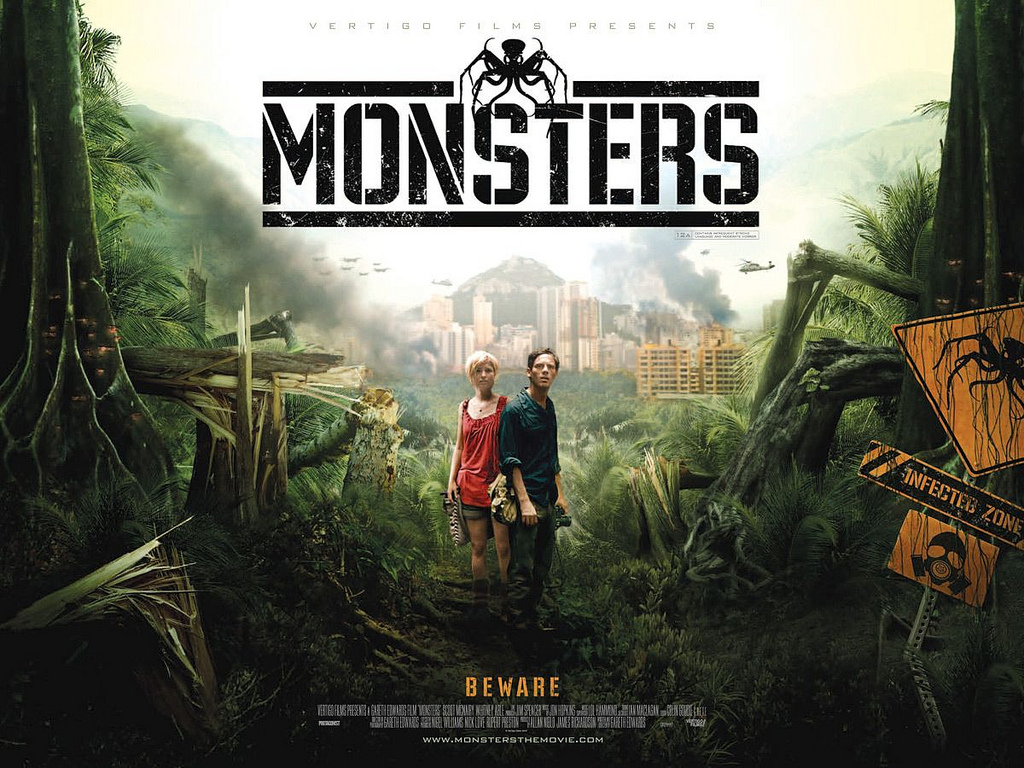
The first feature film from director Gareth Edwards, 2010's Monsters is something of a 28 Days Later movie for the monster genre. It's a pretty simple story, following photographer Andrew Kaulder as he is given the task of bringing his boss's daughter Sam home to the United States. It's basically a road trip movie with a love story at the core. And, of course, there are giant alien creatures that destroy cities and trucks.

Monsters is practically the definition of guerrilla film making. With a budget of $500,000, the film is shot entirely on location throughout five different central American countries. Often, they would have to move quickly to shoot scenes without disrupting the every day life of those places. They also would make up scenes on the spot if they found something that looked visually interesting. The best example of this was the scene with the candle light vigil. Edwards and crew just stumbled upon the Day of the Dead celebration in Mexico. Seeing this, Edwards gathered the actors and crew to come up with a scene that could utilize the event around them. They then found a place to put it into the film. The end result is a tonal shift that really enhances the sense of devastation from the creatures. This is generally how they shot most things.

Edwards does an excellent job keeping the focus on just these two characters while giving a sense of scale with images of destroyed buildings and boats in the background. With a lot of monster movies, you don't really get a sense of the ground level. We tend to see the larger impact of the beast. It's threat is global. Here, we just get a taste of the larger scale, but we ultimately connect to the human cost of giant monster attacks. And when we finally see the beasts in action, the graphics are solid with a good sense of fear from the characters. Instead of pulling back to show us the entire attack, we get shots of the attack from Sam and Kaulder's perspective, making it feel more personal.

The chemistry between Kaulder and Sam is a little rough at first, but builds over time. Some dialogue seems forced or poorly prepared (as they probably made it up just before the shoot), but overall, they do seem to genuinely connect. This is probably in large part due to the fact that actors Scoot McNairy and Whitney Able are actually married in real life. Able plays Sam, a young woman adrift in the midst of an unsure engagement. McNairy plays Kaulder as the annoyed babysitter who wants nothing more than to stay in Central America to take an award winning photograph of a real live monster. Kaulder is impatient, often bordering on outright mean. It's a little unclear why Sam can't just take herself home when she seems to have more money and has an actual grasp on the language (she speaks it fluently while Kaulder can only give an awkward "hasta luego" at times). In this way, the basic premise of the plot is a bit contrive, with the owner of the publishing company Kaulder works for issuing an ultimatum to bring his daughter home in the aftermath of a creature attack.

What makes the beasts seem even more frightening is the real footage put in. Often, we see CGI boats or buildings destroyed in the background of shots, but Edwards also makes it a point to shoot scenes anywhere there was real rubble. In the first scene after the opening credits, we see Kaulder walking up a hill of rubble and broken buildings as he searches for Sam. All of it is real. Similarly, when they get to the destroyed town in America, a storm had just hit and the town really was devastated. There's also a cool shot of a road that just seems to end. The road had been wiped out by a flood prior.

The CGI looks pretty good too. Granted, there ultimately isn't much of it which winds up being the best thing for the film. It's reliant on post production CGI to show the power of the creatures, but it's still used sparingly. This is ultimately a movie about the people, not the monsters. Most of the CGI used winds up being used to put signs into the backgrounds! Tension is created through implications - kind of like how Steven Spielberg had to get creative due to the technical difficulties of the mechanical shark in Jaws.

A lot of people have complained that it's kind of a boring movie and nothing really happens. It's more personal in scale and a bit more somber in tone than typical monster movies, to be sure. And for a movie called Monsters, you only really see them a handful of times. You don't really see them attack anything except a couple of trucks. Still, once they get to America, things get particularly interesting. As a lifelong fan of the genre, it is among my favorite sequences ever in the category of "monster flick."

The final sequence makes the whole movie, really. In an abandoned part of America, Sam and Kaulder find a gas station which they use to call for help. The military is dispatched to rescue them and they're left to simply wait. While they wait, Sam calls her annoyed and overly concerned fiance while Kaulder calls his child. All of the things they've discussed on their travels come to a head here that culminates in a monster investigating the gas station.

The scene starts off as something of a nod to The War of the Worlds. Sam is alone inside the building when she hears the door open. Thinking it's Kaulder returning from the payphone outside, she looks happy for a moment before realizing that instead, it's the long, creepy tentacles of an alien creature. The tentacles investigate the store for a few minutes while Sam struggles to keep it together. Meanwhile, Kaulder is powerless to do anything but watch from outside. It's a pretty tense moment!

A second monster shows up and the two creatures proceed to connect via several tentacles and - presumably - mate. While this happens, Kaulder is still motionless outside watching. Slowly, Sam comes outside to watch what is transpiring as well. As the two creatures intertwine with each other more and more, Sam moves closer and closer to Kaulder.  By the time the creatures are done and move on, Sam and Kaulder are finally in the same shot together. In the background, we hear the incoming humvees and helicopters of the rescuing military party. Finally, Sam admits that she doesn't want to go home. She essentially admits that whatever is waiting for her back in the safety of her normal life is scarier to her than these creatures. The two finally kiss before the military shows up and pushes them into separate humvees.

It's a sequence that goes all over the spectrum. It starts off tense and frightening and ends up with a display of honesty and beauty. These monsters aren't really monsters. They're just creatures, doing what they do. The way that Sam and Kaulder kind of parallel the movements of the monsters is perfect, and suddenly everything makes sense.

The film is essentially just the story of these two characters set in this environment (and there are a number of plotholes, but they're not huge or distracting). It's possible to read into the film a number of different ways. From the outset, you get a sense that it's trying to say something about immigration. The "Infected Zone" is from the middle of Mexico to the border of the United States. The US's response is to build a giant wall at the border to keep the aliens out (this aspect takes a whole new focus given the political climate of 2017). Meanwhile, good, hardworking, family oriented people are being kept out of safety as a result. It could also be argued that the film is a way to show how perilous the actual passage to the United States can be. The messages here seems clear.

Still, the wall ultimately fails and when Kaulder and Sam get into the United States, they see good ol' American towns destroyed by the aliens. If we were to continue the immigration metaphor, it would then suggest that the aliens will get in anyway. And not just that, but destroy America as well! These are both easy messages to take away if reading too much into it. At the end of the day though, it seems pretty unclear if Edwards was trying to say anything at all on the topic.

Monsters isn't for everyone. It isn't action packed and can feel a bit slow-paced at times. Its guerrilla style film making makes it seem ultra-realistic at times while seeming forced at others. It abandons a lot of typical monster movie tropes. Similar to how Danny Boyle wanted to explore life after the breakout in 28 Days Later, Edwards wanted to explore life after the initial monster attacks. It's a place where everyone carries a gas mask and destruction is just part of life. Seeing destroyed tanks or dead creatures is completely normal. This change of pace makes it one of my favorite movies of the past few years.

As a side note: this film ultimately got Gareth Edwards the job for the Legendary reboot of Godzilla. Though I happen to still have some doubts, the way that Edwards showed the dark, human costs of monster attacks in Monsters gives me a lot of hope for his take on Godzilla. When he started work on Monsters, he said he just wanted to make a monster movie. And now he gets to make the mother of all monster movies. (Follow up a few years later: it seems like the concerns were merited, but that the strengths Edwards showed on Monsters proved beneficial to Godzilla as well. He definitely did more than most Godzilla films to show the dark, human cost, and his eye for scale stood out as well.)

Thursday, October 5, 2017

Oxenfree (2016)


The idea of a suspenseful horror mystery game in a two-dimensional, cartoon-ish animation style doesn't sound like it would work out too well, but Oxenfree manages to pull off an eerie atmosphere with great effect. An indie game from 2016, it has generally fostered positive reviews for accomplishing so much with so little. Some might find it a tad slow and boring, but it executes a number of things really well.

Playing a bit like a teenage coming-of-age movie, the primary focus is the narrative. Five young adults go onto this abandoned island for a night of celebratory drinking and rabble rousing. Along the way, they discover strange radio signals that, when picked up using a radio, distorts reality. For a while, it is unclear what exactly is happening. Is it ghosts? A tear that connects to a parallel universe? A time loop? Friends get possessed, situations and conversations repeat, and new mysteries and backstory about the island are uncovered.

Oxenfree is a game easy to recommend to fans of Telltale games like The Walking Dead or Game of Thrones. In fact, one of the co-founders of this game's studio specifically worked on The Wolf Among Us. The influence is obvious from the core mechanic of the game: making choices through dialogue options. What's nice about Oxenfree compared to other decision-driven games is that conversations occur without interrupting. Players can walk and talk at the same time, no longer beholden to cutscenes or restricting conversation sequences that trap players in that moment until the talk is over. Speech bubbles appear above the protagonist's head, adding to a cohesive art style as well. It looks a bit comic book-like, so the speech bubbles enhance that.

The downside, however, is the same as it always is for these types of games. As intriguing as the story might get, there still isn't ultimately that much for the player to do. There is even less to interact with in the world of Oxenfree than that of a Telltale game, or Dontnod's fan-favorite Life is Strange. While Telltale has made efforts to expand a bit beyond the basic mechanic of choosing and Dontnod introduced time rewind powers to the formula, Oxenfree offers little else beyond walking and, well, talking.

The flip side: it handles decisions more organically. One of the problems with something like The Walking Dead is how unnatural some of the dialogue is, and how "gamey" it feels once you go from walking around, pointing and clicking, to engaged in conversation with a character. They also get pretty obvious when you are making a choice clearly meant to impact the story. In many cases, decisions are pretty binary as well. Save Doug, or save Carli? While some of the writing and voice acting in Oxenfree is less than stellar (undoubtedly connected to the fact that it is a small studio indie game), dialogue and choices are presented in a more realistic fashion, with a more natural flow. The best choice-driven games don't make it so obvious when you're making key decisions. Oxenfree doesn't completely avoid this trap, but it manages to create a more honest mechanic.

Perhaps the most impressive aspect of the game is how unsettling it is. One would not expect a side-scrolling, 2D walk-and-talk game to create a disquieting atmosphere, but Oxenfree manages to do so through audio design and some image distortions to great effect. The use of radio and television static is surprisingly efficient at crafting an eerie environment. It can be startling to be playing a game that suddenly cuts out and starts looking warped, as if something has possessed your television and the game, just as the other beings possess the friends. "Terrifying" isn't an accurate way to describe it, but it is shockingly off-putting.

It is a little tricky determining who to recommend Oxenfree to. It isn't so amazing that I would recommend it to anyone and everyone, the way I would, say, Little Nightmares or Horizon: Zero Dawn. At the same time, it does things a little more subtly than something like The Walking Dead and has fewer mechanics than Life is Strange, so there might not ultimately be a ton of crossover there (although, certainly, if you are into Telltale games, you will likely be more receptive to Oxenfree). The pacing is a little inconsistent, and it takes a little while before the good, weird stuff breaks out in earnest. Even then, many might still find it a bit boring. If you're into narrative-driven games with choice-based mechanics, however, and a single, cohesive style and spooky atmosphere, then this is a game you might want to check out.

REDUCTIVE RATING:  Pretty Interesting / Worth Checking Out

Available On: PS4, XBoxOne, Nintendo Switch, Steam, iOS, Android


Thursday, August 31, 2017

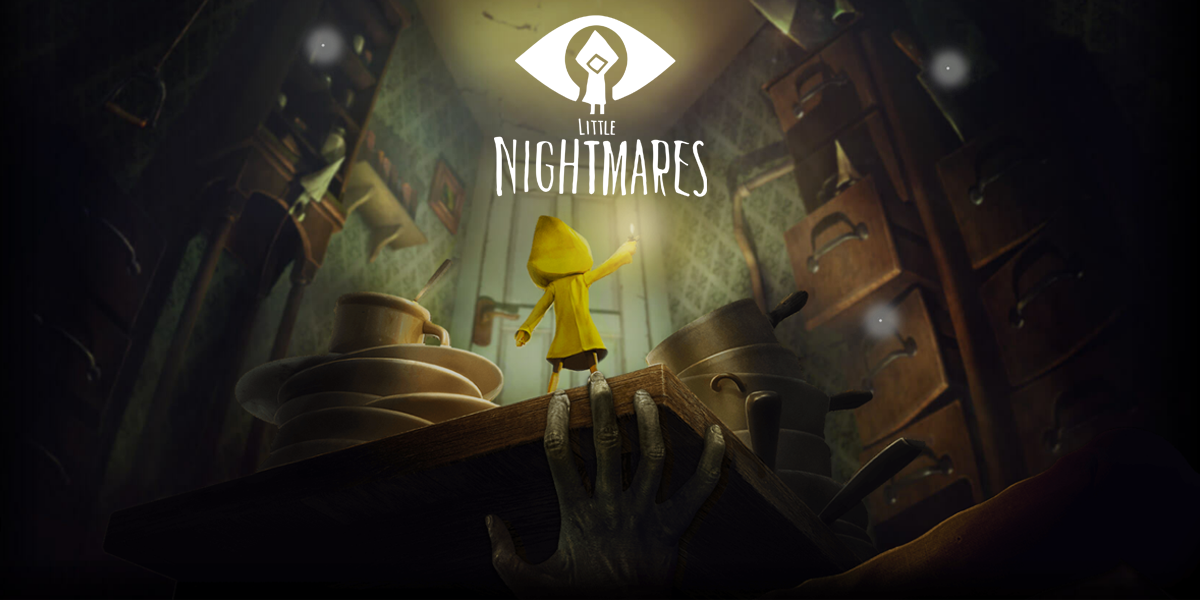
Little Nightmares (2017)


Every once in a while, a game comes out of nowhere and completely blows you away. I can't even remember how I heard about Little Nightmares, but it very quickly shot up the ranks of favorite games of 2017. It has all of the ingredients necessary for being an indie darling, and it lives up to the standards established by other, similar horror/platformers like Limbo or Inside.

In fact, it is almost impossible to discuss Little Nightmares without comparing it to Inside. There are many noticeable similarities between the two. Both are ultimately side-scrolling, horror, puzzle platforms that are mechanically simple, yet shockingly challenging. You will fail a fair amount. Both also rely heavily on background and world design to convey a dark, discomforting environment. What either game is actually about is open to interpretation, but there is no shortage of environmental design elements that push a disquieting atmosphere. If the world in Inside is mysterious and subtle, however, the world of Little Nightmares is a bit more upfront. Creepy humanoids giving chase are replaced by disfigured and disgusting beings that are only slightly human.

What Little Nightmares has going for it is a bit more cohesion in its art style and tone of adventure. Most impressive is the effectiveness of an almost claymation-like look to both the characters and their movement. It almost feels as if you are playing in a darker, somehow stranger Tim Burton movie. It's astounding how such a style can create so many terrifying and discomforting creatures and moments. Not only does it give the game a unique visual element that separates it from so many other games; it goes a long way to making players feel anxious.

A key difference from comparable games (like the aforementioned Limbo or Inside) is that it uses the foreground and background, whereas those other games have you move only left and right. The end result of allowing front and back movement is a depth that makes platforming moments more challenging. That, in turn, also adds to the tension since screwing up an angle can result in being caught by one of the pursuing monsters.


As the game progresses, things get even more twisted and frightening. The penultimate "level" involves sprinting by a group of fat, gigantic, disturbing people hellbent on eating you. They spill down the stairs and crash into the hallways in pursuit, almost as if they were in a Dark Miyazaki universe. I found myself gripping the controller so tightly that my fingers were sore, all because I had turned into a ball of stress! And, somehow, the final section gets legitimately scary! (I had yelped out lout a few times trying to beat the last monster/boss.)

Like Inside, one of the best aspects of the game is how little information it actually feeds you. Upon completion of the game, I immediately dove down the internet rabbit holes for theories of what it all meant. The game is filled with messed up concepts - like the consumption of children - and even a fair amount of Holocaust imagery. The little kid that is controlled by the player even has moments that are startling! Additionally, the complete lack of clues or pesky control reminders makes advancing feel even more satisfying. Many major games tend to hold your hand, making sure you never get stuck. This - like Inside - never gives clues. It never explains anything outside the basic controls at the very beginning of the game. Getting through the next section is incredibly satisfying because you can feel your brain putting it all together.

Perhaps the hardest thing to talk about is just how surprising it was. While a comparatively short game, it is also one of those things where the less you know, the better it is. For me, it started strong and finished stronger. I had no idea what the game was or what was in store; I loved every second of it. It's a small game that came out of nowhere to become one of my favorites in years. In fact, I'd argue it's better than Inside (even if just slightly). I want to rave about it more, but I also don't want to ruin any part of it. Suffice it to say, this is one that I will regularly recommend to people.

As an aside, I would also recommend checking out the DLC. "The Depths" was one of the most tense levels of any game I've played. Essentially, recall how horrifying and stressful the "mermaids" were from Inside, then stretch that out for an entire DLC package. (It's also cool in the way that it sort of recycles levels from the main game, but in different ways.)  I'm not a big fan of DLC overall, but it's definitely worth it.

REDUCTIVE RATING: Amazing! Definitely play it!

Systems: XBox One, PS4, Steam


Tuesday, August 15, 2017

The Last of Us (2013)


Naughty Dog had already wiggled their way into the top spot of cinematic gaming experiences through the Uncharted series, but they cemented it with 2013's The Last of Us. Building off of the adventures of Nathan Drake, they provided a surprisingly refreshing take on the action adventure genre by mixing it with survival horror. To top it all off, they provided some of the best writing and acting seen in video games to date.

It is ultimately difficult to discuss The Last of Us without bringing up spoilers, so be warned that there will be pretty big ones present throughout the piece. Additionally, it is a game in which two aspects are both intrinsically connected and divorced from each other: the gameplay and the narrative.

On the game side, it does a number of things incredibly well. Taking from the survival horror genre, it does a nice job creating tension through tough enemies. Effectively a "zombie" game, it takes its cues from the likes of Resident Evil in that you don't exactly want to run into them. The satisfaction does not come from mowing down endless rows of mindless bodies rushing as a hoard. Rather, getting through the section in relatively good health is ideal. To do so often requires a mixture of stealth and action. Some enemies are nearly impossible to avoid, and thus, you must be ready for a fight. Others give you every opportunity to either sneak by or quietly take them out. Players have to get comfortable doing both to succeed.

Resource management plays a role in the atmosphere as well. Looking around the maps, items can be collected to use for things like molotov cocktails or pipe bombs. Melee weapons can be reinforced, and med-kits can be crafted. To build them, though, requires a safe space out of trouble. The game does not pause while in the crafting menu, so players must be aware of their surroundings, lest they be attacked unprepared. Plus, all items have dual purposes. The ingredients required for a molotov are also required for med-kits. The necessary goods for nail bombs are also required for shivs. It effectively forces one to make key decisions about how to allocate those sources. Shivs are important for opening locked doors filled with items, as well as to escape the clutches of Clickers (which insta-kill you). Yet nail bombs are extremely effective for dealing with large numbers of enemies.

Ammo supplies are also limited. While there are various types of firearms to be found and used, there isn't a ton of ammunition to be found. This, mixed with limited resources, encourages players to act more deliberately or use stealth as much as possible. Confronting enemies - both human or infected - can go very poorly, very quickly.

While these are fun components that maximize the tension and dread, they are also limited. It would not be unfair to argue that there aren't enough ways to utilize the resources collected, or that the AI of enemies isn't exactly smart enough to feel all that exposed when crafting. On "Normal" difficulty, the game also provides more than adequate amounts of resources and ammo to make it through. Then, there's also the "listening" ability that allows players to see where enemies are, if moving.

The game works completely fine as a stealth adventure horror one, and it does these things really well, but it is not off-base to argue it is also pretty limited in scope. This doesn't mean it's bad; just that it isn't quite as revolutionary as many critics make it seem.

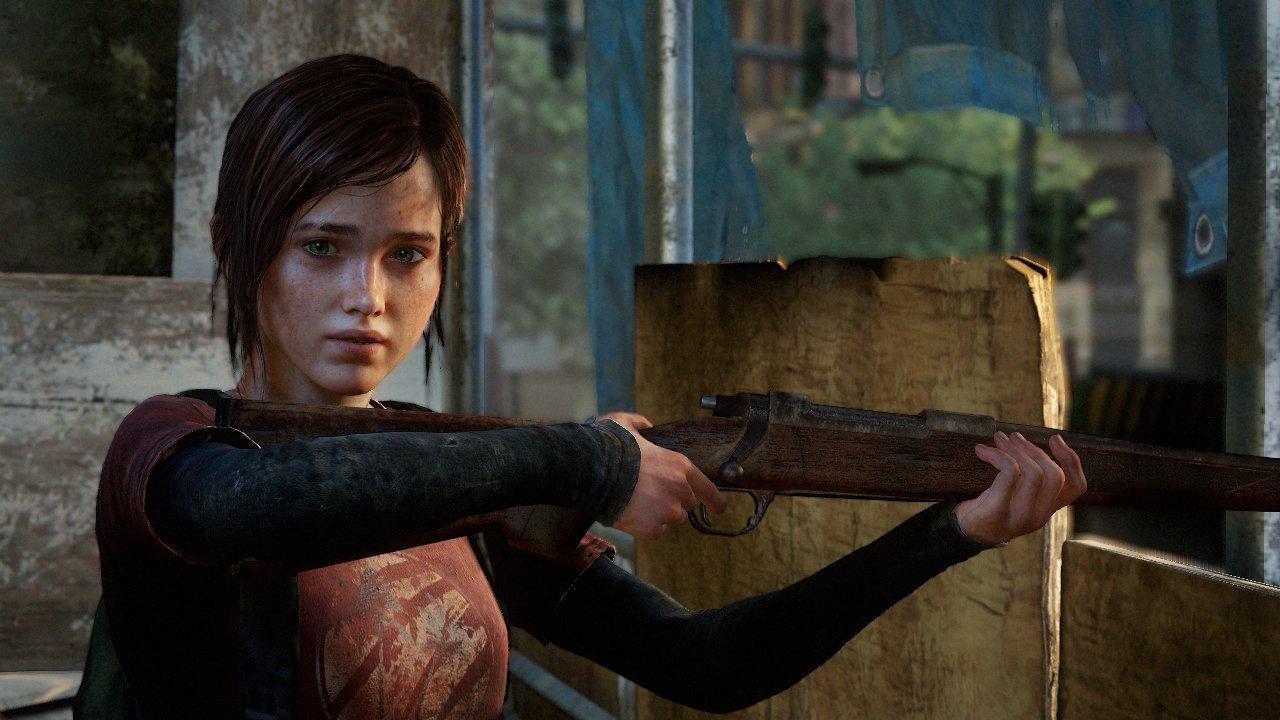
Gameplay itself is pretty tight, especially for a game reliant on an AI companion. Ellie, the young girl Joel (the player) is charged with escorting to Salt Lake City, becomes increasingly empowered throughout the game. At first, she mostly just runs around shouting profanities at enemies. Eventually, she is a full-fledged partner, throwing bricks and stabbing/shooting them as well. This, interestingly, does not make the game ever feel easier. Sometimes, there are some awkward moments of trying to get around each other, but it's overall really smooth.

Perhaps the most well-done aspect is in the level design. Where Uncharted games often feel exactly like the hyper-linear corridor it is, The Last of Us feels a lot wider. It is true that there is only ever one direction to end up in. There is no backtracking, nor are there multiple exit points from a level. It is, by every measure, a linear, narrative-driven game. That said, maps are often large and detailed enough that there is plenty to explore. The world within the game provides many narrative context clues, as well as exposes players to optional conversations and notes left behind, which also provide a shocking amount of emotional impact and insight into the history of this place. In combat scenarios, the open spaces go a long way to the feeling of insecurity. There are very few places to hide in which there isn't a "behind you" to watch out for. It feels both realistic and dangerous, getting players to really observe their environment.


The worst aspect of the game, as is a bit typical of Naughty Dog, is how often it forces players to play a particular way. For most of the game, the agency is in how to approach an area. Just sneak by? Try to go all Predator on them and take them out one by one? Set some traps and then go all Rambo on them? The choice is yours! Except when it isn't. For "cinematic" purposes, the game will often throw you into a scenario that allows for only one style of play. These aren't necessarily "bad moments," but they do sort of run counter to the design of the rest of the game, with its combat and maps that are very in-tune with one another and satisfying.

Of course, The Last of Us would not likely be considered an all-time great if not for its story and characters. Without question, it provides one of the most well-written narratives, filled with parallels and subtleties. Characters are surprisingly well-defined, given most of them are only in it for a stretch. And, of course, the relationship between Ellie and Joel develops in a truly organic, believable, and compelling fashion. It's easy to look at it from just Joel's perspective, being that of a father who's lost everything finding something to care for in a surrogate daughter (Ellie). It is not just his story though. Ellie doesn't exactly fit that perspective, as Joel never quite feels like her surrogate father. Instead, he is just someone who has been able to stick around in her life. Given her rather quick bonding to Tess and Sam, she's substantially more balanced as a person. More welcoming and empathetic than Joel, it isn't even ultimately a story in which both must learn from each other: Joel to be more empathetic and caring from Ellie, and Ellie to be tougher and colder for the sake of survival.

It seems that, too often, more is made of these dynamics than are truly there; at the end of the day, it is about two people making an unlikely connection. The characters are written and performed incredibly well, which breathes further relatability into everything. Under it all is a dark sense of humor, too. Overall, the story is structured intelligently. Broken into seasons to function as "acts," it gets progressively darker before finally having it all fall under them. The opening and ending sequences serve as nice, opposing book-ends. And every character introduced along the way has some thematic relevance to the two central characters.

The Last of Us is aided by having one of the best endings, leaving a ton of room for interpretation and discussion. Does Ellie know? She's had such good bullshit detection the entire game, surely she has to know Joel is lying? Is Joel the bad guy? Did he just screw over humanity for selfish purposes? What about the Fireflies? Up until the end, they were presented as humanity's last true hope. Were they in the wrong? Did they have a point? Was Marlene a sympathetic figure? There is so much to go over. The abrupt, unsatisfying ending is perfect in the way it generates player interpretation. A nice, succinct, simple ending is nice once in a while, but give me the dark, deep well, the juicy, meaty ending I can sink my teeth into any day.

As a whole cohesive unit, the narrative and design often work well together. The epic adventure aspect of the story fits perfectly with the linear design of the game. The story creates an urgency to get through it, which perfectly distracts from any desire to really do greater exploring. Everything about the game keeps pushing you forward. The way Ellie grows as an AI companion in conjunction with her growth as a character is great, and further provides context for her and Joel's bond. The limited resources and tough enemies match the dark, intense, and disturbing world.

There are some missteps, to be sure. The inclusion of "puzzles" to do with Ellie or another AI partner are never difficult and feel very "gamey." A misguided "boss fight" near the end is a bit disruptive. There are even some cutscenes that run contradictory to the rules of the world, such as that Clickers can't see you - they follow you through sound - but you are encouraged to hide when they show up. There are other elements that remind you you're playing a video game, but it isn't inherently bad. It just creates a little bit of dissonance between the narrative and gameplay.

Most of the problems are incredibly minor and don't distract from the game. Everything is made substantially better with an original score from Academy Award-winning composer Gustavo Santaolalla. The game is aided even more with a great piece of DLC in Left Behind, which actually improves the basic gameplay in a few ways. The game might not be for everyone, with its horror roots making it both a bit harder than an adventure game and a lot more violent (in fact, it features one of the few video game moments in which I actually cringed from it), but for those with an appreciation of what the medium holds for the potential of writing, director/writer Neil Druckmann has offered up a master class.

REDUCTIVE RATING:  Incredible!

Available On: PS3, PS4


Saturday, July 22, 2017

Dunkirk (2017)


It can be something of a daunting experience going into a Christopher Nolan film. One of the more interesting directors able to make big budget, original content in Hollywood, Nolan has established himself as something of a mix between a good M. Night Shyamalan with a Michael Bay who reads books.* The grandiose, epic shots and staging makes for incredibly compelling cinematic experiences, while the thematic - sometimes ambiguous or abstract - nature of his stories often require a bit of a "twist."

Shyamalan is a filmmaker who trapped himself as a schticky director, always feeling and forcing a big, shocking plot twist. The end result is that most of his films disappoint. Nolan frequently relies on a schtick as well. Think of how Momento deals with time, or Insomnia making it so the character doesn't even know the reality of the death of his partner. The Prestige has its big reveal at the end that changes things, or Inception never makes it clear what is real and what is a dream. And, of course, Interstellar does a whole big thing about love transcending time. So when you see a Nolan-directed feature about the battle at Dunkirk in World War II, it's almost...strange. 

What unfolds in Dunkirk is very much not what one might expect from another director. This isn't some gigantic adventure tale a la Steven Spielberg and Saving Private Ryan. However, it is very much what one might expect from Christopher Nolan. Warring isn't so much the focus here as much as it is the sense of isolation and a sense of impending dread. It primarily follows three stories: a fighter pilot, a few soldiers desperate to get out of France, and a civilian boat headed to rescue the boys. Cutting among the three lines, the film is constantly showing what could be a narrow escape, only to have things fall apart at the last moment. Rescue boats are loaded up, take off, and are almost immediately bombed by the Luftwaffe. The soldiers find solace on a destroyer, only to get sunk by a u-boat shortly after. 

The feeling of being completely cut off and unable to flee is enhanced dramatically by Hans Zimmer's score. It probably isn't too much to call it one of his best ever. The music takes an even more prominent role in the film in large part because of how little dialogue there is. Characters don't talk to each other for almost ten full minutes. Though there is plenty of death and destruction, gunfights aren't really a prominent thing (outside aerial ones), so you aren't often overwhelmed by constant sound effects all the time either. The music is front and center, and goes a long way to creating that tense atmosphere. 

The cinematography is gorgeous, with many beautiful shots showing large groups of troops or ships. Dunkirk might be one of those films where the "Making Of" featurette might be just as interesting, if not moreso, than the film itself! Nolan has generally always made good use of practical and special effects, and you might find yourself wondering what shots are of real planes or ships versus real ones. Seeing it in IMAX or XD is probably worth it, especially for the sequences of the aerial battles, but it didn't look like any scenes were specifically filmed for it. The aspect ratio never changes, which is nice (something that probably doesn't annoy anyone other than me as a projectionist), but it's always a bit frustrating when you pay extra for a larger screen and they don't even take advantage of it. I'm still unsure why you'd put a movie in the 2.4 aspect ratio in the theater with the tallest screen. 

Of course, being Nolan means that it can't just be a straight shot. Though he does no big, weird thing at the end, per usual, he still just can't tell the story outright. Instead, he unveils everything through non-linear timing. It starts at a specific point, and then ends at the end, but those three arcs in between those points jumps around. There is a stretch of maybe half an hour that cuts from day to night to day to night without batting an eye. It's actually a bit confusing to watch, in party because it isn't really clear that the film is non-linear until that stretch. Unlike other elements of the film, like the cheesy dialogue from Kenneth Branaugh's Commander Bolton, it's a little unclear what purpose it even serves. It doesn't exactly enhance the theme of the film, nor does it really do anything to increase the tension and dread. It just makes it confusing - and in a way that doesn't make any contextual sense either. Why they can't get out of France is made painfully obvious throughout the film, so it isn't exactly like they want you to feel "as confused as they are." And it isn't like the goings-on of the escape are disorienting on a ground level. 

No, it just feels like Christopher Nolan had a totally fine, straight-forward film and had to do something to spice it up. Like the reveal of The Prestige or the writing of Anne Hathaway's speech in Interstellar,  it doesn't entirely work. Like those past films as well, it doesn't break the film by any means. It's still a very good film. It's just a strange decision that doesn't improve the movie. 

In that way, Dunkirk is the perfect example of my complaints with Nolan as a director. I have liked everyone of his films; they are all very good - borderline great, even. But there's just always something he does that doesn't quite work, and it kind of takes away from it. Dunkirk is absolutely worth seeing. It actually does do enough things well and interestingly that it feels unlike most war movies that came before it. At the same time, it falls just short of being great because the cheesy dialogue is a bit too in-your-face for its own good, and the non-linear timing just makes the film itself confusing at times. It's no infinite, cosmic, cross-dimensional book case, sure, but it's still a fairly flawed, very good film. 

REDUCTIVE RATING: Pretty good!

*I co-opted YouTube film critic MovieBob's description of Nolan, and mixed it with my own, since I don't think either of ours is complete without the other. I can't take credit for saying that Nolan is like Michael Bay for people who read books. 


Thursday, June 29, 2017

Baby Driver (2017)


WARNING: SPOILERS PRESENT THROUGHOUT THE WHOLE PIECE.


Edgar Wright is a fan of many genres. Every one of his films has included a heavy dose of nods, references, homages, and influences of previous classic films of a particular genre. Baby Driver is no different, lifting heavily from the heist/car chase repertoire. What makes it stand out, however, is the way it utilizes the soundtrack.

It's not quite accurate to call the film a musical, although it's easy to see why some have jokingly done so. It isn't even a movie about music, a la La La Land. Rather, the music drives everything, from the story pacing to the character beats, and especially the action. Everything is meticulously synced up to the soundtrack. We've seen this before from Wright. You can find little examples of this in prior works. Shaun of the Dead's scene in the Winchester pub, beating the zombie bartender to Queen's "Don't Stop Me Now" is a perfect example. In hindsight, that gag almost seems like practice for Baby Driver, which utilizes everything from gun shots to money being flipped through to car doors slamming in rhythm to the music. We can also look at Scott Pilgrim versus the World as a warm up, seeing as how that film had music central to the plot, characters, and action as well.

Overall, Baby Driver might lack the same amount of depth and number of layers that the perfectly crafted Three Flavours Cornetto trilogy had (especially The World's End), but it is very much as well structured. Wright is a master at setting everything up. It's little things, like Baby's ability to quickly memorize song lyrics and heist plans, which pays off in one of the most perfectly executed jokes in the third act. It's the scene about the bull on television coming back to apply to one of the characters. It's neat little side details, like the whole bit about how the "moment you catch feelings, you catch a bullet," paying off with Doc getting shot within minutes of deciding to help Baby (the first time he displays anything resembling human emotion).

It's also more interesting or significant things. Wright sets up the fallout with Buddy in a clever fashion that pays off with a genuine "twist" of sorts. Buddy seems to be one of the crew at the start that likes Baby, going so much as to share his earbuds, listening to "Brighton Rock" by Queen and being friendly with his driver. By the end, the actions are similar, but everything has been reversed. When he shares Baby's earbuds again, listening this time to Barry White, it is as an enemy. "Brighton Rock" comes back for the final showdown. Nothing gets thrown away. Even the name "Buddy" should have been an indicator. Wright loves playing around with character names as plot clues. By naming a character "Buddy," he is essentially subverting his own trope, which helps keep things fresh, unpredictable, and exciting.

This is the kind of stuff that makes me love Edgar Wright. His works have trained me to watch films in a very different way than I would, say, a Marvel Studios flick. I'm always paying attention. If it weren't Wright, I likely wouldn't have noticed things like the police lights colored clothing in every single washing machine at the laundromat while Baby and Debora were on their date. It serves as a subtle reminder to the audience that despite Baby's best efforts to get out of the heist business, he's still ultimately a criminal and can be discovered and arrested at any point. He might think he's out of the game, but he'll always be a fugitive.

References and subtle connections require a bit more obsessive diving into because of the soundtrack component as well. For the most part, I've been able to pick up on so many little things in his films just by watching them a bunch, whether it's the names of characters pertaining to their fate in Hot Fuzz or the Jackie Chan reference in the drunken action of The World's End. Here, I feel like I have to dive into the soundtrack as well. Doing so highlights the solid nature of the "B-a-b-y baby" repetition correlating to the song, or just how perfectly each song is selected. There are the obvious ones, like "Never, Never Gonna Give You Up" by Barry White, with the line being sung over by Buddy, "I'm never gonna quit. Quitting just ain't my stick." A bit on the nose, sure, but there are many examples of this made more clear by really digging deep into the soundtrack. He's careful to make sure you get it just by watching, of course, but there is enough there that for those who want to obsess over it, there's a bit more material to dig into.

Wright also loves to structure his films almost like visual essays. In pretty much every one of his films, the entire plot is explained in a manner of a few sentences by some character. Ed details everything that is about to happen in Shaun of the Dead while they're drinking in the Winchester post-break up. In Hot Fuzz, Danny basically describes every action that will happen in the end while bugging Nicholas Angel about action movies. None were as clearly stated as in The World's End. It isn't obvious until you re-watch the film, but the entire opening backstory literally spells out the entire plot of it. The same thing happens here. It comes from the briefly featured Griff, who essentially lays out Baby's character arc outright. It's one of those characteristics of Wright's films that train his fans to watch a bit more actively. People want to catch that stuff, but it's often so well woven into the fabric of the dialogue and acting that it can be difficult to suss out what is the "introductory paragraph" of the movie.

Baby Driver also stands out for somewhat similar reasons as Mad Max: Fury Road did: practical effects. In an age where relying on CGI cars for the "crazy stunts" is pretty common, these two films relied on stunt drivers. The rules are pretty clear because they abide by actual, real-world physics. (Mad Max: Fury Road occasionally embellishes this through CGI, but it's still centered around real vehicles doing real stunts.) When you see a car in Baby Driver drift, it's actually doing so in a manner that is possible. That reality-driven action gives everything more weight and makes it more exciting. Watching cars parachute out of an airplane is fun and all, but it's not nearly as exciting as watching one pick up truck push another underneath a tractor trailer before swerving out of it. Wright has always had a good sense of action, building things off of practical stunts and effects, and knowing when and how to properly embellish or utilize CGI. Scott Pilgrim actually used a lot of real stunt work as well, but was cleverly masked by the super stylized look of the comic book/video game nature of that world.

Even more, Wright really lets the audience do some of the work. Sometimes he resorts to cliche exposition dumps, although usually as it is a trope of the genre he's taking from. On the most part, though, he lets a lot of little details go unexplained. Baby Driver probably does that more than any of his past works. We get little hints of backstory or character revelations without having things spelled out in full. Was Bats right about Buddy and Darling? We don't know, but it isn't hard to imagine he is. Then there's the whole reversal of Doc, who reveals a ton just by saying one line of dialogue. "I was in love once," is all he says, and it explains so much without going into detail.


There's a ton of subtle stuff in there. Consider the scene in which Baby pulls out a pink and glittery iPod to play the song "Debora." They don't spell it out, but one gets the idea that he has never actually bought an iPod of his own. His died in the car crash with his parents. Rather, he has inherited iPods from the cars he stole as a younger boy. Those iPods aren't his, which explains why his playlist can go from the John Spencer Blues Explosion to Carla Thomas to Jonathan Richman & the Modern Lovers to the Damned to Queen to Young MC. He buys music, sure. His record collection probably stacks up with anyone else's in Brooklyn or the Pioneer Valley! But he's generally learning about new music through jacking cars (which is why he didn't know the band was T. Rex and not "trex").

It also applies to character traits. Griff pretty much hits the nail on the head when he describes Baby as someone who thinks he's better than the others. Constantly donning headphones and sunglasses, it's an attempt to place himself outside the goings-on of the thieves themselves. A young man, he clearly thinks of himself as more righteous and innocent, trying to create a mental wall between himself and the "real criminals." Ear buds in and shades on, he almost never seems to respond to anything. He is trying to tune out as a means of emotionally distancing himself.

We can see that change after his heist with Bats, when things start getting more violent and uncomfortable for him. When Bats goes in for some gum, he overhears Buddy and Darling talk about killing Bats like Buddy killed someone else. Baby doesn't have headphones or sunglasses at this point, and we can see him wince. At this point, he cannot continue to separate himself from the others. There's nothing to block out this world around him anymore, and it clearly impacts him, being a decent human being and all.

Of course, none of this happens without consequences. While Buddy is wrong about what exactly "facing the music" means when he threatens Baby, our protagonist does suffer consequences. He ultimately is arrested and spends several years in prison before getting the chance to live the life he actually wants. Griff was right that Baby can't wash his hands in the sink, and he was right that he'd eventually have blood on them! Yet he is able to eventually shed that life through his time in the clink. While in prison, there are even a couple of shots of him washing cars or mopping the floor. He is literally cleaning something while metaphorically scrubbing his past away. That he does get a harsh sentence initially and is able to get out in a reasonable amount of time gives us even more reason to cheer on our hero. There is the philosophical debate to be had about the ethics of doing bad things to horrible people doing worse things to others, but Baby further earns his happy ending by surrendering and doing his time. He faces the music, showing that he is a more morally upstanding person than the other crew members, who all died rather than give up their way of life.

And then, of course, there is the technical side of things. Wright builds off of things we have also seen previously in Shaun of the Dead when we see that early, complex, impressively choreographed and lengthy one-shot. If it's not longer than Shaun's trip to the corner store, it's certainly more insane! The amount of stuff happening in the sequence is mind-boggling. He does another one-shot that starts near the ground level as Baby enters his home building, then the crane lifts up three floors and waits from him to rush up those three stories and enter his apartment. There are a number of rotating shots and other angles that make Baby Driver a interesting film to watch on a technical basis.

Unique, well-structured, brilliantly paced and acted, Baby Driver is absolutely one of the best films of the year. Edgar Wright hasn't exactly had an amazing track record at the box office, despite only putting out critically acclaimed and obsessively adored films. (His previous four films are rated 92%, 91%, 81%, and 89% respectively on Rotten Tomatoes, yet they grossed $13, $23, $31, and $26 million at the box office. Respectable, given that Shaun of the Dead, Hot Fuzz, and The World's End all grossed more than their budgets, but Scott Pilgrim vs. the World only earned back about half its budget.) For such well regarded films, Wright hasn't quite been able to break into the mainstream. (Still cursing Marvel Studios for not giving us the Edgar Wright vision of Ant-Man we so very much deserved.)

While I'm not sure Baby Driver is better than The World's End, a film that is so much more layered and thematically substantial, it's very much at home in Wright's resume. It stands out a bit more because of how well everything is synced to the music. Sony Pictures seems to think they have a chance for a bit of a hit on their hands. They've really made a huge marketing campaign, with commercials and billboards all over the place (certainly, it's the most advertised Edgar Wright film to date). They also pushed the released date up several weeks to release in time for the 4th of July holiday weekend.

As a long time fan of Wright, it's always a bit tricky to see his films individually, and not retrospectively examine where it fits in with his previous films. There's a lot of Baby Driver that you can trace back to Shaun of the Dead or Scott Pilgrim. It makes sense he gravitated towards the later when you hear him talk about how he had the idea for his current feature for over two decades. While not thematically connected to any of those films (outside maybe the basic plot point of someone having to take responsibility for their life), each seems to build up to this. It's absolutely worth going back and watching all of them, then re-watching Baby Driver as well. Many might deride Wright's flicks as being too much of genre flicks, but they're so smart and well-crafted, even non-fans of the genre can appreciate them. I'm sure I'll see the film many more times and develop more thoughts on it.

The bottom line is that these are the kinds of films Hollywood studios need to invest more into now: unique ideas and original properties from writer/directors with a clear creative decision (that doesn't come from the studio itself for the sake of franchising) that trains the audience to be more active viewers, treating them as intelligent beings capable of interpreting things and not needing too much hand-holding. They aren't as lucrative as the mindless, thematically underwhelming world-building exercises that, say, Marvel Studios puts out, but something like Baby Driver really stands out as something entirely fresh and almost a revelation. These are the films that make people want to become filmmakers themselves.

And, oh yeah, good luck if you try to resist buying the soundtrack.

REDUCTIVE RATING: Possibly my favorite film of the year, or really, since Mad Max: Fury Road.


Tuesday, June 6, 2017

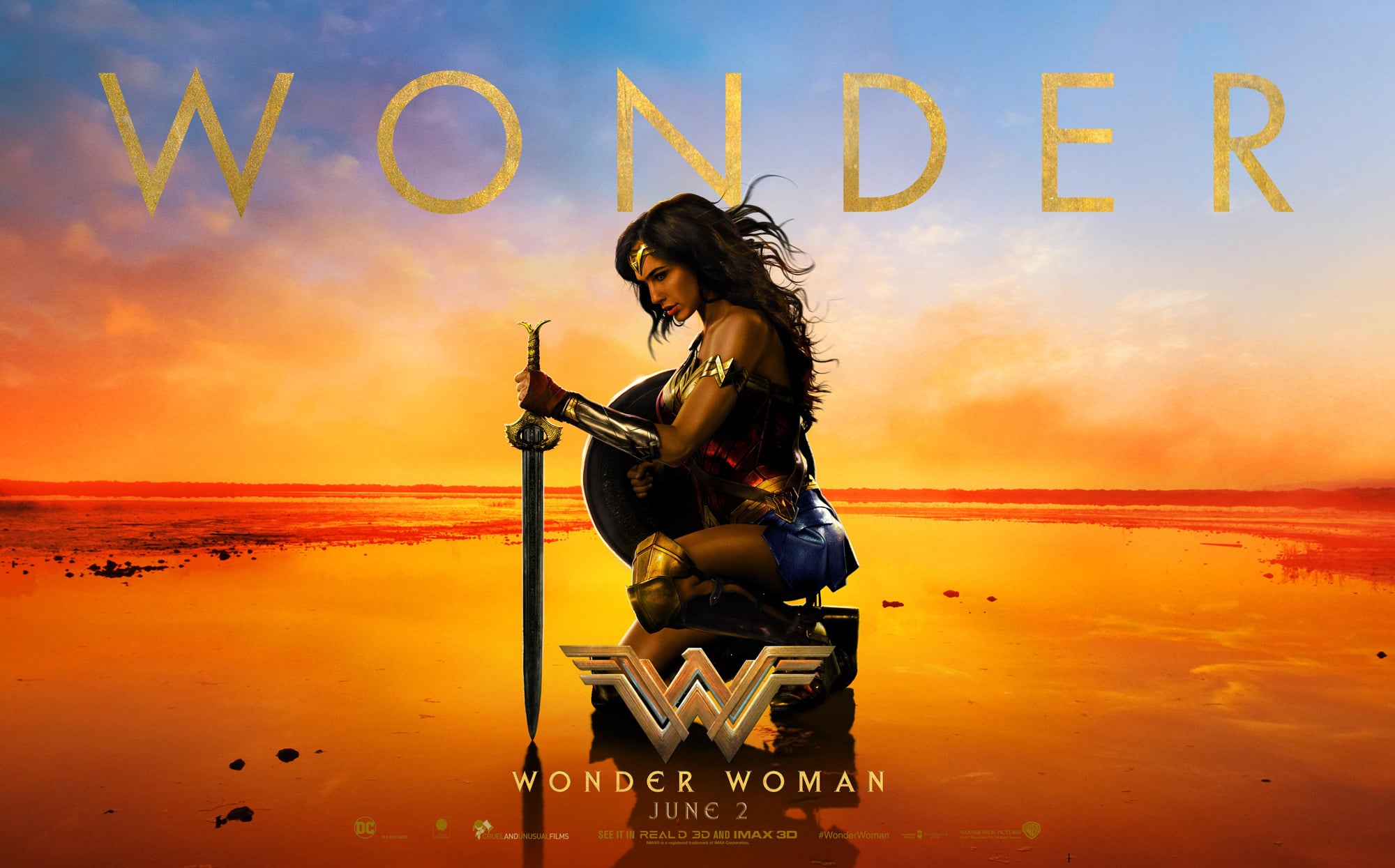
Wonder Woman (2017)


WARNING: SPOILERS


Wonder Woman is a fun superhero film that actually has some depth to it, and could very well be the saving grace for the critically panned DC cinematic universe. It'd be hard to blame anyone for worrying about it going in, given that Man of Steel, Batman v. Superman, and Suicide Squad were (at best) a mixed bag and (at worst) a hot mess. Wonder Woman arrives at the perfect time, not just in the general social context of 2017 (a world that has seen reproductive rights for women under assault, women athletes fighting for fair pay, GamerGaters waging harassment campaigns against women critics, and a President who has bragged and joked about assaulting and accosting young women). It comes at a perfect time in the DCCU as well. Snyder and Ayer attempted to make something different than their Marvel Studios competition, but those are directors that tend to be driven by testosterone and an obsession over the ideal male form.

Indeed, Wonder Woman winds up standing out from most superhero flicks. It offers a much needed respite from muscular dudes punching each other and dictating what is "right." She actually winds up fulfilling the role that Superman is supposed to play in being positive, loving, compassionate, and embodying all that is good and pure.The action in the film is good, which is an important aspect to a genre film, but it is the deeper themes that make it pop. As a character isolated from the world, there is an innocence to Diana that has been absent from the genre since Sam Raimi's Spider-man. Her innocence and ignorance to the outside world is the lens through which we, as the audience, get to see ourselves. Through the superhero genre, the film is surprisingly introspective.

With a villain like Ares, there was much room to tackle substantial themes about the nature of mankind or war. That he drives the film and serves as the primary foil, yet isn't actually forcing anyone to do anything, is what makes that story compelling and meaningful. As he tells Diana, he simply puts an idea into people's minds, and they do the rest. He isn't forcing anyone to create weapons of mass destruction or to go to war, yet they do. At the center of this conflict is the notion of whether people are inherently good or inherently bad. Diana was raised to believe that men were good, but that Ares corrupted their souls. She must confront the fact that her worldview - previously black and white (good/evil) - is actually more complex than that. Steve Trevor himself is a good person who, throughout the entire film, lies, kills, steals, and smuggles. He allows a situation to unfold which destroys a nearby town because he looks at the bigger picture. He sacrifices the town, in his mind, for the sake of the world. This enrages Diana, but in the end, he commits the ultimate act of selflessness, sacrificing himself to destroy the gas bombs, for the same reason.

Ares isn't just speaking to Diana when he informs her that he hasn't forced anyone to do anything. This is a line that should cut the audience as well. In these superhero films, the idea of "good" and "evil" are pretty cut and dry.  The "evil" perpetrated by villains might be large in scope, but is small in focus. There is always the central point. Take down the bad guy; you save the world. Centering the film in World War I is thematically smart here. It doesn't just provide a slightly different visual reference than Captain America: First Avenger (let's be honest, the look of WWI here and WWII there isn't that different); it allows that greater point that we as the audience know this isn't the end of war, and that Ares isn't the cause of it. When Steve Trevor describes gas weapons as "more terrible than anything you can ever imagine," we in the audience can immediately think, "Oh, no, it can get much, much worse!" We are aware of fire bombs, nuclear missiles, hydrogen bombs, and all manner of more deadly weapons of mass destruction. We also recognize the naivety of the characters who refer to WWI as the "war to end all wars." And in the end, when Ares is stopped and the war winds down, we know there is another war on the horizon. More to the point, if WWI ultimately ended because Wonder Woman brought down Ares, it would be reasonably safe to assume WWII ultimately began completely, earnestly because of mankind.

All of that speaks to the nature of man and war. Ares may have put ideas for weapons in the minds of people like Dr. Poison or General Ludendorf, but he didn't force them to do anything. The engaged in war on their own. Granted, this theme gets a bit undercut when Diana decides to show mercy to Dr. Poison. This was a great moment, highlighting the strength of Wonder Woman's character (empathy and compassion), but it does suggest that perhaps yes, she was a good person before she was corrupted. They don't go into her backstory, which is actually a brilliant decision. Horribly scarred, we are left to guess why she works for Ludendorf or even feels some allegiance to him. Perhaps the best scene of her story is when the undercover Captain Trevor compliments her and tells her that she is worth so much more. Wearing a mask to cover her scars, she conveys shockingly much through her eyes. One gets the impression that she is scarred because she has been mistreated by the German military, or has been a victim of this war. For a moment, it appears as though she is touched to feel genuinely appreciated - that is, until Diana walks in and Trevor's attention is drawn away to the beautiful Amazon. That moment, too, suggests much for the character. It is not hard to imagine that she is immediately made to feel inferior: a scarred, damaged woman, ignored when a gorgeous, slender, perfect woman appears. This is a person who presumably has every reason to be bitter at the world around her (arguably, the world of men - as it is men that are conducting the war effort that possibly damaged her, and it is men who seem to value women almost exclusively on appearances).

The end gets a bit thematically muddled. After highlighting that men were warring independently of Ares, it does ultimately end with his defeat. They show him whispering ideas to Dr. Poison and to Ludendorf, and presumably he secretly prolonged the war serving as a member of the British government as well, so what exactly is the cause of the war? On one hand, it's kind of brilliant to set it in WWI because it defies some superhero expectations. Normally, we know a villain is the source of the bad that happens. Here, the "bad" is war in general. Yet we also know that ending WWI does not stop war in general. WWII, Korea, Vietnam, et cetera, are all on the horizon after we see Ares brought down. We also know that nationalism was the driving force for WWI and prior wars. Yet once he is brought down, everyone stops fighting. Is the implication here that he did instigate the war and force people to do things? Or is it that men can be corrupted by all manner of forces, not just divine? If it weren't Ares compelling the German soldiers to fight, it was their ambitious, power-obsessed leaders. If that is the case, then was Diana correct in the first place that men are inherently good unless otherwise corrupted - by gods, by governments, by society? And if that is what it is implying, then what was the point of her having to come to terms with the idea that people are actually quite complex? That people aren't really "black and white" like that? That it isn't that we're "inherently" good, but that we have the capacity for good?

Either way, there are other themes present in the film as well, and it is refreshing to have a superhero flick that actually attempts something a bit more meaningful than the basic "with great power there must also come great responsibility" tagline. That is certainly part of it, to be sure, but it is hardly the only thing. Wonder Woman also balances the tone between the seriousness of those elements with the fun action and well-placed comedic relief that makes the superhero genre entertaining. For a film that is nearly two and a half hours, it's also paced well. It doesn't often feel like it's dragging outside the opening exposition dump, which is a prerequisite of the superhero film. The scenes in the present, which bookend the film, serve only to remind us that the character is part of a larger universe. To that end, it feels completely unnecessary; it doesn't hurt the film, though. Otherwise, the movie is entirely contained within itself, lacking much of the "universe building" that plagued previous DC installments.

The very existence of the film is something of a tent-pole event for feminism. The most popular female comic character in her own solo feature directed by a woman is itself a symbol. As for whether the content of the film is particularly feminist, well, that's going to vary depending on who you ask. It is perhaps unfair to expect it to mean something greater when all they are trying to do is make a fun, entertaining blockbuster film that adequately adapts a beloved character to the big screen. We shouldn't expect deeper meaning here than we do in, say, a Spider-man film. That baggage of "meaning something more" is unique here because, again, female character/female director is a rarity in the genre, and in Hollywood as a whole. They set out to make a good superhero film, and that's exactly what they've done.


Internal messages are a bit of a mixed bag. Some could easily look at it as very much substantially a feminist film: a woman saves the world from a war started and conducted by men in which their masculinity is ultimately the driving force, the savior is from an island of women warriors who are also compassionate and nurture life as much as they fight to defend it, an overqualified heroine is rarely listened to or respect and constantly has to call the patriarchy out on their bullshit, and all saving the day by exhibiting the more "feminine" traits of love, empathy, and compassion in the end. (My personal favorite quasi-feminist moment came with the discussion about the watch. When Captain Trevor steps out of the bath, he thinks Diana is asking him about his penis. She's actually talking about his watch. He explains that it is what he needs to know when to wake up and go to work and all of these other things. Diana responds, "You let that little thing tell you what to do?" Of course, I might be reading way too much into this. I got the impression that they do a switch here. He thinks she's talking about his junk, but she's talking about the watch. This leads the audience to laugh because of the misunderstanding. A relatively solid joke, but now we're thinking about his junk. Then she makes the comment about that "little thing" dictating what he does. I would argue the subtext is that they have swapped, where he's still on the watch, but her comment also refers to his dick. You know, men "think with their dicks"? I'm probably alone in taking it this way, but I thought that was pretty funny.)

Conversely, people might not see that much feminism outside those very basic premises. The ultimate conceit is that men are not to be blamed for their actions (they are good unless otherwise corrupted). Diana is freed from her temporary bondage by Ares after she sees Steve Trevor sacrifice himself (so she's driven to success by the actions of a man). Some have criticized the film for sticking to a traditional male gaze of the character, and her physical beauty is frequently framed in a manner that highlights it. From Steve Trevor criticizing her new outfit as being "too distracting" (because she's too beautiful) to one of his buddies asking for a photograph of her because she's so pretty, the film doesn't exactly do much to knock the objectification of Wonder Woman. These are all presented as little, harmless jokes. Even more, the origin story involving Zeus as her secret father makes some sense in context of this universe, but isn't exactly on point. Wonder Woman's origin has always been strange and has changed, but having her be the literal daughter of Zeus rather than a creation of the gods (or even being altered to be a child of a goddess) still ultimately adds this layer of male-driven action. She wouldn't be powerful without the male Zeus.

Probably one of the strangest moments is when Diana literally gets distracted and goes, "oooh, a baby!" It's easy to crap on this moment when viewing the film through the feminist lens, but I'd argue this is more just clumsy film-making than anything worse. I think the point of this scene was to two primary things. The subtext is that she is an Amazonian princess, a people that are nurturing, compassionate beings. It was perhaps meant to highlight that side of her character. On the surface, it was probably meant more as just a little joke, given that she had never seen a baby before. They don't have those on Themyscira, remember. She was the only child. Trevor says, "That one isn't made from clay," as he drags her away. I think this was meant more as a joke about never seeing a baby more than anything, but it isn't handled super well, and they don't really go too into it.

It might not be entirely accurate to argue Wonder Woman is itself a feminist film as much as it might be to argue it's more of a "feminine" film. It still engages in a number of the more "masculine" traits of its counterparts in the superhero genre, but the compassion, empathy, and desire to protect, mixed with almost more of a ballet-style of combat, make this a superhero film that maybe breaks out from the boy club in more subtle ways. Granted, I'm a CIS, straight, white dude, so you have to take everything I say on the subject with a grain of salt. (I don't think this disqualifies me from having a valid opinion on the matter, but having a life from a male perspective means I probably see things a bit differently than women, so I will refer to them for more insight on the topic.)

All in all, it isn't perfect, but it does enough things really well, and different from the rest of the superhero crop. By virtue of being self-contained and focused on the character herself, it provides fans with what they've been craving from DC movies for years now. It's strange that we had to wait until after Suicide Squad and fifteen separate Marvel movies to get this, but Wonder Woman lives up to its long-awaited hype. After three films that massively disappointed fans, it turns out that it is a woman director who could breathe actual life in this otherwise male-dominated spectacle that is the DC cinematic universe. And, of course, it is nice to finally get a recognizable musical anthem associated with a character.

Just as an aside, I do think it is important to acknowledge Patty Jenkins as the director, but not ignore that the bulk of the creative team was male. The story was conceived and written by a team of men, and it was based on comics largely written and drawn by men. Wonder Woman might be the most famous fictional female character, but it has been a rare occasion in which women have been given creative control over her. It was a bit strange seeing the "special thanks" part of the credits and seeing nothing but male comic book writers and artists. They are all great creators, of course, but it is a little jarring to remember that there have something like four women writers to pen a Wonder Woman series (a character that has been in existence for 76 years).  A solo Wonder Woman feature is great, but progress doesn't stop with its existence. It does little good if women still can't get their feet in the door for writing and directing gigs.

REDUCTIVE RATING:  Really good!   (But, if you were one of those dudes who complained about those select few shows for people who identify as women, you were going to hate this movie no matter what - and also, grow up.)