So kind of a repeat in some ways, but mostly I just talk at length about the trouble with Legendary's kaiju universe (kaijuniverse?). I also try to prove my nerd mettle with a couple of online Godzilla quizzes.
Of all the comic book movie franchises, X-Men has been the most inconsistent. It ranges from legitimately awful (X-Men Origins: Wolverine, Apocalypse) to mediocre (X-Men, Days of Future Past, The Last Stand) to pretty solid (The Wolverine, Deadpool) to pretty good (X2: United, First Class). Spanning nearly two full decades, the series partially responsible for kicking off the superhero movie craze has also survived almost exclusively on that craze. When the movies are awful, there's no concern that the franchise won't just continue on in spite of it.
After seventeen years of mostly Wolverine-centric stories, and some of the most perfect castings in comic book movies with Hugh Jackman and Patrick Stewart, Logan might be the only installment worth considering "great" within the genre. Perhaps the biggest reason is that director James Mangold has embraced the fact that the X-Men timeline makes no sense. It has become an especially convoluted mess with Days of Future Past. Instead of trying to cram it somewhere in the larger universe and its timeline, Mangold and company decided to craft a story mostly independent of it. Yes, there are references to the first X-Men, but they are quick and subtle moments. There isn't a requirement to have seen it to understand. And yes, this works especially well if you are familiar with at least the first film, in which you go in understanding that Wolverine and Professor X are mutants who have formed a bond. Still, that is pretty well implied from the get-go, regardless.
The story takes place in 2029 at a time when mutants have been dying out due to a mysterious virus. Wolverine is dying because the adamantium covering his skeleton is poisoning his body, and the virus is impeding his healing ability. Charles Xavier is in his 90s and has suffered degenerative brain diseases, making him incredibly dangerous if not properly medicated. Everyone else is long gone. The focus on a smaller cast of characters provided adequate time for the few central ones to develop and display proper arcs. When the two retired superheroes find a new mutant girl escaping from a lab creating mutant soldiers, they opt to help escort her from Mexico to Canada. Xavier, predictably, desperately wants to help. Logan, per usual, begrudgingly does. He wants to remain isolated.
Essentially, it's a story that combines elements of Mark Millar's (very overrated) Old Man Logan story and The Last of Us video game. A road trip movie in a bleak, but relatively grounded world, it sets up an emotional journey. The character arc for Logan is not an unfamiliar one - the rough, loner Wolverine reluctantly makes a connection with a young girl and becomes a somewhat protective father figure by the end, like in X-Men - but it is a bit different, and the parallels serve as a nice bookend to the Hugh Jackman take on the character. He starts off more angry at the world, and more reserved than he did in the first film, and he seems to try even harder to avoid making a connection with Laura (X-23). This actually highlights that he has been through an emotional roller coaster that ended with more lows than highs. We know he's been through the ringer at the start in 2000, but he's clearly been through a lot worse by 2017.
What makes Logan stand out above the fray is its lack of concern about "world building," or even making sure to fit into the larger cinematic timeline. Nerds can, obviously, argue about its placement, but the filmmakers clearly don't care much about it. They used the toys in the sandbox to create a unique story with a darker, yet more character-driven story, with no concern about putting the toys back. This allowed for creative freedom not really seen in the franchise before, and is sorely lacking in the superhero genre.
The action is violent, complete with decapitations, skull piercing claw stabs, loss of limbs, and plenty of moments that seem completely out of place for a genre that has played it safe in the world of PG-13. Additionally, there is no shortage of cussing (sometimes a little excessive and unnecessary and feeling a bit like they did it just because they could). There is even a moment wherein a woman flashes Logan. Suffice to say, this is not a superhero movie for kids.
And that's what makes it actually pretty interesting. The violence actually sort of serves as a deconstruction of the genre. Superheroes fight mostly because they have to. No one wants to see super-powered beings talk things over. There always has to be a fight sequence that ultimately feels rather safe for the main characters. Fisticuffs is the only way they can solve problems, and it kind of cycles into this idea that violence is fun. It's fictional boxing, basically. In Logan, the violence occurs because the heroes literally have no choice. They are vulnerable and being pursued by people who want to harm them. They would prefer to flee to Canada and live in safety. At the end, the new mutant kids take flight, only resorting to fighting when there is clearly no alternative. This is violence with emotion and with purpose, rather than just because it has to be there.
There is a weight to the action as well. At no point does it feel like the main characters are safe. By limiting the healing factor of Wolverine, even he feels exposed. When he gets shot or hit, there is legitimate concern. At the very beginning of the film, he is being subdued by a bunch of random car jackers who give him a limp just by kicking him a bunch. This is not the overpowered Wolverine of Bryan Singer years.
Logan might also feature the best acting in a superhero movie outside of the Nolan Batman trilogy. Patrick Stewart and Hugh Jackman have always been great as Charles Xavier and Wolverine respectively, but they put in such powerful, nuanced, and emotional performances that it makes you realize that they've never truly capitalized on that before. Their swan song before retiring the roles (barring any random cameos - both have said they will not be portraying these characters in a major capacity going forward), they could not have gone out on a higher note. Even Dafne Keen (Laura/X-23) was excellent, despite being silent for the first two acts of the film. And, of course, the world could always use more Stephen Merchant (who plays Caliban).
Where the movie ultimately struggles is in some of its pacing. One trope that it engaged with to its detriment was the random cutting back to the villain just to show him being one step behind. If ever a superhero movie did not need to do that, it was this one. It is clear from the moment Xavier and Logan flee Mexico that they will be chased. Rather than unnecessarily cutting back to the bad guy to remind us he's the bad guy and he's on their trail, they could have focused more of that time on the Logan/Laura relationship. That was mostly well done, but could have used another scene or two of them actually bonding in some capacity. Given the story was about the character arc of Wolverine and his connection with Laura, there was no need to show the villain doing villainous things in pursuit. The story wasn't about that, and those scenes broke up the pacing. For a film that also treated its viewers as intelligent humans capable of figuring things out through context clues, it felt a little backwards to then engage in this genre trope that slows things up and makes it seem like we can't figure out that this bad guy is a bad guy.
This was almost exactly the kind of thing I want more of in the genre: stories using well-defined characters in original stories that are complete. Continuity is fine sometimes, but the superhero genre is rife for awesome, original content. This need to fit everything into the "timeline" or the "universe" harms creativity of the filmmakers. Logan falls into some structural traps of the genre, but otherwise has its own unique vision and executes it well. Admittedly, some of the emotion is based around being familiar with Hugh Jackman's stint as Wolverine, and knowing this is his send-off, but it all still works well.
People raved about Deadpool last year, and for fair reasons, but Logan will be the R-rated X-Men connected film that stands the test of time.
Tonight, I lose sleep thinking about something very near and dear to my heart: how the hell does Legendary Pictures think it's going to pull off a solid King Kong v. Godzilla in 2020? The miracle here, of course, is that I kept this under half an hour. Normally, once I start talking Godzilla, it goes for about the duration of Peter Jackson's King Kong!
New podcast, about random topics that keep me up at night. Could be about something serious or meaningful, but likely to just cover a bunch of random crap that no one cares about. But hey, if you ever wanted to hear me talk about "All-Star" by Smash Mouth for half an hour, you're in the right place!
So much of the game deals with themes of control. While the details of what has happened to this world are shady, something is clearly amiss. Many people appear to be literal drones incapable of thought. You run by a city of workers following in step as they make their way to a nearby facility. The people that are not are chasing you, the player, in an effort to detain and subdue you. Some puzzles even require you to use a mind-control device to make the drones do your bidding. Late stages of the game also see what appears to be a bunch of scientists in a research lab as they examine the results of their work. In story, it deals heavily with concepts of control, which are paralleled by virtue of being a video game in which the player controls a character.
At the same time, it's so cryptic that I kind of feel like it has to be about something else entirely. Some have argued it is a commentary about the state of games, and how they are trying too hard to be cinematic, providing all players with identical experiences. This could be seen in the section wherein the boy has to blend in by waking and stopping in perfect stride, and jump when the other people jump, and spin when the other people spin. Some gamers argue that a growing problem in the industry is the popularity of cinematic, linear games. Your experience with Uncharted 4 is not ultimately going to be that different from mine, for example, whereas we could have very different experiences playing Skyrim. It is a fair criticism to some extent (I disagree with it completely, but I understand where that comes from). However, I'm unconvinced that is what the game is trying to do given that Inside and Limbo are ultimately linear games with universal experiences themselves. Seems strange that they might be criticizing themselves.
Then I feel the need to dig deeper, and I can't help but wonder if the whole thing is ultimately just about human conception and birth (and then I think I'm a crazy person!). I know, I know. I'm almost certainly reading way too much into it, and I'm sure I'm the only weirdo on Earth who finished the game thinking this, but hear me out.
It didn't really hit me until late in the game, in particular near the very end when you wind up submerged in a tank with something looking kind of like an embryo and you end up getting pulled inside it. Then, you are this strange, amorphous fetus-looking monster rampaging through the research lab where everyone is watching. This happens, of course, after you break the glass on the tank, flooding the facility (water breaking). You then make your way through the still linear pathways, at some point getting covered in blood, before finally escaping the dark world you were involved with the whole time and resting in the one section of sunlight, just breathing. (I read this as a sort of "escaping the darkness of the womb into the light of the outside world.")
Of course, once that idea popped in there, I couldn't help but think back to the beginning of the game. In the early stages, advancing requires more speed than problem solving. You have to outrun men with flashlights and dogs just to get into the relative safety of the farm area. Was it a visual parallel to the journey of sperm as the fastest can get through to the relative safety of the cervix? Slow sperm die quickly in the vagina There is other imagery as well. For example, to get into the final facility (where the "egg" is), the boy has to get through an entrance that does not stay open for long. Then, to avoid being shot back out from fans, you have to stick to the walls of the narrow vent (like sperm have to stick to the Fallopian tube wall).
I also wondered if everyone rushing to the tank (where the "egg" was) was actually indicative of it being time for birth. All the scientists hurried to watch what was happening, perhaps representing what happens socially when a woman goes into labor. Doctors and nurses attend to the women; families halt what they're doing to go to the hospital; et cetera. And, I can't help but feel as though the title of the game - Inside - is ultimately a subtle hint here. Inside? Inside what? Is it really just meant to mean that you infiltrate these facilities? A fair amount of the game isn't even actually inside them. There is the forest, farm, and city, for example, before eventually you submerge (which, the sudden shift in direction at that moment could be representative of the sperm having to pick a direction). Does the title actually refer to the idea that all this is just representation of what happens inside a woman's body when procreating?
Naturally, this would not be a perfect interpretation. There are plenty of gaps there, and I'm sure everyone is more than capable of tearing this take apart. But for whatever reason, that was what I strangely think the game is actually about in a super meta-narrative sense.
I am also almost certainly crazy, and why this might be on my brain otherwise is beyond me at the moment.
Sometimes, simplicity makes for greatness. Developers can find something that isn't too complex, do it really well, and voila! You've got an excellent game. Playdead's previous game, Limbo, took a simple concept - a side scrolling puzzle game - and excelled at making it dark and atmospheric. Their follow up, Inside, builds on that. Very similar in structure, it goes even further in creating a disquieting, disturbing environment despite being particularly stylized animation and a simple puzzle side-scroller.
The beauty of Inside is in its lack of direction. Yes, by virtue of being a side-scroller, players can only move to the left or the right, but there are never any prompts. Get stuck on a puzzle for long enough, the game provides no clues to assist you. You are on your own, just like the boy you play as. This element creates a parallel feeling between player and character; it's also why solving puzzles and advancing is extremely gratifying. The lack of aid makes it all the more satisfying when you finally do figure out what you're supposed to do.
Like Limbo before it, Inside tells a story through imagery and some gameplay mechanics only. One thing that sets it apart from other games, especially side-scrollers, is the use of background. When push comes to shove, you will take nothing away from the game in a story sense if you just don't pay any attention to it. While we never find out anything specific, the clues of what is going on are there. The developers do a good job training players to observe the background as well. In the beginning, they have several threats come at you from the backdrop. People with flashlights and dogs rush at you from background to foreground, not left to right. This specifically forces players to pay attention to the background, even though for much of it, there is no gameplay reason to do so. It's really well thought out construction.
The specifics of the story are subtle and often vague. While the background really contributes to it, the strongest aspect is the atmosphere. It is creepy and chilling at the beginning, when you control a young boy fleeing men in trucks. It gets terrifying and anxiety-inducing whenever you have run-ins with dogs. The quiet air with only the sound of your footsteps creates a tension. You often can't help but wonder what is going to come at you next. Panic sets in when you have to swim under structures and you begin to lose your breath. Blending the familiar with the strange makes for a game that is very disquieting and subtly disturbing.
The challenge of discussing more about Inside is that one doesn't want to give too much away. It is such a beautiful, chilling game, and so much of it is just out of the lack of knowledge. If you've played Limbo, then you are familiar with the kind of world they like. Yet even then, there is much about Inside that you don't expect. Suffice it to say that if you are going to play it, you should avoid any and all specifics if you can.
That said, I want to throw out some thoughts - if only for my own sake as I try to sort them.
Either way, Inside is a tense, rewarding, unique experience that you really should see for yourself. It's a lot to digest, but it's a great meal to consume.
As big a fan of Mass Effect as I am, I've never taken the time to finish playing BioWare's other popular franchise, Dragon Age. It was given to me as a gift a long time ago and I started to play it way back when, but I just couldn't get into it. Having just completed my annual Mass Effect playthrough, it seemed an appropriate time to give it another shot.
Apparently - despite my Chrono Trigger and Final Fantasy replays - I have a hard time getting into these kinds of RPGs. I'm still never really sure what exactly is going on in a battle and admittedly, it got so difficult for me that I had to lower the difficult. (Yeah, I'll admit it.) After finally playing it to completion, I can say that I did get more sucked into the world, but it still ultimately failed to grab me the way that Mass Effect did, or in RPG terms, the way that any of the post-NES Final Fantasy games did.
The graphics look pretty much on par with the first Mass Effect. That is to say, they're not terrible, but they aren't particularly great either. Though the rendering issue of ME isn't present here, there are some weird things about the characters. It's a strange thing where they aren't necessarily going for ultra-realistic, but they aren't really doing anything particularly stylized either. The end result is - like it's sci-fi counterpart - something that looks like a stepping stone between console generations, really.
Things can get a little hectic during battles as well where sometimes, so much is going on that the game can slow down or start to stutter a bit. It's not as unpolished as BioWare's other franchise, but it still leaves a bit to be desired. Facial expressions especially are a bit lacking, but that's a staple of BioWare.
When it comes to the gameplay, I don't think I figured out everything you can do in the game. I know there's something to do with collecting herbs and mixing them to create new items, or that you can apparently forge new weapons using runes or something, but I never really figured out how to do any of that stuff. I couldn't tell if that were something you did in shops or you did by leveling up your characters and teaching them skills.
As an RPG, there are some expected elements of the gameplay. You control a character and a party of four as you meander through linear pathways in your attempt to complete goals. Unlike the JRPGs where you control the entire party, the AI runs the rest of your team for you here. You can, of course, determine the course of action you want your party members to take. For example, you can alter the settings on your mage to handle healing. If any party members take a good deal of damage, your mage will cast cure spells. Essentially, you set the priority of actions for your AI party members, but you only fully control one member at a time. You can also switch to any of the other three party members as well, so you're not stuck using just the main protagonist.
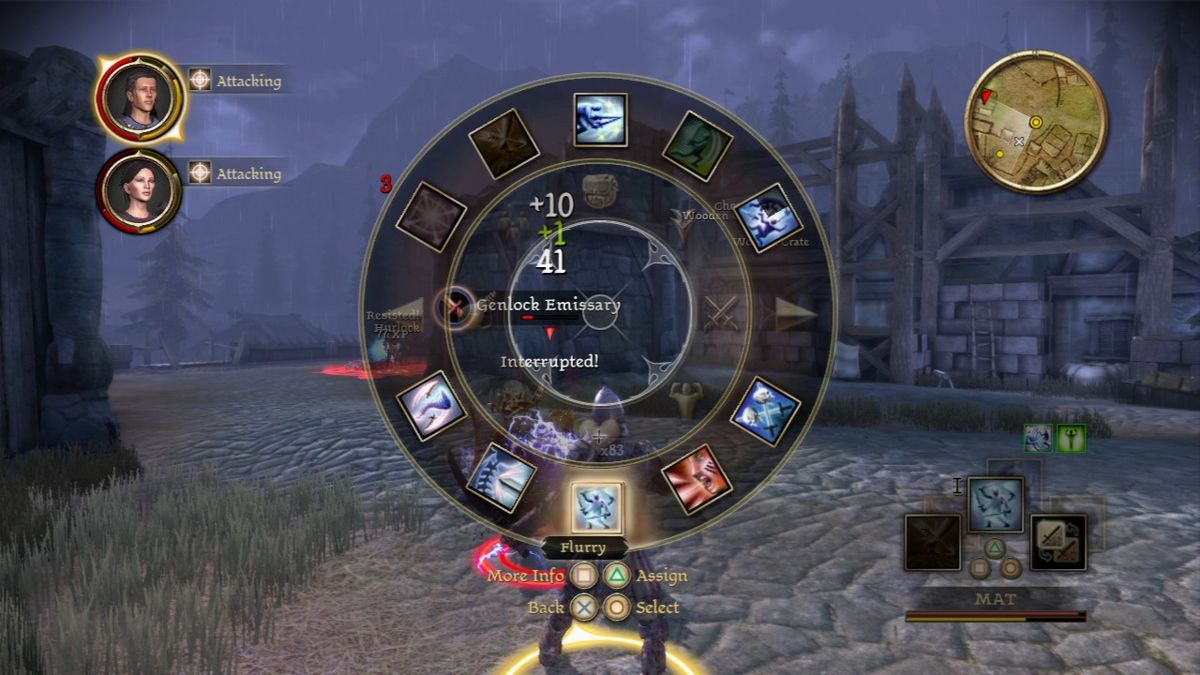
Each character's icon displays typical RPG data. There's the health bar and then either the stamina or mana bar (depending on the character's class - there's no real difference, it's just that mana is tied to magic while stamina is tied to special physical attacks). You run around environments looking for items and objectives. Every so often, you encounter enemies. The environment doesn't change, but you are limited to battling once an encounter begins. No matter how far away you run from a fight, you cannot pick up loot or leave the map. It's actually a bit inconvenient to be unable to interact with your environment during a fight. There's also no flee option, so once you get into a battle, you must finish it. This fact isn't so much a problem until you accidentally wonder into an area that you aren't supposed to be at yet, and get swarmed by too many enemies.
Battles involve physical attacks, magic spells, and special attacks. Each character has a variety of moves that you can use in a fight. To execute these skills, you bring up the classic BioWare radial wheel. This is a quick menu that pauses things so you can pick what you want to do. There is also the ability to assign particular spells or attacks to one of the game pad's buttons. This allows you to quickly strike with those buttons. However, there is a limit to what you can assign to Quick Attack. You are only allowed a total of six spells, which is far fewer than the number you wind up with as you progress through the game.
As usual, defeating enemies awards you with experience points, which then allow you allocate points into certain character traits. Each character can be leveled to increase their stamina, mana, magic power, attack power, and a few other things. There are also points to allocate into particular skills. It's a pretty straight forward RPG element common throughout the genre. There isn't anything particularly revolutionary in the game play.
Decisions do account for some of the game's appeal. Throughout the story, a number of things are left up to you to decide. Some seem small, but others feel like world changing decisions. As you go through and make these decisions, some of your party members will either approve or disapprove of you. If a character's approval rating drops low enough, s/he is able to leave your party. To counter disapproval, you can find and purchase gifts that boost their rating of you. This only works to a point though, as some members will leave regardless provided you make the wrong decision at a certain time. It's an interesting element that I haven't seen in too many games. Occasionally a party member will question you (looking at you, Sten!), but more or less your approval ratings won't drop too much if you don't do much talking and stay at least neutral.
Overall, it's a fairly straight forward and typical western style RPG. I must admit, I'm not a big fan of the style, but there are interesting elements added on. The game also includes places for your war dog to "mark" that grant stat boosts in that environment.)
The start of the game varies depending on what race and class you decide to play as. After an introductory level that showcases the basic dynamics of the battle system, you are recruited into the Grey Wardens - a group of warriors responsible for defending the land of Ferelden from the evil Archdemon dragon and its army of orcs...er...dark spawn known as The Blight. Almost immediately after your initiation, you face a horde of them. You fight along side Cailan, the king, who is killed after being betrayed by his father-in-law Loghain, who then goes on to essentially usurp the position by passing blame onto the Grey Wardens.
You spend most of your time building a case against Loghain. In his efforts to force everyone to unite, he ultimately creates a divide and so a civil war breaks out. Along the way, you are also trying to build up your old alliances with the dwarves, the humans, and the elves. Basically, you are trying to recruit races via their old treaties with the Grey Wardens while also trying to convince people Loghain is evil. Of course, doing so means chores. Lots and lot (and lots) of chores. Typical RPG stuff - "We'll join your alliance if you climb the mountain and retrieve this item." Then you get there and it's someone else saying, "We'll give you the item if you go defeat this monster." You know, RPG busy-work; fetch-quests.
The story is pretty straight forward in terms of plot, but the draw is being able to impact the world around you. While it's not an open-world game (indeed, you can't get to certain places until certain times in the game), you are often required to make decisions that impact the city you are in. You are responsible for decisions that range from saving an Arl's son to deciding who will be king of Orzammar, land of the dwarves. Additionally, decisions you impact your squad's loyalty.
The strength of the game comes from the complexity of the decisions. While other BioWare fan-favorite Mass Effect is also known for allowing decisions, they more or less are simplified. Save this person or save that person. Kill this villain or let him go. Keep this information or destroy it. Dragon Age turns those decisions into legitimate brain-scratchers. There are no clean answers. You can't play the equivalent of Paragon without getting your hands a little dirty.
The characters are fairly forgettable. And while the deeper into the game I got, the more interested in the world I became, I still didn't ultimately care that much about it. These things obviously had a negative impact on my experience. At the end of the day, I lost three party members along the way - the elf dude whose name I never remember, Alistair, and Morrigan. I liked the latter two just fine, but when they left, I didn't feel too bad about it. Alistair was kind of a baby about the whole Loghain thing, and Morrigan had kind of an unreasonable demand. But frankly, I didn't care enough about them as characters to feel upset when they left. Additionally, they were useless party members. I never used Morrigan. And I rarely used Alistair since Sten was stronger and also there was a war dog. So I also didn't feel like my party was any worse for their departures. This is often a problem with RPGs. Doing anything to party members for a narrative emotional punch only works if it also makes you use those characters.
The final mission is great. After spending more than forty hours running around, doing favors for people, and solidifying treaties, you then seek out the invading darkspawn army led by the Archdemon itself. As you work your way through the city, you can call in your dwarf, human, elf, and mage allies. In many ways, the final mission feels like what Mass Effect 3's should have been.
However, the final boss itself was a bit insane. Perhaps it's just the PS3 version, but the game is fairly glitchy (can't tell if it's more or less so than the first Mass Effect). By the end, it was just horrible. It took me four tries to kill the Archdemon, and each time had a huge, battle-impacting glitch. The first time, there was a glitch that prevented a party member who was knocked down from ever getting up. She was literally lying on the ground with full health for half an hour before the rest of my party finally caught up. After loading my game and trying again, there was a glitch that had any of my KO'd party members disappear off the battle field. This meant that I could not cast my revival spell and bring them back into the fold. Load again and the third time had a glitch in which no matter how close I got to the Archdemon, its health bar didn't show up. This made it impossible to tell if I were actually doing any damage at all. My guess is not, given how long I fought him for that time compared to how long I fought him when I finally beat him.
And of course, after three hugely negative glitches that single handedly cost me the battle, I finally got a favorable glitch the fourth time in which the Archdemon landed, but wouldn't attack. He just stood there roaring for about ten minutes while my guys hacked away. It felt cheap, but I also didn't care given that my defeats felt equally so, a feeling that says a lot.