So much of the game deals with themes of control. While the details of what has happened to this world are shady, something is clearly amiss. Many people appear to be literal drones incapable of thought. You run by a city of workers following in step as they make their way to a nearby facility. The people that are not are chasing you, the player, in an effort to detain and subdue you. Some puzzles even require you to use a mind-control device to make the drones do your bidding. Late stages of the game also see what appears to be a bunch of scientists in a research lab as they examine the results of their work. In story, it deals heavily with concepts of control, which are paralleled by virtue of being a video game in which the player controls a character.
At the same time, it's so cryptic that I kind of feel like it has to be about something else entirely. Some have argued it is a commentary about the state of games, and how they are trying too hard to be cinematic, providing all players with identical experiences. This could be seen in the section wherein the boy has to blend in by waking and stopping in perfect stride, and jump when the other people jump, and spin when the other people spin. Some gamers argue that a growing problem in the industry is the popularity of cinematic, linear games. Your experience with Uncharted 4 is not ultimately going to be that different from mine, for example, whereas we could have very different experiences playing Skyrim. It is a fair criticism to some extent (I disagree with it completely, but I understand where that comes from). However, I'm unconvinced that is what the game is trying to do given that Inside and Limbo are ultimately linear games with universal experiences themselves. Seems strange that they might be criticizing themselves.
Then I feel the need to dig deeper, and I can't help but wonder if the whole thing is ultimately just about human conception and birth (and then I think I'm a crazy person!). I know, I know. I'm almost certainly reading way too much into it, and I'm sure I'm the only weirdo on Earth who finished the game thinking this, but hear me out.
It didn't really hit me until late in the game, in particular near the very end when you wind up submerged in a tank with something looking kind of like an embryo and you end up getting pulled inside it. Then, you are this strange, amorphous fetus-looking monster rampaging through the research lab where everyone is watching. This happens, of course, after you break the glass on the tank, flooding the facility (water breaking). You then make your way through the still linear pathways, at some point getting covered in blood, before finally escaping the dark world you were involved with the whole time and resting in the one section of sunlight, just breathing. (I read this as a sort of "escaping the darkness of the womb into the light of the outside world.")
Of course, once that idea popped in there, I couldn't help but think back to the beginning of the game. In the early stages, advancing requires more speed than problem solving. You have to outrun men with flashlights and dogs just to get into the relative safety of the farm area. Was it a visual parallel to the journey of sperm as the fastest can get through to the relative safety of the cervix? Slow sperm die quickly in the vagina There is other imagery as well. For example, to get into the final facility (where the "egg" is), the boy has to get through an entrance that does not stay open for long. Then, to avoid being shot back out from fans, you have to stick to the walls of the narrow vent (like sperm have to stick to the Fallopian tube wall).
I also wondered if everyone rushing to the tank (where the "egg" was) was actually indicative of it being time for birth. All the scientists hurried to watch what was happening, perhaps representing what happens socially when a woman goes into labor. Doctors and nurses attend to the women; families halt what they're doing to go to the hospital; et cetera. And, I can't help but feel as though the title of the game - Inside - is ultimately a subtle hint here. Inside? Inside what? Is it really just meant to mean that you infiltrate these facilities? A fair amount of the game isn't even actually inside them. There is the forest, farm, and city, for example, before eventually you submerge (which, the sudden shift in direction at that moment could be representative of the sperm having to pick a direction). Does the title actually refer to the idea that all this is just representation of what happens inside a woman's body when procreating?
Naturally, this would not be a perfect interpretation. There are plenty of gaps there, and I'm sure everyone is more than capable of tearing this take apart. But for whatever reason, that was what I strangely think the game is actually about in a super meta-narrative sense.
I am also almost certainly crazy, and why this might be on my brain otherwise is beyond me at the moment.
Sometimes, simplicity makes for greatness. Developers can find something that isn't too complex, do it really well, and voila! You've got an excellent game. Playdead's previous game, Limbo, took a simple concept - a side scrolling puzzle game - and excelled at making it dark and atmospheric. Their follow up, Inside, builds on that. Very similar in structure, it goes even further in creating a disquieting, disturbing environment despite being particularly stylized animation and a simple puzzle side-scroller.
The beauty of Inside is in its lack of direction. Yes, by virtue of being a side-scroller, players can only move to the left or the right, but there are never any prompts. Get stuck on a puzzle for long enough, the game provides no clues to assist you. You are on your own, just like the boy you play as. This element creates a parallel feeling between player and character; it's also why solving puzzles and advancing is extremely gratifying. The lack of aid makes it all the more satisfying when you finally do figure out what you're supposed to do.
Like Limbo before it, Inside tells a story through imagery and some gameplay mechanics only. One thing that sets it apart from other games, especially side-scrollers, is the use of background. When push comes to shove, you will take nothing away from the game in a story sense if you just don't pay any attention to it. While we never find out anything specific, the clues of what is going on are there. The developers do a good job training players to observe the background as well. In the beginning, they have several threats come at you from the backdrop. People with flashlights and dogs rush at you from background to foreground, not left to right. This specifically forces players to pay attention to the background, even though for much of it, there is no gameplay reason to do so. It's really well thought out construction.
The specifics of the story are subtle and often vague. While the background really contributes to it, the strongest aspect is the atmosphere. It is creepy and chilling at the beginning, when you control a young boy fleeing men in trucks. It gets terrifying and anxiety-inducing whenever you have run-ins with dogs. The quiet air with only the sound of your footsteps creates a tension. You often can't help but wonder what is going to come at you next. Panic sets in when you have to swim under structures and you begin to lose your breath. Blending the familiar with the strange makes for a game that is very disquieting and subtly disturbing.
The challenge of discussing more about Inside is that one doesn't want to give too much away. It is such a beautiful, chilling game, and so much of it is just out of the lack of knowledge. If you've played Limbo, then you are familiar with the kind of world they like. Yet even then, there is much about Inside that you don't expect. Suffice it to say that if you are going to play it, you should avoid any and all specifics if you can.
That said, I want to throw out some thoughts - if only for my own sake as I try to sort them.
Either way, Inside is a tense, rewarding, unique experience that you really should see for yourself. It's a lot to digest, but it's a great meal to consume.
As big a fan of Mass Effect as I am, I've never taken the time to finish playing BioWare's other popular franchise, Dragon Age. It was given to me as a gift a long time ago and I started to play it way back when, but I just couldn't get into it. Having just completed my annual Mass Effect playthrough, it seemed an appropriate time to give it another shot.
Apparently - despite my Chrono Trigger and Final Fantasy replays - I have a hard time getting into these kinds of RPGs. I'm still never really sure what exactly is going on in a battle and admittedly, it got so difficult for me that I had to lower the difficult. (Yeah, I'll admit it.) After finally playing it to completion, I can say that I did get more sucked into the world, but it still ultimately failed to grab me the way that Mass Effect did, or in RPG terms, the way that any of the post-NES Final Fantasy games did.
The graphics look pretty much on par with the first Mass Effect. That is to say, they're not terrible, but they aren't particularly great either. Though the rendering issue of ME isn't present here, there are some weird things about the characters. It's a strange thing where they aren't necessarily going for ultra-realistic, but they aren't really doing anything particularly stylized either. The end result is - like it's sci-fi counterpart - something that looks like a stepping stone between console generations, really.
Things can get a little hectic during battles as well where sometimes, so much is going on that the game can slow down or start to stutter a bit. It's not as unpolished as BioWare's other franchise, but it still leaves a bit to be desired. Facial expressions especially are a bit lacking, but that's a staple of BioWare.
When it comes to the gameplay, I don't think I figured out everything you can do in the game. I know there's something to do with collecting herbs and mixing them to create new items, or that you can apparently forge new weapons using runes or something, but I never really figured out how to do any of that stuff. I couldn't tell if that were something you did in shops or you did by leveling up your characters and teaching them skills.
As an RPG, there are some expected elements of the gameplay. You control a character and a party of four as you meander through linear pathways in your attempt to complete goals. Unlike the JRPGs where you control the entire party, the AI runs the rest of your team for you here. You can, of course, determine the course of action you want your party members to take. For example, you can alter the settings on your mage to handle healing. If any party members take a good deal of damage, your mage will cast cure spells. Essentially, you set the priority of actions for your AI party members, but you only fully control one member at a time. You can also switch to any of the other three party members as well, so you're not stuck using just the main protagonist.
Each character's icon displays typical RPG data. There's the health bar and then either the stamina or mana bar (depending on the character's class - there's no real difference, it's just that mana is tied to magic while stamina is tied to special physical attacks). You run around environments looking for items and objectives. Every so often, you encounter enemies. The environment doesn't change, but you are limited to battling once an encounter begins. No matter how far away you run from a fight, you cannot pick up loot or leave the map. It's actually a bit inconvenient to be unable to interact with your environment during a fight. There's also no flee option, so once you get into a battle, you must finish it. This fact isn't so much a problem until you accidentally wonder into an area that you aren't supposed to be at yet, and get swarmed by too many enemies.
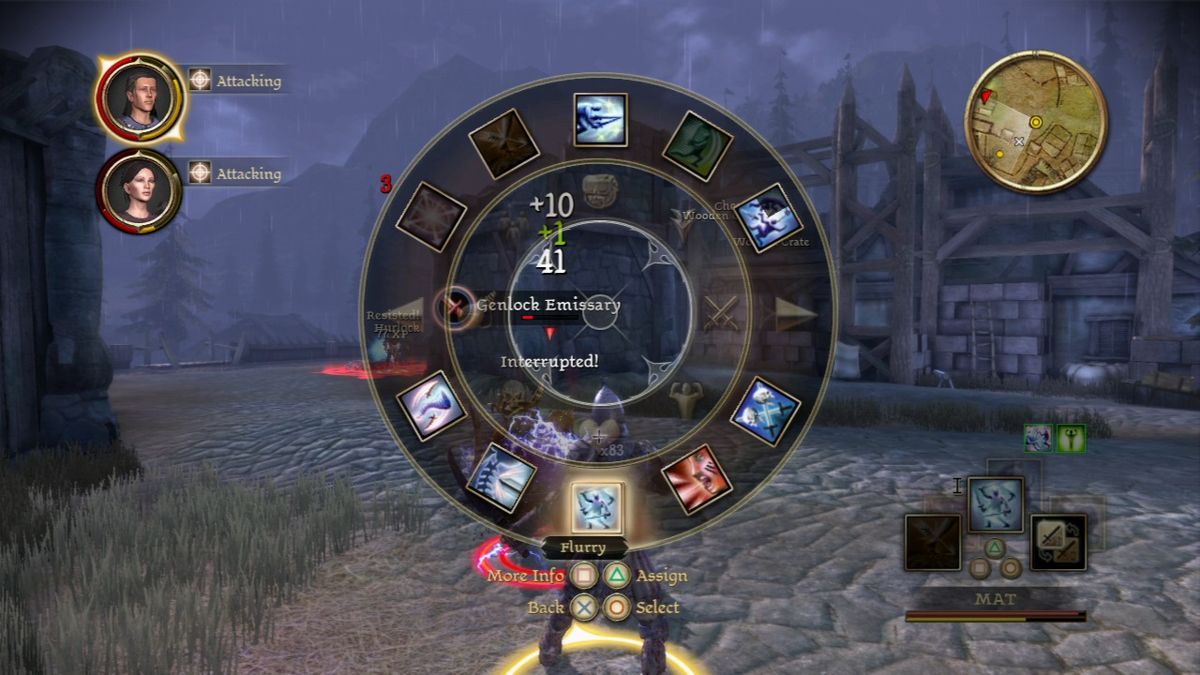
Battles involve physical attacks, magic spells, and special attacks. Each character has a variety of moves that you can use in a fight. To execute these skills, you bring up the classic BioWare radial wheel. This is a quick menu that pauses things so you can pick what you want to do. There is also the ability to assign particular spells or attacks to one of the game pad's buttons. This allows you to quickly strike with those buttons. However, there is a limit to what you can assign to Quick Attack. You are only allowed a total of six spells, which is far fewer than the number you wind up with as you progress through the game.
As usual, defeating enemies awards you with experience points, which then allow you allocate points into certain character traits. Each character can be leveled to increase their stamina, mana, magic power, attack power, and a few other things. There are also points to allocate into particular skills. It's a pretty straight forward RPG element common throughout the genre. There isn't anything particularly revolutionary in the game play.
Decisions do account for some of the game's appeal. Throughout the story, a number of things are left up to you to decide. Some seem small, but others feel like world changing decisions. As you go through and make these decisions, some of your party members will either approve or disapprove of you. If a character's approval rating drops low enough, s/he is able to leave your party. To counter disapproval, you can find and purchase gifts that boost their rating of you. This only works to a point though, as some members will leave regardless provided you make the wrong decision at a certain time. It's an interesting element that I haven't seen in too many games. Occasionally a party member will question you (looking at you, Sten!), but more or less your approval ratings won't drop too much if you don't do much talking and stay at least neutral.
Overall, it's a fairly straight forward and typical western style RPG. I must admit, I'm not a big fan of the style, but there are interesting elements added on. The game also includes places for your war dog to "mark" that grant stat boosts in that environment.)
The start of the game varies depending on what race and class you decide to play as. After an introductory level that showcases the basic dynamics of the battle system, you are recruited into the Grey Wardens - a group of warriors responsible for defending the land of Ferelden from the evil Archdemon dragon and its army of orcs...er...dark spawn known as The Blight. Almost immediately after your initiation, you face a horde of them. You fight along side Cailan, the king, who is killed after being betrayed by his father-in-law Loghain, who then goes on to essentially usurp the position by passing blame onto the Grey Wardens.
You spend most of your time building a case against Loghain. In his efforts to force everyone to unite, he ultimately creates a divide and so a civil war breaks out. Along the way, you are also trying to build up your old alliances with the dwarves, the humans, and the elves. Basically, you are trying to recruit races via their old treaties with the Grey Wardens while also trying to convince people Loghain is evil. Of course, doing so means chores. Lots and lot (and lots) of chores. Typical RPG stuff - "We'll join your alliance if you climb the mountain and retrieve this item." Then you get there and it's someone else saying, "We'll give you the item if you go defeat this monster." You know, RPG busy-work; fetch-quests.
The story is pretty straight forward in terms of plot, but the draw is being able to impact the world around you. While it's not an open-world game (indeed, you can't get to certain places until certain times in the game), you are often required to make decisions that impact the city you are in. You are responsible for decisions that range from saving an Arl's son to deciding who will be king of Orzammar, land of the dwarves. Additionally, decisions you impact your squad's loyalty.
The strength of the game comes from the complexity of the decisions. While other BioWare fan-favorite Mass Effect is also known for allowing decisions, they more or less are simplified. Save this person or save that person. Kill this villain or let him go. Keep this information or destroy it. Dragon Age turns those decisions into legitimate brain-scratchers. There are no clean answers. You can't play the equivalent of Paragon without getting your hands a little dirty.
The characters are fairly forgettable. And while the deeper into the game I got, the more interested in the world I became, I still didn't ultimately care that much about it. These things obviously had a negative impact on my experience. At the end of the day, I lost three party members along the way - the elf dude whose name I never remember, Alistair, and Morrigan. I liked the latter two just fine, but when they left, I didn't feel too bad about it. Alistair was kind of a baby about the whole Loghain thing, and Morrigan had kind of an unreasonable demand. But frankly, I didn't care enough about them as characters to feel upset when they left. Additionally, they were useless party members. I never used Morrigan. And I rarely used Alistair since Sten was stronger and also there was a war dog. So I also didn't feel like my party was any worse for their departures. This is often a problem with RPGs. Doing anything to party members for a narrative emotional punch only works if it also makes you use those characters.
The final mission is great. After spending more than forty hours running around, doing favors for people, and solidifying treaties, you then seek out the invading darkspawn army led by the Archdemon itself. As you work your way through the city, you can call in your dwarf, human, elf, and mage allies. In many ways, the final mission feels like what Mass Effect 3's should have been.
However, the final boss itself was a bit insane. Perhaps it's just the PS3 version, but the game is fairly glitchy (can't tell if it's more or less so than the first Mass Effect). By the end, it was just horrible. It took me four tries to kill the Archdemon, and each time had a huge, battle-impacting glitch. The first time, there was a glitch that prevented a party member who was knocked down from ever getting up. She was literally lying on the ground with full health for half an hour before the rest of my party finally caught up. After loading my game and trying again, there was a glitch that had any of my KO'd party members disappear off the battle field. This meant that I could not cast my revival spell and bring them back into the fold. Load again and the third time had a glitch in which no matter how close I got to the Archdemon, its health bar didn't show up. This made it impossible to tell if I were actually doing any damage at all. My guess is not, given how long I fought him for that time compared to how long I fought him when I finally beat him.
And of course, after three hugely negative glitches that single handedly cost me the battle, I finally got a favorable glitch the fourth time in which the Archdemon landed, but wouldn't attack. He just stood there roaring for about ten minutes while my guys hacked away. It felt cheap, but I also didn't care given that my defeats felt equally so, a feeling that says a lot.
If you were looking for another video game to add to the list of starters for the debate about whether something actually constitutes a "game," Beyond Eyes can be included. A small game, it is likely one that will be skipped over by many. Indeed, the conversation about what makes something a game will likely stick to walking simulators like Dear Esther or The Stanley Parable, or extend into the kind of experiences produced from thatgamecompany (Flower, Journey), but it will likely be a discussion point here as well. Beyond Eyes doesn't quite hit the same high notes as those games, but if you were a fan of those, it might be one worth checking out.
The game centers around one basic concept: you play as Rae, a young girl, as she sets out to find her lost cat. The catch, however, is that she is blind. Experimenting with this dynamic, players have to navigate an empty, white void. Obstacles unveil themselves at the last possible second, since you cannot see them. The map unfolds very much in a "fog of war" fashion (from RTS games). While there is nothing to do other than walk around - something sure to be boring to many players - it doesn't necessarily feel as passive as it sounds. Maps might not be particularly large, but exploring in search of the proper path is actually more engaging than one might think.
An interesting idea to play with blindness, there were a few moments that stuck out. The frustration occasionally felt when you find a fence blocking your way as you figure you are headed in the right direction sheds some insight into the life of a blind person. There are some well done environmental inclusions as well. Crows scream at you from a distance, and occasionally a stranger makes noise nearby which is a bit startling. At one point, a dog starts barking at you from down the path. That moment is great, as it makes you realize how scary it can be. You hear the dog and know where it is, but you can't tell anything else. Is there a fence there? Is the dog on a leash? What kind of dog is it? Similarly, weather can play a factor. In one chapter, a rainstorm breaks out and reduces the amount around you that you can sense. For most of the game, you retain some memory or sense of the areas you just passed. When it rains, the sound washes all that away. Going backwards is as unknown as going forward. All of these aspects provides some intriguing insight into the life of the blind.
Helping the game is its gorgeous art style. It is legitimately beautiful, opting to go with bright colors to clash against the idea of the darkness stemming from a lack of vision. Visually, it is just nice to look at. When things come out of nowhere to frighten Rae, the colors get a bit more subdued, but even then it is still pretty. Rae looks sufficiently uncomfortable wandering through unknown areas by herself. Her body language goes a long way to indicating her emotional state. The music is calm and peaceful, making this one of those relaxing games that you could potentially play before bed. (Some might consider "games to fall asleep to" a negative, but I happen to really like games like that.)
All that said, it doesn't quite hit any of the substantial notes as one of thatgamecompany's games, or the entertaining meta-narrative of The Stanley Parable. It is a lot less cohesive than the likes of Flower or Journey. With those games, the chill nature of the gameplay matches the story pretty well. In Flower, the "go with the flow" gameplay fits the story - in which players control petals riding the wind. You collect more flower petals, then use that to destroy grimy, polluted areas. Such a story demands such relaxing gameplay. Journey, similarly, sees players do little more than run around and jump. Yet as the title suggests, the story is all about this epic, emotional journey that is told through a very subdued fashion.
Beyond Eyes doesn't exactly have the same kind of resonance. The gameplay of walking around to an unfolding environment matches the character trait of blindness. That is without question the most interesting element of the game. However, that does nothing to match the story - which is all about Rae on a giant fetch quest to bring home her cat. As it happens, the big reveal at the end makes that adventure seem even stranger. During the credits, it kind of hits you that the game might not have been developed to give players a means to somewhat understand the world of the blind, but rather for the creator to deal with the loss of a beloved pet.
As a result, the game could stand to be shorter. It already is pretty quick to beat. Six chapters and a prologue, however, in a game where all you do is walk does wind up feeling a bit dragged out. Chapters two and three ultimately feel like they could be cut out entirely. If so, it would become boring less quickly, as you would be left with only the chapters that do something interesting.
There are things to enjoy about Beyond Eyes. Generally the recipient of bad reviews, a lot will depend on your patience for games like these. Indeed, its central concept of having you play as a blind person is interesting. There is much to explore there, and a truly incredible game awaits from that premise. Still, it doesn't hit anywhere near the emotional highs and lows of Journey, nor does it quite have the charm of Flower. It isn't trying to be those things, of course, but that is the audience a game like this would appeal to.
If there's a more reliable team up than Edgar Wright, Simon Pegg, and Nick Frost, I don't know it. Before Hot Fuzz,the trio had proven extremely entertaining and intelligent with Spaced and Shaun of the Dead. Sometimes considered high-end parodies, Shaun came more from a desire to make a zombie movie - not make fun of one. It is essentially a love letter to the genre. Hot Fuzz follows that as well. It's not a parody of action movies, it's honoring them.
The story follows super-cop Nicholas Angel as he gets kicked out of the London police service for essentially showing up the entire squad. He is transferred to the country where there hasn't been a crime in twenty years. It is technically a promotion for Angel, but by all means it is really a demotion. They want him out of sight and out of mind. There, Angel goes from stopping drug deals and violent crimes to trying to catch loose swans and yelling at neighbors for cutting hedges without permission. He also has to deal with an entirely incompetent police squad that wouldn't be able to tell a crime if it bit them on the arse.
Yet once Angel gets there, a string of strange accidents occur that end with five deaths. Slowly, Angel starts piecing things together and realizes that these aren't just strange coincidences. Finding links among the victims, he discovers a motive and a suspect. His claims - along with a fair amount of evidence - fall on deaf ears. In fact, the rest of the police team grumbles every time he brings it up. His only ally is the action movie obsessed Danny Butterman, who is intrigued by Angel. Together, they figure out what exactly is going on and fight the forces behind the murders.
In terms of pacing, it's sort of a movie in two parts. The first hour and fifteen minutes are sort of a slow, deliberate build up. For viewers, there is no big mystery that these aren't accidents. We are present when the mysterious, cloaked figure murders Martin Blower and Eve Draper. We are even privy to the suspect when Simon Skinner (played by an always wonderful Timothy Dalton) makes very specific comments regarding the victims. For us, the fact that they are murders and not accidents is not a secret. This can make it sound like the murder/mystery element of the film is pointless, but that's not entirely true. In a funny twist, though we know exactly what's going on when Angel confronts Skinner and the NWA, it turns out the motives are rather unexpected. All of the evidence and clues that point to a very sinister motive turns out to be irrelevant (or mostly at least). It turns out the motive is simply something even more absurd.
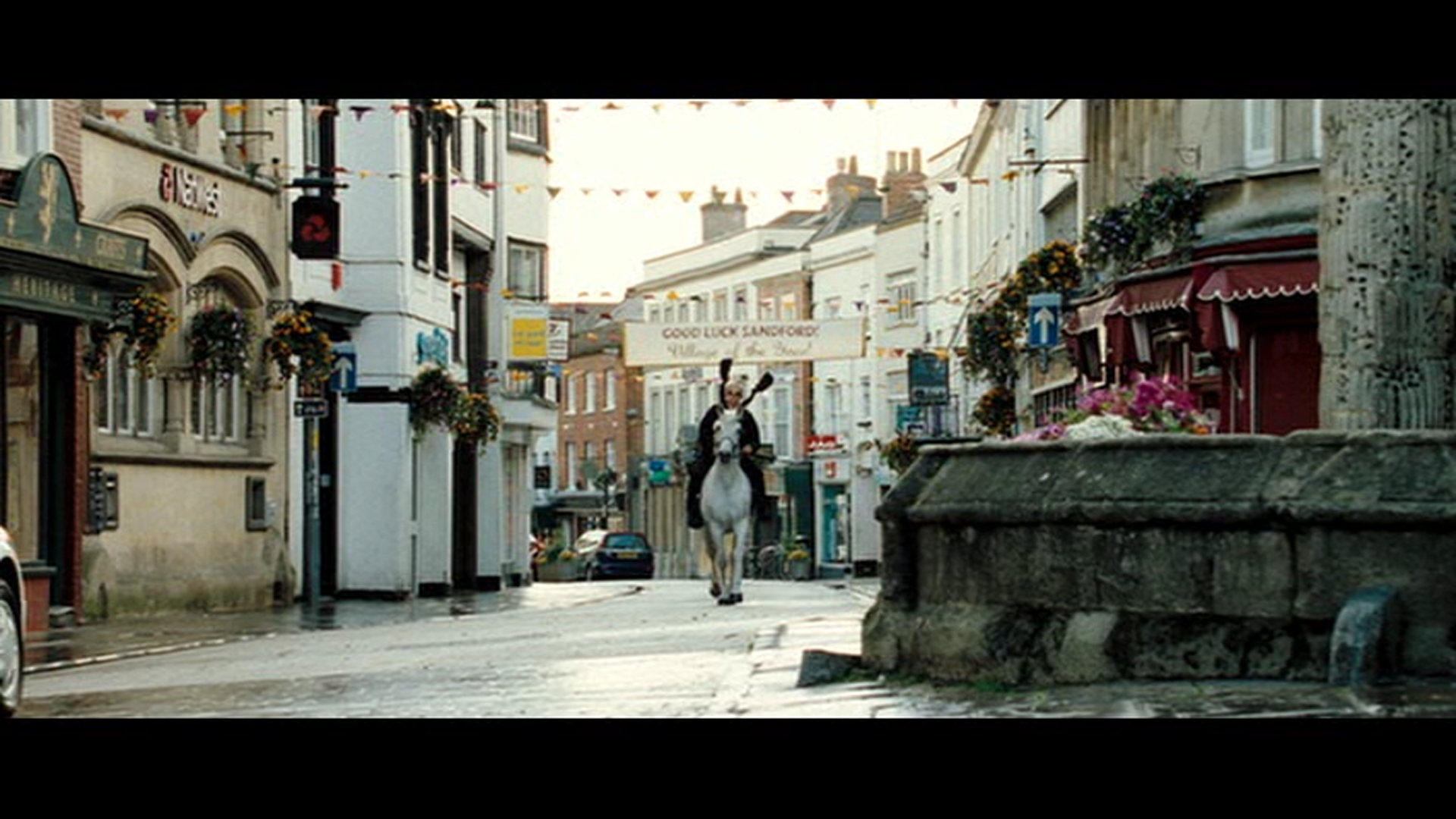
Though the first hour and fifteen minutes is sort of a slow build up, it eventually erupts into a highly entertaining action sequence for the final half an hour. Starting off shades of a Western, Angel returns to the village on a white horse, armed to the teeth. There is a momentary stand off, and then it just explodes. The "shit just got real," as they say (in reference to Bad Boys II). And then it is just a crazy, over the top action film, reminiscent of all the best action movies (with another big reference to Point Break.) An awesome action sequence that keeps on giving, you really do need the slower pace for the first hour or so to maximize the efficiency of it. (It's almost like a Dostoevsky novel: you have to sit through five hundred pages of deliberate and slow paced story to get a hugely satisfying payoff.)
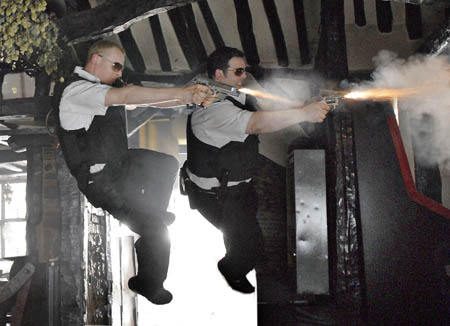
The film doesn't play on the "double meaning" thing as much as in their other works, though it is still very much there. All of Skinner's remarks are intentional and blatant, so you already know he's predicting the future. And there are the comments that are more cleverly hidden in their prediction. For example, early on, Danny is grilling Angel about his experience. "Have you ever fired a gun whilst jumping in the air?" he asks among other things lifted from action movies. Angel has not, as he is grounded in a more realistic "reality." Of course, he and Danny wind up doing all of these things during the final shoot out.
Wright and Pegg do show a fondness for on-point character names though. If The World's End made it a point to name everything according to its function, they do a similar thing in Hot Fuzz. Tim Messenger is a newspaper reporter who has information to give to Angel before he is murdered. Roy and Mary Porter own the local pub. Leslie Tiller is the florist. And then a lot of the Neighborhood Watch members have very violent sounding names! Seymour Skinner, Reverend Shooter, Robin Hatcher, James Reaper - these are all names that sound hostile and violent in nature! This, of course, is something that Wright and Pegg love to do, but it definitely was more a thing in Hot Fuzz and The World's End. Though ultimately not as good as Shaun of the Dead, Hot Fuzz really is an excellent crime/mystery/action flick. It continues the "bromance" plot elements that were heavy in Shaun. Interestingly, there was originally supposed to be a female love interest for Angel, but they decided it didn't add anything to the story and cut the character. Nick Frost is superb again as Pegg's best friend. This time though, Frost plays an immature character with good intentions while Pegg plays the rather stiff and dry character. If Shaun were about "maturing," then Fuzz is about letting your hair down once in a while.
The rest of the cast is great as well. Timothy Dalton is extremely good in the villainous role of Seymour Skinner. "Lock me away," he says to Angel when he runs into him on a jog. "I'm a slasher...a slasher of prices!" These, of course, are the double meaning jokes that Pegg and Wright love, only here it's not meant to be hidden. They make it rather clear that Skinner is a bad guy from the start. However, he then goes on with a more subtle line as he jogs away, "Catch me later!"
Timothy Dalton is awesomely menacing.
Jim Broadbent is also great as the role of police chief, intentionally dumbing down his men and women. He punishes his son Danny, after a night of heavy drinking, with birthday cake and ice cream - to the chagrin of Angel. Then, of course, there are wonderful cameos by some of England's finest: Martin Freeman, Bill Nighy, Steve Coogan, and an always delightful Stephen Merchant. The entire cast is great, and as always, Wright uses a smartly selected soundtrack to go with it.
Hot Fuzz is probably not as intelligent as Shaun or World's End, it is still an amazing, entertaining, and smart film. Being the worst of those three movies is not a bad thing at all. It's the difference in an A and A-, really. It isn't a mindless action film, but it is still a really entertaining one.
When Call of Duty changed pace from World War II era games to the newer, modern setting, it was easy to think that they would switch gears and move forward with that. The huge success of the Modern Warfare franchise had seemingly confirmed that a good decision, and the series hasn't really gone back to the WWII since this game. With that in mind, it's easy to imagine World at War as a sort of epic finale of the WWII Call of Duty games. And quite frankly, it doesn't disappoint.
Since the Call of Duty is a money maker, they seem to be committed to putting one out every year. This seems a bit overkill, and it's easy to think that Treyarch's follow-up to the disappointing Call of Duty 3 was a let down compared to Call of Duty 4: Modern Warfare, but the game actually does a pretty solid job with it's rather predictable narrative. One doesn't typically play a Call of Duty game for the story, but World at War does a nice job keeping it relatively grounded. It does this by actually making the war seem like hell. It's chaotic and brutal. There is blood and death. The soldiers (with the exception of Reznov) don't seem to have that weird "we're the best at warring!" mentality that permeates the rest of the franchise. The Americans are bitter at command for being so wrong about their opposition and they complain regularly about the lack of supplies. They also freak out at times and seem shaken by their comrades' deaths. This is a notable shift from previous games that had them constantly acting extremely confident in their war skills.
This shift in tone - making a war game fun, yet careful to make sure it's hellish attributes are clear (although still glorifying war) - is what makes World at War stand out. The level designs are a rather linear, as is typical of the franchise, but they do open up at times for a wider area that allows different tactical approaches. The weapon selection is a bit wider. They also include a few areas where mounted machine guns are accessible for use, or mortar shells are available to prime and throw like grenades. The Russians have molotov cocktails. The Americans use flamethrowers. The diversity here isn't ultimately great, but it's more than previous games.
The game moves pretty quickly too. It's broken into two campaigns: Russian and American. As Pvt. Miller, you go through a few key battles in the Pacific Theater - most notably Pelilieu and Okinawa. The Pacific campaign doesn't get a lot of attention, so it's kind of interesting to play in it. With Japanese soldiers popping out of spider holes or sniping from in the trees to bonzai charges and booby trapped bodies, it leaves you a little on edge. It creates an eerie feeling - that they can come out of anywhere - that really fits the campaign. It further brings to mind the real life horrors of that war and adds a unique dynamic to the franchise that otherwise is just run and gun with little thought to your surroundings.
The environments are pretty solid as well. You go back and forth between decimated Russia and Germany and then the lifeless rocky islands with palm trees in the Pacific. In Europe, you are constantly navigating a maze of destroyed buildings. In the Pacific, you often have to go into caves and mountains or jump into the subterranean tunnel network dug by the Japanese. What does hurt a little bit is how the time jumps around a bit too. Often when you finish an American mission in the Pacific, you switch over to the Eastern front happening around the same time. But when you go back to the Pacific theater, several years have gone by. It makes sense that they would want to show a few key battles through the war, but you never really get a good sense of the passage of time.
The Russian campaign (of which I'm still not sure why everyone wants to play as the Russians) has you playing as Pvt. Petrenko. First, you somehow avoid being mercilessly murdered during the German invasion of Stalingrad. It then leads you to a crazy chase sequence followed by yet another sniping battle. It's a bit tedious and unoriginal. It seems like every Russian campaign requires a sniping battle these days. What makes this Russian campaign different from others, however, is the sheer brutality of it. Reznov does not hold back. He demands blood and endorses cold-blooded murder of surrendering German troops or anyone who stands in the Red Army's way. There are a few moments thrown in where you have a choice on whether or not you want to be that brutal. Early on, you are held captive and Reznov bursts in. The German captures lie bleeding when he demands you shoot them to finish them off. You don't have to though, and it's nice to get the choice. However, there is an uncomfortable scene later where you trap retreating German troops in a subway area. You are given the choice to shoot them or not. If you don't, other Russians will throw molotovs down and burn them to death instead (in which Reznov will criticize you for allowing them to be tortured to death - even though he spends the majority of the game talking about how he will brutalize the Germans.) It doesn't shy away from how dirty and violent the Russians were in response to the German brutality.
The game play is pretty much just like every other Call of Duty game though. It's not particularly exciting or interesting at this point, but it is a solid scheme. I suppose if it ain't broke... One of the things that gets really annoying though is the way that they seem to increase the difficulty of the game is to simply throw tons and tons of grenades at you. It's more annoying than challenging, although the game does have its share of legitimate challenges. Additionally, there is a level where you are the gunner on a PBY Catalina flying boat. You take on the Japanese Navy and some Zeroes with kamizake pilots. It's a surprisingly fun mission that gets pretty crazy. It might be the only "ride something" mission I've enjoyed in a shooter.
Manning the guns on a PBY Catalina, you take on the Japanese Navy in one of the more fun missions.
Easily the best thing about the game, however, is the ability to play co-op campaign. This was innovative for the time given that no Call of Duty game had allowed multi-player campaign. No Call of Duty game really allows it after as well, making World at War a bit unique in that regard. It might not seem like a big deal, and indeed most CoD players probably prefer online versus anyway, but for someone who prefers co-op, it is. There aren't a lot of WWII era co-op games in the first place, which makes little sense since you're often surrounded by other soldiers in the game.
Though the co-op campaign didn't become a trend unfortunately, it's inclusion of "Call of Duty: Zombies" weirdly did. A special bonus mission after the credits lets you play one last level in which you are holed up in a fort and must fend off an onslaught of zombies. All the while you earn points which you can use to buy upgrades. There's no way to win. You just go until you die and try to get the high score. For whatever reason, Treyarch would continue to include this in their games even though it is actually not that fun.
Here's the thing for me: I enjoy Call of Duty games, really. They're fun and action packed. They tend to be a good challenge while remaining very simple. All of the CoD games have essentially the same control scheme and play almost identically. I don't think they're amazing games and I don't think you need to play more than two because they are all so similar. Still, if you're only going to play a few, World at War isn't a bad one to pick up.
If you wanted to add a game to the list of things that you might not consider a "game" in the technical sense of the word, Home is a good one to check out. A retro style pixelated story that is almost reminiscent of Maniac Mansion, only here, there isn't much in the way of player agency. There isn't much of a challenge, and things don't radically change depending on the choices you make throughout the course of the game. There aren't exactly puzzles either; instead, players will likely have to do some digging around to find key items needed to advance.
Very much on the edge of the much-maligned "walking simulator" genre (think The Stanley Parable or Dear Esther), Home might not be too appealing to many gamers. For a game that pretty much only allows for moving around and choosing yes or no options, it doesn't even feel quite as "gamey" as something like Telltale's The Walking Dead franchise, which does many of the same things. No real puzzles or challenges, deceptively meaningful choices, and - in regards to season one - minimal meaningful changes to the unfolding story based on your decisions.
Still, Home should be judged on its own for what it does. It's visual style is a bit strange, given the horror nature of the narrative, but it actually works. Despite the retro graphical style, there is still a moment of tenseness building up as you make your way through doors and passageways. Every time, the perspective shifts from third person to first as the door opens up. A creepy, well-created sound effect blasts, the screen gets dark for a moment, and you almost expect a stereotypical jump-scare every time! The way it plays with that trope and defies the expectation in order to build suspense and anxiety is excellent. The limited range of the flashlight also creates an eerie atmosphere in a sketchy environment. All things considered, it works surprisingly well for a style that should by all means not work at all.
With limited visual fidelity to create the horror tone, the game relies heavily on sound effects. In order to make the player feel anxious at all, one has to be nearly perfect on the sound engineering. It was a key component to why P.T. was so goddamn terrifying, and it is a big reason why Home can make you tense despite the graphics. Sometimes they go a little overboard, but it's mostly successful. On the PS4, they even use the lights on the controller in an interesting fashion. After about half an hour of playing, as I began uncovering the mystery (or possibly doing so), I noticed that the light on the front of the controller had been getting progressively a darker shade of red, indicating a descent into the horror. When I got home and started denying some obvious facts, the light turned green. It's a subtle thing that doesn't really add anything to the game or story, but it was a neat use of a completely irrelevant feature of the console's controller.
In many ways, the game would be more akin to something like Her Story: not much player agency, but a lot of it being organized around the player piecing together a mysterious story and coming to some conclusion. In my playthrough, it was pretty obvious who "dunnit," but I've been reading some other aspects of other players' experiences, and it sounds like I missed some stuff. Being short - it takes about an hour to complete - it begs re-examination almost immediately. Like Her Story, many people might question whether or not it actually constitutes the label of "game." I, however, prefer to not get so wrapped up in those things. Home is less gripping than Her Story, but if you enjoyed the latter, than it might be worth checking out.
REDUCTIVE RATING: Interesting
(I'm creating a new rating system for things that aren't traditional in its format, which makes them a little bit more niche.)