I'm not quite sure how or why it happened, but last week's examination of the NFL's overtime rules became one of the most viewed entries. Since then, I've been involved in a strangely high number of conversations - online and off - about the perceived "unfairness" of the current rules. After hearing a lot of arguments, I figured I would do some more digging and update my argument with a few thoughts that came to me later.
In the previous article, I mentioned that in 2010 and 2011 combined, teams that got the ball first in overtime had a game winning score on their opening possession just about 16% of the time. Some have accused me of being deceptive with my limited selection of years. I don't think I was being deceptive about it (in the original article, I did specifically state outright that I was citing a very limited sample size, so it's not like I made it a secret). So, naturally, the first thing I went and did was found data in more years.
For the sake of transparency: this information is not readily available. Turns out, no one else has really been collecting this data in one easily accessible spot. Googling, "how many OT games were won opening possession scores" doesn't yield anything particularly helpful. However, the information itself is out there. What I've had to do is painstakingly find all the games in a season that went to overtime (by looking at the scores week by week), then read the play-by-play logs to find out which OT games were won on an opening possession. If you've never tried collecting data like that, let me assure you it's extraordinarily tedious and time consuming. I'm even going to mention that you have to take these stats with an error margin of maybe +/- 2 games total. (I think, for example, I originally claimed that teams that got the ball first in 2014 and 2015 went 15-23. They didn't. They went 15-22. I apparently re-counted a game. Staring at a computer screen and reading tons of tiny text can make it kind of easy to mess up here and there.)
Point being, there's a reason my sampling sizes are not that large. First step, then, was double checking the four years I had already tracked, and then counting more. I've gathered the stats for all four years of the new OT era, and I went back seven years - to 2005 - with the old rules. Not because I'm trying to cherry-pick. Indeed, I fully plan to keep digging at another time. It's just that this has been such a time consuming process that I need a break. Still, seven years of data is enough to give us a bit of a clearer picture.
Here is what I've found:
Teams that got the ball first in overtime from 2005 to 2011 had a combined record of 49-52-1. However, out of those 102 overtime games, only 31 were won on an opening possession. That means that in the span of seven years, the game was over after a single possession 29.5% of the time.
Comparatively, from 2012 to 2015, teams that got the ball first in overtime had a combined record of 37-32-3. Out of 72 overtime games during that span, the game was won on the first possession score, or the team that got the ball first scored and the other team failed (functionally the same as sudden death) 23 times. That's about 31.9% of the time.
Basically, a team that gets the ball first and scores on their opening drive is functionally the same. In four years, there has only been one occasion in which a team scored on their opening drive, then wound up losing the game (the Colts lost to the Panthers in 2015 after getting the ball first and scoring a field goal). 21 out of 23 teams that scored on their opening possession in overtime win the game. (One time resulted in a tie - more on that in a moment.)
Well, ok, what about games that were won on an opening possession touchdown? From 2012 to 2015, that's happened 20 times, out of 72 overtime games. that's about 28% of the time. It makes sense that we'd see a jump in this stat given that the new rules fundamentally shift the strategy of coaches, offenses, and special teams now that a field goal doesn't guarantee anything (even though it kind of effectively does). One might expect to see a rather substantial dip when looking back at this stat when looking at the original rules. Yet from 2005 to 2011, overtime games were won an an opening possession touchdown 24 out of 102 times - or 23.5% of the time.
Yes, yes, I understand that results don't equate to fairness. But this further backs my argument that this idea that all you have to do, really, was win the coin toss was complete nonsense. Football is a little more complex than that. Games won on opening possessions has been almost identical in the first four years of new OT rules as they were in the last seven years of old ones. The frequency a game is won on an opening touchdown isn't particularly different either.
So what was the point of these overtime rules?
I suppose in defense of the anti-old rules and "win the coin toss, win the game" fighters, it's worthwhile to examine years independent of each other too. Certainly when you look at the years individually, you find that there is no real pattern. Below is the breakdown of percentage that games with the old rules were won an the opening possession, without the other team's offense seeing the ball:
2005 - (31%)
2006 - (41.6%)
2007 - (40%)
2008 - (50%)
2009 - (40%)
2010 - (11%)
2011 - (27%)
At first glance, one might say that there is something of a commonality in that three of the four years saw it occur 40% of the time. One year even saw half of all overtime games end on the first possession! And yet, there's also 2010 and 2011, and 2005 only saw this happen less than a third of the time. I'd guess that if we went back further, we'd see something similar in that the success rate fluctuates pretty wildly at times.
Regardless, none of those statistics indicates that this was something happening all the time, like everyone suggests. Even 2008, the year most favorable to the team that gets first possession, it only happened half of the time. Hardly enough to indict the rules. And oh yeah, the overwhelming majority of overtime games today are still won on field goals.
However, there's one other stat I'd like to call attention to. Did you notice that in the last seven years of the old rules, there was just one tie? Did you happen to catch that in the first four years of the new overtime rules, there have been three? 2015 is the first year of the new rules that didn't have a game end in a tie, but there were a few close calls. This leads me to a few additional thoughts about overtime rules from a design perspective.
Take a moment to consider what the function of overtime is. The entire point of overtime is to determine a winner. The whole "fair" argument is really strange to me since it throws out the fact that there was an entire sixty minutes of regulation in which both teams had plenty of opportunities and chances to legitimately win the game. When it's still tied, the game slightly alters one rule to help determine a winner when a full game wasn't enough. All it changes is that the first team to score wins. That's it! The game plays out almost exactly the way it would in regulation. The only strategical difference is that coaches will call super conservative plays deep in the opponent's territory, knowing they don't need to try for the touchdown.
Can you recognize what that rule change does, from a game perspective? It practically guarantees a winner. Sure, there have been those few games that still end in a tie, even with sudden death rules, but the rest of the time, there is always a winner as long as someone scores. The sudden death rules decrease the chances of a tie.
Here's what the new rules functionally do: by allowing the other team to have an offensive possession if the first team scores a field goal, the rules actually increase the chances of a tie. Here's the perfect example: a couple of years ago, the Vikings and Packers went to overtime. The Packers got it first and scored a field goal. The Vikings got a possession, by rule, and proceeded to score a field goal of their own. With a normal fifteen minute period, that doesn't leave a lot of room for additional possessions. There was about six minutes left in the period when the Packers got the ball back for their second possession. Plenty of time to kick a game winning field goal, but when teams have to drive 60 to 70 yards down field for a high percentage chance, it might take a little more.
In this case, the new overtime rules directly led to a game ending in a tie, whereas with the old rules, there would have been a winner (and it would have been the Packers, who conveniently are always complaining about OT rules since they keep losing in the post season - seriously, the Packers have lost their last four playoff games that went to overtime). What's more is this same situation happened with the Bengals and Panthers! That game would have had a winner if not for the new overtime rules. These situations highlight how the new rules can sometimes defy their purpose.
From a game design perspective, you generally don't want a set of rules that can off-set the function of them. If the overtime rules are meant to determine a winner, a system of rules that increases the chances of ties defeats the purpose. (We almost had this same situation happen again this year, by the way, when the Colts scored on their opening possession, and the Panthers scored a tying field goal too. Fortunately, with about five minutes left, the Panthers defense got a takeaway to set up excellent field position for the game winning field goal.)
So ok, the stats don't really back the idea that the old rules really were so terrible, but they just felt wrong. The results don't mean anything about "fairness," it's argued. The whole premise that it's not fair is built on the conceit that the primary element of football is the offense. Even after the rule change in 2012, we still hear people argue that it isn't fair that the other team "didn't get the ball."
Fun fact about football: it's not a turn-based game. Sure, it's not a free-flowing game like soccer or basketball or hockey. And yes, we do like to make analogies to chess. Thing about chess though? It is turn-based. For a while, it was considered an unfair advantage for players who get the first move. After some time, players got really good at developing strategies that there are many who think going second is advantageous. Either way, the point is that chess, like checkers or othello, are purely turn-based games. When one player goes, the other player cannot do anything but watch.
Football does not actually work like that. It's maybe easy to think of offense as "getting a turn" with the ball, but it's not purely turn-based. When the other team has the ball - or has their "turn" - you have your defense on the field. You don't sit idly by while the other team moves the ball into field goal range. When it's not "your turn," you still have the opportunity to act in a way that can earn the win. Because both teams field players at the same time, there is nothing inherently "unfair" about it. If the concern were that both teams get a possession in overtime, then there should be equal focus given to ensuring both teams have an equal number of possessions during regulation too. How many times does a team win after getting the ball first in the game, then getting the ball and trying to kill the clock? This entire strategy is built around ensuring your team has one more possession than the other team. Is that any more "fair"?
The main reason why I don't like all of these rule changes is sort of a fundamental design thing for me. Given that some teams build around offense - like all of those Colts teams with Peyton Manning - and others build primarily around defense - like the Seahawks - it seems weird that the argument is that we need to ensure offenses get a chance. At the end of the day, we're trying to mold the rules around the teams, rather than having the teams build around the rules.
It's a highly questionable approach to design, and one that I don't think the league should get into. Even the idea of college rules - which I think is very entertaining - takes away special teams and some key coaching aspects. Field position is removed from the equation entirely, as are all of those decisions that make or break teams and coaches.
So yeah, I still don't think the rules ever had to change in the first place. The new rules are worse, even if slightly more entertaining. And I do worry a bit about what any more knee-jerk rule changes will do.
Friday, January 22, 2016

Monday, January 18, 2016
Fair Is A Feeling: A Critical Look at the NFL's Overtime Rules
The NFL is in something of a no-win position when it comes to their overtime rules. For the longest time, they had very simple, straightforward rules to it, but fans complained. The noise got so bad that in 2012, the rules committee voted to change it. On the most part, the suddenly convoluted rules were well received. And yet here we are, again, with a team losing in overtime, in the post season, without ever possessing the ball, and people are complaining about the rules.
Frankly, the NFL is never going to pass overtime rules that please everyone. At the end of the day, sports fans are very emotionally-driven. And let's be real here, the Green Bay Packers wouldn't be saying anything about the perceived "fairness" of the rules, or arguing that they need to change if their defense had, I don't know, not given up an insane 75 yard catch and run by Larry Fitzgerald.
One thing that's really interesting about sports though is that at their core, they're just games. Most of these sports have a lot of crazy rules, but many of them - as complex as they sometimes are - actually do a lot to keep a balance. People don't often look at rules or rule changes in terms of game design.
For example, look at intentional grounding. A quarterback cannot throw the ball away when under pressure if he's in the pocket. If he gets out of the tackle box, however, he can. On the surface, this seems totally arbitrary. Why can't the quarterback throw the ball away when he's in the pocket, but if he moves a few yards to the left, he can? Well, balance. It may be tempting to view that as a rule designed simply to drive up sack stats and increase excitement, but it also creates balance between offense and defense, making it fair. Given the formations of offenses and defenses, all of the pressure comes in through the pocket. If the quarterback were allowed to simply throw it away without penalty while there, the system would lean in favor of one side, giving him an unfair advantage. By outlawing throw aways within the pocket, it gives the defense a chance to succeed too, rather than giving the QB the unfair ability to just chuck the ball wherever at the last second to avoid losing yards in a sack.
Additionally, when the quarterback gets out of the pocket, he's essentially earned the right to throw it away. The defense has had a chance to get pressure, and didn't capitalize, thus now the quarterback can perform that action in a way that is fair. These seemingly pointless rules actually create a fairness wherein the defense has a chance to sack the quarterback, but the quarterback - once meeting a particular condition - is not forced to take a sack every time there's pressure. These kinds of rules help create a level systematic playing field. Of course, why the quarterback has to get the ball back to the line of scrimmage doesn't strike me as anything but arbitrary, but no one ever said all of these rules were well thought out game design elements.
Often times, people want changes when they feel they got screwed out of a rule, even though those changes can't change the past, and could very well hurt your own team later down the road. Here, I'm going to attempt to break down why, from a game design perspective, the current overtime rules are a hot mess that doesn't actually make the game more fair. Bear with me, this could get long-winded.
For those who are not sports fans, the former overtime rules in question were quite straightforward. If, at the end of regulation, the game is still tied, they functionally restart the game with sudden death rules. Meaning, first one to score wins. This essentially put the impetus on chance. It was often thought that whoever won the ensuing coin toss at the start of overtime would win the game. After all, field goal kickers have gotten so good that you have a great shot at winning if your offense can just drive to about the opponent's thirty yard line.
Fans got so annoyed with the idea that a field goal early in OT wins the game that the league was eventually confronted with the idea of altering it. The more positively received rules aren't the most difficult to grasp, but it takes a bit longer to explain. Follow me here: the game can only end in overtime on one possession if the offense that first receives the ball scores a touchdown on their first drive, or the defense manages to score a safety or returns a fumble or interception for a defensive touchdown. If the first offense scores a field goal, then the other team gets one possession to tie the game with a field goal of their own, or can win if they score a touchdown. If the first offense doesn't score, or they score a field goal and the second offense also scores a field goal on their possession, then the game defaults to sudden death rules and the first team to score any points in any fashion wins. Alternatively, if the first offense doesn't score at all, and on their ensuing possession, the second offense doesn't score either, then the game defaults to sudden death rules as well.
Did you follow that? If it sounds pretty complex, it's because it is. It's rather unnecessary too. Let's break down why these rules don't actually make overtime any more fair.
The problem with the original overtime rules, it's argued, is that it's skewed too much in favor of offenses and special teams. It's often posited that sudden death rules that include field goals puts the defenses at too much of a disadvantage. Ostensibly, it's unbalanced and "unfair" to the team that doesn't win the coin toss.
According to a super interesting breakdown from Football Outsiders, the average starting field position off of kickoff for most of the early aughts was about one's own 28 or 29 yard line. In 2010, NFL kickers connected on 74% of kicks between 40 and 50 yards. Let's use these parameters for a moment. The argument goes that for the offense that gets the ball first in old rules has to drive about 45 yards to have a 75% chance of winning off a long field goal, given the improved overall quality of modern kickers. With the current rules in place, the first offense could drive the same 45 yards and kick a long field goal, but then they'll have to play defense and stop the opposing team from doing the same thing or better.
First off, that isn't really "nothing." The idea that this system is imbalanced in favor of the offense and special teams is kind of absurd. Sure, the offense only has to drive about half the distance that it would need for a touchdown, but that's to specifically set up a long field goal, which would mean that it's not skewed particularly favorably for special teams. Kickers have gotten a lot better over the years, but most teams don't play overtime to set up a 40+ field goal, especially when you recall another rule: if a kicker misses a field goal, the opposing team gets the ball at the spot of the kick, not the line of scrimmage like usual. Meaning, if a team does play for a long 45 yard field goal to win, and misses, then you're giving the ball to your opponent with great field position. The second offense would only have to drive 35 to 40 yards for the same opportunity to win the game.
And, of course, for shorter field goals, the offense still has to drive a good chunk of the field. If a team starts on their own 30 yard line and hopes for a 30 yard field goal, they'll have to drive about 50 yards from to get into range at their opponent's 20 yard line. It shouldn't seem so unfair that a defense has to stop an offense from driving down literally half the field.
Secondly, and more significantly, it is disingenuous to suggest that the other team - the team that lost the coin toss - "didn't get a chance." They did. In such field goal winning situations, the other team had chances to reduce field positions or block the kick with their special teams, and had the opportunity to keep the opposing offense out of field goal range with their defense. Football is not just offense. The original overtime rules were surprisingly balanced to not show any real favor to the offense or the defense or the special teams. It was balanced. The defense has an opportunity to make a stop or get a turnover. The special teams has an opportunity to score/contain the opponent. And the offense has an opportunity to drive to score the game winning points.
Here's what the new rules did, if anything: it actually skewed it so that the defense has an advantage. They are no longer on the line for giving up large chunks of yardage. If a defense played poorly in overtime and allowed an opposing offense to get into field goal range, that was their fault. They'd lose the game for playing poorly. Now though, if a defense gives up a lot of yards and a field goal, their offense has one more opportunity to bust them out of trouble.
See, here's the other thing about the new rule changes: they were completely unnecessary. Apart from the fact that a team can still win without the opposing offense ever seeing the field (as happened in the Green Bay/Arizona game), there was another rule introduced that actually fundamentally made things better for the original rules, that instead, with the new OT rules, makes the new OT rules even more imbalanced than the original rules.
That major change is, of course, the kickoff spot. Sports are a bit different than most games in the sense that these aren't pieces moving around a board. These are human beings. As such, there are going to have to be concessions for the sake of player safety. For example, the new kickoff spot, mixed with banning the wedge formation and more than two players linking are dumb rules from a gameplay perspective, but make total sense when considering player safety.
And here's what the new kickoff spot does for overtime rules: it pits the first offense in worse field position. Instead of starting near their own 30 yard line, teams are regularly starting on their own 20 due to the huge increase in touchbacks. Plus, if for some reason they do get a return, there's a strong probability they'll be starting inside their own 20. What this does it makes the distance the offense needs to go for a potentially game winning field goal farther by about ten yards. A team needs to drive about 55 to 60 yards to get into reasonable field goal range now. In effect what this does is makes it more challenging for the offenses. So the new kick off rule hurts the offense and helps the defense, and the new overtime rules hurt the offense and helps the defense. These two rules, however separate they may be, have ultimately skewed the balance in favor of the team that is on defense. They are presented with a better opportunity.
What's kind of funny though is that what people thought about the original overtime rules and what they assume about the new ones are, frankly, without statistical merit. Now, admittedly I'm using a rather limited sampling size. Given that the main argument is that the original rules were skewed too heavily in the favor of the team that wins the coin toss (read: the offense that gets the ball first), and the new rules are supposed to balance it out, then presumably, looking at the data should show us that the team that gets the ball first should have been winning most of their games in the old rules, and the winning has been subsequently more even with the new rules. To check this, I meticulously looked through the game logs of four years: 2010 and 2011 (the last two years of the old OT rules), and then 2014 and 2015 (the two most recent years of the new OT rules). The data suggests what I've always felt to be true: the mechanic wasn't broke, and there was never a reason to change them in the first place. Here, check it out:
Between 2010 and 2011 - the final two years of the old rules with the simple sudden death even by field goal stipulation - teams that got the first possession had a losing record of 15-23. That's a winning percentage of .394. More than that, of the 38 games that went to overtime, only 6 were won on the first possession. Yes, that's right. Only 15.8% of the time under the old rules did a team that got the ball first win the game on their first possession in a two year span.
Conversely, between 2014 and 2015 - the most recent two years of the new rules that are supposed to be more "fair," - teams that got the first possession had a winning record of 19-13. That's a winning percentage of .594. And again, more than that, of the 32 games that went to overtime, 14 were won by teams that scored a touchdown or scored a field goal on their opening possession, followed by their opponents failing to score (which is functionally the same result as the old overtime rules). That means that in the new overtime rules, 43.8% of the time, the game is over because of scores on the opening possession.
Essentially, there is no statistical data that actually suggests that winning the coin toss and receiving the kick off for the first possession held any discernible competitive advantage under the old rules. Probably because it's football and teams have defenses and special teams. Contrary to popular opinion, it isn't only offense.
Of course, the most obvious counterargument here is that statistical correlation does not equal causation. Obviously, teams that get the ball first were not losing games because they got the ball first. The same argument, naturally, can be applied to the new overtime rules too. The Packers, for example, did not lose because they didn't get the ball first.
Bottom line: the new rules do virtually nothing to make the game "more fair." From a design perspective, the old rules were nearly perfect. The advantage of winning the coin toss was obviously not a problematically large advantage. The team that kicked off was given a chance to get the ball back (and at times, even win the game - there were at least three games I encountered in the old rules that were won on defensive touchdowns, and none of them were that Packers game when they beat the Seahawks through a pick six of Matt Hasselback way back when!). Functionally, it was fair to both teams. They were neutral rules. It didn't favor the offense. It didn't favor the special teams. And it didn't favor the defense. It provided equal significance to each phase of the game.
The new rules have made no difference, except that now, it gives a defense more leeway. Mixed with the new kickoff rules, it even gives the defense more of an advantage. In essence, the new rules are actually more unfair than they were before (even if I completely agree that it's not particularly "unfair" - however, the rules are slightly imbalanced, leaning more favorably on defenses now).
Yes, yes, I just made a rather confusing argument. While I believe the statistics prove that tales of the coin toss's significance in the original rules are dramatically exaggerated, I don't believe statistics are everything. I'm not a total idiot and know I just made an argument that the new rules should be helping the defense, but the statistics show that more overtime games are won on first possessions than ever, despite it being harder.
They're sort of separate arguments though. As I said, the statistical correlation does not mean causation. The statistics argument was used to highlight that the old rules were not giving a team any particular unfair advantage in terms of results. Examining how the mechanics work in detail, though, highlights why they actually do - as a system of rules - give a slight advantage to the defense. Obviously, one can quite simply look at the pro-offense statistics of 2014 and 2015 to say that the new rules clearly don't give defenses a big advantage, but I hope the fact that I also examined how the mechanics actually work on a game-level, and not just on a results basis, helps clear up that I'm arguing in defense of the old rules and suggesting the new rules are really only slightly more unfair on a mechanical level.
What was the real cause of concern to begin with? Is the problem really that it's "unfair" the other team doesn't get a possession? If that were true, the new overtime rules don't actually do much to change that, since a team can still be robbed of a possession if the first team scores a touchdown. If that were the argument, then by all means, the NFL should adopt college rules, where each team gets a possession from the 20 yard line and is given a chance to score - playing a bit more like penalty kicks, if penalty kicks weren't a load of nonsense that is extremely favorable to the kicker and extremely unfair to the goalkeeper. (While I don't necessarily think college OT rules are "more fair," I do think that it is a more entertaining system at any rate.)
If the problem people had was that a field goal on an opening possession would win the game (something that didn't happen nearly as often as people seem to think it did), that might be a fair point. Kickers are more accurate than they've ever been. The league is currently altering PAT rules to make the most boring and unnecessary play in all of football even vaguely relevant, since kickers and their extra point attempts were converted at an absurdly high rate. Seriously, it was basically 100% of the time. Even more, accuracy at a distance has also jumped pretty substantially over the last decade and a half.
Admittedly, I'm one of the few football fans who likes kickers and punters. I've always found them an intriguing part of a football game. They're far more a part of a team's game strategy than people ever give them credit for, and while people may find kicks boring, I find the long kick with the game on the line one of the most exciting plays in football. Few football plays have the same kind of anticipation and anxiety-inducing build up as the field goal attempt. Adam Vinatieri lining up in the snow against the Raiders or against the Rams or Panthers with no time left was the football equivalent of a batter stepping up to the plate with a full count, bases loaded, bottom of the ninth down by two.
However, I can concede that kickers are too accurate now. When they're as great as they've been, even long field goals are a bit boring. If this is the problem though, then the solution for overtime isn't to change the overtime rules into this super complicated thing that takes two paragraphs to explain. Instead, the thing that should really have been addressed was increasing the difficulty of field goals. How about instead of the convoluted overtime rules, they make the field goal cross bar higher and the side posts narrower. Make it so kickers need to be even more accurate. If field goals aren't automatic, then no one can really complain about a field goal winning a game in sudden death overtime.
Or, alternatively, the league could examine the possibility of altering point values. Field goals could function a bit like shots in basketball where at a certain range, they're worth two points, at another range, they're worth three, and at 50+ yards, they're worth four. (It's really not that hard or more complicated to keep track of this stuff...) Or, we could abolish the extra point and only do two-point conversions, as starting from the five yard line to make it something that isn't automatic. (11 teams that attempted at least one two-point conversion in 2015 had a conversion rate of under 50%. 15 teams had 50% or higher. 4 teams didn't attempt one at all. Point being, successful conversions are still a bit skewed favorably for the offense. Setting it back to the five would presumably give the defense more of a shot.)
Point being, looking at adjusting point values would help reduce the chances of a game going into overtime entirely. Yes, yes, I know, I know. "But tradition!" "A field goal has always been worth three!" "You can't abolish the dumbest, most pointless, and least exciting play in all of sports! (the PAT)" But the thing is, in game design, you typically don't just accept a points system that allows for a bunch of ties to keep happening. This suggestion, by the bye, isn't entirely necessary (even if I think it's a good solution). All in all, 38 overtime games in 2010 and 2011 is still a rather small percentage. Given there are 267 games in an NFL season, 38 OT games in two seasons (534 games) means that only about 7% of those games went to overtime. Is that a large enough percentage to merit rule changes? Up for debate, really (I'd say yes, but others might disagree).
Look, Packers fans have been on the wrong side of overtime post season games two years in a row. I get it. It is kind of anticlimactic to have one score at the beginning of a new period conclude the game. Frankly, if we want complete fairness, the NFL post season overtime rules should be a full, ten minute period that plays out in its entirety. No sudden death at this point. If it it's still tied at the end, then you play another fifteen minute period that is completely sudden death. No one can complain about "fairness" when you've played basically five periods of football! At some point, you just have to accept that the other team made more plays when you lose.
It's just funny to me that people always want to change rules that cost them that year, without examining what its impact might be. We changed a system that wasn't broken to one that is slightly imbalanced, just because a few times at key moments in the season, a field goal won a game in sudden death. From a design perspective, the original rules were better, cleaner design. From an entertainment perspective, it was virtually the same.
All in all, there's no need to change the current rules unless we are aiming to simplify them. As it happens, I prefer my rules simple and straight forward, so I would support changing it back to simple sudden death, or just a full period followed by sudden death if still tied. But at the end of the day, the current rules - as unnecessary as they are - are every bit as fair as the originals.
And yes, the original rules were totally fair too.
UPDATE:
Done a little more digging. For the sake of transparency, the reason I went with two years on each end for the OT victory stats was that I had to go through all the game logs myself. There wasn't really a central source of the information. It was a tedious and time consuming process.
I've done a little more digging and included three additional years. It does appear, with a larger sampling size, that winning on the opening possession happens more frequently than it did in 2010 and 2011. Hard to say without doing far more intensive digging if those two years were just weird outliers, but even in 2007, 2008, and 2009, it still wasn't a common enough to feel like it was hugely unfair.
In those three years, the winning percentage does skyrocket compared to 2010 and 2011. Teams that got the first possession were 30-15-1 in those years.
But what's funny is, 21 of those 45 games were won on the opening possession. That's 45%, still less than half the time. While that paints a different picture than 2010 and 2011, it hardly gives a portrait of a horribly unfair system. If anything, it still comes off as rather fair.
Looking at individual years also shows that there isn't anything universal. It sometimes swings wildly. For example, if you were to look at 2009, teams that got the first possession were far more successful than than the same teams in 2007, a year that fits the norms found in 2010 and 2011. Point here being, there doesn't appear to much of a consistent picture being painted, and that the success of teams getting the first possession vary wildly by year. None of it really suggests that the rules were the problem.
Frankly, the NFL is never going to pass overtime rules that please everyone. At the end of the day, sports fans are very emotionally-driven. And let's be real here, the Green Bay Packers wouldn't be saying anything about the perceived "fairness" of the rules, or arguing that they need to change if their defense had, I don't know, not given up an insane 75 yard catch and run by Larry Fitzgerald.
One thing that's really interesting about sports though is that at their core, they're just games. Most of these sports have a lot of crazy rules, but many of them - as complex as they sometimes are - actually do a lot to keep a balance. People don't often look at rules or rule changes in terms of game design.
For example, look at intentional grounding. A quarterback cannot throw the ball away when under pressure if he's in the pocket. If he gets out of the tackle box, however, he can. On the surface, this seems totally arbitrary. Why can't the quarterback throw the ball away when he's in the pocket, but if he moves a few yards to the left, he can? Well, balance. It may be tempting to view that as a rule designed simply to drive up sack stats and increase excitement, but it also creates balance between offense and defense, making it fair. Given the formations of offenses and defenses, all of the pressure comes in through the pocket. If the quarterback were allowed to simply throw it away without penalty while there, the system would lean in favor of one side, giving him an unfair advantage. By outlawing throw aways within the pocket, it gives the defense a chance to succeed too, rather than giving the QB the unfair ability to just chuck the ball wherever at the last second to avoid losing yards in a sack.
Additionally, when the quarterback gets out of the pocket, he's essentially earned the right to throw it away. The defense has had a chance to get pressure, and didn't capitalize, thus now the quarterback can perform that action in a way that is fair. These seemingly pointless rules actually create a fairness wherein the defense has a chance to sack the quarterback, but the quarterback - once meeting a particular condition - is not forced to take a sack every time there's pressure. These kinds of rules help create a level systematic playing field. Of course, why the quarterback has to get the ball back to the line of scrimmage doesn't strike me as anything but arbitrary, but no one ever said all of these rules were well thought out game design elements.
Often times, people want changes when they feel they got screwed out of a rule, even though those changes can't change the past, and could very well hurt your own team later down the road. Here, I'm going to attempt to break down why, from a game design perspective, the current overtime rules are a hot mess that doesn't actually make the game more fair. Bear with me, this could get long-winded.
For those who are not sports fans, the former overtime rules in question were quite straightforward. If, at the end of regulation, the game is still tied, they functionally restart the game with sudden death rules. Meaning, first one to score wins. This essentially put the impetus on chance. It was often thought that whoever won the ensuing coin toss at the start of overtime would win the game. After all, field goal kickers have gotten so good that you have a great shot at winning if your offense can just drive to about the opponent's thirty yard line.
Fans got so annoyed with the idea that a field goal early in OT wins the game that the league was eventually confronted with the idea of altering it. The more positively received rules aren't the most difficult to grasp, but it takes a bit longer to explain. Follow me here: the game can only end in overtime on one possession if the offense that first receives the ball scores a touchdown on their first drive, or the defense manages to score a safety or returns a fumble or interception for a defensive touchdown. If the first offense scores a field goal, then the other team gets one possession to tie the game with a field goal of their own, or can win if they score a touchdown. If the first offense doesn't score, or they score a field goal and the second offense also scores a field goal on their possession, then the game defaults to sudden death rules and the first team to score any points in any fashion wins. Alternatively, if the first offense doesn't score at all, and on their ensuing possession, the second offense doesn't score either, then the game defaults to sudden death rules as well.
Did you follow that? If it sounds pretty complex, it's because it is. It's rather unnecessary too. Let's break down why these rules don't actually make overtime any more fair.
The problem with the original overtime rules, it's argued, is that it's skewed too much in favor of offenses and special teams. It's often posited that sudden death rules that include field goals puts the defenses at too much of a disadvantage. Ostensibly, it's unbalanced and "unfair" to the team that doesn't win the coin toss.
According to a super interesting breakdown from Football Outsiders, the average starting field position off of kickoff for most of the early aughts was about one's own 28 or 29 yard line. In 2010, NFL kickers connected on 74% of kicks between 40 and 50 yards. Let's use these parameters for a moment. The argument goes that for the offense that gets the ball first in old rules has to drive about 45 yards to have a 75% chance of winning off a long field goal, given the improved overall quality of modern kickers. With the current rules in place, the first offense could drive the same 45 yards and kick a long field goal, but then they'll have to play defense and stop the opposing team from doing the same thing or better.
First off, that isn't really "nothing." The idea that this system is imbalanced in favor of the offense and special teams is kind of absurd. Sure, the offense only has to drive about half the distance that it would need for a touchdown, but that's to specifically set up a long field goal, which would mean that it's not skewed particularly favorably for special teams. Kickers have gotten a lot better over the years, but most teams don't play overtime to set up a 40+ field goal, especially when you recall another rule: if a kicker misses a field goal, the opposing team gets the ball at the spot of the kick, not the line of scrimmage like usual. Meaning, if a team does play for a long 45 yard field goal to win, and misses, then you're giving the ball to your opponent with great field position. The second offense would only have to drive 35 to 40 yards for the same opportunity to win the game.
And, of course, for shorter field goals, the offense still has to drive a good chunk of the field. If a team starts on their own 30 yard line and hopes for a 30 yard field goal, they'll have to drive about 50 yards from to get into range at their opponent's 20 yard line. It shouldn't seem so unfair that a defense has to stop an offense from driving down literally half the field.
Secondly, and more significantly, it is disingenuous to suggest that the other team - the team that lost the coin toss - "didn't get a chance." They did. In such field goal winning situations, the other team had chances to reduce field positions or block the kick with their special teams, and had the opportunity to keep the opposing offense out of field goal range with their defense. Football is not just offense. The original overtime rules were surprisingly balanced to not show any real favor to the offense or the defense or the special teams. It was balanced. The defense has an opportunity to make a stop or get a turnover. The special teams has an opportunity to score/contain the opponent. And the offense has an opportunity to drive to score the game winning points.
Here's what the new rules did, if anything: it actually skewed it so that the defense has an advantage. They are no longer on the line for giving up large chunks of yardage. If a defense played poorly in overtime and allowed an opposing offense to get into field goal range, that was their fault. They'd lose the game for playing poorly. Now though, if a defense gives up a lot of yards and a field goal, their offense has one more opportunity to bust them out of trouble.
See, here's the other thing about the new rule changes: they were completely unnecessary. Apart from the fact that a team can still win without the opposing offense ever seeing the field (as happened in the Green Bay/Arizona game), there was another rule introduced that actually fundamentally made things better for the original rules, that instead, with the new OT rules, makes the new OT rules even more imbalanced than the original rules.
That major change is, of course, the kickoff spot. Sports are a bit different than most games in the sense that these aren't pieces moving around a board. These are human beings. As such, there are going to have to be concessions for the sake of player safety. For example, the new kickoff spot, mixed with banning the wedge formation and more than two players linking are dumb rules from a gameplay perspective, but make total sense when considering player safety.
And here's what the new kickoff spot does for overtime rules: it pits the first offense in worse field position. Instead of starting near their own 30 yard line, teams are regularly starting on their own 20 due to the huge increase in touchbacks. Plus, if for some reason they do get a return, there's a strong probability they'll be starting inside their own 20. What this does it makes the distance the offense needs to go for a potentially game winning field goal farther by about ten yards. A team needs to drive about 55 to 60 yards to get into reasonable field goal range now. In effect what this does is makes it more challenging for the offenses. So the new kick off rule hurts the offense and helps the defense, and the new overtime rules hurt the offense and helps the defense. These two rules, however separate they may be, have ultimately skewed the balance in favor of the team that is on defense. They are presented with a better opportunity.
What's kind of funny though is that what people thought about the original overtime rules and what they assume about the new ones are, frankly, without statistical merit. Now, admittedly I'm using a rather limited sampling size. Given that the main argument is that the original rules were skewed too heavily in the favor of the team that wins the coin toss (read: the offense that gets the ball first), and the new rules are supposed to balance it out, then presumably, looking at the data should show us that the team that gets the ball first should have been winning most of their games in the old rules, and the winning has been subsequently more even with the new rules. To check this, I meticulously looked through the game logs of four years: 2010 and 2011 (the last two years of the old OT rules), and then 2014 and 2015 (the two most recent years of the new OT rules). The data suggests what I've always felt to be true: the mechanic wasn't broke, and there was never a reason to change them in the first place. Here, check it out:
Between 2010 and 2011 - the final two years of the old rules with the simple sudden death even by field goal stipulation - teams that got the first possession had a losing record of 15-23. That's a winning percentage of .394. More than that, of the 38 games that went to overtime, only 6 were won on the first possession. Yes, that's right. Only 15.8% of the time under the old rules did a team that got the ball first win the game on their first possession in a two year span.
Conversely, between 2014 and 2015 - the most recent two years of the new rules that are supposed to be more "fair," - teams that got the first possession had a winning record of 19-13. That's a winning percentage of .594. And again, more than that, of the 32 games that went to overtime, 14 were won by teams that scored a touchdown or scored a field goal on their opening possession, followed by their opponents failing to score (which is functionally the same result as the old overtime rules). That means that in the new overtime rules, 43.8% of the time, the game is over because of scores on the opening possession.
Essentially, there is no statistical data that actually suggests that winning the coin toss and receiving the kick off for the first possession held any discernible competitive advantage under the old rules. Probably because it's football and teams have defenses and special teams. Contrary to popular opinion, it isn't only offense.
Of course, the most obvious counterargument here is that statistical correlation does not equal causation. Obviously, teams that get the ball first were not losing games because they got the ball first. The same argument, naturally, can be applied to the new overtime rules too. The Packers, for example, did not lose because they didn't get the ball first.
Bottom line: the new rules do virtually nothing to make the game "more fair." From a design perspective, the old rules were nearly perfect. The advantage of winning the coin toss was obviously not a problematically large advantage. The team that kicked off was given a chance to get the ball back (and at times, even win the game - there were at least three games I encountered in the old rules that were won on defensive touchdowns, and none of them were that Packers game when they beat the Seahawks through a pick six of Matt Hasselback way back when!). Functionally, it was fair to both teams. They were neutral rules. It didn't favor the offense. It didn't favor the special teams. And it didn't favor the defense. It provided equal significance to each phase of the game.
The new rules have made no difference, except that now, it gives a defense more leeway. Mixed with the new kickoff rules, it even gives the defense more of an advantage. In essence, the new rules are actually more unfair than they were before (even if I completely agree that it's not particularly "unfair" - however, the rules are slightly imbalanced, leaning more favorably on defenses now).
Yes, yes, I just made a rather confusing argument. While I believe the statistics prove that tales of the coin toss's significance in the original rules are dramatically exaggerated, I don't believe statistics are everything. I'm not a total idiot and know I just made an argument that the new rules should be helping the defense, but the statistics show that more overtime games are won on first possessions than ever, despite it being harder.
They're sort of separate arguments though. As I said, the statistical correlation does not mean causation. The statistics argument was used to highlight that the old rules were not giving a team any particular unfair advantage in terms of results. Examining how the mechanics work in detail, though, highlights why they actually do - as a system of rules - give a slight advantage to the defense. Obviously, one can quite simply look at the pro-offense statistics of 2014 and 2015 to say that the new rules clearly don't give defenses a big advantage, but I hope the fact that I also examined how the mechanics actually work on a game-level, and not just on a results basis, helps clear up that I'm arguing in defense of the old rules and suggesting the new rules are really only slightly more unfair on a mechanical level.
What was the real cause of concern to begin with? Is the problem really that it's "unfair" the other team doesn't get a possession? If that were true, the new overtime rules don't actually do much to change that, since a team can still be robbed of a possession if the first team scores a touchdown. If that were the argument, then by all means, the NFL should adopt college rules, where each team gets a possession from the 20 yard line and is given a chance to score - playing a bit more like penalty kicks, if penalty kicks weren't a load of nonsense that is extremely favorable to the kicker and extremely unfair to the goalkeeper. (While I don't necessarily think college OT rules are "more fair," I do think that it is a more entertaining system at any rate.)
If the problem people had was that a field goal on an opening possession would win the game (something that didn't happen nearly as often as people seem to think it did), that might be a fair point. Kickers are more accurate than they've ever been. The league is currently altering PAT rules to make the most boring and unnecessary play in all of football even vaguely relevant, since kickers and their extra point attempts were converted at an absurdly high rate. Seriously, it was basically 100% of the time. Even more, accuracy at a distance has also jumped pretty substantially over the last decade and a half.
Admittedly, I'm one of the few football fans who likes kickers and punters. I've always found them an intriguing part of a football game. They're far more a part of a team's game strategy than people ever give them credit for, and while people may find kicks boring, I find the long kick with the game on the line one of the most exciting plays in football. Few football plays have the same kind of anticipation and anxiety-inducing build up as the field goal attempt. Adam Vinatieri lining up in the snow against the Raiders or against the Rams or Panthers with no time left was the football equivalent of a batter stepping up to the plate with a full count, bases loaded, bottom of the ninth down by two.
However, I can concede that kickers are too accurate now. When they're as great as they've been, even long field goals are a bit boring. If this is the problem though, then the solution for overtime isn't to change the overtime rules into this super complicated thing that takes two paragraphs to explain. Instead, the thing that should really have been addressed was increasing the difficulty of field goals. How about instead of the convoluted overtime rules, they make the field goal cross bar higher and the side posts narrower. Make it so kickers need to be even more accurate. If field goals aren't automatic, then no one can really complain about a field goal winning a game in sudden death overtime.
Or, alternatively, the league could examine the possibility of altering point values. Field goals could function a bit like shots in basketball where at a certain range, they're worth two points, at another range, they're worth three, and at 50+ yards, they're worth four. (It's really not that hard or more complicated to keep track of this stuff...) Or, we could abolish the extra point and only do two-point conversions, as starting from the five yard line to make it something that isn't automatic. (11 teams that attempted at least one two-point conversion in 2015 had a conversion rate of under 50%. 15 teams had 50% or higher. 4 teams didn't attempt one at all. Point being, successful conversions are still a bit skewed favorably for the offense. Setting it back to the five would presumably give the defense more of a shot.)
Point being, looking at adjusting point values would help reduce the chances of a game going into overtime entirely. Yes, yes, I know, I know. "But tradition!" "A field goal has always been worth three!" "You can't abolish the dumbest, most pointless, and least exciting play in all of sports! (the PAT)" But the thing is, in game design, you typically don't just accept a points system that allows for a bunch of ties to keep happening. This suggestion, by the bye, isn't entirely necessary (even if I think it's a good solution). All in all, 38 overtime games in 2010 and 2011 is still a rather small percentage. Given there are 267 games in an NFL season, 38 OT games in two seasons (534 games) means that only about 7% of those games went to overtime. Is that a large enough percentage to merit rule changes? Up for debate, really (I'd say yes, but others might disagree).
Look, Packers fans have been on the wrong side of overtime post season games two years in a row. I get it. It is kind of anticlimactic to have one score at the beginning of a new period conclude the game. Frankly, if we want complete fairness, the NFL post season overtime rules should be a full, ten minute period that plays out in its entirety. No sudden death at this point. If it it's still tied at the end, then you play another fifteen minute period that is completely sudden death. No one can complain about "fairness" when you've played basically five periods of football! At some point, you just have to accept that the other team made more plays when you lose.
It's just funny to me that people always want to change rules that cost them that year, without examining what its impact might be. We changed a system that wasn't broken to one that is slightly imbalanced, just because a few times at key moments in the season, a field goal won a game in sudden death. From a design perspective, the original rules were better, cleaner design. From an entertainment perspective, it was virtually the same.
All in all, there's no need to change the current rules unless we are aiming to simplify them. As it happens, I prefer my rules simple and straight forward, so I would support changing it back to simple sudden death, or just a full period followed by sudden death if still tied. But at the end of the day, the current rules - as unnecessary as they are - are every bit as fair as the originals.
And yes, the original rules were totally fair too.
UPDATE:
Done a little more digging. For the sake of transparency, the reason I went with two years on each end for the OT victory stats was that I had to go through all the game logs myself. There wasn't really a central source of the information. It was a tedious and time consuming process.
I've done a little more digging and included three additional years. It does appear, with a larger sampling size, that winning on the opening possession happens more frequently than it did in 2010 and 2011. Hard to say without doing far more intensive digging if those two years were just weird outliers, but even in 2007, 2008, and 2009, it still wasn't a common enough to feel like it was hugely unfair.
In those three years, the winning percentage does skyrocket compared to 2010 and 2011. Teams that got the first possession were 30-15-1 in those years.
But what's funny is, 21 of those 45 games were won on the opening possession. That's 45%, still less than half the time. While that paints a different picture than 2010 and 2011, it hardly gives a portrait of a horribly unfair system. If anything, it still comes off as rather fair.
Looking at individual years also shows that there isn't anything universal. It sometimes swings wildly. For example, if you were to look at 2009, teams that got the first possession were far more successful than than the same teams in 2007, a year that fits the norms found in 2010 and 2011. Point here being, there doesn't appear to much of a consistent picture being painted, and that the success of teams getting the first possession vary wildly by year. None of it really suggests that the rules were the problem.
Thursday, January 14, 2016
Le Transperceneige & All You Need Is Kill
As much as we may complain about Hollywood turning every book, comic, older film, or toy lines into what often amounts to little more than an advert, there's one underlying truth behind it all: it works. When the Watchmen film dropped in 2009, DC printed and sold almost a million additional copies of the book. And sure, DC was always going to find a way to reprint and resell it in order to keep the rights, but that doesn't account for nearly a million copies! Bottom line: film adaptations raise awareness to the source material, which translates to increased sales.
It kind of makes sense. The strength of this system is that it can shine a light on minor works from smaller publishers too. For example, how many people even knew of A History of Violence or Road to Perdition before the films hit theaters? Both are considered all-time classics in the graphic novel medium, but it's undeniable that the movies brought more people into "the know." In 2014, we got two more awesome sci-fi films based on foreign comics. Those films: Bong Joon-ho's incredible dystopian Snowpiercer, and the Tom Cruise vehicle Edge of Tomorrow.

Snowpiercer is loosely based on a French graphic novel by writers Jacques Lob and Benjamin Legrand with artist Jean-Marc Rochette (the art, by the way, is black and white and among the best art I've seen). Told in three books, the basic environment is the same as the film. In the near future, the world has frozen over and everyone has died except for almost a thousand people living on a perpetually moving train called the Snowpiercer. The train provides adequate protection from the cold, but there's still a divide among the front and back of the train. A man named Proloff escapes from the rear of the train and is immediately quarantined by authorities worried that he carries disease and will spread it to the wealthier passengers up front. A woman named Adeline wishes to help him out of humanitarian kindness, but is quickly wrapped up in his schemes.
Unlike the film - in which the main male protagonist Curtis leads a revolution to take the front of the train - the comic follows Adeline and Proloff as they are escorted by guards to the front. The general wishes to speak to them, so we follow them through the cars. Though Adeline is from the "middle cars," even she is in awe with the excess of the front trains. Eventually, Proloff attempts to take control of the engine.
In the second and third books, we are meant to believe it takes place on a completely different train. The leaders are more deceptive, subduing their subjects under the threat of someday colliding with the Snowpiercer. These books contain a lot more in terms of content and themes. There is a big conflict among the "hero" Puig Valles and the military, and religious leaders - the latter who claim they speak on behalf of the Engine. There are more interesting elements added to these books as well. To keep the people content and submissive, they have several lotteries in which people can either win a "virtual trip" or the right to have a child. There's also a humorous cult that believes they are actually stuck on a spaceship and that the leaders are lying to them about being on a train. Suffice to say, these books offer a lot more.
Of course, all three books ultimately pale in comparison to Bong Joon-ho's film. His film takes a few of the basic concepts or plot elements, but really just makes his own film inspired by it. Perhaps this is the best way to make adaptations. Instead of going all Zack Snyder and simply trying to put a comic panel by panel on the screen, make a film inspired by the source material that gives the general feel of it, but is truly designed for the medium of film.

The Tom Cruise summer film Edge of Tomorrow is similarly based loosely on the novel All You Need Is Kill by Hiroshi Sakurazaka. The book is the story of an unlikely heroic soldier who - while fighting alien invaders - somehow gets caught in a time loop. It's essentially a sci-fi edition of Groundhog Day. The story primarily follows Keiji Kiriya, but also takes some time to follow the character of Rita Vrataski, a woman who had also been stuck in a time loop. Both characters benefited from such loops. Being able to re-live each battle they fought meant they got progressively better as fighters. Rita had become the face of the military, a hero used often as a recruiting tool.
The two strike up an unlikely relationship, although Keiji essentially has to start over from scratch every day. The film isn't too dissimilar from the book in that basic premise. Tom Cruise plays William Cage, a man who has no battle experience, gets caught in that time loop and, with Rita's help, becomes an elite super soldier. The structure is a bit similar too in that where the film uses humorous montages, the book uses extremely brief, paragraph-long chapters to speed up and drive home the process.
(WARNING: SPOILERS AHEAD!)
On the most part, the film does a better job with the basic story than the book. (Is it strange that I prefer the film adaptations of both these stories to their comic/novel source material?) However, it's impossible to compare these two without discussing the ending. They end in almost completely and fundamentally different fashions. So again, be warned that further reading will result in spoilers to both the film and the book:
In Edge of Tomorrow, Cage and Rita appear to sacrifice themselves to destroy the Omega, an alien device that allows for such time traveling in order to better crush their enemies. Even though both get essentially wrecked by the Alpha, destroying the Omega results in one final reset where - for some reason - Cage and Rita are both alive and hadn't met yet, but the aliens are starting to die off. It's very much an "upbeat" ending, presumably because that's how Hollywood blockbusters are supposed to end. After all, you can't kill a main character - especially a love interest - unless it's an old mentor-type. On the one hand, they both survive. On the other, Cage doesn't get any recognition for his role in saving the day.
All You Need Is Kill has a fundamentally different and darker ending. The book has a different set of rules than the film does, so the whole looping thing happens for slightly different reasons. It turns out that although Rita lost the ability to reset, she has - as a result - become an "Antenna." After over a hundred pages of seeing Rita and Keiji come together and form an unlikely relationship, it ends in such a way where they must fight to the death. Rita wants to survive and try to destroy the mimics herself. However, being an antenna means that she will continue to be stuck in the loop. Keiji can only get out of his loop and stop the mimics by destroying the antenna - by killing her.
It's a much more tragic ending. Where the film removes Cage's glory in exchange for Rita's life and the sake of a romantic and upbeat ending, the book sacrifices the love interest. It's a twist that is not only unexpected, but it's also an emotionally paralyzing moment. As a reader, you've spent much of the book watching these two come together and form a strong bond. Now, the only way to save the day is for Rita to die. We realize that all this time, Rita wasn't really helping Keiji improve so he can kill mimics; she was preparing him to kill her. Reluctantly, Keiji fights back and wins. As the mimics start to fall, he is showered in praise by the world and turned into a similarly heroic, messianic character as Rita was before him. We understand it's for the best - the world matters a bit more than the relationship of two individuals - but it still feels like an empty victory.
While I feel that the film is overall better, there's no question that the end of the book is far superior, both in general concept and in execution. The film's ending isn't just typical of Hollywood fare; it's also extremely confusing. The book makes it clear what happened, which also helps create the conflicting emotional response of the reader. It's hard to get a particularly compelling response to the film's ending when it doesn't make any narrative or thematic sense.
It isn't often that one can say the film is better than the source material, but both of these are. However, it is important to note that by no means does that mean the graphic novel and the book are bad. They're both good, quick reads. The films also work as examples of taking the basic premise of a book and making something new. Many die-hard nerds become extremely hostile at the slightest of changes, but sometimes what works in a book doesn't really work on film. I'd recommend checking out both film and comic/book.
It kind of makes sense. The strength of this system is that it can shine a light on minor works from smaller publishers too. For example, how many people even knew of A History of Violence or Road to Perdition before the films hit theaters? Both are considered all-time classics in the graphic novel medium, but it's undeniable that the movies brought more people into "the know." In 2014, we got two more awesome sci-fi films based on foreign comics. Those films: Bong Joon-ho's incredible dystopian Snowpiercer, and the Tom Cruise vehicle Edge of Tomorrow.
Snowpiercer is loosely based on a French graphic novel by writers Jacques Lob and Benjamin Legrand with artist Jean-Marc Rochette (the art, by the way, is black and white and among the best art I've seen). Told in three books, the basic environment is the same as the film. In the near future, the world has frozen over and everyone has died except for almost a thousand people living on a perpetually moving train called the Snowpiercer. The train provides adequate protection from the cold, but there's still a divide among the front and back of the train. A man named Proloff escapes from the rear of the train and is immediately quarantined by authorities worried that he carries disease and will spread it to the wealthier passengers up front. A woman named Adeline wishes to help him out of humanitarian kindness, but is quickly wrapped up in his schemes.
Unlike the film - in which the main male protagonist Curtis leads a revolution to take the front of the train - the comic follows Adeline and Proloff as they are escorted by guards to the front. The general wishes to speak to them, so we follow them through the cars. Though Adeline is from the "middle cars," even she is in awe with the excess of the front trains. Eventually, Proloff attempts to take control of the engine.
In the second and third books, we are meant to believe it takes place on a completely different train. The leaders are more deceptive, subduing their subjects under the threat of someday colliding with the Snowpiercer. These books contain a lot more in terms of content and themes. There is a big conflict among the "hero" Puig Valles and the military, and religious leaders - the latter who claim they speak on behalf of the Engine. There are more interesting elements added to these books as well. To keep the people content and submissive, they have several lotteries in which people can either win a "virtual trip" or the right to have a child. There's also a humorous cult that believes they are actually stuck on a spaceship and that the leaders are lying to them about being on a train. Suffice to say, these books offer a lot more.
Of course, all three books ultimately pale in comparison to Bong Joon-ho's film. His film takes a few of the basic concepts or plot elements, but really just makes his own film inspired by it. Perhaps this is the best way to make adaptations. Instead of going all Zack Snyder and simply trying to put a comic panel by panel on the screen, make a film inspired by the source material that gives the general feel of it, but is truly designed for the medium of film.

The Tom Cruise summer film Edge of Tomorrow is similarly based loosely on the novel All You Need Is Kill by Hiroshi Sakurazaka. The book is the story of an unlikely heroic soldier who - while fighting alien invaders - somehow gets caught in a time loop. It's essentially a sci-fi edition of Groundhog Day. The story primarily follows Keiji Kiriya, but also takes some time to follow the character of Rita Vrataski, a woman who had also been stuck in a time loop. Both characters benefited from such loops. Being able to re-live each battle they fought meant they got progressively better as fighters. Rita had become the face of the military, a hero used often as a recruiting tool.
The two strike up an unlikely relationship, although Keiji essentially has to start over from scratch every day. The film isn't too dissimilar from the book in that basic premise. Tom Cruise plays William Cage, a man who has no battle experience, gets caught in that time loop and, with Rita's help, becomes an elite super soldier. The structure is a bit similar too in that where the film uses humorous montages, the book uses extremely brief, paragraph-long chapters to speed up and drive home the process.
(WARNING: SPOILERS AHEAD!)
On the most part, the film does a better job with the basic story than the book. (Is it strange that I prefer the film adaptations of both these stories to their comic/novel source material?) However, it's impossible to compare these two without discussing the ending. They end in almost completely and fundamentally different fashions. So again, be warned that further reading will result in spoilers to both the film and the book:
In Edge of Tomorrow, Cage and Rita appear to sacrifice themselves to destroy the Omega, an alien device that allows for such time traveling in order to better crush their enemies. Even though both get essentially wrecked by the Alpha, destroying the Omega results in one final reset where - for some reason - Cage and Rita are both alive and hadn't met yet, but the aliens are starting to die off. It's very much an "upbeat" ending, presumably because that's how Hollywood blockbusters are supposed to end. After all, you can't kill a main character - especially a love interest - unless it's an old mentor-type. On the one hand, they both survive. On the other, Cage doesn't get any recognition for his role in saving the day.
All You Need Is Kill has a fundamentally different and darker ending. The book has a different set of rules than the film does, so the whole looping thing happens for slightly different reasons. It turns out that although Rita lost the ability to reset, she has - as a result - become an "Antenna." After over a hundred pages of seeing Rita and Keiji come together and form an unlikely relationship, it ends in such a way where they must fight to the death. Rita wants to survive and try to destroy the mimics herself. However, being an antenna means that she will continue to be stuck in the loop. Keiji can only get out of his loop and stop the mimics by destroying the antenna - by killing her.
It's a much more tragic ending. Where the film removes Cage's glory in exchange for Rita's life and the sake of a romantic and upbeat ending, the book sacrifices the love interest. It's a twist that is not only unexpected, but it's also an emotionally paralyzing moment. As a reader, you've spent much of the book watching these two come together and form a strong bond. Now, the only way to save the day is for Rita to die. We realize that all this time, Rita wasn't really helping Keiji improve so he can kill mimics; she was preparing him to kill her. Reluctantly, Keiji fights back and wins. As the mimics start to fall, he is showered in praise by the world and turned into a similarly heroic, messianic character as Rita was before him. We understand it's for the best - the world matters a bit more than the relationship of two individuals - but it still feels like an empty victory.
While I feel that the film is overall better, there's no question that the end of the book is far superior, both in general concept and in execution. The film's ending isn't just typical of Hollywood fare; it's also extremely confusing. The book makes it clear what happened, which also helps create the conflicting emotional response of the reader. It's hard to get a particularly compelling response to the film's ending when it doesn't make any narrative or thematic sense.
It isn't often that one can say the film is better than the source material, but both of these are. However, it is important to note that by no means does that mean the graphic novel and the book are bad. They're both good, quick reads. The films also work as examples of taking the basic premise of a book and making something new. Many die-hard nerds become extremely hostile at the slightest of changes, but sometimes what works in a book doesn't really work on film. I'd recommend checking out both film and comic/book.
Wednesday, January 13, 2016
LIST-O-MANIA: Games For the Non-Gamer
I always find it interesting when someone says something like, "I don't like video games." To me, that's a bit like saying that you don't like movies or books or something (which, I suppose there are people who don't like movies in general, or books in general either). I'm pretty confident that I might very well be able to find something you would like, if you told me you don't like or care about video games. As long as you're opening to trying it, that is.
So, here is my attempt at a list of ten games for the non-gamer. These are games that don't require that much gaming literacy to pick up and enjoy. And, they're just really great games, so even if you are a seasoned gamer, these are worth checking out.
11. Valiant Hearts: The Great War
Available On: XBox360, XB1, PS3, PS4, PC, iOS, Android
You don't need much gaming experience to enjoy Valiant Hearts: The Great War. It's a simple, linear puzzle game that, for a game about World War I, doesn't include much violence. You never shoot or kill anyone. Indeed, you play as characters in a war trying to avoid violence. It's not particularly difficult, making it easily accessible for non-gamers. It's informative and emotional all at the same time. It may be a simple game, but it does most of those simple things really well.
And just the emotions...

10. Pretentious Game
Available On: PC, iOS, Android, Kongregate.com (for free, even)
The name of the game probably fits according to some people, but it's a pretty well thought out and genuine game. It mixes simplicity with mechanics as metaphor kind of like a Mike Bithell game. In fact, it kind of looks like Thomas Was Alone. The characters are little blocks, but they represent people.
The game itself is almost entirely built on the premise of mechanics as metaphor. Each chapter is pretty short - only a couple of minutes, really - but there isn't necessarily a consistent style of play, other than that you move each square to a particular destination. It's basically a puzzle game in which you figure out what to do based on the clues given in the narrative. For example, there's a part talking about how this man would get drunk and couldn't control himself, at which point the square you control will often switch, so left arrow moves you right and right moves you left. One moment talks about how lost someone is feeling, causing the square to disappear in a dark background. It can sometimes be a little tricky to figure out what exactly each thing meas, but it's an interesting idea.
The story is a rather sad tale of lost love, really. Like Thomas Was Alone, Pretentious Game has a surprising amount of emotional power behind it for a game that features primarily cubes.

9. Her Story
Available On: PC, OS X, iOS
Her Story breaks the mold of what people might expect from a video game. It's actually kind of a passive game. Players don't get overly involved in it. In fact, the only thing players will input are keywords into a search bar in order to find new videos. The primary mechanic of the game is, quite simply, watching video clips of a woman as she tells her story about her history and her relationship to a man who has been found dead. Basically, the concept is that you are given access to old police tapes from when they interrogated a suspect in a murder case back in the '90s. The clips themselves look like old VHS tape recordings, but the computer screen is also a mock up of '90s computers as well, complete with a little time-wasting computer game you can play.
The videos are broken up into a ton of little pieces, and it's up to the player to find them all via searching the computer by keywords. Players can also re-organize the clips by "tagging" them with different labels, which is helpful when referring to older clips. The game is basically a giant puzzle, but unlike most puzzle games, the player doesn't get confirmation if they're right or wrong. There aren't really any moments to indicate that you're on the right track, and you never get an actual answer. Instead, you're left with all the notes you may have taken and a pretty good idea - maybe - of what happened and whether she were reasonably suspected of murder.
It's an interesting idea for a puzzle game, and I'd say it's maybe for anyone who became obsessed with the Serial podcast. It does a great job making you feel like a detective, but be prepared for what might be a slightly unsatisfying conclusion, given it's somewhat ambiguous. Sure, not a ton of replay value on this one, but I can't put into words how great I found my initial playthrough. It's quite the experience.
8. This War of Mine
Available On: PC, OS X, iOS, Android, PS4, XB1
I tried to avoid putting some of the bleaker, more serious games on the list because, well, people typically want to play games to have fun. Still, there are two games that I highly recommend because they're quite powerful and highlight what games are capable of doing. If you've ever watched television, you've probably seen commercials for one of the seemingly endless supply of war games. Typically, war games are built on premise of turning you into an elite soldier. It's an easy thing to do, but a lot of games use war as their background because of the action and adventure inherently built into it.
This War of Mine is not that kind of war game. Instead of turning you into one of the soldiers, built up as all heroic and all, it puts you in the role of civilians trying to survive in a war zone. Players control a number of survivors stuck in a house during the day in a region decimated by war. During this phase of the game, you use resources you've collected to survive. You'll tell some of your house mates to eat, or sleep, or take medicine, or whatever else they may need to do. Some, you'll have using resources to build new things like beds, stoves, animal traps, or even just boards to stop looters.
At night, you'll send one of your party to a location from a map. Some areas are off-limits because of recent battles. Others are home to civilians who aren't able to defend themselves, allowing you to steal from them with ease if you should choose. Some places, though, will have you run into other survivors. Occasionally, they'll be peaceful and even want to trade, but others will shoot you on sight. Your goal is to collect as many resources as you can. Food, water, medical supplies, building supplies: there's a lot of variety in what you can gather. Problem is, you have a limited number of things you can carry.
Each character has their own ailments to deal with. You're constantly trying to balance your limited food supply with each person in the party who is almost always hungry. You also get people who are sick, injured, or just sad. It's a really, really difficult and heartbreaking. Surviving is really difficult.
The game itself is simple. It's just point and click. You don't need much skill to play it. You just need to be able to stomach the difficult decisions. It's a really poignant game, demonstrating the brutality that a lot of people in real wars have to deal with.

7. Papers, Please
Available On: PC, OS X, iOS
Yep. Another bleak and depressing, yet extremely poignant game. Papers, Please puts players in the role of an immigration officer. Throughout the course of the game, all you basically do - from a game perspective - is look at an immigrant's paper work, determine if it's valid or invalid, and either approve them for entry or deny them entry. It's tedious, and at times very cold, but that's the point.
When not processing applicants, you're trying to figure out the best way to manage your finances. The game puts players in a fictional world that is probably run by a fascist dictator. At the end of each day, you must allocate your money into a variety of important things like food, heat, or medicine. Your family gets sick frequently enough, especially if you can't spend money on heat all the time. Money is a pretty limited resource, which connects to the immigrant processing gameplay too.
At times, you are presented with bribes. Immigrants will offer to pay you to allow them entry despite invalid paperwork. At the same time, border guards will offer you a cut of their bonuses for imprisoning applicants, forcing you to confront the uncomfortable scenario of apprehending someone with an invalid passport just so you can make money to pay for your child's medicine. There's a lot of gray area in the game, making it one of the best and most excruciating games built on morality. Like This War of Mine, the morality isn't clear cut, and is meant to make players reflect on the situation.

6. One-Finger Death Punch
Available On: XBox360, Android, iOS, PC
Ok! Let's get away from the bleak, but important games for a moment. One-Finger Death Punch is one of the simplest, craziest, and most fun games I've played in a while. The game does a good job getting progressively more challenging, offering splits in the story's path so players can choose how quickly they want the game to get more difficult. At some point, it stops being particularly easy, but it never stops being super simple.
Quite literally, you will only ever hit one of two buttons. One that correlates to "left attack" and one that is "right attack." The rest is just a rhythm based game, almost shades of simpler Dance Dance Revolution. All you do is tap the correct button when it shows up. It's all timing based, which makes later levels really challenging as they introduce new button combos to deal with and faster paces.
Bottom line: it's just sooooo much fun.

5. Monument Valley
Available On: iOS, Android
I'm not much of a mobile gamer, and I'm especially not typically into games on touch screen phones. Yet every once in a while, there is a super addictive game that I really enjoy. Whether it's the stylized side-scrolling Canabalt or the hyper addictive platforming Doodle Jump, it's not like there aren't fun games for your phone. Even as they try to adapt older classics like Chrono Trigger or Wolfenstein 3D so they're playable on your iPhone or Galaxy, it never quite works well enough for me to ever stick with it.
Monument Valley is a short and unique puzzle game that captures a lot of the spirit of the great indie games you can find on Steam. It's got a bit of Fez influence in the sense that perspective can matter. The main difference though is that all of the levels are built like these MC Escher-like puzzles. It might take a few levels to really get the hang of it, given that it's all built around optical illusions, but as a puzzle game, it's simultaneously different and similar enough to many of your more popular puzzle games on mobile.

4. Portal 2
Available On: XBox360, PS3, PC, OS X
Look, Portal 2 or even it's predecessor are among the greatest games ever made, but it made a little more sense to drop it from the top spot because it is a first person perspective, and you have basic FPS controls. The puzzle nature of the game is really fun. Mixed with the incredible humor, it also makes the game very appealing for people who don't play a lot of video games.
Because of it's more advanced controls, it can take a little more time and commitment for non-gamers to get it down. For veteran gamers, the FPS controls are intuitive. It's easy to think, "It's second nature to me, so why is anyone else struggling with it?" But it's important to keep in mind just how much experience a lot of us core gamers have with such schemes. (Just try to remember the very first FPS game you've played. Probably hard to recall at this point, but it probably felt weird at first, and took some time to really get down.)
While the first Portal was excellent, it just felt right to put the sequel ahead, since it's so much funnier. Plus, you can play in a co-op mode, making it a great game for gamers to try with their non-gamer friends.

3. Life Is Strange
Available On: XBox360, XB1, PS3, PS4, PC
Much can be said about the flaws inherent to narrative-drive games with its primary mechanics built around making choices, but Life Is Strange does a lot of things better than most. The time rewind powers add to the adventure/clicking gameplay, and also add to the overall themes and story. While the final episode is a bit disappointing, the game is strong enough - with good enough characters, an intriguing enough story, significant decisions to make, and a killer soundtrack - to make up for it.
The fact that it starts off really grounded, and centers around some fairly realistic characters makes it an easy game to relate to. There are few games that resonated with me on such a deeply personal level. It's an easy game to pick up and figure out, making it a great game showcasing the power of video games as a medium of story-telling.
2. Flower
Available On: PS3, PS4, PS Vita
If you want a really simple game that is beautiful and relaxing, then look no further than Flower. Thatgamecompany has really made a name for itself with beautiful, calming experiences. Fl0w is also a weirdly relaxing and simple game, and Journey is probably it's master opus at this point (which I admittedly have yet to play, which is why it's not on this list...yet!)
What's the premise of Flower? Well, you play as pedals on the wind as a row of house plants in the city dream about life in a field rather than the polluted metropolitan areas they know. Quite literally, you just blow around the fields collecting pedals. The goal is primarily to just beautify the fields. Thatgamecompany doesn't plan on producing any huge games, and that's totally fine. While some gamers might prefer their games to be really difficult and challenging, I think there is something to the idea of "lean back" games that we can play, interact with, and relax to.
It's also super rad for the way it uses musical notes to correspond to different types of pedals, allowing players to essentially create their own unique take of the music tracks.

1. Thomas Was Alone
Available On: PS3, PS4, PS Vita, XB1, PC, OS X, iOS, Android, Wii U
One of the best, and most simple games in a long time, Thomas Was Alone is a game that anyone - gamer or non-gamer - can love. At its core, it's a basic puzzle game. You're navigating a bunch of rectangles through a level to their respective exit points. Each rectangle has its own unique ability that will help get everyone to their spots.
At the same time, it offers a surprisingly compelling and emotionally touching story. Each rectangle has their own personality too. While voice over narration isn't the most complex form of story telling, it's what is needed for this game. (Also, the game is built on simplicity, so it fits tonally.) Often, the character traits match the power traits of each rectangle as well.
Fun gameplay, a compelling story, surprisingly human characters, and a killer soundtrack make this one of the most accessible games that anyone can enjoy.

So, here is my attempt at a list of ten games for the non-gamer. These are games that don't require that much gaming literacy to pick up and enjoy. And, they're just really great games, so even if you are a seasoned gamer, these are worth checking out.
11. Valiant Hearts: The Great War
Available On: XBox360, XB1, PS3, PS4, PC, iOS, Android
You don't need much gaming experience to enjoy Valiant Hearts: The Great War. It's a simple, linear puzzle game that, for a game about World War I, doesn't include much violence. You never shoot or kill anyone. Indeed, you play as characters in a war trying to avoid violence. It's not particularly difficult, making it easily accessible for non-gamers. It's informative and emotional all at the same time. It may be a simple game, but it does most of those simple things really well.
And just the emotions...
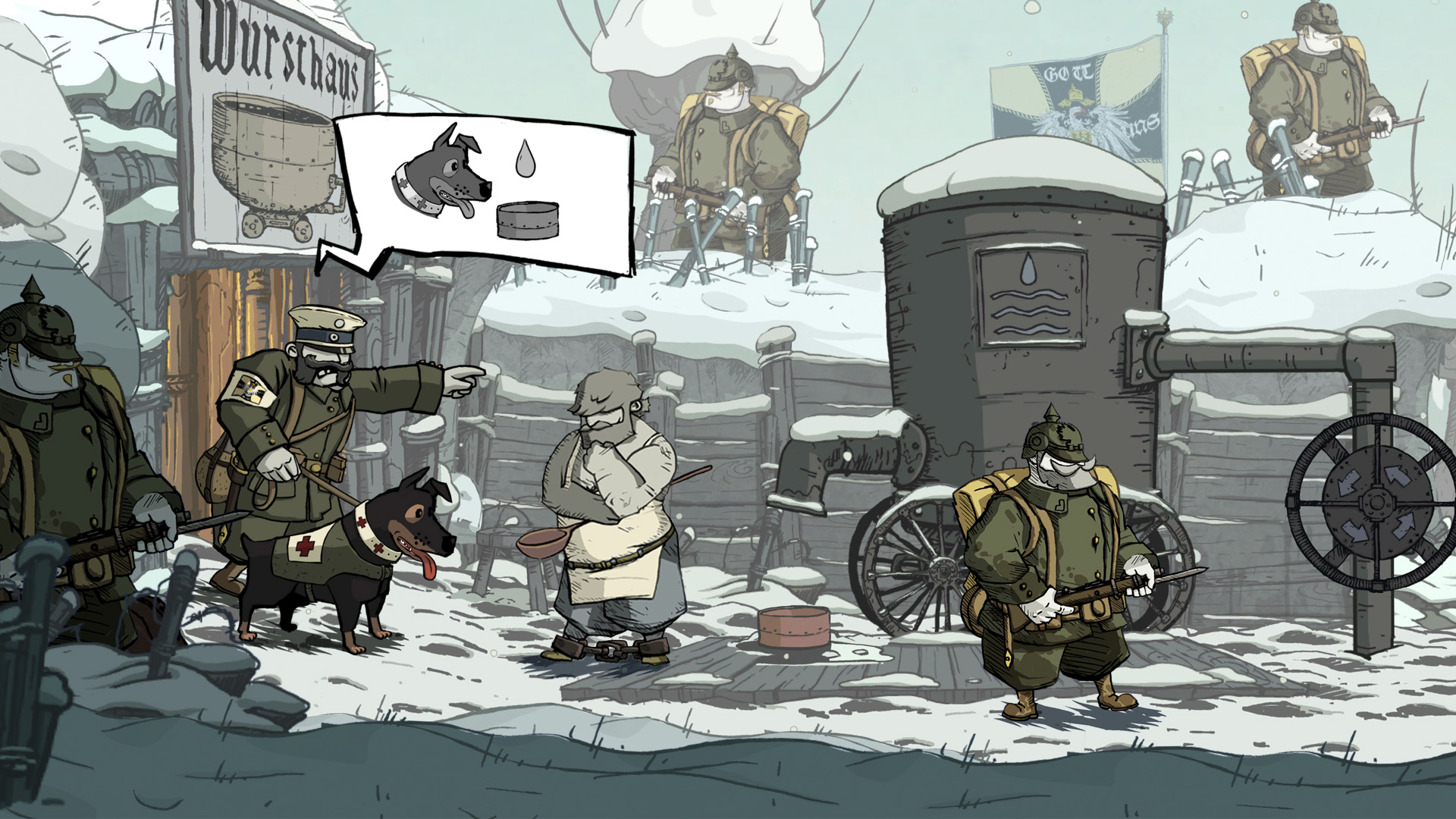
10. Pretentious Game
Available On: PC, iOS, Android, Kongregate.com (for free, even)
The name of the game probably fits according to some people, but it's a pretty well thought out and genuine game. It mixes simplicity with mechanics as metaphor kind of like a Mike Bithell game. In fact, it kind of looks like Thomas Was Alone. The characters are little blocks, but they represent people.
The game itself is almost entirely built on the premise of mechanics as metaphor. Each chapter is pretty short - only a couple of minutes, really - but there isn't necessarily a consistent style of play, other than that you move each square to a particular destination. It's basically a puzzle game in which you figure out what to do based on the clues given in the narrative. For example, there's a part talking about how this man would get drunk and couldn't control himself, at which point the square you control will often switch, so left arrow moves you right and right moves you left. One moment talks about how lost someone is feeling, causing the square to disappear in a dark background. It can sometimes be a little tricky to figure out what exactly each thing meas, but it's an interesting idea.
The story is a rather sad tale of lost love, really. Like Thomas Was Alone, Pretentious Game has a surprising amount of emotional power behind it for a game that features primarily cubes.

9. Her Story
Available On: PC, OS X, iOS
Her Story breaks the mold of what people might expect from a video game. It's actually kind of a passive game. Players don't get overly involved in it. In fact, the only thing players will input are keywords into a search bar in order to find new videos. The primary mechanic of the game is, quite simply, watching video clips of a woman as she tells her story about her history and her relationship to a man who has been found dead. Basically, the concept is that you are given access to old police tapes from when they interrogated a suspect in a murder case back in the '90s. The clips themselves look like old VHS tape recordings, but the computer screen is also a mock up of '90s computers as well, complete with a little time-wasting computer game you can play.
The videos are broken up into a ton of little pieces, and it's up to the player to find them all via searching the computer by keywords. Players can also re-organize the clips by "tagging" them with different labels, which is helpful when referring to older clips. The game is basically a giant puzzle, but unlike most puzzle games, the player doesn't get confirmation if they're right or wrong. There aren't really any moments to indicate that you're on the right track, and you never get an actual answer. Instead, you're left with all the notes you may have taken and a pretty good idea - maybe - of what happened and whether she were reasonably suspected of murder.
It's an interesting idea for a puzzle game, and I'd say it's maybe for anyone who became obsessed with the Serial podcast. It does a great job making you feel like a detective, but be prepared for what might be a slightly unsatisfying conclusion, given it's somewhat ambiguous. Sure, not a ton of replay value on this one, but I can't put into words how great I found my initial playthrough. It's quite the experience.
8. This War of Mine
Available On: PC, OS X, iOS, Android, PS4, XB1
I tried to avoid putting some of the bleaker, more serious games on the list because, well, people typically want to play games to have fun. Still, there are two games that I highly recommend because they're quite powerful and highlight what games are capable of doing. If you've ever watched television, you've probably seen commercials for one of the seemingly endless supply of war games. Typically, war games are built on premise of turning you into an elite soldier. It's an easy thing to do, but a lot of games use war as their background because of the action and adventure inherently built into it.
This War of Mine is not that kind of war game. Instead of turning you into one of the soldiers, built up as all heroic and all, it puts you in the role of civilians trying to survive in a war zone. Players control a number of survivors stuck in a house during the day in a region decimated by war. During this phase of the game, you use resources you've collected to survive. You'll tell some of your house mates to eat, or sleep, or take medicine, or whatever else they may need to do. Some, you'll have using resources to build new things like beds, stoves, animal traps, or even just boards to stop looters.
At night, you'll send one of your party to a location from a map. Some areas are off-limits because of recent battles. Others are home to civilians who aren't able to defend themselves, allowing you to steal from them with ease if you should choose. Some places, though, will have you run into other survivors. Occasionally, they'll be peaceful and even want to trade, but others will shoot you on sight. Your goal is to collect as many resources as you can. Food, water, medical supplies, building supplies: there's a lot of variety in what you can gather. Problem is, you have a limited number of things you can carry.
Each character has their own ailments to deal with. You're constantly trying to balance your limited food supply with each person in the party who is almost always hungry. You also get people who are sick, injured, or just sad. It's a really, really difficult and heartbreaking. Surviving is really difficult.
The game itself is simple. It's just point and click. You don't need much skill to play it. You just need to be able to stomach the difficult decisions. It's a really poignant game, demonstrating the brutality that a lot of people in real wars have to deal with.

7. Papers, Please
Available On: PC, OS X, iOS
Yep. Another bleak and depressing, yet extremely poignant game. Papers, Please puts players in the role of an immigration officer. Throughout the course of the game, all you basically do - from a game perspective - is look at an immigrant's paper work, determine if it's valid or invalid, and either approve them for entry or deny them entry. It's tedious, and at times very cold, but that's the point.
When not processing applicants, you're trying to figure out the best way to manage your finances. The game puts players in a fictional world that is probably run by a fascist dictator. At the end of each day, you must allocate your money into a variety of important things like food, heat, or medicine. Your family gets sick frequently enough, especially if you can't spend money on heat all the time. Money is a pretty limited resource, which connects to the immigrant processing gameplay too.
At times, you are presented with bribes. Immigrants will offer to pay you to allow them entry despite invalid paperwork. At the same time, border guards will offer you a cut of their bonuses for imprisoning applicants, forcing you to confront the uncomfortable scenario of apprehending someone with an invalid passport just so you can make money to pay for your child's medicine. There's a lot of gray area in the game, making it one of the best and most excruciating games built on morality. Like This War of Mine, the morality isn't clear cut, and is meant to make players reflect on the situation.

6. One-Finger Death Punch
Available On: XBox360, Android, iOS, PC
Ok! Let's get away from the bleak, but important games for a moment. One-Finger Death Punch is one of the simplest, craziest, and most fun games I've played in a while. The game does a good job getting progressively more challenging, offering splits in the story's path so players can choose how quickly they want the game to get more difficult. At some point, it stops being particularly easy, but it never stops being super simple.
Quite literally, you will only ever hit one of two buttons. One that correlates to "left attack" and one that is "right attack." The rest is just a rhythm based game, almost shades of simpler Dance Dance Revolution. All you do is tap the correct button when it shows up. It's all timing based, which makes later levels really challenging as they introduce new button combos to deal with and faster paces.
Bottom line: it's just sooooo much fun.
5. Monument Valley
Available On: iOS, Android
I'm not much of a mobile gamer, and I'm especially not typically into games on touch screen phones. Yet every once in a while, there is a super addictive game that I really enjoy. Whether it's the stylized side-scrolling Canabalt or the hyper addictive platforming Doodle Jump, it's not like there aren't fun games for your phone. Even as they try to adapt older classics like Chrono Trigger or Wolfenstein 3D so they're playable on your iPhone or Galaxy, it never quite works well enough for me to ever stick with it.
Monument Valley is a short and unique puzzle game that captures a lot of the spirit of the great indie games you can find on Steam. It's got a bit of Fez influence in the sense that perspective can matter. The main difference though is that all of the levels are built like these MC Escher-like puzzles. It might take a few levels to really get the hang of it, given that it's all built around optical illusions, but as a puzzle game, it's simultaneously different and similar enough to many of your more popular puzzle games on mobile.
4. Portal 2
Available On: XBox360, PS3, PC, OS X
Look, Portal 2 or even it's predecessor are among the greatest games ever made, but it made a little more sense to drop it from the top spot because it is a first person perspective, and you have basic FPS controls. The puzzle nature of the game is really fun. Mixed with the incredible humor, it also makes the game very appealing for people who don't play a lot of video games.
Because of it's more advanced controls, it can take a little more time and commitment for non-gamers to get it down. For veteran gamers, the FPS controls are intuitive. It's easy to think, "It's second nature to me, so why is anyone else struggling with it?" But it's important to keep in mind just how much experience a lot of us core gamers have with such schemes. (Just try to remember the very first FPS game you've played. Probably hard to recall at this point, but it probably felt weird at first, and took some time to really get down.)
While the first Portal was excellent, it just felt right to put the sequel ahead, since it's so much funnier. Plus, you can play in a co-op mode, making it a great game for gamers to try with their non-gamer friends.
3. Life Is Strange
Available On: XBox360, XB1, PS3, PS4, PC
Much can be said about the flaws inherent to narrative-drive games with its primary mechanics built around making choices, but Life Is Strange does a lot of things better than most. The time rewind powers add to the adventure/clicking gameplay, and also add to the overall themes and story. While the final episode is a bit disappointing, the game is strong enough - with good enough characters, an intriguing enough story, significant decisions to make, and a killer soundtrack - to make up for it.
The fact that it starts off really grounded, and centers around some fairly realistic characters makes it an easy game to relate to. There are few games that resonated with me on such a deeply personal level. It's an easy game to pick up and figure out, making it a great game showcasing the power of video games as a medium of story-telling.
2. Flower
Available On: PS3, PS4, PS Vita
If you want a really simple game that is beautiful and relaxing, then look no further than Flower. Thatgamecompany has really made a name for itself with beautiful, calming experiences. Fl0w is also a weirdly relaxing and simple game, and Journey is probably it's master opus at this point (which I admittedly have yet to play, which is why it's not on this list...yet!)
What's the premise of Flower? Well, you play as pedals on the wind as a row of house plants in the city dream about life in a field rather than the polluted metropolitan areas they know. Quite literally, you just blow around the fields collecting pedals. The goal is primarily to just beautify the fields. Thatgamecompany doesn't plan on producing any huge games, and that's totally fine. While some gamers might prefer their games to be really difficult and challenging, I think there is something to the idea of "lean back" games that we can play, interact with, and relax to.
It's also super rad for the way it uses musical notes to correspond to different types of pedals, allowing players to essentially create their own unique take of the music tracks.

1. Thomas Was Alone
Available On: PS3, PS4, PS Vita, XB1, PC, OS X, iOS, Android, Wii U
One of the best, and most simple games in a long time, Thomas Was Alone is a game that anyone - gamer or non-gamer - can love. At its core, it's a basic puzzle game. You're navigating a bunch of rectangles through a level to their respective exit points. Each rectangle has its own unique ability that will help get everyone to their spots.
At the same time, it offers a surprisingly compelling and emotionally touching story. Each rectangle has their own personality too. While voice over narration isn't the most complex form of story telling, it's what is needed for this game. (Also, the game is built on simplicity, so it fits tonally.) Often, the character traits match the power traits of each rectangle as well.
Fun gameplay, a compelling story, surprisingly human characters, and a killer soundtrack make this one of the most accessible games that anyone can enjoy.

Tuesday, January 5, 2016
LIST-O-MANIA: The Best of 2015
Another year is in the books. Like always, there was no shortage of complete garbage (Fantastic Four), but there were also a lot of great stuff! I didn't get a chance to play too many games released this year - $40-$60 for a new/new-ish game is a bit much right now, but I did get to play some stuff. For that category, I'm keeping it to five entries. I also don't watch too much television, so we'll keep that list to five as well. Movies are easy though. Cheap by comparison of video games, and much less time consuming than television, we'll expand that category to ten. Plus, we'll mention some of the stuff that makes 2016 look promising!
TOP 5 VIDEO GAMES
5. Volume
Mike Bithell makes great games by embracing simplicity. Thomas Was Alone was a beautiful game, and certainly one of the more mentioned of the indie sweetheart games. It's success is largely from the way it used simple gameplay in a compelling fashion. His follow up, Volume, follows a similar trend. It's more complex, but his stealth-game that is a futuristic retelling of Robin Hood is really easy to pick up. Each level is a time-based challenge, so you won't get stuck on difficult sections for too long. This allows players to get through it how they wish. More of a casual gamer who wants to get through the story? It's a bit challenging at times, but you won't get overly frustrated. More of a hardcore gamer who wants to get the high score or get under par each time? That will take up a fair amount of time. Volume is another great game that is beautifully simplistic.
4. Rocket League
One of the most genuinely fun games in a long time, Rocket League succeeds by creating the simplest premise combining two things: soccer and racing. How do you describe the game? Well, it's soccer, but the players are rocket cars. It's fast and chaotic, but pure fun. They've recently added mutators to the game as well, only enhancing the mayhem. It takes a while to get really good at it, but even at the "beginner" level, it's hard not to enjoy yourself.
3. Her Story
My big take away from Her Story is that I would be the worst detective in the world. Her Story is a neat and unique little game wherein there's surprisingly little gameplay. No, it's not another one of those "walking simulators." Instead, the game is a big puzzle that wants you to put it together yourself and never tells you if you're totally right or way off base. Basically, you're watching a giant library of old video clips of a woman being interviewed by a detective. The questions are edited out, so all you get are her responses. It's your job as the player to piece together this person's story. The only real input you have as a player is to input keywords as you search the database. You type in keywords and video clips with that word will show up. It's actually a bit trickier than it sounds, as there are a lot of videos. There might not be that much replay value in the game, but few games have provided as awesome an initial experience as Her Story, and the way you feel as you start unwinding this story.
2. Life Is Strange
Episodic games have become a lot more popular and common in the aftermath of Telltale's The Walking Dead success. Dontnod Entertainment tried their hand at it with Life Is Strange. What sets this game apart is how it begins by being really grounded and innocent, then progressively gets darker and darker. By the end, it's almost entirely unrecognizable. At its core, it's very similar to those Telltale games. You control Max around the environment, looking at and interacting with items. Max learns she can manipulate time, which adds a little about to the "walk-and-look" gameplay. Most puzzles involve watching events unfold, rewinding time, and figuring out the proper way to change what's coming. Though the finale is a little weak overall, the rest of it is so nice and emotional. It's the characters that sell it (and maybe the awesome indie soundtrack). And, ya know, the feelings!
1. Undertale
Undertale is the latest indie sweetheart game, but with good reason. It's funny that the retro look of gaming has made for itself a tidy little corner of the market! This RPG takes a lot of its cues from Super Nintendo-era gaming, most often drawing comparisons to Earthbound. It's not hard to see why. While the gameplay might be a little weird - it's largely either timing-based attacks or a Asteroid-like mini-game to avoid attacks while figuring out how to "spare" enemies - everything else is nearly perfect. The characters are great and realized incredibly well. The writing is nearly perfect. And it's just a lot of fun. What's interesting about the game is that you can go through killing everything (like you normally would), you can go through and not kill a single enemy (which requires certain actions during battle), or some combination of the two. It might not be the best game for people who don't like to get stuck on challenging bosses, or who get frustrated easily, but if you don't mind needing a few tries to get through an enemy, it's definitely worth checking out.
TOP 6 SHOWS

6. Last Week Tonight With John Oliver
The student has become the master as John Oliver took over his own political comedy after his stint on The Daily Show. As the genre expands, there's one that stands above the rest. It might not be the institution of Jon Stewart's show, but John Oliver has crafted one of the most legitimately informative and enraging (in the right ways) comedy show on television. Sure, it's a little unfair to compare Last Week Tonight with The Daily Show or The Nightly Show. Being weekly means that Oliver and his crew can dig deeper into a single subject. Yet it's that ability to do so that makes it the best. Even more is all the stuff they've done outside of the show in service of it, like starting a legally recognized church or putting up billboards around the world.
5. Daredevil
No, it's not a perfect show. The dialogue is sometimes clunky and some of the relationships seem rather contrived. And let's not bring up how bad the Daredevil suit at the end looked! Or that the finale was a bit rushed and disappointing. Still, what made Daredevil so captivating was it's dark, crime noir story and arguably Marvel's best on-screen villain to date. Wilson Fisk was compelling in his layers and complexity. Daredevil stands out from all the other Marvel movies and shows by immediately going dark. The violence can get pretty brutal at times. This is not your Joss Whedon Avengers style of Marvel stuff. It works by remaining true to the character while telling an intriguing story, all while working in some key mystical elements of Daredevil's lore.
4. The Last Man On Earth
Phil Lord and Christopher Miller have been making a name for themselves. Even if you don't recognize them, you're probably familiar with their work. The LEGO Movie and 21 Jump Street have both been widely loved, and they're both really funny. Teaming up with Will Forte again (see Clone High), they've created one of the weirder comedies on a mainstream network. Focused on a group of survivors in a world where a plague has seemingly killed all other life, it's a strange placement for a comedy. Yet it works, largely due to Forte's comedic acting chops, as well as Kristen Schaal's perfect performance as well.
3. Jessica Jones
While Daredevil may have been a more accurate comic book adaptation, Jessica Jones was probably the better overall show. The way everything connected and was in service of the greater themes and concepts adds a layer that its Marvel Netflix predecessor lacked. It also didn't hurt that it had slightly better dialogue and character writing, but overall, it's that it's more than just a comic book show that gives it a slight edge.
2. Master of None
Probably the least likely show you would expect out of Aziz Ansari, Master of None is just really, really good. It's funny and touching and poignant at all the right moments. It's a bit weird seeing Ansari play an actually realistic and relatable character, dealing with a lot of the same generational problems we all are, and keeping it in context with and acknowledging other people's issues and histories. It's just a really well balanced show.
1. Unbreakable Kimmy Schmidt
The strange thing about comedies is that it's hard to explain to someone who might not have the same sense of humor as you why it's so funny. Kimmy Scmhidt is the funniest and most charming shows in a long, long time. Ellie Kemper's smile is contagious, and it's awesome to get a show that makes it a point to retain a sense of wonder and optimism at a time when cynicism and brooding characters are making a strong comeback (seriously, it's getting dangerously similar to the '90s lately...) It's a winning combination of cheesy jokes with nerdy referential humor, all anchored by a brilliant performance from Kemper. This is honestly just a show I can always go back to and watch at any point and still be entertained by. I've watched it so many times this year, and rewatching it the other day, I still found jokes I laugh out loud to.
Honorable Mentions: I also just wanted to take a moment to throw out a few honorable mentions to shows that didn't premiere in 2015, but had what I felt to be strong seasons. Most notably, I really though Community recovered well for its final season earlier in the year. It hit a rocky patch in the aftermath of NBC's firing of Dan Harmon and then going from NBC to Hulu to Yahoo, but it did regain a lot of the charm and heart of the early seasons in time for its finale.
Also wanted to give credit to Parks & Recreation for crafting one of the weirder series finale seasons in a while. The futuristic sci-fi elements of the finale, mixed with very modern political issues made it such a joy to watch. For a show that struggled a bit in the beginning, it ended on such a high note.
And finally, Orange is the New Black continues to impress. Season three was really, really good, and has further cemented it as one of the top shows being made.
TOP 10 MOVIES
10. It Follows
Yes, at the end of the day, It Follows is kind of a dumb movie. It's not the scariest, and the psychological terror only goes so far. It's message - if it has one - is muddled and confusing, and its resolution is sudden and almost annoyingly vague. Yet the style and tone of the film makes it such a good watch. It has its thrills, and it's brilliant in the way that it channels its inner '80s John Carpenter. Plus, that Disasterpeace soundtrack.
9. Ant-Man
The general consensus with Ant-Man is that it's pretty ok. Fun, but nothing incredible. Certainly, it's not hard to imagine how much better it would have been if Marvel had been able to retain Edgar Wright. Still, what we got was a return to "Phase I" style of Marvel movies at a time when "Phase II" was in full effect. The return to a smaller scope and a more personal impact, I found, greatly refreshing.
8. Kingsman: The Secret Service
Based on a lesser known Mark Millar comic of the same name, Kingsman: The Secret Service is a stylized, violent, and fun twist on James Bond. Following a mythical group of British spies, Colin Firth gets to try his hand as a quasi-action star, and he kills it. It's just a good, fun action movie. Matthew Vaughn continues to impress with his comic book adaptations. Even Kick-Ass - based on the hugely overrated Mark Millar comic - was good!
7. A Girl Walks Home Alone At Night
This movie isn't going to be for everyone. Not because it's "scary" (it's not) or "violent" (it's not) or "gory" (it's not), but because it's so stylized and slow. It feels a lot more like a Western than a horror or drama. In fact, a whole lot of nothing actually even happens. There's not much dialogue, and there are a lot of scenes of characters just sort of silently watching each other. But that's why it's such a cool movie. It conveys so much through so little action or dialogue, and it's just visually an awesome movie.
6. The Martian
A good Ridley Scott movie? I know that sounds unbelievable, but it's true! Scott has finally made a solid, fun, entertaining movie that's a blast to watch. Matt Damon turns in one of his best performances as an astronaut stranded alone on Mars. He's largely acting against himself, with no one else sharing the screen with him for the overwhelming majority of the film. It's also refreshing to see a movie that functions as a love letter to science, rather than simply treating it as a silly plot device that can be just randomly made up and altered whenever convenient (a la Gravity).
5. The Overnight
Jason Schwartzman and Adam Scott, and their (prosthetic) dongs. That's pretty much what you're in for with this weird, awesome, hilarious film that's one of the best "adults trying to grow up." On the surface, it might appear to be just an indie Hangover knock off, but it's so much more than that, and so much better. Just watch it. Trust me.
4. Kumiko, The Treasure Hunter
This one might be a tougher sell, since I haven't found anyone who liked it nearly as much as I did. They sell you on the idea that it's "based on a true story," but it's really just based on an urban legend. There's a tale in Minnesota of a Japanese woman who was searching for the treasure buried in Fargo - the fictional treasure in a fictional movie. Kumiko, The Treasure Hunter puts a human face on this legend. Pretty much what drives this movie is the performance of Rinko Kikuchi, who is just a complete joy to watch. If the film is more of a character study, then you need a great actor to pull it off. Kikuchi straight up kills it here. It's one of my favorite movies in a while, but take that with a grain of salt, since - like The Secret Life of Walter Mitty before it - it might just be one of those films that hits me in just the right spot that it won't hit anyone else.
3. What We Do In The Shadows
Two vampire movies on my top ten list! Weird. What We Do In the Shadows is a hilarious fake documentary comedy centered on a house full of vampires as they make their way through the world around them, especially when they have to show the ropes to a new vampire that they accidentally turned themselves. Few movies made me crack up as frequently and as hard as this one.
2. Inside Out
Pixar continues their domination over American-made animation, this time providing one of the most interesting and touching films of their entire repertoire. It was probably always going to be a more emotional tale given it is literally centered around a young girl's emotions, embodied by some great voice actors. The way Joy and Sadness work together makes for some of the most compelling character action of the entire year, and the way it impacts young Riley has it one of the most emotional films in a long time. It's hard to pick a favorite Pixar film, but I thought it was their best to date.
1. Mad Max: Fury Road
Look, I really, really wanted to find a movie I liked more this year than Mad Max: Fury Road. I tried so hard to pick something over it, just because it's been the one to get all the hype and accolades. So many have put it as their favorite film of the year. At the end of the day, there was just nothing else that even came close. Of all the films I'd seen this year, Mad Max is the only one I specifically went to see several times in theater. It's a high octane blast - just loads of fun - with two great characters in Furiosa and Max. George Miller weirdly advances cinema by going back to more practical-driven effects. Make no mistake; there's a lot of CGI in the film too, but it's all used to enhance the practical effects. Even more, Miller manages to make something new while hitting some of the same beats as some of the other Mad Max films. A lot of the film is derivative of itself, but in a way less blatantly than, say, Star Wars: The Force Awakens. I still watch this movie and still can't believe it. It's also one of the few Hollywood blockbusters that doesn't sacrifice substantial story for mindless action. Sure, the story is not the most deep thing ever, but it's not a softball story either. As much as I wanted to avoid doing what everyone else is doing, at the end of the day, there's a reason it's widely being considered the top movie of the year.
So, those are my lists. What's at the top of yours?
TOP 5 VIDEO GAMES
5. Volume
Mike Bithell makes great games by embracing simplicity. Thomas Was Alone was a beautiful game, and certainly one of the more mentioned of the indie sweetheart games. It's success is largely from the way it used simple gameplay in a compelling fashion. His follow up, Volume, follows a similar trend. It's more complex, but his stealth-game that is a futuristic retelling of Robin Hood is really easy to pick up. Each level is a time-based challenge, so you won't get stuck on difficult sections for too long. This allows players to get through it how they wish. More of a casual gamer who wants to get through the story? It's a bit challenging at times, but you won't get overly frustrated. More of a hardcore gamer who wants to get the high score or get under par each time? That will take up a fair amount of time. Volume is another great game that is beautifully simplistic.
4. Rocket League
One of the most genuinely fun games in a long time, Rocket League succeeds by creating the simplest premise combining two things: soccer and racing. How do you describe the game? Well, it's soccer, but the players are rocket cars. It's fast and chaotic, but pure fun. They've recently added mutators to the game as well, only enhancing the mayhem. It takes a while to get really good at it, but even at the "beginner" level, it's hard not to enjoy yourself.
3. Her Story
My big take away from Her Story is that I would be the worst detective in the world. Her Story is a neat and unique little game wherein there's surprisingly little gameplay. No, it's not another one of those "walking simulators." Instead, the game is a big puzzle that wants you to put it together yourself and never tells you if you're totally right or way off base. Basically, you're watching a giant library of old video clips of a woman being interviewed by a detective. The questions are edited out, so all you get are her responses. It's your job as the player to piece together this person's story. The only real input you have as a player is to input keywords as you search the database. You type in keywords and video clips with that word will show up. It's actually a bit trickier than it sounds, as there are a lot of videos. There might not be that much replay value in the game, but few games have provided as awesome an initial experience as Her Story, and the way you feel as you start unwinding this story.
2. Life Is Strange
Episodic games have become a lot more popular and common in the aftermath of Telltale's The Walking Dead success. Dontnod Entertainment tried their hand at it with Life Is Strange. What sets this game apart is how it begins by being really grounded and innocent, then progressively gets darker and darker. By the end, it's almost entirely unrecognizable. At its core, it's very similar to those Telltale games. You control Max around the environment, looking at and interacting with items. Max learns she can manipulate time, which adds a little about to the "walk-and-look" gameplay. Most puzzles involve watching events unfold, rewinding time, and figuring out the proper way to change what's coming. Though the finale is a little weak overall, the rest of it is so nice and emotional. It's the characters that sell it (and maybe the awesome indie soundtrack). And, ya know, the feelings!
1. Undertale
Undertale is the latest indie sweetheart game, but with good reason. It's funny that the retro look of gaming has made for itself a tidy little corner of the market! This RPG takes a lot of its cues from Super Nintendo-era gaming, most often drawing comparisons to Earthbound. It's not hard to see why. While the gameplay might be a little weird - it's largely either timing-based attacks or a Asteroid-like mini-game to avoid attacks while figuring out how to "spare" enemies - everything else is nearly perfect. The characters are great and realized incredibly well. The writing is nearly perfect. And it's just a lot of fun. What's interesting about the game is that you can go through killing everything (like you normally would), you can go through and not kill a single enemy (which requires certain actions during battle), or some combination of the two. It might not be the best game for people who don't like to get stuck on challenging bosses, or who get frustrated easily, but if you don't mind needing a few tries to get through an enemy, it's definitely worth checking out.
TOP 6 SHOWS

6. Last Week Tonight With John Oliver
The student has become the master as John Oliver took over his own political comedy after his stint on The Daily Show. As the genre expands, there's one that stands above the rest. It might not be the institution of Jon Stewart's show, but John Oliver has crafted one of the most legitimately informative and enraging (in the right ways) comedy show on television. Sure, it's a little unfair to compare Last Week Tonight with The Daily Show or The Nightly Show. Being weekly means that Oliver and his crew can dig deeper into a single subject. Yet it's that ability to do so that makes it the best. Even more is all the stuff they've done outside of the show in service of it, like starting a legally recognized church or putting up billboards around the world.
5. Daredevil
No, it's not a perfect show. The dialogue is sometimes clunky and some of the relationships seem rather contrived. And let's not bring up how bad the Daredevil suit at the end looked! Or that the finale was a bit rushed and disappointing. Still, what made Daredevil so captivating was it's dark, crime noir story and arguably Marvel's best on-screen villain to date. Wilson Fisk was compelling in his layers and complexity. Daredevil stands out from all the other Marvel movies and shows by immediately going dark. The violence can get pretty brutal at times. This is not your Joss Whedon Avengers style of Marvel stuff. It works by remaining true to the character while telling an intriguing story, all while working in some key mystical elements of Daredevil's lore.
4. The Last Man On Earth
Phil Lord and Christopher Miller have been making a name for themselves. Even if you don't recognize them, you're probably familiar with their work. The LEGO Movie and 21 Jump Street have both been widely loved, and they're both really funny. Teaming up with Will Forte again (see Clone High), they've created one of the weirder comedies on a mainstream network. Focused on a group of survivors in a world where a plague has seemingly killed all other life, it's a strange placement for a comedy. Yet it works, largely due to Forte's comedic acting chops, as well as Kristen Schaal's perfect performance as well.
3. Jessica Jones
While Daredevil may have been a more accurate comic book adaptation, Jessica Jones was probably the better overall show. The way everything connected and was in service of the greater themes and concepts adds a layer that its Marvel Netflix predecessor lacked. It also didn't hurt that it had slightly better dialogue and character writing, but overall, it's that it's more than just a comic book show that gives it a slight edge.
2. Master of None
Probably the least likely show you would expect out of Aziz Ansari, Master of None is just really, really good. It's funny and touching and poignant at all the right moments. It's a bit weird seeing Ansari play an actually realistic and relatable character, dealing with a lot of the same generational problems we all are, and keeping it in context with and acknowledging other people's issues and histories. It's just a really well balanced show.
1. Unbreakable Kimmy Schmidt
The strange thing about comedies is that it's hard to explain to someone who might not have the same sense of humor as you why it's so funny. Kimmy Scmhidt is the funniest and most charming shows in a long, long time. Ellie Kemper's smile is contagious, and it's awesome to get a show that makes it a point to retain a sense of wonder and optimism at a time when cynicism and brooding characters are making a strong comeback (seriously, it's getting dangerously similar to the '90s lately...) It's a winning combination of cheesy jokes with nerdy referential humor, all anchored by a brilliant performance from Kemper. This is honestly just a show I can always go back to and watch at any point and still be entertained by. I've watched it so many times this year, and rewatching it the other day, I still found jokes I laugh out loud to.
Honorable Mentions: I also just wanted to take a moment to throw out a few honorable mentions to shows that didn't premiere in 2015, but had what I felt to be strong seasons. Most notably, I really though Community recovered well for its final season earlier in the year. It hit a rocky patch in the aftermath of NBC's firing of Dan Harmon and then going from NBC to Hulu to Yahoo, but it did regain a lot of the charm and heart of the early seasons in time for its finale.
Also wanted to give credit to Parks & Recreation for crafting one of the weirder series finale seasons in a while. The futuristic sci-fi elements of the finale, mixed with very modern political issues made it such a joy to watch. For a show that struggled a bit in the beginning, it ended on such a high note.
And finally, Orange is the New Black continues to impress. Season three was really, really good, and has further cemented it as one of the top shows being made.
TOP 10 MOVIES
10. It Follows
Yes, at the end of the day, It Follows is kind of a dumb movie. It's not the scariest, and the psychological terror only goes so far. It's message - if it has one - is muddled and confusing, and its resolution is sudden and almost annoyingly vague. Yet the style and tone of the film makes it such a good watch. It has its thrills, and it's brilliant in the way that it channels its inner '80s John Carpenter. Plus, that Disasterpeace soundtrack.
9. Ant-Man
The general consensus with Ant-Man is that it's pretty ok. Fun, but nothing incredible. Certainly, it's not hard to imagine how much better it would have been if Marvel had been able to retain Edgar Wright. Still, what we got was a return to "Phase I" style of Marvel movies at a time when "Phase II" was in full effect. The return to a smaller scope and a more personal impact, I found, greatly refreshing.
8. Kingsman: The Secret Service
Based on a lesser known Mark Millar comic of the same name, Kingsman: The Secret Service is a stylized, violent, and fun twist on James Bond. Following a mythical group of British spies, Colin Firth gets to try his hand as a quasi-action star, and he kills it. It's just a good, fun action movie. Matthew Vaughn continues to impress with his comic book adaptations. Even Kick-Ass - based on the hugely overrated Mark Millar comic - was good!
7. A Girl Walks Home Alone At Night
This movie isn't going to be for everyone. Not because it's "scary" (it's not) or "violent" (it's not) or "gory" (it's not), but because it's so stylized and slow. It feels a lot more like a Western than a horror or drama. In fact, a whole lot of nothing actually even happens. There's not much dialogue, and there are a lot of scenes of characters just sort of silently watching each other. But that's why it's such a cool movie. It conveys so much through so little action or dialogue, and it's just visually an awesome movie.
6. The Martian
A good Ridley Scott movie? I know that sounds unbelievable, but it's true! Scott has finally made a solid, fun, entertaining movie that's a blast to watch. Matt Damon turns in one of his best performances as an astronaut stranded alone on Mars. He's largely acting against himself, with no one else sharing the screen with him for the overwhelming majority of the film. It's also refreshing to see a movie that functions as a love letter to science, rather than simply treating it as a silly plot device that can be just randomly made up and altered whenever convenient (a la Gravity).
5. The Overnight
Jason Schwartzman and Adam Scott, and their (prosthetic) dongs. That's pretty much what you're in for with this weird, awesome, hilarious film that's one of the best "adults trying to grow up." On the surface, it might appear to be just an indie Hangover knock off, but it's so much more than that, and so much better. Just watch it. Trust me.
4. Kumiko, The Treasure Hunter
This one might be a tougher sell, since I haven't found anyone who liked it nearly as much as I did. They sell you on the idea that it's "based on a true story," but it's really just based on an urban legend. There's a tale in Minnesota of a Japanese woman who was searching for the treasure buried in Fargo - the fictional treasure in a fictional movie. Kumiko, The Treasure Hunter puts a human face on this legend. Pretty much what drives this movie is the performance of Rinko Kikuchi, who is just a complete joy to watch. If the film is more of a character study, then you need a great actor to pull it off. Kikuchi straight up kills it here. It's one of my favorite movies in a while, but take that with a grain of salt, since - like The Secret Life of Walter Mitty before it - it might just be one of those films that hits me in just the right spot that it won't hit anyone else.
3. What We Do In The Shadows
Two vampire movies on my top ten list! Weird. What We Do In the Shadows is a hilarious fake documentary comedy centered on a house full of vampires as they make their way through the world around them, especially when they have to show the ropes to a new vampire that they accidentally turned themselves. Few movies made me crack up as frequently and as hard as this one.
2. Inside Out
Pixar continues their domination over American-made animation, this time providing one of the most interesting and touching films of their entire repertoire. It was probably always going to be a more emotional tale given it is literally centered around a young girl's emotions, embodied by some great voice actors. The way Joy and Sadness work together makes for some of the most compelling character action of the entire year, and the way it impacts young Riley has it one of the most emotional films in a long time. It's hard to pick a favorite Pixar film, but I thought it was their best to date.
1. Mad Max: Fury Road
Look, I really, really wanted to find a movie I liked more this year than Mad Max: Fury Road. I tried so hard to pick something over it, just because it's been the one to get all the hype and accolades. So many have put it as their favorite film of the year. At the end of the day, there was just nothing else that even came close. Of all the films I'd seen this year, Mad Max is the only one I specifically went to see several times in theater. It's a high octane blast - just loads of fun - with two great characters in Furiosa and Max. George Miller weirdly advances cinema by going back to more practical-driven effects. Make no mistake; there's a lot of CGI in the film too, but it's all used to enhance the practical effects. Even more, Miller manages to make something new while hitting some of the same beats as some of the other Mad Max films. A lot of the film is derivative of itself, but in a way less blatantly than, say, Star Wars: The Force Awakens. I still watch this movie and still can't believe it. It's also one of the few Hollywood blockbusters that doesn't sacrifice substantial story for mindless action. Sure, the story is not the most deep thing ever, but it's not a softball story either. As much as I wanted to avoid doing what everyone else is doing, at the end of the day, there's a reason it's widely being considered the top movie of the year.
So, those are my lists. What's at the top of yours?
Monday, January 4, 2016
The Last of Us: The Outskirts Part 2: Tess/Run

Things are supposed to be looking up. We've made it through the unstable building, survived the clickers in the subway, and fended off a rushing horde of infected. We're past the danger posed by the infected now, and we are supposed to feel a bit like we're out of the woods. This is also reinforced by the arrival of daylight, something we tend to associate with safety in these types of stories. Even more, our target destination is just a few blocks away. We're pretty much there.
Of course, not everything is great. Tess, who we know can handle herself, is starting to act a little strange. She's no longer engaged in much of the conversation, instead mostly issuing orders and keeping everyone focused. At the same time, she's a bit panicky. When Ellie asks what they'll do if they get there and the Fireflies are all dead, Tess gets almost confrontational while saying everything will be fine. "It has to be," she mutters under her breath. Though everything around us suggests we're good, there are these kinds of subtle hints to tell us we're wrong.
Just before we get to the capital building, we see a bombed out street that is flooded. We must cross it. It's easy-peasy, of course. Nothing special about it, really. What's interesting is that they choose to use this moment to introduce the idea that Ellie can't swim. Normally in games, they introduce a new concept when it is relevant to the gameplay. Here, they introduce something that will come up a bunch of times throughout the game, but it doesn't matter here. It seems like such a small thing, but this helps reduce the "gamey" feel of the game. I know, I know. That sounds really strange and dumb. However, so much of The Last of Us is successful because of how immersive it is. It's these kinds of seemingly minor decisions that increase that feeling. It would feel a bit "gamey" if Ellie stated that she can't swim, and then immediately the player has to find a palette for her to jump on so we can cross a body of water. And sure, we have to do that in a little bit, but that delay between when you have to do something "gamey" and when the concept is introduce as a character trait through the narrative helps keep us fully immersed.

Of course, here we get our first big emotional moment in this new world. Turns out, Tess has been acting strangely because she was bitten and infected. This is her last stop, as she calls it. It's not as emotional a moment as Sarah's death in the prologue, but it's still a powerful scene with great writing. More importantly though, there is great acting and animating here. Those are critical in the way the scene plays out.
The acting and animation have to work in tandem here, otherwise the scene wouldn't work. Everyone's body language is key. Joel is angry, almost pissed off that Tess is going to be leaving him. Tess is, understandably, flustered knowing she's about to die. She's also desperate to have her death mean something - in this case, getting the immune Ellie to the Fireflies so there may someday be a cure. Ellie, meanwhile, is smart and observant, but she stands there tensed up. What is extremely clear in this scene (if it weren't already) is that these actors are on a set and acting physically. A lot of video games will have animators work on the character motions with the actors just lending their voices to the scene. Here, all actors are present on a set. They're in mo-cap suits. And they're doing more traditional style of acting. That decision goes a long way in this game.
Joel seems angry at Tess, as if he's offended that she could "let this happen." When he says that this is not "us," Tess finally snaps. "What do you know about us? About me?" It's a great little moment where you realize that Joel's relationship with Tess might very well be similar to the player's. It's easy to like Tess, and she's a solid ally in these early stages, but we don't ultimately know that much about her. This is probably how Joel sees her too. She's easy enough to like and get along with, but really, she's been a survivor. Joel may have been drawn to her simply because she's been around and lasted. We know he likes to keep his distance. There's some ambiguity in their relationship presented here. On the one hand, Tess says that there surely is enough between them for her request to mean something, for Joel to feel some sort of obligation to her. At the same time, it's tough to tell just how close and open these two really were with each other, and how much of the relationship may have been built on the foundation that they're good at surviving.
Now, I'm admittedly not sure how the military knew they were at the state house. It's one of those plot contrivances for the sake of drama and action. It sort of doesn't make much sense, really. No one ever argued the game was perfect. Nothing ever is. The nice thing it does, though, is allow Tess - someone we've probably come to really like - to go out on her terms as best as possible. She's always been strong and determined from what we've seen of her, so refusing to turn into a mindless zombie creature is within her character. It also helps us deal with it a bit better. She tells Joel to "just fucking go" in order to make it easier for her, but letting her go out to delay the military so we can escape makes it a little easier for us too.

Of course, the military fires a hilarious number of rounds just to take out one person. We're now left with the remainder. It's the first time we will spend in an enclosed space with armed enemies. It can be a bit tricky, as a result, especially since the map here can be a little confusing to navigate with it's many rooms, open spaces, and enemy and cover distribution. As we go, Ellie seems pretty disturbed by everything. Makes sense. She's young and new to this stuff. Joel basically yells at her for getting too emotional, pretty much the basis for their relationship in the first half of the game.
The Tess moment is one of the few occasions in which we immediately follow an emotional beat with a lot of action. Typically, they let you catch your breath, or sit on what you just witnessed for a bit. After Sarah's death, for example, we flash forward twenty years and then just walk around for a bit. Here, we're forced to deal with a few segments of armed soldiers. The second part of the state house is surprisingly difficult to sneak through. It's one of the great maps where you have to be really careful and aware of your surroundings. Every room has several open doors, and they all sort of face each other meaning guards will almost always have the ability to spot you if you aren't cautious.
After escaping the state house, you find yourself again in the subway. There are spores everywhere, prompting Joel to put on his mask, but Ellie doesn't have to. If we players weren't convinced yet, like Joel, now we know for certain that she absolutely is immune. No faking here. (They don't do anything to really make us as players skeptical of her claim, so this more proves to Joel than anyone.) Visibility tends to be a bit weird here. With the poor lighting and spores, it's kind of hard to see. That's pretty rad level design, to be honest. In small portions, that idea is great! What can be a bit frustrating though is that you can't really take advantage of that, as the enemies seem to have no problem whatsoever seeing you across the spore-filled room.
Either way, it's not tough. There are just two guards and even if they spot you, it's pretty easy to take them out. We then continue down the subway, poor lights, spores, and all. It's a really creepy atmosphere and one of my favorite mini-sections of the game. The first time you play it, you can't know there are no infected here, but they sure make it seem like there must be clickers somewhere! After all, we were just in the subway an hour earlier and it was crawling with them! We've also come to associate spores with infected. Most players probably make their way through this section on their toes and staying alert. We've avoided the military now, but we're not in the quarantine zone anymore. This is infected territory!
In actuality, there's nothing here. There are no enemies after those first two soldiers. It's basically one big psych out. What does come back is the fact that Ellie can't swim. Now we have to deal with that, as a chunk of the subway is flooded pretty badly. This is our introduction to palettes and ferrying Ellie from Place A to Place B. Like the whole plank thing, this is a rather weak attempt at introducing "puzzle elements" to the game. It's not really very puzzling, first off. Nor is it at all a challenge in any way. It's more just occasionally time consuming and choppy. Planks and ferrying are probably the weakest parts of gameplay and level design in the game, but they also only come up every once in a while. It's not a super common thing.

As an aside, you can find a corpse with a note about meeting a smuggler. Apparently, this person was supposed to meet a man named Frank to trade supplies with, but Frank never showed up. This comes up later, actually. These little things are really interesting and appealing about the game.
We conclude the section back at daylight. The soldiers are gone, and we get one more cutscene to highlight what a grump Joel is (although, understandably so). He seems really annoyed to be involved in this at all - which is how he felt from the get-go - but we also understand that he will keep his word to Tess. She was right that there was enough between them for Joel to feel an obligation to her. Ellie is pretty much the more traditional heroic character in the game, so she tries to offer her condolences about Tess. Joel shuts her up and tells her to keep their histories to themselves.
This is the moment where Joel is really in charge. Up to this point, Tess had been leading, or Tommy before that. Now, Joel is finally taking point in the game. And he's a lot more stern and cold. Now that Tess isn't there to provide some relatively normal human interactions, Joel will pretty much do whatever he can to keep his distance.
Subscribe to:
Posts (Atom)